













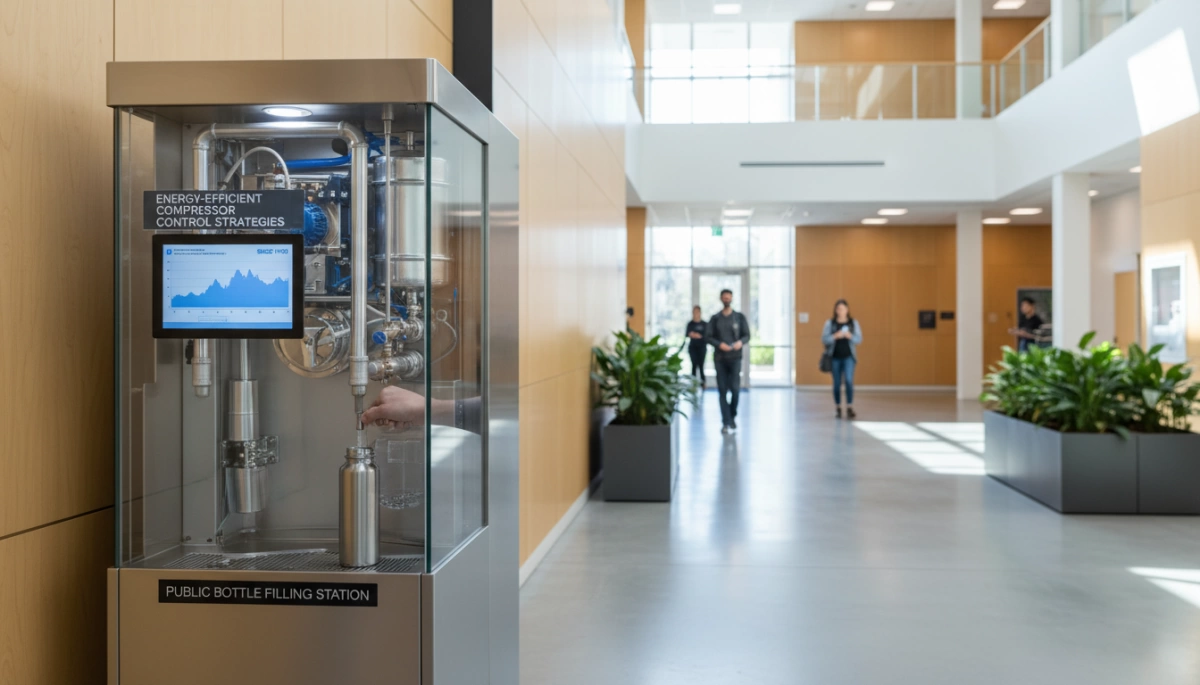
Why Compressor Efficiency Matters in Public Bottle Filling Stations
When I talk with facility teams running schools, airports, offices, or gyms, I hear the same questions: “Why are our refrigerated bottle fillers drawing so much power?” and “How do we cut that waste without hurting user experience?” The answer almost always comes back to one thing: compressor efficiency.
Energy Impact in High‑Traffic Spaces
Refrigerated public bottle filling stations run quietly in the background, but they add up on your utility bill, especially in high‑traffic areas. A typical chilled water dispenser may:
- Draw 100–300 watts whenever the compressor runs
- Cycle on and off all day to keep a small tank of water cold
- Sit in “ready” mode burning standby power even when nobody is filling bottles
Multiply that by dozens of public hydration stations across a campus or portfolio, and you’re looking at a noticeable chunk of your plug load. That’s where energy‑efficient compressor control strategies start paying real dividends.
Variable Demand, Compressor Cycling, and Standby Losses
Public hydration demand is inherently intermittent. You might see:
- Heavy use during class changes, lunch, or shift breaks
- Long idle periods overnight, on weekends, or between events
Without smart refrigeration controls, this variable demand leads to:
- Frequent compressor cycling – short, inefficient start‑stop bursts that waste energy and stress components
- Standby losses – the system keeps water cold 24/7 even when no one is using the station
Energy‑efficient compressor controls for bottle filling stations are designed to flatten that waste, matching cooling more closely to real usage.
Key Drivers of Compressor Power Consumption
If you want to optimize power consumption at a bottle filling station, a few variables matter most:
- Ambient temperature and ventilation – Hot mechanical rooms, hallways without airflow, or crowded back panels force the compressor to work harder and run longer.
- Usage frequency and pattern – High peaks of back‑to‑back bottle fills demand more cooling recovery; low nighttime use is a chance to cut runtime.
- Insulation and cabinet design – Well‑insulated cold tanks and tight cabinet seals reduce heat gain, shrinking duty cycle and compressor workload.
- Compressor type and controls – Basic fixed‑speed units run at full power whenever they’re on; energy‑efficient compressor designs with better control logic deliver more chilled water per kWh.
Understanding these levers is the first step toward duty cycle optimization and real energy savings.
Control Strategies, Duty Cycle, and Lifecycle Costs
In simple terms, duty cycle is the percentage of time the compressor is actually running. A poorly controlled public hydration station might run its compressor far more than necessary, driving up:
- Electricity costs from constant cycling and high standby power
- Maintenance costs as compressors and relays wear out faster
- Total lifecycle cost of each refrigerated bottle filler in your portfolio
Energy‑saving refrigeration controls—like smarter thermostat logic, on‑demand cooling, and better standby power management—directly cut the duty cycle, reduce compressor cycling, and extend equipment life. For facility managers, this is one of the most cost‑effective ways to drive facility energy cost reduction at the plug level.
Energy Benchmarks and Performance Specs
To make good purchasing and retrofit decisions, I always recommend anchoring on objective energy performance data:
- Energy Star rated public water dispensers and similar labels provide a quick benchmark for kWh/year.
- Clear energy performance specifications in RFPs and bid documents (max kWh/year, standby power limits, compressor control requirements) force vendors to compete on real efficiency.
- Comparable metrics like kWh per gallon dispensed help you evaluate true refrigerated bottle filler energy savings across brands and models.
When we design Driplife hydration stations, we build around these benchmarks from day one—optimizing compressor efficiency, minimizing standby power, and making sure our public bottle filling stations deliver chilled water with the lowest possible power consumption over their full lifecycle.
Core Compressor Control Strategies for Maximum Efficiency
Dialing in energy‑efficient compressor control strategies for public bottle filling stations is where I usually see the biggest, fastest energy wins. In high‑traffic U.S. schools, airports, and gyms, the goal is simple: keep water cold, cut compressor run hours, and kill standby waste.
On‑demand, sensor‑based compressor activation
I design refrigerated bottle fillers so the compressor only works when the station is actually doing something useful.
- Use flow sensors to detect real dispense events instead of running on a fixed schedule.
- Add IR or proximity sensors so the control board can shift between “active,” “ready,” and “sleep” modes based on people nearby.
- Tie compressor start logic to these signals and to tank temperature, so we avoid random, unnecessary cycling.
This kind of smart refrigeration control works well alongside broader cost control strategies in dispenser manufacturing, especially when you’re deploying dozens of units in one facility.
Duty cycle optimization for chilled bottle fillers
For duty cycle optimization in public spaces, I focus on three levers:
- Set tighter logic around minimum on/off times to prevent rapid cycling.
- Use adaptive deadbands on the thermostat so the compressor runs fewer, longer, efficient cycles.
- Log run hours and tank temperatures to fine‑tune settings during the first few weeks of real‑world usage.
This cuts power consumption per gallon dispensed and directly lowers facility energy costs.
Adaptive thermostat control and thermal storage
To extend off cycles while keeping water cold and safe:
- Use adaptive thermostat control that learns daily traffic patterns (school vs. overnight, office vs. weekend).
- Add more effective thermal storage (right‑sized cold tank, coil design, insulation) to hold temperature longer.
- Allow a slightly wider, controlled temperature band during low‑use hours to reduce compressor runtime.
This approach boosts compressor efficiency for public hydration stations without hurting user comfort.
Variable speed drive (VSD) compressors for variable demand
Variable speed compressor water coolers are a strong fit for variable‑demand hydration stations:
- A VSD compressor ramps up during peak refill windows, then slows down when demand drops.
- Softer start and smoother modulation prevent harsh start‑stop cycling in public drinking fountains.
- You get better part‑load efficiency, quieter operation, and lower mechanical stress on the system.
In U.S. buildings with uneven traffic (airports, gyms, event venues), VSDs are often the best long‑term play.
Load‑unload vs. modulating controls at part load
At part load, the wrong control method can quietly burn kWh all year:
- Load‑unload controls are simple but can waste energy if the system spends most of the day unloaded and idling.
- Modulating controls (especially with VSD) match cooling output to actual load, improving part‑load efficiency.
- For most public hydration stations, I favor modulating/VSD control unless the load profile is extremely binary.
Choosing the right strategy should be part of your energy performance specification up front.
Standby power reduction for bottle filling stations
Standby power reduction is low‑hanging fruit for nearly every refrigerated bottle filler:
- Add intelligent sleep modes that drop the system into ultra‑low power when no one is around.
- Use timers and schedules (nights, weekends, school breaks) to disable or relax cooling when the building is empty.
- Specify low‑power control boards, LED indicators, and efficient power supplies to cut background draw.
These steps drive down public hydration station power consumption without touching user experience.
Smart sequencing and multi‑stage refrigeration control
For facilities running multiple units or multi‑stage systems, smart sequencing matters:
- Stagger compressor starts so you don’t hit peak demand charges with several units kicking on at once.
- Rotate lead/lag units to balance runtime and extend compressor life.
- Use multi‑stage control to bring on additional capacity only when the cold water buffer truly needs it.
Done right, these sequencing strategies deliver refrigerated bottle filler energy savings across entire campuses, not just single stations.
Quick Reference: Key Control Strategies
| Strategy | Main Benefit | Best For |
|---|---|---|
| On‑demand sensor activation | Cuts wasted runtime, smarter duty cycle | Schools, offices, gyms |
| Adaptive thermostat & thermal storage | Longer off cycles, stable water temperature | All indoor public hydration stations |
| VSD compressor with modulating control | High part‑load efficiency, less cycling | Variable‑traffic venues (airports, arenas) |
| Standby power reduction (sleep/timers) | Lower overnight/holiday power consumption | Any facility with predictable off hours |
| Smart sequencing and multi‑stage control | Lower peaks, even wear across multiple units | Campuses, multi‑unit corridors, large complexes |
Advanced Energy-Efficient Technologies for Bottle Filling Station Compressors
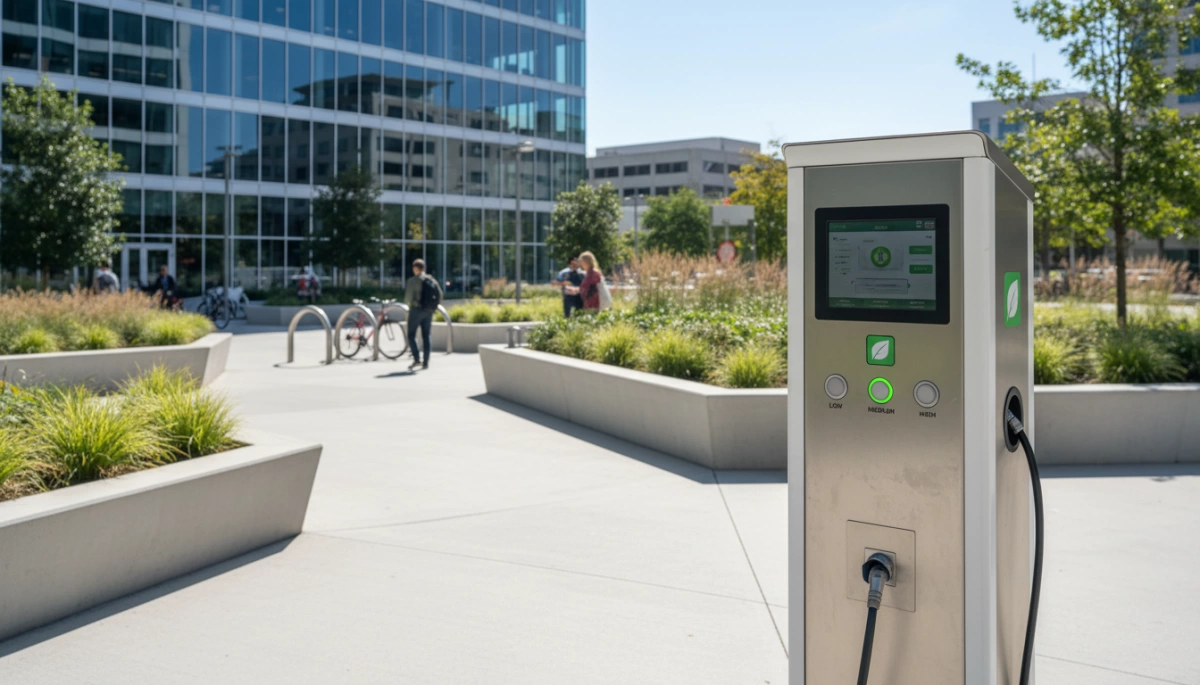
When I design energy-efficient compressor systems for public bottle filling stations, I focus on squeezing the most chilled water out of every kilowatt-hour.
Smart refrigeration controls and eco-smart sensors
Smart refrigeration controls are the core of any energy efficient compressor setup.
- I use light, occupancy, and flow sensors so the system “wakes up” only when people are actually using the station.
- Schedules cut power at night, weekends, or low-traffic hours while still protecting water quality.
- These smart refrigeration controls prevent constant compressor cycling and deliver real refrigerated bottle filler energy savings in schools, offices, airports, and gyms.
High-efficiency compressor components
Chilled water dispenser compressor efficiency starts with the hardware:
- High-efficiency compressors, optimized condensers, and fan motors reduce power consumption per gallon dispensed.
- Well-sized heat exchangers and smart expansion valves keep part-load efficiency strong, even when demand is light.
- Pairing a variable speed compressor water cooler with these components keeps duty cycle optimization for drinking fountains simple and reliable.
Better insulation and cabinet design
I also cut load before I ever worry about controls:
- Thicker insulation and tighter cabinet seals reduce heat gain so the compressor runs less often.
- Smart cabinet airflow design keeps hot and cold sections separated, improving standby power reduction for every bottle filling station.
- This directly lowers public hydration station power consumption in hot U.S. climates and crowded indoor spaces.
Low-GWP refrigerants and sustainable design
For sustainable public water dispenser technology, refrigerant choice matters:
- Low-GWP refrigerants reduce environmental impact without sacrificing compressor efficiency in public hydration systems.
- Combined with efficient controls and components, they support eco-friendly bottle filling refrigeration that meets U.S. sustainability goals and local codes.
Advanced filtration paired with efficient refrigeration
Filtration and cooling should work together, not fight each other:
- I match advanced filtration systems with compressor controls so the unit can rest when there’s no flow, instead of running flat out.
- Smart layouts keep filters accessible and protect chilled loops from unnecessary heat gain.
- If you’re considering filtration options, it’s worth looking at how reverse osmosis filter pitchers work so you understand the tradeoffs between water purity, flow rate, and cooling load.
Designing eco-friendly systems for public infrastructure
When I design energy-efficient, eco-friendly bottle filling refrigeration systems for public infrastructure, I always aim for:
- Variable speed or high-efficiency compressors sized for real usage patterns.
- Smart sensor-based controls with strong standby power management.
- Good insulation, low-GWP refrigerants, and filtration that doesn’t overload the cooling system.
Done right, these energy saving refrigeration controls cut facility energy cost per bottle, extend equipment life, and deliver a sustainable public water dispenser experience people actually like to use.
Implementation Strategies for Energy-Efficient Compressor Control
When I look at energy-efficient compressor control strategies for public bottle filling stations, I treat them like any other building system: measure first, then optimize.
How to run a simple compressor energy audit
To understand public hydration station power consumption, I start with a quick mini audit:
- Log power draw with a plug-in kWh meter or submeter for at least 7 days. Capture weekdays and weekends.
- Track compressor duty cycle by recording how long the compressor runs each hour (many meters can log this automatically).
- Note ambient temperature, usage patterns (school day vs. after hours), and whether the unit is a refrigerated bottle filler, drinking fountain, or combo.
This gives a baseline for power consumption per day and per gallon dispensed so I can size the savings from duty cycle optimization.
Measuring baseline duty cycle and usage
For real-world usage, I focus on a few numbers:
- Average duty cycle (percent of time the compressor runs).
- kWh per day and kWh per 1,000 bottles filled.
- Standby power use overnight when there’s almost no traffic.
If I see high overnight power and long run times, I know there’s big room for standby power reduction and smarter thermostat control.
Quick energy-saving wins and simple retrofits
Most facilities can grab fast refrigerated bottle filler energy savings with basic tweaks:
- Add timers or scheduling to shut down or sleep units after hours (schools, offices, gyms).
- Increase water temperature setpoint slightly to cut compressor runtime without hurting user comfort.
- Clean condenser coils and improve airflow around the cabinet to improve chilled water dispenser compressor efficiency.
- Install low-cost occupancy or light-based controls so units ramp down when spaces are empty.
These are cheap changes that immediately reduce facility energy cost for each bottle filler.
Retrofitting with smarter controls and VSDs
For older public hydration stations, retrofits can deliver bigger gains:
- Swap in smarter compressor control boards that support on-demand cooling, sleep modes, and better standby power management.
- Where possible, use variable speed compressor water cooler retrofits or units with VSDs to handle variable demand without constant start-stop cycling.
- Combine controls with better filtration so users still get clean water; in some facilities we pair refrigerated stations with advanced faucet filtration systems for taps and break rooms.
Even partial upgrades can prevent compressor cycling and extend equipment life.
Specifying new energy-efficient bottle filling stations
When I help specify new units for schools, airports, offices, or gyms, I call out energy performance requirements directly in RFPs:
- Require Energy Star rated public water dispensers or equivalent third-party verified efficiency.
- Specify duty cycle optimization features: adaptive thermostat control, thermal storage, and on-demand cooling.
- Call for standby power reduction: deep sleep modes, low-power electronics, smart scheduling, and occupancy sensing.
- Include variable speed compressor options where high and variable traffic are expected (airports, arenas, campuses).
This ensures sustainable public water dispenser technology is baked into the design instead of treated as an add-on.
What to include in specs and RFPs
In procurement specs, I make compressor efficiency and controls non-negotiable:
- Maximum kWh per year at standard test conditions.
- Clear part-load efficiency performance data.
- Built-in smart refrigeration controls for on-demand operation and scheduling.
- Easy access to energy use data (local display or BMS integration) so facility teams can keep optimizing.
That level of detail protects budgets and keeps future utility bills predictable.
Simple ROI and payback checks
Before approving upgrades, I run a quick ROI on compressor control improvements:
- Estimate annual kWh savings from reduced duty cycle and lower standby power.
- Multiply by local $/kWh to get yearly cost savings.
- Compare that to installed cost of new controls, VSDs, or new Energy Star units.
For many U.S. facilities with higher electricity rates, payback for energy-efficient compressor controls on bottle filling stations is often in the 2–4 year range, with ongoing facility energy cost reduction after that.
Real-World Energy Savings from Optimized Compressor Controls
When we dial in energy‑efficient compressor control strategies on public bottle filling stations, the real‑world savings are big and fast. In U.S. schools, offices, and transit hubs, we consistently see refrigerated bottle filler energy savings in the 30–50% range just by tightening up compressor cycling, standby power, and thermostat control—without sacrificing cold water or user experience.
In a typical school corridor, switching older constant‑run coolers to on‑demand cooling with smart refrigeration controls and better standby power management can cut annual power consumption per unit from roughly 600–800 kWh to 350–500 kWh. Offices and gyms that use timers, occupancy‑based controls, and basic duty cycle optimization often report:
- 30–40% lower electricity use on each chilled water dispenser
- Noticeably cooler equipment rooms and less load on HVAC
- Simple payback on retrofit boards and controls in 1–3 years
On large public sites—airports, universities, stadiums—scaling optimized compressor cycling prevention and part‑load efficiency strategies across dozens of public hydration stations turns into a serious facility energy cost reduction. Small tweaks like:
- On‑demand activation tied to bottle sensor/IR triggers
- Deep sleep modes during nights and weekends
- Tighter thermostat control and improved insulation
can shave thousands of dollars a year off energy bills while supporting local carbon reduction and ESG targets.
With our own Driplife energy‑efficient hydration station designs, we combine efficient compressor packages, tight cabinet insulation, and control logic tuned for real U.S. traffic patterns (peak school changeovers, office rush, weekend slowdowns). In field installs, we’ve seen up to 45% lower power consumption compared to older models, especially when sites pair our dispensers with low‑maintenance RO systems that keep flow stable and reduce unnecessary compressor starts—very similar to how we engineer our family cold drinking water solutions with countertop cooling RO systems.
The big lessons learned:
- Start with measurement: log duty cycle and kWh for at least a week.
- Fix the simple stuff first: timers, sleep modes, thermostat setpoints.
- Standardize specs: require energy‑efficient compressors, on‑demand controls, and low standby power in every RFP.
- Roll out in waves: pilot a few stations, then replicate the best settings across all sites.
When facility teams treat compressor efficiency in public hydration stations as a defined energy project—not just “plug and forget” equipment—they get cleaner water, lower bills, and stronger sustainability metrics with very little added complexity.