










Understanding the Mechanism: Adsorption vs. Redox
To engineer a filtration system that lasts, we must distinguish between physical trapping and chemical conversion. At Driplife, our R&D laboratory focuses on the distinct operational differences between Granular Activated Carbon (GAC) and Kinetic Degradation Fluxion (KDF) to optimize filter longevity.
Carbon’s Role (Adsorption): The Sponge Effect for Organics
Activated carbon functions primarily through physical adsorption. It acts as a molecular sponge, utilizing a massive internal surface area to trap contaminants within its pore structure.
- Target Contaminants: Excellent for removing Volatile Organic Compounds (VOCs), pesticides, and improving taste and odor.
- The Limitation: This is a finite process. Once the adsorption sites are filled (pore saturation), the media loses its efficacy and must be replaced. Without protection, harsh chemicals like chlorine can rapidly exhaust these sites, reducing the filter’s lifespan.
KDF’s Role (Redox): Electrochemical Oxidation-Reduction Explained
KDF media does not “trap” impurities; it changes them. Utilizing a high-purity copper-zinc formulation, KDF operates on the principle of electrochemical oxidation-reduction (redox).
- Electron Exchange: The media generates a redox potential that exchanges electrons with contaminants in the water stream.
- Chemical Conversion: Instead of storing pollutants, KDF chemically converts them. For example, free chlorine is instantly changed into harmless, water-soluble chloride.
- Durability: Since this is a chemical reaction rather than physical storage, the media does not clog in the same way carbon does, maintaining performance even in high-flow scenarios.
The Synergy: Chemical Transformation Before Physical Trapping
The most efficient filtration systems utilize filter media synergy by positioning KDF upstream of the carbon block. This creates a two-stage defense mechanism:
- Stage 1 (Redox): The KDF layer acts as pre-treatment, neutralizing aggressive oxidizers like chlorine and heavy metals via electrochemical oxidation.
- Stage 2 (Adsorption): The water, now stripped of harsh chemicals, flows into the carbon bed.
By handling the heavy chemical load with KDF, we preserve the carbon’s adsorption capacity strictly for organic polishing. This prevents premature exhaustion and significantly extends the service life of the carbon cartridge.
Three Ways KDF Prolongs Active Carbon Life
At Driplife, we don’t just throw media into a cartridge; we engineer filter media synergy. While Granular Activated Carbon (GAC) is the workhorse for polishing water and removing taste, it has vulnerabilities. Kinetic Degradation Fluxion (KDF) acts as the first line of defense, significantly extending the service life of the carbon stage. Here is how this dynamic duo works in our systems.
The Chlorine Shield: Preventing Chemical Exhaustion
Chlorine is the primary enemy of activated carbon’s lifespan. When carbon is forced to remove high levels of chlorine, its adsorption capacity for other contaminants is rapidly depleted. KDF media utilizes its redox potential to chemically convert free chlorine into harmless, water-soluble chloride before it ever reaches the carbon bed.
By acting as a “chlorine shield,” KDF creates a buffer that allows the carbon to reserve its active sites for removing Volatile Organic Compounds (VOCs) and improving taste. This layering is particularly vital in high-temperature applications, such as our best shower head water filter, where chlorine vaporization is a major concern and carbon alone would exhaust too quickly.
Bacteriostatic Control: Stopping Biofouling
One of the biggest hidden threats to filter longevity is biofouling prevention. A wet carbon bed can become a breeding ground for bacteria, leading to the buildup of slime (biofilm) that physically blocks water from entering the carbon pores.
- Electrochemical Environment: The redox reaction generates a mild electrolytic field that is hostile to microorganisms.
- Hydroxyl Radicals: The process forms hydroxyl radicals and hydrogen peroxide, which interfere with the ability of bacteria to survive.
This bacteriostatic property ensures the carbon remains clean and permeable, maintaining proper flow rates and preventing the pressure drops associated with clogged, slimy filters.
Heavy Metal Reduction: Protecting Carbon Pores
Activated carbon is not primarily designed for heavy metal reduction, yet without pre-treatment, metals like lead, mercury, and copper will occupy the carbon’s micropores. This leads to premature pore saturation, rendering the filter useless for its intended purpose.
KDF media handles these inorganic contaminants through electrochemical oxidation, bonding the heavy metals to the surface of the KDF granules. By stripping these heavy metals out of the water stream first, we ensure the carbon pores remain open and available to trap organic contaminants, effectively maximizing the service life extension of the entire system.
Performance in Harsh Conditions: Hot Water & High Flow

Temperature Resilience: Why Carbon Fails in Heat vs. KDF Stability
When we engineer filtration solutions for demanding environments, we have to account for the physical limitations of standard media. Granular Activated Carbon (GAC) is excellent for adsorption, but it struggles significantly with heat. In hot water applications, carbon is prone to desorption—a process where high temperatures cause the carbon pores to open up and release previously trapped contaminants back into the water stream.
KDF (Kinetic Degradation Fluxion) media changes this dynamic entirely. As a high-purity copper-zinc formulation, KDF maintains its structural and chemical integrity even at elevated temperatures that would render carbon ineffective. This temperature resilience allows us to deploy effective chlorine and heavy metal reduction in hot water lines, ensuring that the purification process remains stable regardless of thermal fluctuations.
Flow Rate Stability: Maintaining Pressure (Delta P) by Preventing Biofilm
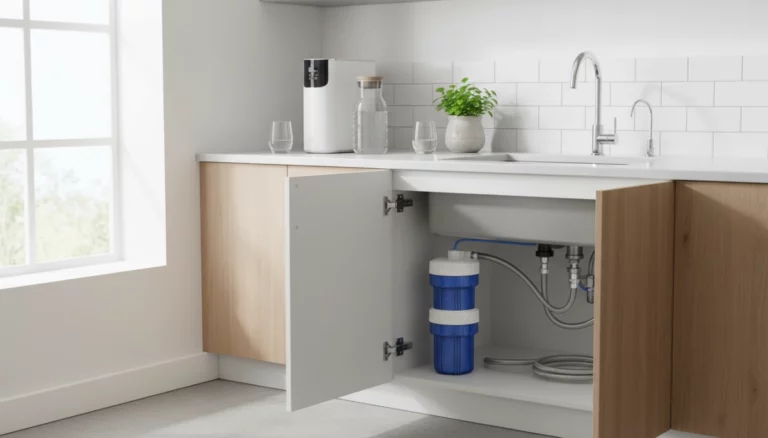
For our high-output units, such as under-sink reverse osmosis filtration systems, maintaining a consistent flow rate is critical for user satisfaction. A primary cause of reduced flow in carbon-only filters is biofouling—the accumulation of bacterial slime (biofilm) that clogs the media surface. This blockage increases the differential pressure (Delta P), forcing the pump to work harder while delivering less water.
KDF acts as a crucial stabilizer here through its bacteriostatic properties. By generating an electrochemical potential that is hostile to microorganisms, KDF prevents algae and bacteria from colonizing the filter bed.
- Prevents Clogging: Keeps the media bed open and permeable.
- Stabilizes Pressure: Maintains a low Delta P for consistent output.
- Protects Components: Reduces strain on pumps and downstream membranes.
By integrating KDF, we ensure that flow rate stability is preserved throughout the filter’s lifecycle, preventing the premature pressure drops that commonly plague standard carbon filters.
The Commercial ROI: Why Manufacturers Use KDF
Cost vs. Longevity: Lowering Total Cost of Ownership (TCO)
At Driplife, we know that the initial price tag isn’t the only number that matters. While adding Kinetic Degradation Fluxion (KDF) to a filtration system increases the upfront manufacturing cost slightly compared to using plain carbon, the long-term payoff is massive. By shielding the carbon from chlorine and heavy metals, we significantly achieve service life extension for the entire cartridge.
For our OEM/ODM partners, this lowers the Total Cost of Ownership (TCO) for the end-user. A filter that lasts 12 months instead of 6 offers better value and reduces the hassle of frequent maintenance. This reliability is crucial when expanding your market share with smart countertop RO water filter technology, as customers prioritize durability and low maintenance costs over cheap, short-lived consumables.
Key Financial Benefits:
- Reduced Frequency: Fewer filter changes mean lower annual operating costs.
- Brand Loyalty: Products that last longer build stronger trust with consumers.
- Inventory Efficiency: Longer shelf life and usage cycles streamline supply chain logistics.
Sustainability: Reducing Plastic Waste and Landfill Impact via Extended Life
Sustainability isn’t just a buzzword; it’s a manufacturing responsibility. Every time a filter cartridge is exhausted and replaced, the plastic housing and saturated media end up in a landfill. By utilizing filter media synergy to prolong the active life of the carbon, we effectively reduce the number of cartridges thrown away each year.
We focus on engineering solutions that maximize cost-efficiency while minimizing environmental impact. A system that requires half as many replacements is inherently greener. This approach aligns with modern consumer demands for eco-friendly products, proving that high-performance water treatment can also support a cleaner planet.
Driplife’s Approach to Multi-Stage Filtration
At Driplife, we don’t just dump media into a canister and hope for the best. We treat filtration as a science, specifically focusing on filter media synergy. To truly leverage the role of KDF in prolonging active carbon life, we focus on three core pillars of engineering and manufacturing.
Engineering Precision: Calculating Optimal KDF-Carbon Ratios
Finding the balance is key. If you use too little KDF, the chlorine shield fails, and the carbon gets exhausted too quickly. Use too much, and the unit cost skyrockets unnecessarily. We calculate the precise mass and volume ratios of Kinetic Degradation Fluxion (KDF) to Granular Activated Carbon (GAC) based on intended flow rates and contaminant loads. This ensures the redox potential is maximized to neutralize threats before they ever reach the carbon pores.
Manufacturing Capability: Testing Media Blends for Maximum Efficiency
Theory is great, but real-world performance is what matters. In our labs, we subject our blends to accelerated life testing. We monitor adsorption capacity and pressure drops to guarantee performance stability. As a company at the forefront of industry innovations in water filter manufacturing, we validate that our specific layering techniques prevent biofouling and channeling, ensuring the filter works as hard on day 100 as it does on day 1.
OEM/ODM Flexibility: Custom Long-Life Formulations for Brands
One size rarely fits all in the US market. Water quality varies wildly from state to state. We offer comprehensive Water filtration OEM/ODM services that allow brands to customize their formulations.
- Heavy Metal Focus: We can increase KDF 55 or 85 ratios for areas with lead or sulfur issues.
- Chlorine Defense: We adjust the blend to prioritize residual chlorine removal for city water applications.
- Extended Lifespan: We engineer specific service life extension protocols to help brands claim longer filter life with confidence.
By tailoring these multi-barrier science solutions, we help brands deliver a product that doesn’t just filter water—it lasts longer and saves the end-user money.
Frequently Asked Questions About KDF and Carbon Filtration
Does KDF replace activated carbon entirely?
No, it does not. Think of them as a team rather than competitors. Kinetic Degradation Fluxion (KDF) relies on electrochemical oxidation (redox) to neutralize inorganic contaminants like heavy metals and chlorine. Granular Activated Carbon (GAC), on the other hand, uses adsorption capacity to trap organic chemicals, Volatile Organic Compounds (VOCs), and improve taste. We combine these technologies in our water filter for tap systems to ensure comprehensive purification that a single media cannot achieve alone.
How much does KDF extend the life of a carbon filter?
By acting as a “chlorine shield,” KDF significantly aids in service life extension for carbon blocks. Chlorine is the primary enemy of carbon, rapidly exhausting its active sites. By neutralizing up to 99% of chlorine before it hits the carbon stage, KDF prevents premature pore saturation. This allows the carbon to reserve its surface area for trapping organics, often extending the effective lifespan of the carbon cartridge by 15 times compared to standalone carbon filters.
Is KDF effective in hot water applications?
Yes, this is one of its strongest advantages. Traditional carbon filters can suffer from desorption in hot water, where trapped contaminants are released back into the flow. KDF media maintains high performance stability at elevated temperatures. This makes it essential for shower filters and integrated hot-water purification units where standard carbon would fail.
What is the difference between KDF 55 and KDF 85 in these blends?
The difference lies in the specific contaminants they target to achieve filter media synergy:
- KDF 55: Optimized for reducing chlorine and soluble heavy metals. This is the standard choice for municipal water sources.
- KDF 85: Engineered to remove iron and hydrogen sulfide. This is critical for well water applications where “rotten egg” smells are common.
As experienced reverse osmosis system manufacturers, we calculate the precise ratios of these media during our R&D process to ensure every OEM/ODM solution meets the specific water quality challenges of the target market.