














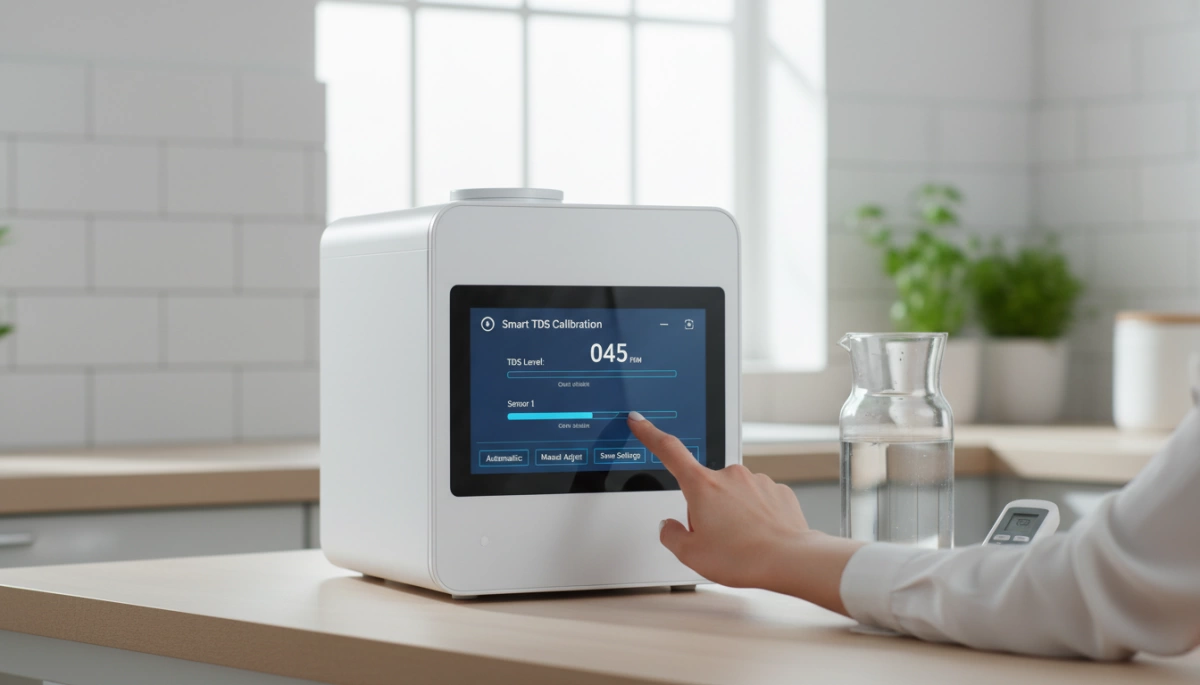
You’ve likely seen the sleek LED displays on modern water purifiers promising real-time purity updates.
But do you actually trust those numbers?
As an industry insider, I can tell you that a digital display is only as reliable as the Smart TDS Monitoring Sensor Calibration Technology driving it. Without precise Automatic Temperature Compensation (ATC) and drift-correction algorithms, those “smart” features are often just marketing gimmicks.
In this guide, we’re going to break down exactly how Countertop RO systems maintain clinical accuracy without manual adjustments and why this engineering matters for your business.
Let’s get technical.
Understanding TDS Monitoring in Compact RO Systems
When we talk about transparency in water filtration, we aren’t just talking about clear water; we are talking about clear data. In the engineering of our countertop RO units, Smart TDS Monitoring Sensor Calibration Technology is the brain behind the brawn of the filtration membrane. It transforms invisible water chemistry into actionable numbers on the user’s display.
EC vs. TDS: The Science Simplified
To understand how our smart sensors work, you have to understand what they are actually reading. A digital water purity tester doesn’t count particles one by one. Instead, it uses an Electrical Conductivity (EC) Probe.
- The Principle: Pure water is a poor conductor of electricity. However, when solids like minerals, salts, or metals are dissolved in it, conductivity increases.
- The Conversion: Our system measures this conductivity and applies a conversion factor to display a Dissolved Solids PPM Reading (Parts Per Million).
- The Result: This allows us to give users an immediate, understandable metric for water quality without needing a laboratory.
Dual-Probe Monitoring System Architecture
Reliability comes from context. A single number on a screen means nothing if you don’t know where you started. That is why we integrate a Dual-Probe Monitoring System into our portable chassis.
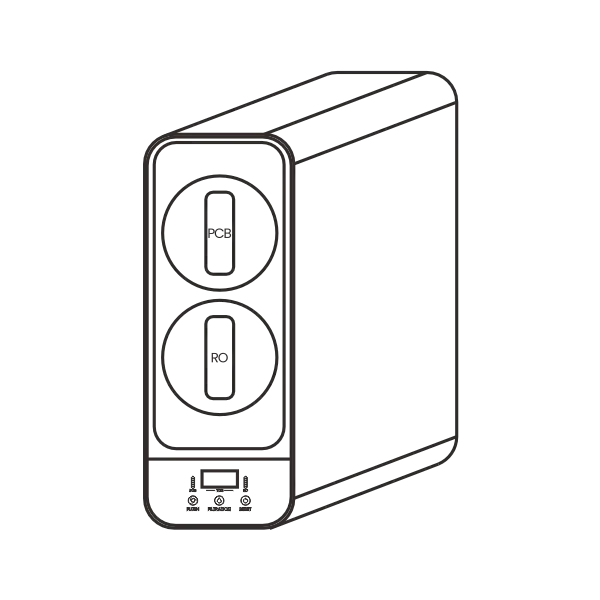
- Feed Water Sensor (Inlet): Located before the first stage of filtration, this sensor establishes the baseline quality of your tap water.
- Permeate Sensor (Outlet): Positioned after the RO membrane and post-carbon filter, this sensor verifies the final purity level.
By monitoring both ends of the spectrum, we provide Real-time Water Quality Analysis that users can trust. You can literally see the difference between the dirty water going in and the clean water coming out.
Calculating RO Membrane Rejection Rate
The true power of this dual-sensor setup is the ability to calculate the RO Membrane Rejection Rate on the fly. This is the efficiency score of the system. By constantly comparing the high TDS of the feed water against the low TDS of the purified water, the system’s microcontroller confirms that the 4-stage filtration process is functioning correctly. If the rejection rate drops, the smart display provides immediate feedback, ensuring you never drink from a compromised filter.
The Smart Factor: Auto-Calibration & Compensation Technology
We know that simply reading raw electrical signals isn’t enough for accurate water quality data. That is why we integrate Smart TDS Monitoring Sensor Calibration Technology in Countertop RO systems to interpret the data correctly before it hits the display. This ensures that the numbers you see on the screen reflect the actual purity of your water, regardless of environmental variables.
Automatic Temperature Compensation (ATC)
Water conductivity changes drastically with temperature. A glass of cold tap water in winter has a different Electrolytic Conductivity Measurement than that same water in the summer, even if the contaminant load is identical. To solve this, we utilize Automatic Temperature Compensation (ATC). This feature normalizes the reading to a standard reference temperature (usually 25°C). It ensures that our smart water quality display engineering provides consistent data, preventing false alarms just because your feed water is colder than usual.
Firmware-Based Calibration Curves
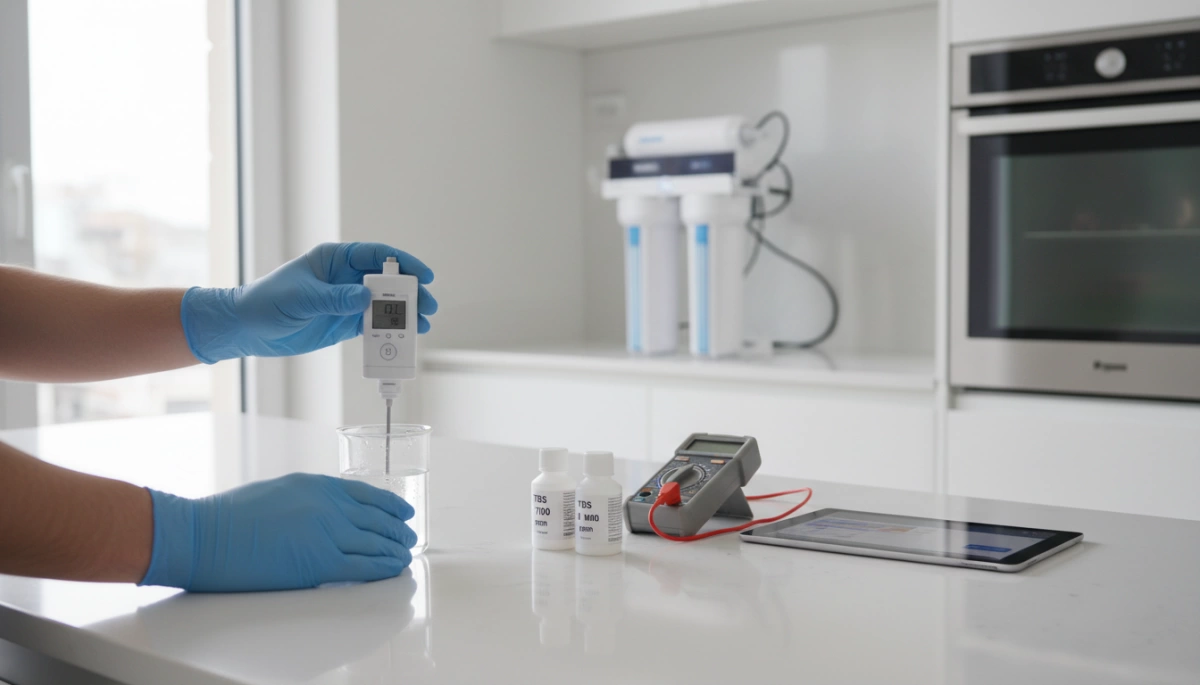
Raw sensor data is rarely linear. We employ advanced Microcontroller Unit (MCU) Algorithms to process the input from the probes. By using a Non-linear Calibration Curve, the firmware adjusts for different water profiles, such as the difference between soft municipal water and mineral-heavy well water. This built-in Sensor Drift Compensation allows the system to maintain accuracy over time without requiring the user to manually tweak settings with a screwdriver and calibration fluid.
Anti-Interference Design
In a compact water dispenser with filter, the internal components are packed tightly together. High-pressure pumps and UV sterilization lights generate electrical noise that can distort sensitive conductivity readings. Our engineering focuses on isolating the sensors from this interference. By shielding the signal path, we ensure the Dual-Probe Monitoring System reads only the water chemistry, not the static from the pump motor. This results in a stable, jitter-free readout that users can trust.
Countertop-Specific Challenges & Solutions
Tackling the TDS Creep Phenomenon
One of the biggest hurdles we face with portable reverse osmosis systems is a natural occurrence known as TDS Creep. When an RO system sits idle, the internal pressure changes, allowing a small amount of dissolved solids to diffuse back through the membrane into the pure water side. For users relying on Smart TDS Monitoring Sensor Calibration Technology in Countertop RO, this can be confusing; the first few seconds of water flow might show a higher PPM reading than expected, triggering false concerns about filter health. This isn’t a defect—it’s physics, but we have engineered a way around it to ensure the data remains reliable.
Smart Solution: Auto-Flush Technology
To combat these idle spikes, we implement Auto-Flush Technology directly into the firmware. Before the system dispenses water or after it has been sitting for a set period, the unit automatically rinses the RO membrane. This process flushes out the concentrated water that causes the creep, ensuring that the Dissolved Solids PPM Reading you see on the screen reflects the actual filtration performance, not stagnant water. This feature is a standard expectation for our top desktop water dispensers, ensuring that every cup meets our strict purity standards.
Compact Sensor Integration
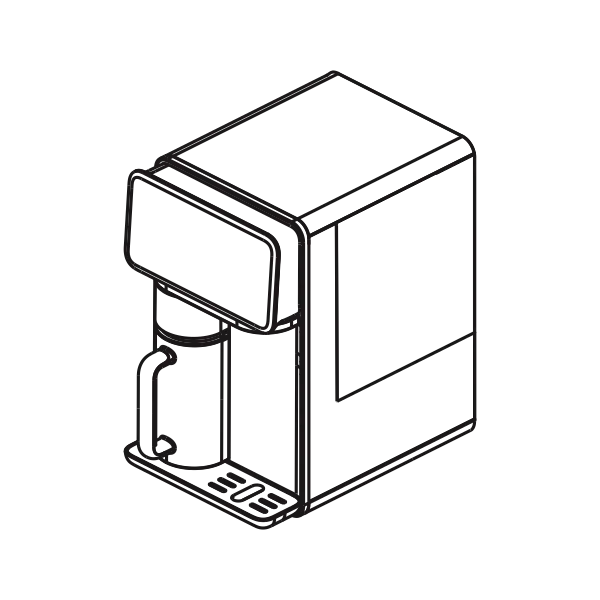
Fitting industrial-grade monitoring into a sleek, portable chassis requires precise engineering. Unlike bulky under-sink units, our countertop models have limited internal space. We utilize miniaturized Dual-Probe Monitoring Systems that fit tight fluid paths without disrupting flow. These sensors are shielded to prevent electrical noise from the pump or UV components, ensuring that the Real-time Water Quality Analysis remains stable and accurate despite the compact footprint.
The Role of Calibration in Filter Life Prediction
Moving Beyond Time-Based Timers to Volumetric and Quality-Based Logic
In the early days of water filtration, we relied on simple clock-based timers to guess when a filter needed changing. Honestly, that approach is obsolete. A timer doesn’t know if you filtered five gallons or five hundred, nor does it know if your source water is relatively clean or heavily contaminated. We have shifted our engineering focus toward Real-time Water Quality Analysis combined with volumetric tracking.
By integrating Smart TDS Monitoring Sensor Calibration Technology in Countertop RO systems, we measure the actual workload of the filtration unit. This logic ensures that customers in areas with harder water get alerts sooner, while those with cleaner municipal water get maximum mileage out of their filters. It is about efficiency and honesty—changing filters only when physics says it is necessary, not when a calendar does.
The Feedback Loop: Using TDS Sensor Data for Alerts
The core of our smart alert system relies on a constant feedback loop provided by the Dual-Probe Monitoring System. The Microcontroller Unit (MCU) continuously compares the Dissolved Solids PPM Reading from the inlet water against the purified water. This allows us to calculate the dynamic RO Membrane Rejection Rate.
Here is how the logic works inside the firmware:
- Baseline Establishment: The system records the rejection rate when the membrane is new.
- Trend Monitoring: As the membrane ages, the rejection efficiency naturally declines.
- Threshold Trigger: Once the efficiency drops below a safety percentage (confirmed by calibrated sensors), the “Change Filter” LED activates.
To keep these readings accurate over time and prevent fouling that skews data, understanding why auto-flush functions are essential for membrane longevity is crucial for maintaining the sensor’s environment. Without this self-cleaning cycle, the feedback loop would be compromised by debris buildup.
Preventing False Alarms Through Smart Threshold Monitoring
Nothing frustrates a user more than a “Replace Filter” light turning on months too early. This usually happens due to Sensor Drift or temporary spikes in tap water conductivity. Our Sensor Drift Compensation algorithms are designed to filter out these anomalies.
We employ a “debounce” logic within the MCU Algorithms:
- Verification: The system requires multiple consistent poor readings over a set period before triggering an alert.
- Calibration Check: It cross-references current Electrolytic Conductivity Measurement against the Non-linear Calibration Curve stored in memory.
- Temperature Adjustment: It confirms that a spike isn’t just a result of hot water entering the system, utilizing Automatic Temperature Compensation (ATC).
By relying on precise calibration rather than raw, noisy data, we ensure that the filter life indicator is a trusted gauge of water safety, not just a nuisance light.
Precision Manufacturing and User Transparency
At DripLife, we believe that trust starts on the assembly line. Our commitment to OEM Water Filtration Engineering ensures that every sensor is rigorously tested before it ever reaches a customer’s kitchen. We utilize industrial-grade reference solutions during the manufacturing process to lock in factory calibration standards. This guarantees that the Smart TDS monitoring sensor calibration technology in countertop RO systems provides precise, hospital-grade accuracy right out of the box, eliminating the drift often seen in cheaper generic models.
For the end-user, this precision translates into total transparency. The integrated Digital Water Purity Tester displays Real-time Water Quality Analysis on the smart LED screen, showing the exact TDS levels of both the tap water entering the system and the purified water dispensing into the glass. This immediate feedback loop is essential for users who want to verify performance without needing external tools. Understanding these readouts is one of the most practical portable reverse osmosis systems benefits and tips for ensuring your family is drinking safe water.
Why Precision Matters for Our Partners:
- Reduced Support Calls: Self-calibrating sensors minimize false alarms and “off” readings, drastically cutting down on after-sales troubleshooting.
- Enhanced Credibility: Smart Home Water Appliances that provide consistent data build long-term brand loyalty.
- Distributor Confidence: Reliability is a key factor in distributor selection smart monitoring RO partnerships, ensuring that the product works as promised without constant maintenance interventions.