














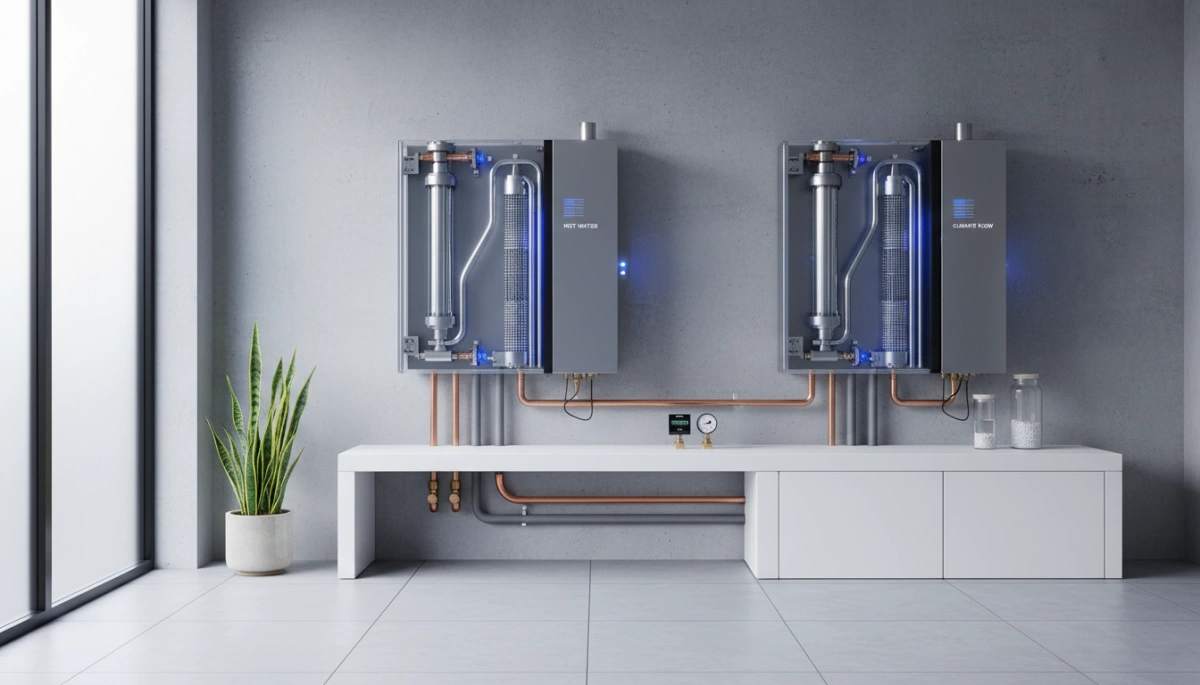
The Silent Efficiency Killer: Thermal Scaling
In every project where I design Anti Scale Design for Heating and Cooling Modules, I treat thermal scaling as a silent efficiency killer, not a minor maintenance issue. Even a thin scale layer can destroy thermal heat transfer efficiency and quietly drive up operating cost.
How Scaling Steals Heat Transfer
When hard water hits hot surfaces, calcium carbonate precipitation starts to form an insulating film on:
- electric heating elements
- brazed plate and shell-and-tube heat exchangers
- chiller and condenser surfaces
This mineral layer has very low thermal conductivity. It acts like a blanket, increasing the heat exchanger fouling factor and causing:
- higher approach temperatures
- longer heat-up or cool-down times
- unstable outlet temperature control
Scale Thickness vs. Energy Use
The relationship is simple: more scale, more energy.
- Even 0.5 mm of hard scale can cut thermal conductivity dramatically.
- The system compensates with longer run times, higher setpoints, and more frequent cycling.
- The result is increased kWh consumption, higher gas or electric bills, and more stress on components.
From a design standpoint, any avoidable fouling factor is wasted capacity. I design around that from day one.
Damage to Heating and Cooling Hardware
Scale is not just an efficiency issue; it is a reliability and lifespan issue:
- Heating elements overheat under the insulating layer, leading to hot spots, element burnout, and premature failure.
- Cooling circuits and narrow passages plug with deposits, restricting flow and raising pressure drop.
- Pumps, valves, and controls see higher mechanical and thermal stress as they fight against scaled, restricted paths.
This is why I build hard water mitigation strategies directly into the anti scale design for heating modules and cooling modules, instead of treating scale as a downstream maintenance problem.
Core Principles of Anti Scale Engineering Design
In my anti scale design for heating and cooling modules, I start with the surface itself. The role of surface material and topography is huge for limescale control. A smooth, electropolished stainless steel surface leaves far fewer rough spots where calcium carbonate can grab on. When I combine that electropolished surface finish with hydrophobic coatings, I cut nucleation sites way down and keep more hardness in suspension instead of locked on the metal.
Flow design is the next lever. I use hydrodynamic flow optimization to keep water moving in a controlled, slightly turbulent regime. That turbulent flow scale prevention strategy helps sweep crystals away before they build into a hard layer. At the same time, I work hard on dead zone elimination in piping and manifolds, so there are no quiet pockets where water sits, cools, and drops out scale.
On the heat side, I design for smart thermal flux management. By using low watt density heating elements, I avoid extreme hot spots that drive rapid calcium carbonate precipitation and thermal conductivity loss. Lower surface temperatures protect the heater, keep the heat exchanger fouling factor under control, and stabilize long term performance in both anti scale design for heating modules and anti scale design for cooling modules.
If you’re pairing these designs with hard water mitigation strategies, it’s worth looking at how we handle under-sink water filtration and treatment to support HVAC water treatment systems and scale prevention in real homes and light commercial installs.
Integrated Anti Scale Design for Heating and Cooling Modules
For heating and cooling modules in the U.S., I design integrated water treatment so scale prevention is built in, not bolted on later. The core is physical anti scale design using Template Assisted Crystallization (TAC) media. TAC converts dissolved hardness into harmless, microscopic crystals (nucleation assisted crystallization) that stay suspended in the water instead of sticking to heat exchanger surfaces, which protects thermal heat transfer efficiency without adding salt or discharge.
To back that up, I use polyphosphate scale inhibitor dosing when water chemistry or operating temperatures demand extra protection. Proper polyphosphate dosing forms a thin protective layer on metal and interferes with calcium carbonate precipitation, cutting down limescale in both heating modules and cooling modules. Upstream, I always size pre filtration for variable flow conditions—sediment and chlorine removal keep TAC anti scale media, ion exchange resins, and downstream components working as designed, similar to how you’d protect a KDF-based filtration stage from fouling.
Where hardness and performance requirements are extreme, I integrate compact ion exchange cartridges into the module. This gives me a scalable hard water mitigation strategy: TAC for low-maintenance, non-salt anti scale protection, polyphosphate for flexible dosing, and ion exchange for critical loads like high-efficiency boilers, chillers, and point-of-use heaters. Together, these anti scale design choices keep modules smaller, more efficient, and easier to maintain in real-world U.S. HVAC and hot water applications.
Heating Modules: Anti Scale Design Focus
When I design anti scale heating modules for boilers and instant water heaters, I focus on keeping hard water scale away from the hottest surfaces. That’s how I protect efficiency and avoid surprise failures in U.S. homes and light commercial systems.
Anti scale design for boilers and instant water heaters
For anti scale design in heating modules, I start with:
- Low watt density heating elements to reduce surface temperature and cut down on calcium carbonate precipitation right at the metal.
- Smooth, electropolished flow paths that lower nucleation sites and make it harder for limescale to stick.
- Optimized flow geometry that keeps water moving so hot spots don’t become permanent scale zones.
This kind of heater protection design is key for long term performance in hard water regions across the U.S.
Cold zone technology to reduce hard scale
I also use cold zone technology in anti scale design for heating modules:
- Keeping the base or threaded area of the element in a cooler “cold zone” so scale doesn’t cement itself where removal is hardest.
- Shaping the heating profile so thermal flux is even, avoiding extreme peaks that drive mineral crystallization.
This approach slows solid scale formation and makes any deposits softer and easier to flush out.
Auto flushing and purge cycles
To keep heating modules clean, I build in auto flushing and purge cycles:
- Timed or sensor‑based purge routines that flush precipitated hardness before it hardens on the metal.
- High‑velocity flushing that sweeps out loose crystals from dead legs and low‑flow pockets.
- Easy tie‑in to pre filtration and, where needed, a compact polyphosphate dosing system or TAC anti scale media upstream for added hard water mitigation.
These features work well alongside whole‑home or point‑of‑use treatment like a compact charcoal water filter system to keep both water quality and equipment protection in balance.
Protecting heating elements and heat exchangers
To protect electric heating elements and heat exchangers from fouling:
- I target turbulent flow scale prevention in the design so scale can’t build a thick insulating layer.
- I size passages to maintain proper velocity even at part load, avoiding stagnant “scale traps.”
- I include access points and modular layouts so elements and compact heat exchangers can be pulled, inspected, or replaced fast.
With this anti scale design for heating modules, I’m aiming for fewer service calls, stable thermal heat transfer efficiency, and reliable hot water performance even in tough hard water conditions.
Cooling Modules: Anti Scale Design Focus
When I design anti scale systems for cooling modules, I treat chillers, condensers, evaporators, and cooling towers as one connected loop. If scale builds up anywhere, thermal heat transfer efficiency drops everywhere.
Anti scale design for chillers, condensers, and evaporators
For cooling modules, my anti scale design focus is simple: keep heat exchange surfaces clean without constant chemical cleaning.
- I use smooth tubes, optimized water velocity, and turbulent flow to keep minerals from settling on chiller and condenser surfaces.
- On evaporators, I match flow rate, temperature, and surface finish so we reduce nucleation sites and slow down hard water scale formation.
- With proper hydrodynamic flow optimization and low fouling materials, we keep the heat exchanger fouling factor low and protect long-term cooling capacity.
Bio fouling versus mineral scaling in cooling water
In most U.S. commercial and light industrial systems, I have to manage both bio fouling and mineral scaling at the same time.
- Mineral scaling (mainly calcium carbonate precipitation) shows up as hard, white deposits that choke tubes and reduce thermal conductivity.
- Bio fouling forms soft, slimy layers that trap minerals, increasing pressure drop and insulation on the heat transfer surfaces.
- My approach is mechanical first: flow velocity, filtration, and surface design to limit both organic growth and mineral attachment, then targeted HVAC water treatment systems only where needed.
Bleed off, blowdown, and conductivity control
Cooling tower water naturally gets more concentrated as water evaporates. If we don’t control it, scaling hits fast.
- I design bleed off and blowdown control based on real-time conductivity, not guesswork.
- By setting clear conductivity limits, we hold dissolved solids just below the scaling threshold instead of wasting water.
- This kind of hard water mitigation strategy saves energy, reduces water use, and keeps cooling modules running at stable load.
Cooling tower design for dissolved solids and scale
For towers, anti scale design is built into the layout, not bolted on later.
- I size basins and overflows to avoid dead zones where solids settle and start scale buildup.
- Spray patterns and fill are chosen to improve contact while reducing areas where limescale can lock in.
- When customers also want better domestic or process water quality, I often pair tower-side design with upstream treatment like ultrafiltration faucet water filters to cut particulate load before it ever reaches their HVAC water treatment systems.
With the right anti scale design for cooling modules, I can protect chillers, condensers, evaporators, and towers from limescale, keep operating costs predictable, and deliver reliable performance in tough U.S. hard water regions.
Material Compatibility And Corrosion Control In Anti Scale Design
Anti scale design for heating and cooling modules only works long term if I balance scale control with corrosion risk. I always start with the water chemistry and use the Langelier Saturation Index (LSI) to see if the water is naturally scaling, neutral, or corrosive. In most U.S. regions with hard municipal water, I tune the treatment to keep LSI slightly positive so I get less calcium carbonate precipitation on hot surfaces without turning the water aggressively corrosive to metal parts.
When I choose materials, I match the metal and polymer to the job:
- Electropolished stainless steel for high‑temperature heat exchangers where I need both corrosion resistance and fewer nucleation sites for limescale.
- Copper or copper alloys where I want strong thermal conductivity but still need good durability in HVAC water treatment systems.
- Engineered polymers and high‑temperature plastics for manifolds and housings that see variable flow and don’t benefit from metal conductivity.
For tanks and heavy‑duty heat exchangers, I add sacrificial anode protection (usually magnesium or aluminum rods) so the anode takes the hit instead of the tank shell or heating coil. This gives me a safety buffer when water conditions swing, maintenance is delayed, or customers change their hard water mitigation strategies. If I need to drive scale risk down even further at the source, I pair the system with dedicated calcium and hardness reduction filters, similar to how a calcium water filter cartridge keeps hardness in check before it ever reaches sensitive heater and chiller components.
Smart Monitoring and Maintenance for Anti Scale Design
In our anti scale design for heating and cooling modules, I treat smart monitoring as insurance for long-term performance. When I pair IoT scale monitoring sensors with good mechanical design, I can see problems before they cost you energy, parts, or downtime.
- I use IoT monitoring of pressure drop and thermal resistance to spot early signs of limescale and heat exchanger fouling. A rising pressure drop or falling thermal heat transfer efficiency is often the first clue that calcium carbonate precipitation is starting to build up inside a coil or plate pack.
- Sensor-based alerts trigger cleaning and maintenance only when you actually need it. Instead of fixed schedules, I set thresholds for flow, temperature delta, and fouling factor so your techs get a clear “service now” signal, not guesswork.
- I design modules to be truly modular: heat exchangers, filter housings, and TAC anti scale media cartridges are easy to pull, inspect, and swap without tearing apart piping. This modular heat exchanger design keeps industrial boiler maintenance and cooling module service quick, clean, and predictable.
- For small commercial and residential applications, pairing smart monitoring with upstream filtration—like a compact counter water filter system to cut sediment and hardness load—helps your anti scale design work better and last longer in real U.S. water conditions.
By combining data-driven maintenance, modular components, and hard water mitigation strategies, I protect heaters, chillers, and HVAC water treatment systems from silent scale buildup and unexpected downtime.
Partnering for Reliable Anti Scale Design
When I design anti scale systems for heating and cooling modules, I always pair smart mechanical design with solid water treatment. That combo is what protects thermal heat transfer efficiency, keeps limescale off heat exchangers, and cuts long‑term energy and maintenance costs.
Combining Mechanical Design and Water Treatment
For long‑term reliability, I treat anti scale design as a full system, not a bolt‑on accessory:
- I match flow paths, manifold layouts, and low watt density heating elements with the right hard water mitigation strategies like template assisted crystallization (TAC) and polyphosphate scale inhibitor dosing.
- I size pre filtration and TAC anti scale media around real-world U.S. usage patterns: variable flow, seasonal demand, and mixed hot/cold water loads in HVAC water treatment systems.
- When customers already use point-of-use filtration, I align the anti scale design with existing setups, similar to how we think about countertop water filters and their maintenance needs.
OEM and ODM Collaboration
As an OEM/ODM partner, I build anti scale design into the product from day one:
- I co-develop compact anti scale design for heating modules, cooling modules, and filtration components so the scale prevention strategy is baked into the manifolds, housings, and connections.
- I standardize OEM water filtration components—cartridges, TAC modules, and polyphosphate dosing systems—so they drop into different boiler, chiller, and HVAC platforms with minimal redesign.
- I focus on modular heat exchanger design so partners can service or upgrade the scale mitigation system without redesigning the whole unit.
Custom Anti Scale Engineering Support
Every site has its own water profile, so I treat engineering support as part of the product:
- I review local water reports, calculate Langelier Saturation Index, and balance corrosion and scaling control for each heating and cooling module design.
- I tune anti scale design for HVAC systems—flow rates, temperature ranges, and duty cycles—so heat exchanger fouling factor stays low over time.
- I help integrate IoT scale monitoring sensors, pressure drop tracking, and simple maintenance workflows, giving facilities teams a clear, long term performance protection plan for their hard water adaptation design.