















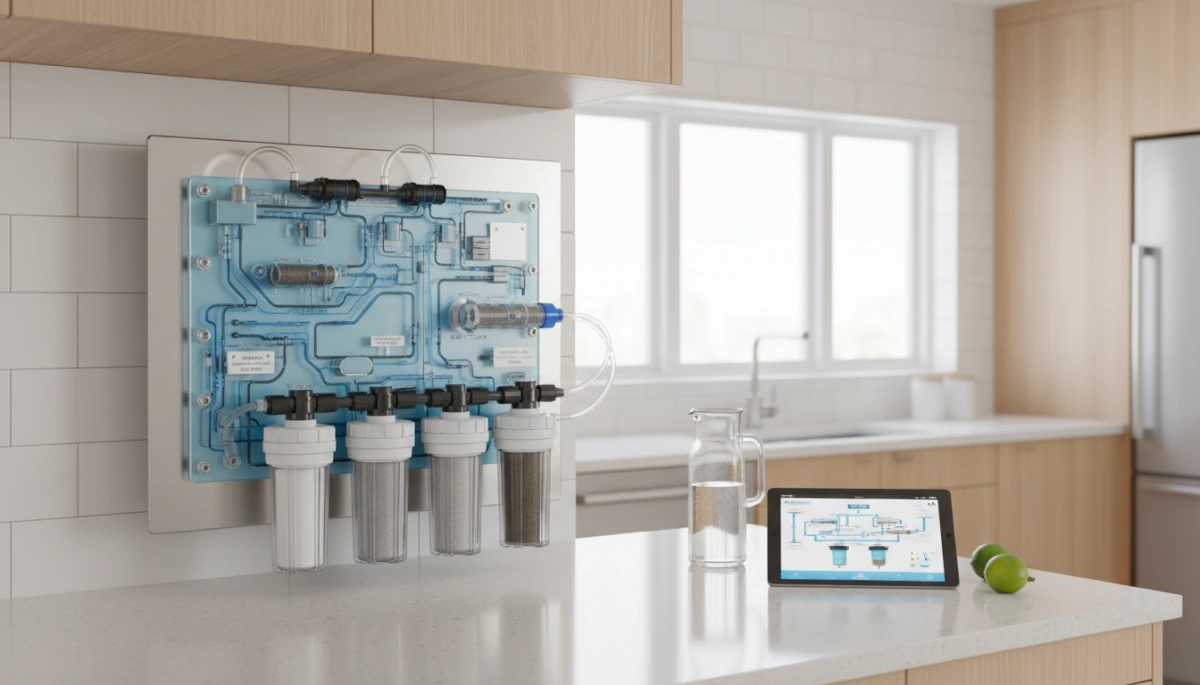
What Is an Integrated Waterway Board?
If you have ever opened up a traditional reverse osmosis system, you probably saw a chaotic web of tubing—what we in the industry call the “spaghetti mess.” It is intimidating and, frankly, a leak waiting to happen. At DripLife, we engineered a solution to eliminate that chaos: the integrated water circuit manifold.
Defining the Integrated Water Circuit Manifold
Think of the integrated waterway board as the “motherboard” of your water purification system. Instead of relying on loose PE tubes to transport water between the pump, filters, and membrane, we mold the entire flow path into a solid, single block of high-quality plastic. This RO internal channel structure manages the flow of water through precision-engineered internal tunnels rather than external hoses. It creates a seamless, connector-free RO engineering standard that defines modern, high-end purification.
Traditional Tubing vs. Integrated Boards
The difference between the old school and our modern approach is night and day. Traditional systems rely on dozens of manual connections, each one a potential failure point.
- Traditional Design: Uses over 20+ PE tubes and push-fit connectors. If one O-ring fails or a tube kinks, you face a high risk of leakage and pressure drops.
- Integrated Design: We utilize a one-piece injection molding RO technique. This reduces connection points by up to 80%, drastically lowering the risk of leaks and ensuring internal leak prevention.
Visualizing the Flow: Streamlined Efficiency
By switching to a tankless RO waterway board, we strip away the bulk. The water travels a direct, optimized path through the manifold. This doesn’t just look cleaner; it ensures consistent hydraulic pressure and eliminates the dead zones found in messy tubing setups where bacteria can sometimes linger. It is the foundation of a safe, compact, and efficient home water solution.
The Manufacturing Process: Precision Injection Molding
To build a truly reliable system, we moved away from manual assembly and embraced one-piece injection molding RO technology. This isn’t about simply shaping plastic; it is about creating a unified hydraulic heart for the purifier. We utilize high-performance, food-grade plastic waterway boards that are molded as a single, solid unit. This ensures that the water touching your glass never interacts with dangerous adhesives or degrading materials.
Engineering Intricate Internal Channels
The real engineering feat happens inside the block. By using precision molds, we design complex RO internal channel structures with optimized 90-degree turns and smooth pathways. This layout manages water flow far better than bent tubing ever could.
- Flow Efficiency: Channels are mathematically calculated to minimize friction loss.
- Space Saving: Complex routing is compressed into a slim, flat board.
One-Piece vs. Split-Welded Designs
There is a massive difference in structural integrity between a solid board and a split-welded one. Split designs rely on ultrasonic welding to fuse two halves together, creating a seam that is prone to splitting under stress over time. Our one-piece design eliminates this seam entirely, resulting in a significantly stronger component that resists expansion.
Quality Control and Pressure Testing
We don’t guess; we test. Every manifold undergoes a rigorous burst pressure test RO manifold protocol. We simulate water hammer effects—sudden pressure spikes common in US households—to ensure the board can handle extreme fluctuations without cracking. This guarantees that the unit remains leak-free for years, providing peace of mind alongside pure water.
Core Engineering Advantages of Integrated Boards

The shift to an integrated water circuit manifold isn’t just aesthetic; it’s a fundamental upgrade in reliability. The most immediate benefit is internal leak prevention. Traditional systems rely on a maze of PE tubing and quick-connect fittings, each representing a potential failure point. By adopting a connector-free RO engineering approach, we eliminate over 20 connection points, drastically reducing the risk of water damage in your home.
Beyond leak protection, these boards offer superior structural integrity. The pressure-resistant waterway plate is designed to withstand significant hydraulic stress, including the “water hammer” effect that often cracks standard fittings. We subject these components to a rigorous burst pressure test to ensure they hold up under real-world conditions, a standard maintained by top-tier water purifier suppliers. This robustness is essential for the longevity of the system.
Performance-wise, the engineering focuses on optimized flow dynamics. The high-flow RO internal pathways are molded to minimize friction and turbulence, allowing for efficient 600GPD to 800GPD outputs without the pressure drop common in spaghetti-tube setups. This efficiency is what allows for the sleek under-sink RO compact design found in modern units. By consolidating the entire hydraulic system into a single board, we achieve a tankless RO waterway board profile that saves up to 70% of cabinet space compared to bulky, tank-dependent models.
Key Technical Benefits
- Leak-Proof Architecture: Replaces risky tube connections with a seamless, injection-molded block.
- High Pressure Tolerance: Engineered to handle high hydraulic loads without cracking or deformation.
- Space Efficiency: Enables the slim profile of tankless systems, freeing up valuable under-sink storage.
- Consistent Flow: Internal channels are optimized to maintain high flow rates for instant fresh water.
Maintenance and User Experience Improvements
The shift to an integrated water circuit manifold isn’t just about internal engineering; it fundamentally changes how users interact with their water systems. By consolidating complex plumbing into a single molded block, we have eliminated the cramped, chaotic maintenance struggles typical of traditional RO units. The result is a system that is easier to service and cheaper to own over time.
Simplified Snap-On Filter Integration
The most immediate benefit of the quick-change filter RO board is the ease of replacement. In older systems, changing a filter meant shutting off valves, bleeding pressure, and wrestling with housing wrenches in a dark under-sink cabinet. With our integrated design, the manifold acts as a precision docking station.
We utilize a “Twist-and-Pull” mechanism that aligns perfectly with the internal channels. This allows for snap-on filter integration where a user can swap a filter in about three seconds without a single tool. The manifold provides the structural resistance needed to lock the filter in place, ensuring a watertight seal every time.
Enhanced Serviceability and Lower Costs
From a service perspective, the tankless RO waterway board drastically reduces the points of failure. Traditional systems often require professional servicing to hunt down micro-leaks among dozens of tube connections. By removing these connections, the system becomes virtually maintenance-free aside from routine filter swaps. This reliability plays a major role in reducing the overall cost of water filter for home ownership, as users rarely need to pay for emergency plumbing repairs or replacement fittings.
Addressing the “Bricking” Myth
A common concern in the industry is the “bricking” myth—the fear that if a proprietary integrated manifold cracks, the entire machine becomes useless waste. In reality, the structural integrity of these boards makes this scenario highly unlikely compared to the constant failure rate of standard tubing.
- Durability: These boards are injection molded from heavy-duty, food-grade materials designed to withstand pressures far exceeding standard residential water pressure.
- Modularity: In the rare event of a defect, the manifold is a single component that can often be replaced, rather than scrapping the unit.
- Leak Prevention: The risk of a solid block cracking is infinitesimally lower than the risk of a plastic tube fitting splitting or popping off.
By centralizing the water path, we create a robust core that protects the user’s investment rather than endangering it.
Advanced Features and Material Safety
The engineering behind an integrated water circuit manifold goes beyond simple plumbing; it acts as the central hub for system intelligence and safety. We design these boards to actively manage water quality rather than just passively transporting it. By embedding flow paths directly into a solid block, we enable advanced features that traditional tubing simply cannot support.
Intelligent Automatic Flushing Integration
One of the critical functions of our integrated design is the support for intelligent automatic flushing. The internal channels are engineered to route water efficiently during self-cleaning cycles.
- Stagnation Prevention: The board automatically directs water to flush the membrane when the system sits idle, preventing bacterial growth.
- Membrane Longevity: By clearing concentrated solids from the RO membrane surface, the integrated flow path extends the lifespan of the filters.
- Smart Coordination: The manifold works in sync with onboard sensors to trigger flushing based on usage patterns, ensuring the first cup is always fresh.
PFAS-Free Materials and Safety Certifications
Since the food-grade plastic waterway board is the only surface touching your drinking water after filtration, material safety is non-negotiable. We utilize high-grade, injection-molded polymers that are strictly tested for chemical stability.
- BPA and PFAS Free: We use materials that do not leach harmful chemicals, ensuring the water remains pure.
- Pressure Resistance: The materials are selected for high structural integrity to withstand water hammer effects without cracking.
- Secondary Pollution Control: Unlike rough internal surfaces of older pipes, the smooth, molded channels prevent sediment buildup and biofilm formation.
High-Flow Internal Pathways
To support modern demands, we engineer high-flow RO internal pathways specifically for 400-1200 GPD units. Traditional 1/4-inch tubing often creates bottlenecks that restrict the output of high-capacity membranes. Our integrated boards feature widened, hydrodynamically optimized channels that reduce friction loss. This ensures that when you open one of our kitchen faucets with filtration features, you get a robust stream instantly, without the lag associated with tank-based systems.
Performance & Safety Specs
| Feature | Benefit |
|---|---|
| Material Composition | Food-grade ABS/PP (BPA/Lead-free) |
| Flow Capacity | Optimized for 400GPD – 1200GPD output |
| Burst Pressure | Tested to withstand >500 PSI |
| Path Design | Zero dead-angle channels to prevent bacterial growth |
Frequently Asked Questions About RO Waterway Boards
Do integrated waterway boards restrict water flow?
Not at all. In fact, the integrated water circuit manifold is engineered to optimize flow dynamics better than traditional tubing. Old-school tubes can kink or bend, causing pressure drops, but our high-flow RO internal pathways are precision-molded with smooth, fixed channels. This design minimizes friction and turbulence, allowing high-capacity systems (like 600GPD or 800GPD models) to deliver water instantly. While a simple water purifier for sink faucet is excellent for basic filtration, these integrated boards are the heavy lifters required for high-volume reverse osmosis performance.
Can you repair a cracked integrated manifold?
Technically, no—and you shouldn’t try. These boards are manufactured using one-piece injection molding RO techniques to withstand significant hydraulic pressure. If a crack were to occur (which is rare given our rigorous burst pressure test standards), patching it with glue or epoxy is unsafe because it compromises the structural integrity of the high-pressure vessel. The safest solution is replacing the module to maintain a truly leak-proof RO system design.
Are integrated boards better than traditional tubing?
For modern residential use, absolutely. Traditional systems are often a “spaghetti mess” of tubes and quick-connect fittings, where every connection is a potential leak point. By utilizing connector-free RO engineering, we eliminate over 20 connection points, drastically reducing the risk of water damage. This architecture also enables a compact tankless RO waterway board design, saving up to 70% of your under-sink space compared to bulky, tube-heavy units.
How long do integrated RO manifolds last?
These components are built for the long haul. We use durable, food-grade plastic waterway boards designed to resist water hammer and constant pressure fluctuations. Unlike rubber hoses that can degrade or become brittle over time, the pressure-resistant waterway plate is engineered to last the entire lifespan of the water purification unit. It is a “set it and forget it” solution that ensures your system runs cleanly without the maintenance headaches of checking for loose tubes.