












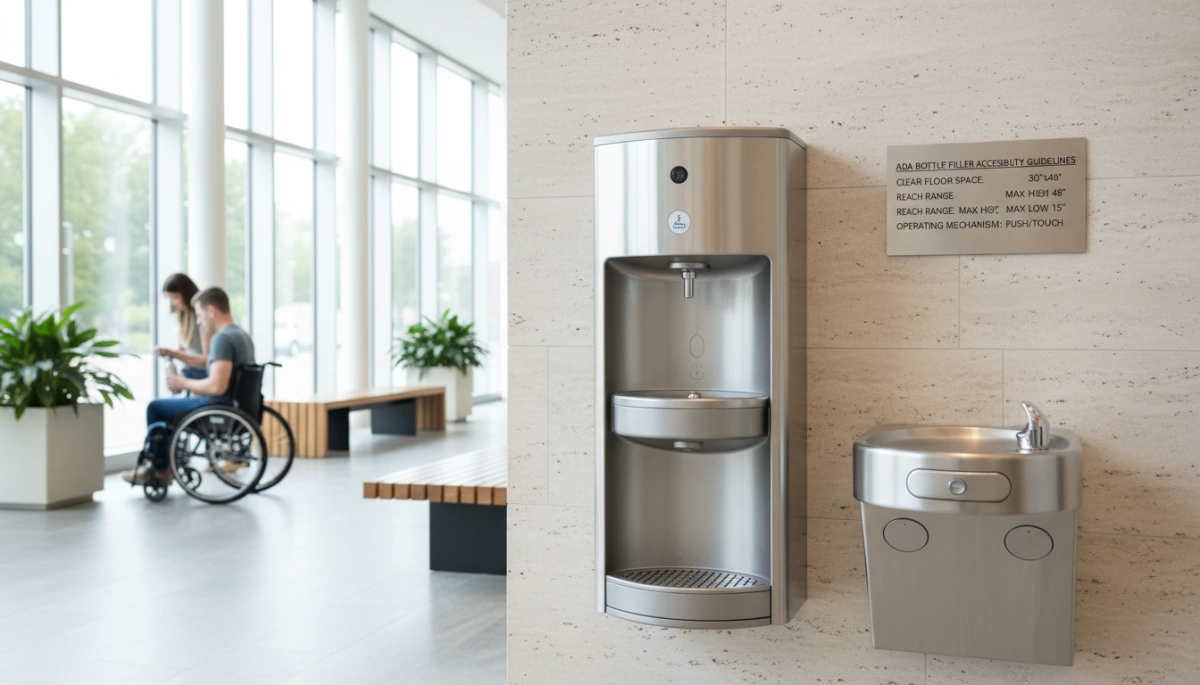
If you’re planning a new hydration station—or retrofitting an existing one—getting ADA accessibility right isn’t optional. It’s the difference between a truly inclusive space and a daily barrier for wheelchair users and others with limited mobility.
The challenge? Modern bottle filling stations aren’t always addressed clearly in code summaries, and it’s easy to get critical details wrong: spout height, reach ranges, forward vs. side approach, knee and toe clearance, and clear floor space. Miss any of these, and your “green” hydration upgrade could fail ADA review.
In this guide, you’ll get the ADA accessibility basics for bottle filling stations—with a practical focus on heights, reach ranges, and approach requirements based on the 2010 ADA Standards for Accessible Design. You’ll see how to:
- Place spouts and controls within compliant forward and side reach ranges
- Provide adequate knee and toe clearance so wheelchair users can get close enough
- Plan clear floor space and approaches that actually work in real-world corridors and alcoves
You’ll also learn how these rules apply when bottle fillers are integrated with drinking fountains, so you don’t accidentally substitute one for the other and fall out of compliance.
And if you’re looking for reliable, ADA-conscious bottle filling solutions, you’ll see how Driplife—a China-based manufacturer—designs filtration and filling systems that support both accessibility and sustainability.
ADA Accessibility Basics for Bottle Filling Stations
If you’re adding hydration stations to a public facility in the U.S., you cannot ignore ADA bottle filling station requirements. I design and specify these units all the time, and the same issues keep coming up: heights, reach ranges, and how a wheelchair user actually gets to and uses the station.
Below is a quick, practical overview so you can get it right the first time.
Core ADA Standards That Apply
For fixed, wall-mounted or recessed bottle fillers, the 2010 ADA Standards for Accessible Design typically apply to:
- Accessible routes – ADA §§206, 402–404
- Drinking fountains scoping – ADA §211
- Reach ranges – ADA §308
- Operable parts – ADA §309
- Clear floor space and approach – ADA §305
- Protruding objects – ADA §307
Even though “bottle fillers” are not singled out by name, they’re treated like operable fixtures similar to drinking fountains and hydration stations.
Bottle Fillers vs. ADA Drinking Fountains
A key point: a bottle filling station does not replace an ADA-compliant drinking fountain.
- ADA §211.2 requires:
- At least one wheelchair-accessible drinking fountain
- And one standing-height fountain in most occupancies
- Bottle fillers can be:
- Integrated with fountains (most common)
- Standalone units mounted above, beside, or near a fountain
The safest approach: treat the bottle filler as an additional feature and make sure the required ADA drinking fountains are fully compliant on their own.
When Bottle Fillers Must Be Accessible (ADA §211 + Common Practice)
ADA scoping focuses on drinking fountains, but once you provide a fixed bottle filler in a public or common-use area, it will almost always be expected to be accessible.
As a rule of thumb in public facilities:
- If there is one bottle filling station at a location,
→ design it as wheelchair accessible (clear floor space, reach, and controls within ADA limits). - If you install multiple units at a bank or wall,
→ at least 50% should meet ADA accessibility standards, and they should be on an accessible route.
Local building codes and state accessibility standards (like CBC, TAS, etc.) may be more explicit, so always verify both ADA and local code.
New Construction vs. Alterations vs. Existing Facilities
How strict do you need to be? It depends on the project type:
| Project Type | What’s Expected for Bottle Fillers |
|---|---|
| New construction | Full ADA compliance: accessible route, clear floor space, heights, reach, and controls. |
| Alterations | New or relocated units must comply to the maximum extent feasible within existing constraints. |
| Existing facilities | If you’re not touching the fountain/wall, full retrofits may not be triggered, but once you “alter” or “replace,” ADA applies. |
When in doubt, I treat any new fixed hydration installation like new construction: build it accessible, and you avoid future retrofits and complaints.
Locating Stations on an Accessible Route
Even a perfectly mounted unit fails ADA if users cannot reach it.
Key points:
- Place the station on an accessible route with:
- Firm, stable, slip-resistant surface
- No steps or abrupt level changes over ½ inch
- Corridor clear width typically 36 inches min. (more in high-traffic areas)
- Keep the station close to:
- Main circulation paths (corridors, lobbies, near restrooms)
- Elevators and primary entries in multi-story buildings
Avoid “hiding” the ADA bottle filler behind narrow doors, on raised platforms, or in tight corners.
Typical Use Cases and What to Watch
In most of my projects, ADA-compliant bottle filling stations show up in:
Schools and universities
- Student height ranges, crowded corridors, lockers nearby
- Use lower mounting heights in elementary areas
Offices and corporate campuses
- Mix of seated and standing users
- Focus on wellness, touchless controls, and clean layouts
Transit hubs and airports
- Heavy traffic, luggage, and strollers
- Need generous clearances and durable, high-traffic models
Gyms and recreation centers
- High turnover, sweaty hands, frequent use
- Touchless, easy-to-clean models work best
Hospitals and clinics
- Immunocompromised patients, staff in a hurry
- Sensor-activated units and clear approach paths are critical
No matter the building type, the goal is the same: a wheelchair accessible bottle filling station with compliant height, reach, and approach, installed where people naturally move.
Quick ADA Bottle Filler Planning Checklist (High-Level)
Before you dive into details on heights or reach ranges, confirm:
- Is this station on a true accessible route?
- Can a wheelchair user get to, align with, and operate the unit?
- Are you still meeting ADA drinking fountain requirements separately?
- Will the layout work for real users in your facility (students, travelers, staff, patients)?
If you lock in those points early, the later dimensions—clear floor space, knee clearance, reach range, and operable parts—fall into place much more smoothly.