













You might already suspect that standard water pitchers aren’t catching everything…
But do you know exactly what they are missing?
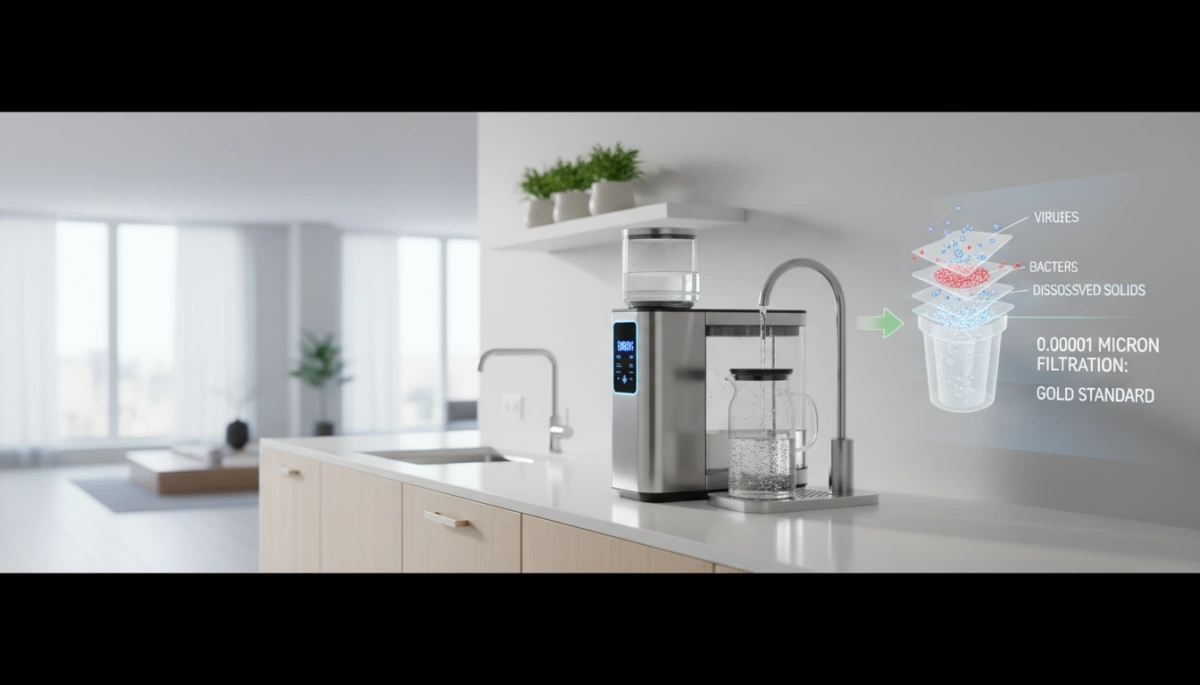
The difference between “filtered” water and truly “purified” water comes down to a specific microscopic measurement: 0.0001 microns.
While basic filters catch dirt, this Gold Standard is the only barrier tight enough to stop viruses, Lead, and PFAS dead in their tracks.
In this post, I’m going to break down the physics of Reverse Osmosis and show you why 0.0001 micron filtration is non-negotiable for your health.
Let’s dive in.
Visualizing the Scale: How Small is 0.0001 Micron?
When we talk about water safety at Drip, we aren’t just worried about the dirt you can see; we are focused on the invisible threats you can’t. Understanding the Micron Rating Explained is crucial to realizing why standard filters often fall short. A micron is one-millionth of a meter, but 0.0001 micron is a level of precision that borders on the atomic scale. This is the realm of Hyperfiltration Technology, where we stop filtering physical debris and start separating molecules.
Comparing the Microscopic World
To truly grasp the magnitude of this Filtration Precision, we have to look at relative sizes. A standard sediment filter might catch visible particles, but it leaves the dangerous, invisible contaminants behind.
Here is how a 0.0001 micron pore size compares to common objects and contaminants:
| Object / Contaminant | Size (Microns) | Relative Scale |
|---|---|---|
| Human Hair | ~75.0 | The size of a football stadium |
| Red Blood Cell | ~7.0 | A large car |
| Bacteria (E. coli) | ~2.0 | A bicycle |
| Virus | ~0.1 | A marble |
| RO Membrane Pore | 0.0001 | A grain of sand |
The Sieve Analogy: Size Exclusion
I often explain Semi-permeable Membrane mechanics using a simple sieve analogy. Imagine trying to stop sand using a chain-link fence. The fence (a standard carbon filter) easily stops a basketball (sand/sediment) or a baseball (algae), but the sand (dissolved solids and viruses) flies right through the gaps.
0.0001 micron filtration acts more like a solid concrete wall than a fence. The pores are so incredibly small that they create a physical barrier against virtually everything except pure water molecules. This process, known as size exclusion, ensures that contaminants like heavy metals and viruses are physically unable to pass through to your glass.
The Molecular Threshold for Purity
Why do we insist on this specific number? Because 0.0001 micron is the Molecular Water Purification threshold. At this level, we are effectively stripping water down to its essential H2O structure. It is the only reliable way to ensure Purity Level consistency because it doesn’t rely on chemical reactions that can be exhausted; it relies on the immutable laws of physics. If a contaminant is larger than a water molecule—which almost all pollutants are—it simply cannot pass.
What Does 0.0001 Micron Filtration Actually Remove?
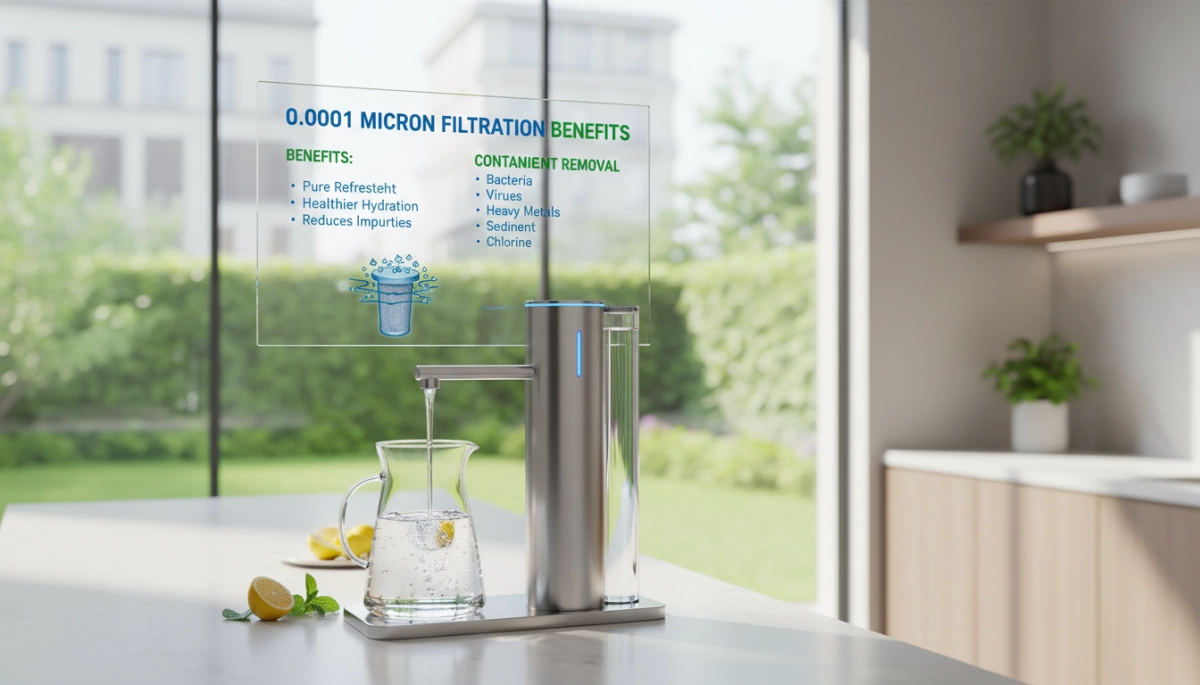
When we talk about 0.0001 micron filtration, we are operating at the molecular level. Standard carbon filters are great for improving taste and odor, but they often act like open doors for dissolved contaminants. The Reverse Osmosis Membrane used in our systems acts as a strict gatekeeper, allowing only pure water molecules to pass while rejecting virtually everything else.
Here is what this level of Filtration Precision actually eliminates from your tap water:
- Invisible Heavy Metals: Dangerous elements like Arsenic, Mercury, and effective Lead Removal are critical because these metals are dissolved in water, making them invisible to the naked eye. This membrane blocks them completely.
- PFAS and Forever Chemicals: With growing concerns over industrial runoff in the United States, PFAS Water Filtration is essential. These complex chemical chains are too large to squeeze through a 0.0001-micron pore.
- Viruses and Bacteria: As a comprehensive Waterborne Pathogen Barrier, this filtration size is significantly smaller than the smallest virus, providing 99.99% efficiency against biological threats.
The most immediate indicator of this performance is Total Dissolved Solids (TDS) Reduction. While simple filters might lower TDS slightly, our technology drastically reduces these numbers, which you can often verify in real-time on the smart displays of our countertop reverse osmosis systems. This ensures that what you are drinking is not just filtered, but truly purified.
The Hierarchy of Filtration: Why ‘Micro’ Isn’t Enough
Most people assume that if water flows through a filter, it’s clean. The reality is that filtration is a game of levels, and “micro” filtration simply doesn’t cut it for the contaminants we face today. To understand why we insist on 0.0001 micron precision, you have to look at the hierarchy of water treatment.
Sediment Filters vs. Ultrafiltration vs. Reverse Osmosis
Think of filtration like a series of nets with different hole sizes.
- Sediment Filters (5.0 – 1.0 Microns): These are the “chain-link fences” of filtration. They are excellent at catching large debris like rust, sand, and dirt typically found in aging US municipal pipes. However, invisible chemical compounds flow right through them.
- Ultrafiltration (0.01 Microns): This is tighter, like a screen door. It stops most bacteria and suspended solids, but it fails to stop viruses, heavy metals, or dissolved salts.
- Reverse Osmosis (0.0001 Microns): This is the Hyperfiltration Technology we utilize. It functions less like a net and more like a molecular bouncer, rejecting almost everything that isn’t a pure water molecule.
Why 5.0 and 0.01 Micron Ratings Fail Against Dissolved Solids
The biggest misconception in the industry is that a standard carbon pitcher or fridge filter (usually rated between 1 to 20 microns) makes water “pure.” These filters are Nominal Micron rated, meaning they reduce chlorine taste and odor, but they are physically incapable of Total Dissolved Solids (TDS) Reduction.
If you test water filtered by a 0.01-micron system, you will find that the TDS levels remain nearly identical to the tap water. Why? Because dissolved solids like Arsenic, Lead, and PFAS are molecularly smaller than the pore size of those filters. They pass through unhindered.
The Hyperfiltration Advantage of RO Membranes
This is where the Reverse Osmosis Membrane proves its value as the gold standard. By forcing water through a semi-permeable membrane at 0.0001 microns, we achieve Filtration Precision that is 100 times finer than ultrafiltration.
This process separates the water from the contaminants at an atomic level. While this intense purification is necessary for safety, it also strips the water completely, which is why understanding the pH levels of RO water and subsequent adjustment is a critical part of our system design. We don’t just want clean water; we want water that is balanced and healthy.
Key Differences in Filtration Capabilities:
| Filter Type | Micron Rating | Removes Sediment? | Removes Bacteria? | Removes Viruses & TDS? |
|---|---|---|---|---|
| Sediment | 5.0 – 1.0 | Yes | No | No |
| Ultrafiltration | 0.01 | Yes | Yes | No |
| Reverse Osmosis | 0.0001 | Yes | Yes | Yes |
Addressing the Minerals Debate: Purity vs. Health

Does RO Remove Good Minerals?
Let’s be honest about the trade-off involved in achieving the highest Purity Level. When we push water through a Reverse Osmosis Membrane with 0.0001-micron precision, the system doesn’t discriminate between harmful contaminants and beneficial minerals. It acts as an absolute barrier. Consequently, standard RO filtration strips out healthy elements like calcium and magnesium along with the lead and arsenic. This results in water that is technically pure but often tastes “flat” and can be slightly acidic.
The Role of Remineralization in Modern Systems
We believe that filtration shouldn’t stop at just removing the bad stuff; it needs to restore the good stuff. This is why the Remineralization Stage is a non-negotiable part of our engineering. Unlike basic filters that leave you with “dead” water, our systems use a post-filtration process to reintroduce essential minerals. If you are curious about the specifics of this process, understanding how to add minerals to water is key to recognizing the difference between standard RO water and truly healthy hydration.
Balancing Safety with Taste and Health Benefits
The goal is to meet rigorous Water Purity Standards without sacrificing health or flavor. By integrating an alkaline remineralization filter after the RO membrane, we ensure the water is not only free from toxins but also pH-balanced. This process restores:
- Calcium: For strong bones and teeth.
- Magnesium: To support metabolic function.
- Sodium & Potassium: For proper hydration balance.
This dual-step approach—stripping contaminants at the molecular level and then restoring mineral balance—is how we turn pure water into healthy water.
Engineering the Gold Standard with Driplife
At Drip Life, we didn’t just want to meet the standard; we wanted to define it for residential use. We have taken industrial-grade Hyperfiltration Technology and scaled it down into a sleek, compact unit that fits right under your sink. Achieving 0.0001-micron precision requires robust engineering, which is why our systems are built to handle high pressure without compromising on durability. We bridge the gap between commercial purity and home convenience.
Speed is usually the trade-off for purity, but we fixed that. Our systems boast a 600 GPD Flow Rate, meaning you get a cup of crystal-clear water in seconds, not minutes. We also optimized the efficiency, achieving a high pure-to-drain ratio that wastes significantly less water than traditional setups.
Why our engineering stands out:
- Industrial Precision: We use composite filters that protect the 0.0001-micron membrane, extending its lifespan.
- Smart Monitoring: Integrated faucets display real-time TDS levels so you know the system is working.
- Space Saving: Our compact design saves 70% of under-sink space compared to bulky tank systems.
The biggest game-changer, however, is the design. We ditched the bulky storage tank found in old-school filters. A Tankless RO System eliminates the risk of “secondary pollution”—where clean water sits in a rubber bladder and grows bacteria over time. You get fresh filtration on demand, every single time. This same dedication to instant, hygienic purification is what drives the engineering behind our 2026s top countertop hot water dispensers, ensuring that whether you need chilled or boiling water, the purity remains absolute.
FAQ: Common Questions About 0.0001 Micron Filtration
When you are looking at high-end water purification, the technical specs can get overwhelming. We often hear specific questions from customers trying to decide if a Reverse Osmosis Membrane is right for their home. Here are the honest answers regarding the 0.0001 micron filtration standard we use at Drip.
Is 0.0001 micron filtration overkill for city water?
This is the most common question we get. While municipal water treatment plants in the United States do a decent job of meeting federal Water Purity Standards, “compliant” doesn’t always mean “pure.” By the time that water travels through miles of aging infrastructure to reach your tap, it can pick up contaminants that standard filters miss.
0.0001 micron filtration is not overkill if you care about:
- Lead Removal: Old service lines can leach lead, which simple carbon filters often fail to catch entirely.
- PFAS Water Filtration: Known as “forever chemicals,” these require the tight weave of an RO membrane to be effectively blocked.
- Unpredictable Spikes: City water quality can fluctuate. Our system acts as a final firewall against unexpected contamination events.
If you want to ensure your water is free from invisible threats, this level of precision is the baseline for safety, not a luxury.
How often do I need to change a 0.0001 micron membrane?
Unlike standard pitcher filters that need swapping every two months, the Reverse Osmosis Membrane in a Tankless RO System is built for the long haul. Because our systems use a composite design where pre-filters handle the heavy lifting (sediment and large particles), the delicate 0.0001-micron layer is protected.
- Lifespan: Typically, these membranes last between 12 to 24 months, depending on your local water quality and usage.
- Smart Monitoring: You don’t need to guess. Our smart faucets display real-time filter status, so you know exactly when it’s time.
- Easy Maintenance: When it is time to change, our “twist-and-pull” design lets you swap the filter in 3 seconds without shutting off the main water supply.
Maintaining this membrane is crucial because RO systems protect expensive kitchen steam ovens and kettles from scale buildup, ensuring your appliances last as long as your filtration system.
Can 0.0001 micron filters remove salt from water?
Yes, they can. This is one of the defining features of Hyperfiltration Technology. A 0.0001-micron pore size is small enough to block dissolved salts and sodium, which is why RO is used for desalination globally.
This process results in significant Total Dissolved Solids (TDS) Reduction. However, drinking demineralized water can taste flat and acidic. That is why we engineer our systems with a Remineralization Stage. After the Heavy Metal Filtration and salt removal are complete, we restore beneficial minerals like Calcium, Magnesium, and Potassium. This gives you the purity of 0.0001-micron filtration with the healthy mineral balance and taste of natural spring water.