
















If your shower smells like a swimming pool, your skin feels tight and itchy, or your hair looks dull no matter what products you use, your water is probably the real problem—not your routine.
That’s where shower filters come in. But not all filters work the same way.
Behind the marketing claims, one material quietly does a lot of the heavy lifting: activated carbon supporting media. Used alongside technologies like KDF, it acts like a molecular sponge—adsorbing chlorine, chloramine, organic contaminants, and odor-causing compounds that standard filters can miss, especially in hot, high‑flow shower water.
In this guide, you’ll see exactly how activated carbon works inside shower filters, why it’s so effective as supporting media in multi‑stage systems, and how it can translate into softer skin, healthier hair, and cleaner air in your bathroom.
If you’re comparing KDF vs carbon, researching the best shower filter media, or simply want to reduce your daily chlorine exposure, keep reading—this is where the science finally becomes practical.
What Is Activated Carbon in Shower Filters?
Simple Definition: What Activated Carbon Really Is
When you see “activated carbon shower filter” on a product, it’s basically talking about a highly processed, ultra-porous form of carbon that works like a molecular sponge.
In simple terms:
- It’s carbon (like charcoal) that has been “activated” to open up millions of tiny pores.
- Those pores grab and hold unwanted chemicals from your shower water, especially chlorine, some organic contaminants, and VOCs (volatile organic compounds).
- It doesn’t just trap dirt; it adsorbs chemicals onto its surface, which is why it’s so effective for chlorine removal shower filters.
How Activated Carbon Is Made (Coconut Shell, Coal, Wood)
Most high-quality carbon media shower filtration systems use one of these sources:
- Coconut shell activated carbon – The premium choice for shower water purification. It has a very tight pore structure, great for removing chlorine taste and odor and many organic compounds.
- Coal-based carbon – Common and effective, but typically less “clean” and less eco-friendly than coconut shell.
- Wood-based carbon – Used more for air filtration; in shower filters it’s less common.
All of these materials are:
- Carbonized (heated in low oxygen to create basic charcoal).
- Activated (exposed to steam or chemicals at high temperature).
This activation step explodes the surface with micro-pores, turning a small amount of carbon into an enormous adsorption surface ideal for shower water chlorine adsorption.
Why Pore Structure and Surface Area Matter in Showers
In a shower, water is moving fast and hot, so the filter media must work quickly:
- Activated carbon has a huge internal surface area—often over 1,000 m² per gram.
- Its pore structure lets contaminants stick to the carbon surface in a fraction of a second.
- This is crucial in a hot water shower filter where contact time is short and chlorine is volatile.
The better the pore structure, the more efficiently the carbon can:
- Reduce chlorine smell in shower water
- Improve odor and feel
- Capture organic compounds and disinfection byproducts (DBPs) that form in treated municipal water
Types of Activated Carbon in Shower Filters (GAC vs Catalytic Carbon)
Most multi-stage shower filtration systems use one of two main forms:
GAC (Granular Activated Carbon)
- Loose granules packed inside the cartridge
- Great for chlorine removal shower filters and improving smell and feel
- Common in granular activated carbon GAC shower designs
Catalytic Activated Carbon
- Specially treated carbon with enhanced surface chemistry
- Much better for handling chloramine reduction shower (chlorine + ammonia)
- More powerful against organic contaminants and DBPs
Some designs also use carbon block vs GAC in drinking systems, but in showers, GAC and catalytic carbon are preferred because they allow higher flow rates and lower pressure drop.
Why Some Carbons Work Better for Chlorinated Municipal Water
If you’re on city water in the US, you’re almost certainly dealing with chlorine or chloramine. Not all carbons handle these equally:
Standard GAC
- Very effective at free chlorine removal
- Great for improving odor, taste, and that “pool smell” from shower water
- Ideal for most chlorinated municipal water setups
Catalytic carbon
- Specifically optimized for chloramine and more stubborn byproducts
- Better when utilities use chloramine instead of straight chlorine
- Often used in premium shower filter manufacturers like what I build under the Driplife brand for more demanding water profiles
In a well-designed KDF carbon composite shower filter, activated carbon acts as the supporting filtration media, polishing out chlorine, organics, and VOCs after other stages have done their part—giving you cleaner, softer-feeling water on skin and hair without overcomplicating your shower setup.
How Activated Carbon Cleans Shower Water
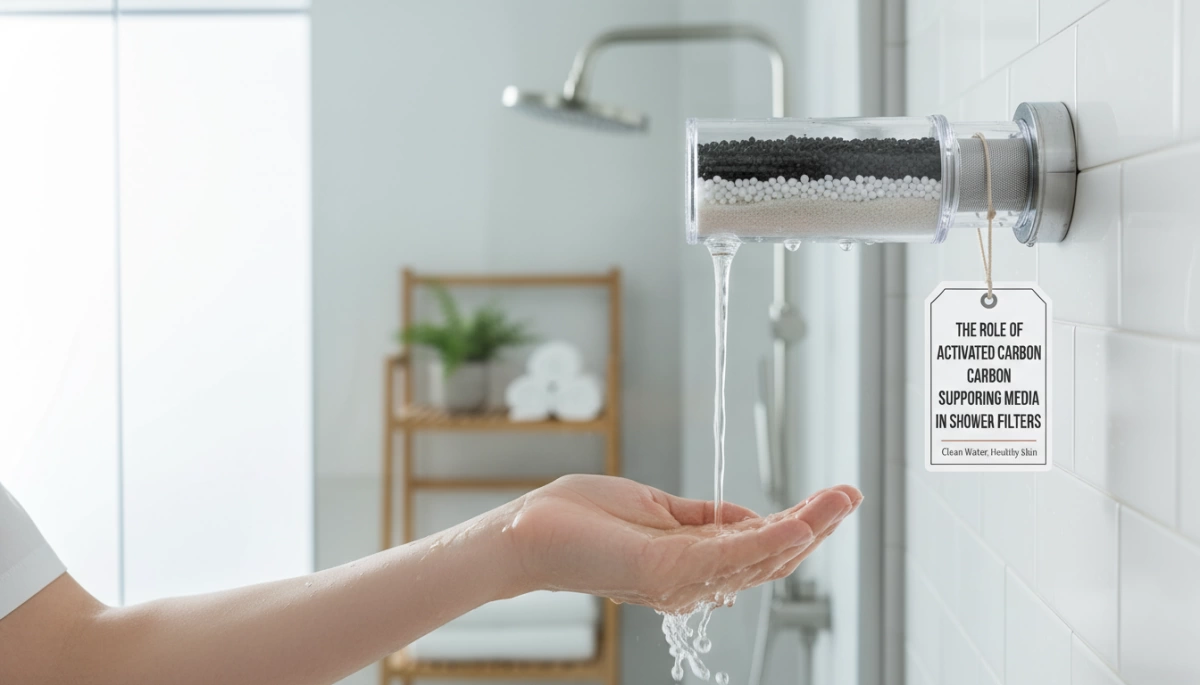
Activated carbon in a shower filter works like a molecular sponge. Instead of “straining” particles like a simple screen, it uses adsorption—water flows over the carbon, and unwanted chemicals stick to its massive internal surface area inside all those tiny pores.
Adsorption: Carbon as a Molecular Sponge
Think of granular activated carbon (GAC) as a porous, high-surface-area media that grabs and holds:
- Chlorine
- Many organic contaminants
- VOCs (volatile organic compounds)
- Some disinfection byproducts (DBPs)
Those molecules are attracted to the carbon surface and stay there until the media is exhausted.
Chlorine Removal in a Shower Filter
In a chlorine removal shower filter, activated carbon:
- Reacts with free chlorine, converting it into chloride, which is far less harsh on skin and hair
- Cuts that “pool smell” and chemical odor in the shower
- Helps reduce irritation for people with sensitive skin or eczema
Catalytic carbon, a more advanced form of activated carbon, is even better at handling tough disinfectants and is often paired with KDF or other media in multi-stage shower filtration systems designed for municipal water.
What Happens to Organics and VOCs
Activated carbon is especially strong at:
- Trapping organic compounds from aging pipes or municipal systems
- Adsorbing VOCs and certain DBPs that can be released into hot shower steam
- Improving overall odor and perceived “clean” feel of shower water
This is the same core adsorption principle used in premium drinking systems like a countertop carbon-based water filter where taste, odor, and VOC reduction are critical.
Limits in Fast, Hot Shower Flow
Even the best activated carbon shower filter has limits:
- High flow rate = less contact time = weaker adsorption
- Hot water can slightly reduce adsorption efficiency
- Very contaminated water or high chlorine levels will exhaust carbon faster
That’s why real performance depends on contact time and a smart media layout, not just throwing carbon into a cartridge.
Why Carbon Works Best in a Multi-Stage System
Activated carbon is powerful, but it’s even better as supporting filtration media:
- Sediment or pre-filters catch rust/sand so carbon doesn’t clog
- KDF or similar media handle heavy metals and hot water stability
- Carbon focuses on chlorine, organics, VOCs, and odor
This secondary filtration media carbon shower system setup extends filter life, keeps flow strong, and delivers cleaner, softer-feeling water for daily showers without gimmicks.
Why Activated Carbon Is “Supporting Media” in Shower Filters
What “supporting media” means in a shower filter
In a real activated carbon shower filter, carbon isn’t always the star of the show. It’s supporting media—one layer in a multi-stage cartridge that backs up the primary filtration media and fills in the gaps they can’t cover.
In plain terms:
- Primary media (like KDF) handles the heavy, fast reactions in hot water
- Activated carbon polishes the water—cuts chlorine taste and odor, grabs organic contaminants, and improves the feel and smell of your shower
How carbon supports KDF in hot water
In a KDF carbon composite shower filter, each media does what it’s best at, especially in hot U.S. municipal water:
- KDF: Reduces chlorine and some heavy metals using a redox (electrochemical) reaction that actually works better in hot water
- Granular activated carbon (GAC) or catalytic carbon: Adsorbs the leftover chlorine, VOCs, and organic compounds, and improves smell and comfort
By putting activated carbon behind KDF, the carbon sees less free chlorine shock, which helps it last longer and stay effective under daily hot showers.
KDF vs activated carbon vs other shower filter media
Here’s the simple division of roles inside a multi-stage shower filter:
- KDF – Best for:
- Free chlorine reduction in hot water
- Certain heavy metals (like lead, mercury, nickel)
- Activated carbon / catalytic carbon – Best for:
- Chlorine smell and taste
- Organic contaminants and VOC removal
- Disinfection byproducts that cause that “pool” or “chemical” smell
- Other media (sediment filters, scale media, vitamin C, etc.) – Best for:
- Sand, rust, and particles
- Scale and hardness (partial treatment)
- Extra chloramine/chlorine support
When carbon is used as supporting filtration media, the whole multi-stage shower filtration system performs better than any single media alone.
How supporting carbon extends filter life and performance
Using activated carbon as a supporting media inside the cartridge gives you:
- Longer life – KDF takes on the chlorine shock first, so the carbon doesn’t burn out as quickly
- More stable performance – Less “spike and crash,” more consistent chlorine removal over the filter’s rated lifespan
- Better overall purification – KDF handles metals and hot chlorine chemistry, while carbon handles organic compound removal and odor cleanup
That’s how a well-designed carbon media shower filtration system keeps working close to its rated life instead of feeling “dead” after a few months.
Standalone carbon filters vs carbon as support media
A standalone granular activated carbon GAC shower filter can help with chlorine taste and odor, but it has limits in hot, high-flow shower use:
- Hot water and high flow mean short contact time, so carbon alone can struggle with heavy chlorine loads
- Chlorine can exhaust plain carbon media fast, especially in heavily treated municipal systems
- Carbon-only designs usually don’t handle metals, scale, or strong chloramine very well
That’s why I prefer to build around multi-stage carbon and KDF systems instead of carbon-only gimmicks. When carbon is used as supporting filtration media, you get a more balanced shower water purification setup that actually matches how U.S. families really shower—hot, often, and with treated city water.
Activated Carbon vs Other Shower Filter Media
Activated carbon vs KDF (chlorine + heavy metals)
For most U.S. homes on chlorinated municipal water, the best performance comes from activated carbon + KDF working together, not either one alone.
Activated carbon shower filters
- Great for: chlorine taste and odor, VOCs, organic chemicals, disinfection byproducts.
- Works by: adsorption (carbon acts like a molecular sponge).
- Weak spot: Not a heavy-metal specialist.
KDF media
- Great for: heavy metals (lead, mercury, some iron), plus helping with chlorine through redox reactions.
- Strong in hot water, where normal carbon alone can struggle.
- Weak spot: Doesn’t target VOCs and organics as well as carbon.
In a KDF carbon composite shower filter, KDF handles the metals and hot water stability, while carbon focuses on chlorine smell, taste, and organics. That’s why serious shower filters use both.
Carbon vs Vitamin C filters (chlorine + chloramine)
Vitamin C (ascorbic acid) filters are popular, but they behave very differently from activated carbon:
- Vitamin C shower filters
- Neutralize free chlorine quickly.
- Can help with chloramine, but contact time and dosing are critical.
- Often shorter lifespan and less effective on VOCs and DBPs.
- Activated carbon shower filters
- Very effective for free chlorine, odors, and organic compounds.
- Standard GAC is weaker on chloramine at shower flow rates.
- Catalytic carbon does much better with chloramine reduction, especially when the system is well-designed for contact time.
If your U.S. city uses chloramine (very common), a catalytic carbon shower filtration system is usually more reliable long-term than a basic vitamin C cartridge.
Where activated carbon wins
Activated carbon is the go-to media when you care about how your shower water smells, tastes, and feels:
- Removes “pool smell” chlorine odor from shower water.
- Reduces VOC contaminants and many organic chemicals from municipal systems.
- Targets disinfection byproducts (DBPs) that can be released into shower steam, helping lower what you inhale.
- Improves overall bathing comfort for people with sensitive skin and dry hair by reducing chemical load.
This is why any premium multi-stage shower filtration system aimed at comfort and skin/hair benefits will almost always include coconut shell activated carbon or catalytic carbon as a core layer.
Where other media win (scale, hardness, some metals)
Activated carbon is not a magic bullet, and it’s not a water softener:
- Not ideal for:
- Hard water / scale (calcium, magnesium) → you need softening or scale-control media, not just carbon.
- Certain dissolved metals and iron staining → KDF or other specialty resins are better.
- KDF and specialty media:
- Handle heavy metals more effectively.
- Help control bacteria growth inside the filter.
- Work better under high-temperature shower conditions.
So if your main issue is white scale on glass, rough “hard” water, or visible metal staining, carbon alone won’t fix it.
Best use cases for combining carbon with other media
For most U.S. households, mixed-media shower filters deliver the best value:
Carbon + KDF
- Best combo for chlorinated municipal water, especially in hot showers.
- Carbon handles chlorine smell, taste, VOCs.
- KDF supports chlorine reduction, heavy metals, and hot water durability.
Carbon + scale media / softening tech
- For regions with hard water, carbon improves chemical quality, while scale media helps with soap scum and buildup.
The sweet spot is a multi-stage shower filter where activated carbon acts as supporting filtration media, not the only line of defense. If you care about what’s in your water more broadly (not just chlorine), you’ll want a system built around carbon + KDF + other targeted media, the same way top drinking-water systems combine methods like RO and carbon for broader coverage, as you see with advanced setups in reverse osmosis countertop systems.
Contaminants Activated Carbon Targets in Shower Water
Activated carbon in a shower filter is there to go after the stuff you feel and smell every day in city water, especially if you’re on chlorinated municipal water.
Free chlorine removal (big deal for skin and hair)
In most U.S. cities, free chlorine is the main disinfectant in tap water. In a hot shower, that chlorine:
- Strips natural oils from your skin and scalp
- Can worsen dry skin, eczema, and irritation
- Makes hair feel rough, dull, and harder to manage
An activated carbon shower filter adsorbs (locks onto) free chlorine, so by the time the water hits your skin, chlorine levels are dramatically reduced. That’s why people often say their skin feels less tight and their hair feels softer after switching to a chlorine removal shower filter.
Chloramine: what carbon can and can’t do
More U.S. utilities now use chloramine (chlorine + ammonia) instead of straight chlorine. Regular granular activated carbon (GAC) can reduce chloramine a bit, but not aggressively, especially at fast shower flow rates.
- Standard carbon = decent for free chlorine, weaker for chloramine
- Catalytic carbon = upgraded carbon surface that does a better job breaking down chloramine in real-world shower conditions
If your city uses chloramine (common in bigger metro areas), look for catalytic carbon shower filtration plus other media support, not just “basic carbon.”
Organic contaminants and VOCs in tap water
Beyond chlorine, activated carbon targets a long list of organic contaminants and VOCs (volatile organic compounds) that can show up in municipal water, such as:
- Industrial solvents and byproducts
- Some pesticides and herbicide residues
- Certain household chemical traces
These compounds are tiny, and carbon’s pore structure lets it act like a molecular sponge, pulling them out of your shower water. That’s a key advantage over simple vitamin C filters, which mainly react with chlorine/chloramine and don’t really deal with broader organic contaminant removal.
Disinfection byproducts (DBPs) in hot showers
When chlorine reacts with natural organic matter in water, you get disinfection byproducts (DBPs) like THMs and HAAs. The concern is higher in hot showers, where:
- DBPs can volatilize into steam
- You’re not just getting skin contact; you’re also breathing them in
Activated carbon is one of the more practical ways to reduce many DBPs in shower water. It doesn’t magically erase every single byproduct, but it significantly cuts down the load compared with unfiltered tap water. If you care about DBPs in your drinking water, you’ll likely care about them in your shower too – similar logic to what we cover in our breakdown of health-focused bath and shower filtration demand at Driplife’s skin care–driven bath water filtration guide.
Odor, “pool smell,” and overall comfort
That “pool smell” in the bathroom isn’t just annoying – it’s mostly chlorinated compounds in the air.
Activated carbon helps by:
- Reducing free chlorine and many chlorine-based odors
- Cutting down on musty or chemical smells from organic and VOC contamination
- Making the bathroom air feel cleaner and less harsh, especially in small, steamy bathrooms
Bottom line: as supporting filtration media, activated carbon quietly does a lot of heavy lifting—handling chlorine, many organics, and a big chunk of the smells and vapors that make showers feel harsher than they need to be.
Health & Skin Benefits of Activated Carbon Shower Filters
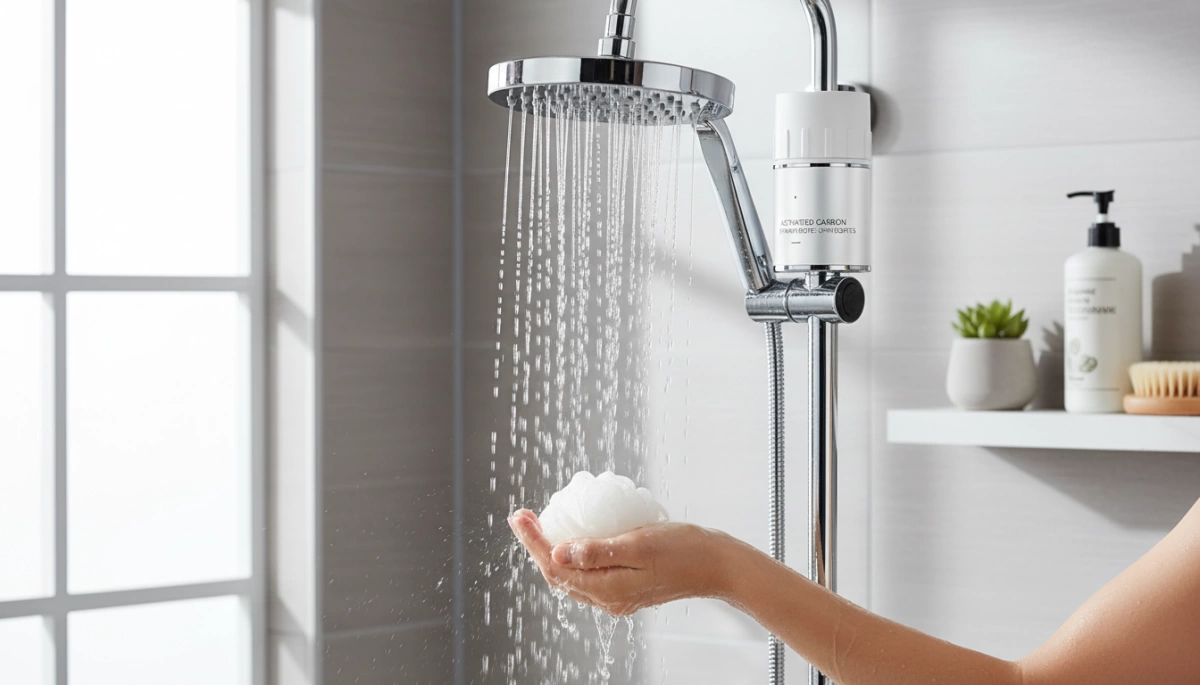
Activated carbon shower filters make a real difference for skin, hair, and everyday comfort—especially with chlorinated municipal water in the U.S.
1. Dry Skin, Eczema & Irritation
Chlorine is tough on your skin barrier. In hot showers, it strips away natural oils and can trigger flare-ups.
What users typically notice:
- Less tight, itchy skin after showers
- Fewer eczema and dermatitis flare-ups (especially in winter)
- Calmer, less red skin on the neck, back, and shoulders
Why:
An activated carbon shower filter reduces free chlorine and many harsh byproducts, so your skin isn’t fighting chemicals every time you shower.
2. Softer, Less Brittle Hair
Chlorine and organic contaminants can leave hair feeling rough and dull.
Benefits of carbon-supported shower filters for hair:
- Hair feels softer and easier to detangle
- Less frizz and breakage, especially on color-treated or curly hair
- Scalp feels less dry and itchy
People who wash their hair daily or hit the gym often notice the biggest difference.
3. Steam & Breathing Comfort
In a hot shower, chlorine and some volatile organic compounds (VOCs) can move from water into steam, so you breathe them in.
Activated carbon helps by:
- Lowering chlorine levels before steam forms
- Reducing some VOCs that contribute to “chemical” or “pool” smells
- Making the bathroom air feel cleaner and less harsh on sinuses
This matters for anyone with asthma, allergies, or sensitive airways.
4. Who Sees the Biggest Improvements?
Carbon-supported shower filters are especially helpful for:
| User Type | What They Usually Notice First |
|---|---|
| Kids & babies | Calmer skin, fewer dry patches |
| Sensitive or eczema-prone skin | Less itching, less irritation after showers |
| Daily / twice-daily showerers | Softer skin, less dryness over the week |
| Color-treated / curly hair | Better texture, less breakage, easier styling |
| Apartment living (city water) | Less chlorine smell, cleaner-feeling shower time |
5. Everyday Lifestyle Upgrades
This isn’t just about lab results—it’s about how your shower feels day to day.
With a good activated carbon shower filter:
- The water feels “softer” on skin, even if it isn’t soft water
- The chlorine smell is dramatically reduced or gone
- Showers feel more spa-like and less like a public pool
- You step out of the shower feeling clean, not stripped
If you already use filtered water for drinking—like a countertop RO or faucet system—it makes sense to treat your shower the same way. Many of our U.S. customers who invest in home water filtration say the shower is where they feel the comfort upgrade most.
Design of Multi-Stage Shower Filters with Activated Carbon
Typical Media Stack in an Activated Carbon Shower Filter
In a solid multi-stage shower filtration system, I usually build the media stack in this order:
- Sediment layer – catches rust, sand, and larger particles so they don’t clog the finer media.
- KDF media – targets chlorine, some heavy metals, and helps control bacteria in hot water.
- Granular activated carbon (GAC) or catalytic carbon – focuses on chlorine removal, odor, taste, VOCs, and organic contaminants.
- Optional final polishing layer – sometimes another fine carbon or mineral layer to “finish” the water feel.
This layered setup is similar to what we use in more complex household water purifiers for drinking water, just optimized for higher flow and hot shower water.
How Water Flows Through the Filter Layers
Inside a multi-stage shower filtration system, water doesn’t just “pass by” the carbon. It’s routed to slow down and actually interact with each layer:
- Water enters and hits the sediment stage first.
- It then moves through the KDF section, where a redox reaction starts reducing chlorine.
- Next, it flows through the activated carbon media, where chlorine, DBPs, and organics are adsorbed onto the carbon’s pore structure.
- Finally, it exits through any polishing stage and out the shower head.
The goal: maximum contact time between water and media without killing your flow rate.
Why Activated Carbon Placement Matters
I always place activated carbon after KDF for a reason:
- KDF handles a big chunk of free chlorine first.
- That lets the activated carbon shower filter section focus on chlorine byproducts, VOCs, and odor, instead of being exhausted too quickly.
- This order helps carbon last longer and keeps chlorine smell in shower water under control.
If carbon is thrown in the wrong spot or in a very thin layer, you get weak chlorine removal and poor shower water odor removal.
How Multi-Stage Design Boosts Adsorption
Activated carbon works by adsorption—it’s basically a molecular sponge. Multi-stage design improves that by:
- Pre-filtration – less dirt hitting the carbon means more pores available for chemicals, not particles.
- Better contact time – layered paths make water stay in contact with GAC or catalytic carbon longer.
- Shared workload – KDF + carbon + other media each take a piece of the job, so no single layer is overloaded.
This is why a KDF carbon composite shower filter almost always outperforms a single, thin carbon-only shower head.
Compact Shower Heads vs Larger Inline Filters
For US homes, I see two main setups:
Compact shower head filters
- Clean look and easy install.
- Limited space, so less media volume and shorter contact time.
- Good for apartments, renters, and lighter filtration needs.
Larger inline shower filters
- Installed between the pipe and your existing shower head.
- More room for sediment + KDF + activated carbon and other media.
- Better for families, high chlorine city water, or anyone with sensitive skin taking frequent hot showers.
If you’re building or choosing a premium system, multi-stage with generous carbon media volume and smart flow design always wins over small, gimmicky “one-layer” filters.
Choosing a Shower Filter with Activated Carbon Supporting Media
How to read specs for activated carbon and KDF
When you look at an activated carbon shower filter or a KDF carbon composite shower filter, don’t just read the marketing line — read the specs:
- Media listed clearly: Look for “coconut shell granular activated carbon (GAC)” and “KDF-55 (for chlorine)” or “KDF-85 (for iron/metals).”
- Target contaminants named: The spec sheet should clearly state “free chlorine removal,” “chlorine taste and odor adsorption,” and ideally “VOC reduction” or “organic contaminants.”
- Performance claims: For U.S. city water, you want data like “up to X% chlorine removal at X GPM flow rate” rather than vague “purifies water” language.
- Certifications: NSF/ANSI references (like 42 for chlorine, taste and odor) show the media is tested to a recognized standard, similar to what’s used in good faucet and drinking water filters.
What to look for in carbon media quality
For a serious activated carbon shower filter, focus on media quality, not buzzwords:
- Coconut shell activated carbon: Denser pore structure, better for chlorine and organic compound removal in hot water.
- Catalytic carbon: If your city uses chloramine, look for “catalytic carbon shower filtration” for better reduction than standard GAC.
- Granular vs carbon block: In showers, GAC is common because it handles high flow and hot water better than tight carbon blocks.
- Independent testing: Ask for lab results or NSF-compliant testing; real chlorine removal shower filter data beats generic claims every time.
Pick the right filter style: fixed, handheld, or inline
Match the shower filter design to how you actually shower:
- Fixed shower head filter: Clean look, easy for small bathrooms, good if everyone uses the same height and angle.
- Handheld shower filter: Best for families, pets, kids, and cleaning; look for multi-stage shower filtration in the handle or inline.
- Inline shower filter: Installs between your existing shower arm and head; ideal if you already love your shower head but want activated carbon support filtration.
Signs of a well-designed carbon-supported shower filter
A strong carbon-supported shower filtration system usually has:
- Multi-stage design: Sediment + KDF + activated carbon (and sometimes extra media) for balanced chlorine, odor, and organic contaminant reduction.
- Clear flow and capacity specs: GPM flow listed, plus estimated gallon capacity or month lifespan at normal U.S. usage.
- Realistic positioning: Phrases like “helps reduce chlorine,” “improves odor and feel,” and “supports organic contaminant filtration” — not “turns tap water into spring water.”
- Media transparency: You know exactly what’s inside: KDF type, carbon type, and any additional shower filter media types.
Red flags and gimmicks to avoid
If you see these, walk away:
- Vague media descriptions: “Advanced stones,” “mineral balls,” or “nano beads” with no clear mention of activated carbon, KDF, or vitamin C.
- No testing data: Big health promises but zero lab report, NSF mention, or contaminant list.
- Unrealistic claims: “Removes 99.999% of all contaminants,” “softens hard water,” or “lasts 2–3 years” in hot shower water — not happening with real carbon adsorption.
- No replacement info: If cartridge life, replacement schedule, or media change process isn’t clear, it’s not built for serious long-term use.
If the specs clearly explain the activated carbon, KDF, flow rate, and filter life — and the claims make sense — you’re looking at a carbon shower filter designed for real-world American homes, not just a pretty shower head.
Performance, Lifespan, and Maintenance of Carbon Media
How long does activated carbon last in a shower filter?
In a typical activated carbon shower filter, granular activated carbon (GAC) or catalytic carbon media usually lasts:
- 4–6 months for a family that showers daily
- Up to 8–10 months for light use (1–2 people, quick showers)
Most good activated carbon shower filters are rated around 10,000–12,000 gallons of hot water, but real life always comes down to how often and how long you shower.
What affects carbon media lifespan?
The actual life of carbon media in a chlorine removal shower filter depends on:
- Water quality
- High chlorine, chloramine, or organic contaminants = faster exhaustion
- Dirt/sediment can clog pores and block adsorption
- Usage
- Big family, long daily showers = shorter life
- Temperature
- Very hot water slightly reduces adsorption efficiency over time
- Flow rate
- High flow (rain shower, power shower) means less contact time with the carbon
- Faster flow = less effective shower water chlorine adsorption
If your home has tough water conditions or you run high-flow shower systems similar to what we engineer for our high-flow filtration lines, expect to replace media on the shorter end of the range.
How to know when your carbon shower filter needs replacing
Signs your carbon-based shower filter is done:
- Chlorine smell comes back (that “pool” or bleach scent)
- Skin and hair start feeling dry, tight, or itchy again
- You see a light color change in water when first turning on (in cheap filters)
- Filter casing feels slimy or gunky inside when changed (biofilm buildup)
If the manufacturer gives a time or gallon rating, follow that as your maximum, not a suggestion.
Best practices for keeping your carbon media working
To get the most from your carbon and KDF multi-stage filter:
- Flush the filter: Run warm water for 1–3 minutes after first install or cartridge change
- Stay on a replacement schedule: Mark your calendar or set a reminder every 4–6 months
- Avoid super high temps constantly: Occasional hot is fine; constant near-boiling speeds up exhaustion
- Don’t ignore reduced performance: Smell or irritation returning = swap the cartridge
Simple rule: if your benefits from activated carbon shower filtration fade, your media is likely near the end of its life.
What happens if you keep using exhausted activated carbon?
Running a shower with exhausted activated carbon doesn’t explode anything, but it quietly defeats the purpose:
- Chlorine and VOC removal drops to almost zero
- Pores can start releasing adsorbed contaminants back into the water stream
- You get full exposure to chlorine, disinfection byproducts (DBPs), and organic contaminants in hot shower steam
- Biofilm and bacteria can colonize old media in extreme neglect
In short, an overdue filter is basically a plastic housing with water running through it—no real carbon adsorption filtration happening. If you care about skin, hair, and respiratory health, don’t stretch carbon media beyond its rated life.
Driplife’s Approach to Activated Carbon Supporting Media
Multi-stage shower filters built around activated carbon
At Driplife, I design every multi-stage shower filter with activated carbon as the core supporting media, not an afterthought. We use it to handle chlorine taste and odor adsorption, organic compound removal, and to “polish” the water after heavier media like KDF have done their job. The result is a balanced shower filtration system that targets real-world tap water problems in U.S. homes, especially on municipal supplies.
Coconut shell and catalytic carbon for chlorinated water
For most chlorinated municipal water in the United States, we rely on:
- Coconut shell granular activated carbon (GAC) – high pore density, great for chlorine, VOCs, and that “pool smell” in hot showers.
- Catalytic carbon – boosted surface chemistry that improves chloramine reduction and tackles tougher disinfection byproducts.
This combo gives strong shower water chlorine adsorption performance, even at typical U.S. shower flow rates and temperatures.
Pairing carbon with KDF and other media for hot showers
Our KDF–carbon composite shower filters are engineered so each media does what it does best:
- KDF: Targets heavy metals, helps with scale formation, and performs well in hot water shower filter conditions.
- Activated carbon: Acts as the secondary filtration media, removing organic contaminants, VOCs, and odors that slip past earlier stages.
- Optional sediment or other layers: Protect the carbon from clogging and extend its life.
By using activated carbon as supporting filtration media, we keep performance stable across different water qualities and shower habits.
Quality control, testing, and performance focus
As a China-based premium shower filter manufacturer, I run tight quality control on every batch of carbon and KDF media:
- Verified material sources (coconut shell and catalytic grades)
- Consistent particle size and packing density for better contact time
- Performance testing focused on chlorine removal shower filter results and flow stability
The same manufacturing discipline we apply in our other lines, like our engineered water filtration platforms, also guides how we build and test shower systems.
Who Driplife shower filters are best for
Driplife’s activated carbon shower filter designs fit best for:
- U.S. city and suburban homes on chlorinated municipal water
- People with sensitive skin, kids, or eczema who want less chlorine and fewer disinfection byproducts in hot shower steam
- Users who care about odor, “pool smell,” and hair feel more than full-house water softening
- Renters or homeowners who want a simple, multi-stage shower filtration system without plumbing changes
If your main concern is chlorine, smell, and organic contaminants in shower water, our carbon and KDF multi-stage filter setups are built specifically around that use case.
Common Questions About Activated Carbon Shower Filters
Does activated carbon remove chloramine in showers?
Activated carbon can reduce chloramine, but standard GAC (granular activated carbon) isn’t great at it in a fast, hot shower. For chloraminated city water, you really want:
- Catalytic carbon (much better for chloramine than regular carbon)
- Enough contact time (larger, multi-stage shower filter, not a tiny gimmick head)
- Often paired media like KDF to help handle chlorine and metals
If your water utility uses chloramine (common in many U.S. cities), look for “catalytic carbon shower filtration” and real test data, not just marketing claims.
Is activated carbon safe for hot water and daily use?
Yes. Quality activated carbon shower filters are safe for daily hot showers when:
- The cartridge is rated for hot water use
- The housing is made from high-temp, food-grade materials
- The manufacturer follows proper filtration design, similar to what we use in faucet and countertop filters designed for everyday use (see the same approach in our water filter vs purifier breakdown)
Carbon doesn’t “leach chemicals” into your water; it adsorbs chlorine, odors, and organic contaminants, then just gradually becomes exhausted.
GAC vs carbon block in shower filters: what’s the real difference?
For shower use:
GAC (granular activated carbon)
- Loose granules
- Lower pressure drop, better for good flow in showers
- Ideal as supporting filtration media in multi-stage shower systems
Carbon block
- Compressed into a solid block
- Better fine particle filtration and VOC removal with longer contact time
- Usually too restrictive for a compact shower head unless the housing is large
Most good multi-stage shower filtration systems use GAC or catalytic GAC to balance performance and flow.
How often should I replace a carbon-based shower filter?
For U.S. municipal water, a typical activated carbon shower filter needs replacement about:
- Every 3–6 months for most families
- Or about 5,000–10,000 gallons, depending on the design
You should replace faster if:
- Chlorine smell comes back
- Skin/hair feel like pre-filter days
- Flow drops even after flushing
Running exhausted carbon doesn’t just “do nothing” – it can start passing everything through and may even release trapped contaminants.
Can activated carbon handle hard water, or do I need a softener too?
Activated carbon does not soften water. It’s excellent for:
- Chlorine removal shower filters
- VOC removal shower head filters
- Odor, taste, and organic compound reduction
But for hard water (scale, spots, stiffness) you’ll still need:
- A water softener or
- A dedicated scale control/anti-scale media system
Best setup for many U.S. homes:
Softener for hardness + KDF carbon composite shower filter for chlorine, organics, and better skin/hair feel.