














The Engineering Case for Secondary Sterilization
As manufacturers, we often fixate on the precision of the filtration membrane. While achieving 0.0001-micron filtration is the core of any Reverse Osmosis (RO) system, it is only half the battle in a countertop form factor. The reality of UV sterilization integration in countertop RO purifiers is driven by a simple, inconvenient truth: filtration cleans the water, but it doesn’t keep it clean forever. Once that water leaves the membrane, the engineering challenge shifts from purification to preservation.
Why RO Isn’t Enough: The Biological Vulnerability of Permeate
We engineer our RO membranes to strip away heavy metals, viruses, and bacteria with incredible efficiency. However, this process also removes residual disinfectants like chlorine. While this is perfect for taste and chemical safety, it creates a “biological vulnerability.”
The resulting permeate is essentially a blank slate. If this ultra-pure water sits in a non-sterile storage tank without a secondary sterilization module RO system, it becomes highly susceptible to retrograde contamination. Airborne bacteria or microorganisms introduced from the dispensing nozzle can migrate back into the system. Without a secondary active barrier, the clean water tank can inadvertently become a breeding ground for biofilm, undermining the work of the primary filters.
Thermal Challenges: Internal Heat Generation
In the world of compact countertop appliances, space is a luxury we don’t have. We pack high-pressure pumps, power supply units, and instant heating modules into a sleek, minimal chassis. This density creates a unique engineering hurdle: internal heat generation.
- Heat Transfer: Components like the 3-second instant heat module radiate thermal energy even when idle.
- The Incubator Effect: This waste heat can raise the ambient temperature within the casing, slightly warming the water stored in the internal reservoir.
- Bacterial Acceleration: Warmer water significantly accelerates potential microbial growth rates compared to cold, plumbed-in under-sink units.
To combat this, microbial control engineering in RO purifiers must account for these thermal pockets. We cannot simply rely on insulation; we must actively sterilize the environment where the water resides.
Consumer Behavior Variables: Stagnation Risks
We design systems for ideal usage scenarios, but real-world consumer behavior is unpredictable. A major driver for integrating UV or secondary sterilization is the risk of stagnation.
- Intermittent Use: Users may leave the unit untouched for weekends or holidays.
- Low Turnover: In small households or offices, the water in the tank might not cycle through completely every 24 hours.
- Hydrodynamic Dead Zones: Even with regular use, standard tanks may have corners where water circulation is poor.
When water stagnates, the risk of secondary pollution skyrockets. A static tank without active intervention is a liability. This is why we treat secondary contamination control as a fundamental safety requirement, not an optional upgrade. By engineering active sterilization loops, we ensure that the first cup of water dispensed after a long weekend is just as safe and fresh as the one dispensed immediately after filtration.
Technology Selection: UV-C LED vs. Traditional Mercury
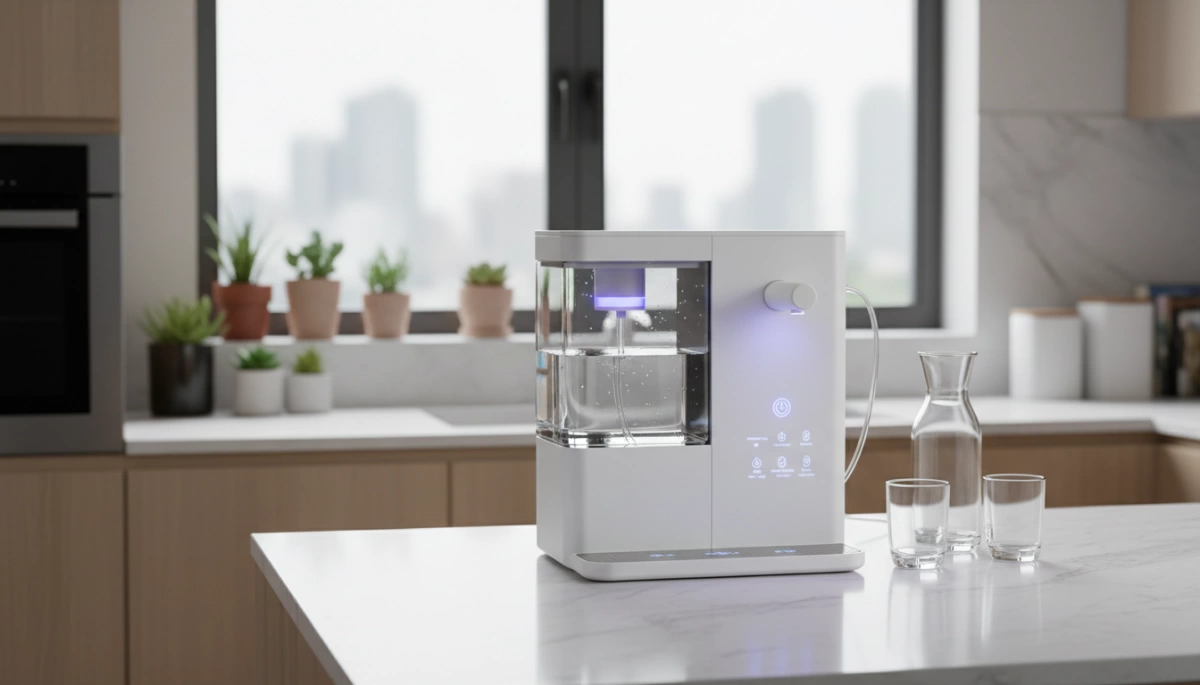
When engineering compact systems, the choice between traditional mercury lamps and modern UVC-LED Water Disinfection is clear. In our countertop RO platforms, space is a luxury we cannot waste. Traditional cylindrical mercury reactors are too bulky and fragile for the tight internal architecture of a portable unit. Instead, we utilize UVC-LED chips that offer high-density sterilization power in a footprint smaller than a fingernail, allowing for flexible placement within the hydraulic path.
Precision is just as critical as size. While mercury lamps emit a broad spectrum, our LED modules are tuned specifically to the 265nm Germicidal Wavelength (within the 260nm–280nm peak). This specific band is most effective at disrupting microbial DNA and RNA, ensuring maximum Log Reduction Value (LRV) without the heat generation or mercury risks associated with older tech.
Operational efficiency drives this transition. Mercury lamps degrade rapidly with frequent switching and require warm-up time, which is incompatible with on-demand dispensing. Our LED systems feature instant-on capabilities, activating only when water flows. This supports Point-of-Use (POU) Sterilization while meeting strict ErP energy compliance standards. By integrating these advanced modules into our home reverse osmosis water filter designs, we ensure safety without compromising the system’s lifespan or energy footprint.
Integration Engineering: Structural Design & Placement
When we approach UV sterilization integration in countertop RO purifiers, the physical layout is just as critical as the wavelength selection. You cannot simply place a light source inside a chassis and expect total disinfection. Our engineering teams focus on two primary architectural strategies to ensure the secondary sterilization module RO system functions effectively without compromising the compact footprint of the device.
Placement Strategy A: Static Tank Sterilization (Immersion)
For the internal pure water reservoir, our goal is bacteriostatic water storage. The challenge here isn’t intensity, but coverage. Water in a storage tank can develop hydrodynamic dead zones—corners where water doesn’t circulate and UV light doesn’t reach. To combat this, we utilize optical fluid simulation during the design phase.
- Eliminating Shadow Zones: We engineer the tank geometry to be as spherical or cylindrical as possible to minimize corners. Furthermore, we often integrate highly reflective internal tank linings (using materials like polished stainless steel or specific food-grade polymers) that bounce UVC photons around the chamber. This ensures that the UV dose reaches every milliliter of stored water, preventing biofilm formation on the tank walls.
Placement Strategy B: Flow-Through Sterilization (Dispensing)
The second strategy targets the dispensing path, often referred to as Point-of-Use (POU) Sterilization. Here, the water is moving rapidly, meaning the exposure time is short. We install high-intensity UVC-LED arrays directly in the flow channel leading to the nozzle. This creates a firewall against retrograde contamination, ensuring that bacteria cannot migrate from the external nozzle back into the system. This level of precision is standard in our countertop cold water purifier models, where maintaining water safety is paramount even when the unit is in standby.
Thermal Management: Dissipating LED PCB Heat
A major oversight in generic designs is poor thermal management. While UVC-LEDs run cooler than mercury lamps, the chips themselves generate significant heat at the PCB level. If this heat isn’t removed, the LED’s output drops, and its lifespan shortens. We address thermal dissipation in water purifiers by mounting the LED modules on aluminum core PCBs or integrating them into the water path’s thermal mass (while keeping them electrically isolated). This allows the flowing water or the chassis structure to act as a heat sink, keeping the sterilization module operating at peak efficiency for years.
Control Logic & Firmware Integration
Hardware is only half the battle in UV or Secondary Sterilization Integration Engineering in Countertop RO Platforms. Without intelligent firmware, a UV module is either a battery drain or a thermal liability. We approach the control logic as the brain of the purification system, ensuring the sterilization hardware operates exactly when needed to maintain Secondary Contamination Control without compromising the user experience.
The Breathing Cycle: Intermittent Sterilization Duty Cycle
Leaving a UV light on 24/7 in a static tank is poor engineering. It generates excess heat, warms the drinking water, and drastically shortens the LED lifespan. We implement a “breathing” logic—an Intermittent Sterilization Duty Cycle—where the module activates for specific intervals (e.g., 10 minutes every hour). This ensures the water remains bacteriostatic without the thermal buildup associated with continuous operation. This logic is crucial for maintaining the freshness expected in high-end systems, similar to how we design reverse osmosis water filters with remineralization to actively enhance water quality post-filtration.
Smart Triggers: Flow and Sensor Fusion
Our firmware integrates inputs from multiple sensors to trigger sterilization events dynamically:
- Dispense Activation: The moment the flow sensor detects water movement, the point-of-use (POU) UV module activates instantly. This ensures the water is treated milliseconds before it hits the user’s glass.
- Safety Cut-Offs: We hard-code safety protocols linked to magnetic lid sensors. If the raw water tank or internal maintenance panels are opened, the UV power cuts instantly to prevent accidental eye exposure.
- Wake-on-Approach: In our premium Smart RO Platform Design, proximity sensors can trigger a preemptive sterilization cycle as a user approaches the unit.
Visual Feedback: UI Engineering for Peace of Mind
Because UV sterilization is silent and invisible, users often doubt if it is actually working. We bridge this gap through the User Interface (UI). The display logic is programmed to show a distinct sterilization icon or “Purifying” status bar whenever the UVC-LED is active. This visual confirmation is a vital part of the product experience, reassuring the user that the system is actively preventing biofilm and delivering safe water.
Beyond UV: Holistic Secondary Sterilization Materials
While active UV-C components are critical, a robust engineering strategy for UV or Secondary Sterilization Integration Engineering in Countertop RO Platforms must also address passive contamination risks. We cannot rely solely on light to keep water safe; the physical environment where the water sits must be inherently hostile to microbial growth. This requires a holistic approach to material selection and airflow management within the chassis.
Antibacterial Materials: Ag+ Doped ABS Integration
Standard food-grade plastics are often insufficient for long-term Bacteriostatic Water Storage in warm environments. To combat biofilm formation on tank walls—a common issue in static reservoirs—we utilize Antibacterial ABS Materials doped with silver ions (Ag+).
- Mechanism: Silver ions disrupt bacterial cell walls and inhibit enzyme production, preventing microbes from anchoring to the tank surface.
- Application: These materials are used for the raw water tank, the purified water reservoir, and the internal piping of the dispensing line.
- Result: This creates a permanent, passive defense layer that works 24/7, ensuring that the high purity levels—often highlighted when comparing Alkaline Water vs. Reverse Osmosis—are maintained even when the device is in standby mode.
Air Filtration: 0.1-Micron Breathers on Tank Vents
A frequently overlooked vector for contamination in countertop units is air displacement. As water is dispensed, air must enter the tank to equalize pressure. If this air carries dust or spores, the sterile tank becomes compromised.
- The Solution: We integrate high-efficiency particulate air breathers on the tank vents.
- Precision: These 0.1-micron breathers filter out airborne contaminants before they touch the stored water.
- Secondary Contamination Control: By treating the air intake as a critical control point, we ensure that the water remains as clean as it was the moment it passed through the RO membrane.
Driplife’s ODM Approach to Sterilization Engineering
At Driplife, we view ODM Water Purification Engineering as a holistic process. We don’t just bolt on off-the-shelf parts; we engineer the sterilization architecture from the ground up to match the specific hydraulic dynamics of each platform. Our goal is to ensure that the UV sterilization integration countertop RO purifier functions as a cohesive unit where safety and efficiency coexist.
Our engineering process focuses on three critical pillars:
- Custom Module Design: Space inside a countertop unit is premium real estate. We design custom PCB layouts and secondary sterilization module RO system configurations tailored to specific chassis geometries. This ensures the UVC-LEDs are positioned for optimal UVC-LED Water Disinfection without creating thermal bottlenecks or compromising the unit’s sleek design.
- Lab-Validated Performance: Theoretical engineering isn’t enough. We subject our designs to rigorous bio-challenge testing to verify the Log Reduction Value (LRV). We validate efficacy against standard indicators like E. coli and MS2 Phage. This level of testing is what truly separates a high-performance water filter vs purifier when it comes to biological safety.
- The Plug-and-Play Promise: We deliver fully assembled, certified platforms. Our partners receive a finished product where the sterilization logic, thermal management, and hydraulic flow are already optimized. This reduces development risk and accelerates time-to-market for brands looking to launch advanced, safe water solutions.
FAQ: Engineering Secondary Sterilization in RO Systems
How does UVC-LED compare to mercury lamps in compact units?
In the context of countertop RO internal architecture, traditional mercury lamps are increasingly obsolete. They are bulky, fragile, and require high voltage, making them difficult to fit into sleek, portable designs. UVC-LED water disinfection technology changes the game by offering a solid-state solution that is compact, durable, and mercury-free. Unlike lamps that require warm-up time, LEDs provide instant peak germicidal intensity, allowing us to engineer smarter, on-demand sterilization cycles that save energy while ensuring safety.
What is the optimal duty cycle for intermittent sterilization?
Running a UV module continuously is inefficient and can heat the water unnecessarily. We typically engineer an intermittent sterilization duty cycle—often programmed to run for 5 to 10 minutes every few hours. This “breathing” logic maintains bacteriostatic water storage by preventing bacterial regrowth during periods of stagnation, without causing thermal spikes. This balance is critical for maintaining the freshness expected from a high-end countertop reverse osmosis hot and cold water filter system.
Can antibacterial materials replace UV sterilization entirely?
No, they serve different functions. Antibacterial ABS materials (often doped with silver ions) are passive; they inhibit biofilm adhesion on the tank walls but do not actively kill bacteria suspended in the water column. For robust microbial control engineering in RO purifiers, we use a “hurdle technology” approach. We combine passive antimicrobial surfaces to protect the container with active secondary sterilization module RO system integration to treat the fluid, ensuring comprehensive hygiene.
How do you prevent heat buildup in static tank sterilization?
Heat management is a major engineering challenge in compact chassis. While LEDs are cooler than mercury lamps, the PCBs still generate thermal energy. We address thermal dissipation in water purifiers by mounting LED modules on aluminum substrates with high thermal conductivity, directing heat away from the water tank and towards external vents. This ensures that the UV sterilization integration in countertop RO purifiers keeps the water safe without compromising the cooling performance of the dispenser.