













The Science of Scale: Understanding Why Membranes Fail
I have seen countless reverse osmosis systems fail not because of mechanical defects, but because of basic chemistry ignoring the limits of physics. RO Membrane Scaling Prevention Technology isn’t just about adding chemicals; it starts with understanding the microscopic battlefield on the membrane surface. When we force pure water through a semi-permeable barrier, we are essentially concentrating the remaining salts to a point where they can no longer stay dissolved. Once that solubility limit is breached, crystallization begins, turning your high-performance membrane into a mineral-clogged barrier.
Concentration Polarization and Solubility Limits
The real enemy in RO operations is a phenomenon known as Concentration Polarization. This occurs when dissolved salts accumulate on the high-pressure side of the membrane surface faster than they can diffuse back into the bulk feed stream.
Even if your feed water analysis suggests the mineral levels are within a safe range, the concentration right at the membrane surface can be exponentially higher. This localized zone of supersaturation drives Calcium Carbonate Precipitation and other mineral scaling, creating a hard shell that blocks flow and increases energy consumption.
Identifying the Usual Suspects
We typically encounter four main categories of scalants that threaten High-Rejection RO Membranes:
- Calcium and Magnesium: The primary components of water hardness. These form carbonate scales that are common but generally treatable with acid cleaning.
- Sulfates: Specifically Calcium, Barium, and Strontium sulfates. These form permanent, hard crystals that are notoriously difficult to dissolve once formed.
- Silica: The most troublesome scalant. When silica levels exceed solubility, it polymerizes into a glass-like glaze that standard cleaning chemicals often cannot remove.
- Iron and Manganese: While often considered foulants, they can act as binders for other scale formations, accelerating the blockage.
Spotting Warning Signs: Pressure vs. Quality
Diagnosing the issue early is critical for Osmotic Pressure Management. We look for specific indicators to distinguish scaling from other types of failure:
- Pressure Drops: Scaling typically causes a gradual increase in the pressure required to maintain the same production rate. You will see a higher differential pressure (Delta P) across the vessel.
- Permeate Flux Decline: As the scale layer thickens, it physically blocks water passage, significantly reducing the volume of treated water produced.
- Rejection Quality: Unlike membrane degradation (where salt passage increases immediately), scaling often maintains high salt rejection initially. The quality might remain good, but the system chokes on flow.
By monitoring these variables, we can implement scaling prevention RO technology before irreversible damage occurs.
Technology 1: Advanced Membrane Surface Engineering
When we talk about RO Membrane Scaling Prevention Technology, we aren’t just looking at what we add to the water; we are looking at the membrane itself. In my experience, the physical and chemical structure of the membrane sheet is the most critical factor in determining how long a system lasts before it chokes on mineral deposits. We focus heavily on TFC Polyamide composites that are engineered to resist adhesion at a microscopic level.
Surface Morphology: Smoothing Out the Roughness
Standard membranes look like mountain ranges under a microscope. Those “valleys” are exactly where scale crystals like calcium carbonate start to nest and grow. Our approach involves manufacturing membranes with an ultra-smooth surface topology. By reducing the surface roughness, we effectively remove the anchor points for mineral crystals. If the surface is glass-smooth, the turbulent water flow easily sweeps potential scalants away before they can bond.
Modifying Surface Charge
Electrical interaction plays a massive role in separation. Most standard membranes carry a surface charge that can inadvertently attract oppositely charged ions, accelerating fouling. By modifying surface charge to be more neutral or specifically tuned to repel the dominant ions in the feed water (like sulfates or silica), we create an electrostatic barrier. This isn’t just filtration; it is active repulsion. This ensures that even when you verify performance with a TDS tester, the rejection rates remain stable over time because the pores aren’t being clogged by magnetic attraction.
Hydrophilicity: The Water Shield
The holy grail of scale resistant RO membrane design is hydrophilicity—how much the material “loves” water. We engineer the membrane surface to be highly hydrophilic. Here is why this matters:
- Hydration Layer: The surface attracts water molecules so strongly that they form a tight, protective “water shell” over the polymer.
- Barrier Effect: Oil, organics, and scale-forming minerals cannot penetrate this water layer to touch the actual membrane surface.
- Easy Cleaning: Because contaminants are sitting on water rather than sticking to the plastic, they wash off much easier during maintenance cycles.
This advanced surface chemistry transforms the membrane from a passive filter into an active shield against hard water damage.
Technology 2: Integrated Pre-Treatment Hardware
Why the RO Membrane Cannot Stand Alone
I always emphasize that a Reverse Osmosis membrane is the heart of the system, but without a skeleton and skin to protect it, it won’t last. You cannot simply feed raw, untreated water into a high-rejection element and expect longevity. Feed Water Pre-treatment is the absolute baseline for RO Membrane Scaling Prevention Technology. Without these protective layers, the membrane surface gets bombarded by suspended solids and hardness minerals, leading to immediate performance degradation. Unlike a simple tap with filter water setup that might use a single stage, professional RO systems demand a multi-barrier approach to ensure the delicate polyamide layer survives.
Precision Filtration: Lowering the Silt Density Index (SDI)
Before we even worry about dissolved salts, we have to deal with physical particulates. We use precision sediment filtration to aggressively lower the Silt Density Index (SDI). The SDI is a critical measurement of the fouling potential of water due to suspended particles.
- Target SDI: We aim for an SDI of less than 3.0 for optimal membrane life.
- Filtration Stages: This typically involves a 5-micron filter followed by a 1-micron filter to trap rust, sand, and colloidal matter.
- Result: By removing these physical contaminants, we prevent the “mud” that creates a breeding ground for scale crystals to anchor onto.
Softening and Dosing: Ion-Exchange and Antiscalant Pumps
Once the physical debris is gone, we tackle the dissolved hardness. This is where the chemistry happens.
- Ion-Exchange Softeners: For residential and light commercial units, we use cartridges that physically swap calcium and magnesium ions for sodium ions. This eliminates the primary ingredients of scale.
- Antiscalant Dosing Systems: In larger industrial applications, we utilize precision pumps to inject antiscalants. These chemicals interfere with the crystal growth of Calcium Carbonate Precipitation, effectively keeping the minerals in a liquid state even as they become super-concentrated.
By integrating these hardware components, we ensure the water hitting the membrane is chemically and physically prepped to pass through without leaving a mineral crust behind.
Technology 3: Hydraulic Design and Flow Optimization
You can have the best membrane material in the world, but if the water flow isn’t managed correctly, scale is inevitable. In our manufacturing process, we prioritize hydraulic design to ensure scaling prevention ro technology is built directly into the physics of the system. It is not just about chemistry; it is about how the water moves.
Cross-Flow Velocity: Sweeping Salts Away
We utilize high Cross-flow Filtration Velocity to create essential turbulence on the membrane surface. Unlike standard filtration where water is pushed directly against a barrier, cross-flow pushes feed water parallel to the membrane.
- Turbulence: This movement disrupts the boundary layer.
- Prevention: It stops Concentration Polarization, a phenomenon where dissolved salts accumulate in a dense layer right next to the membrane surface.
By keeping the water moving fast across the surface, we literally sweep the minerals away into the reject stream before they have time to crystallize and bond to the material.
Auto-Flush Technology and Solenoid Valves
Mechanical intervention is crucial for system longevity. We integrate an Auto-Flush Solenoid Valve into the control logic. This valve automatically opens during startup and shutdown sequences to bypass the flow restrictor, allowing a high-velocity stream of water to scour the membrane surface.
- Startup Flush: Clears out any stagnant water that settled inside the housing overnight.
- Shutdown Flush: Removes concentrated brine before the system goes into standby, preventing minerals from settling while the unit is off.
This precise control over water movement is often optimized through the engineering behind integrated waterway boards, which streamlines flow paths to maintain consistent pressure and velocity without the pressure loss associated with messy tubing.
Recovery Rate Balancing
Pushing for maximum water efficiency is often a recipe for disaster in hard water regions. We focus on Osmotic Pressure Management by carefully calculating the recovery rate—the ratio of pure water produced to waste water generated.
If we extract too much permeate, the remaining waste stream becomes supersaturated with Calcium and Magnesium. We balance this ratio to ensure the waste stream remains dilute enough to carry minerals out of the system without precipitating onto the membrane surface. It is a trade-off between water efficiency and hardware protection that saves money on replacements in the long run.
Monitoring and Predictive Maintenance Strategies

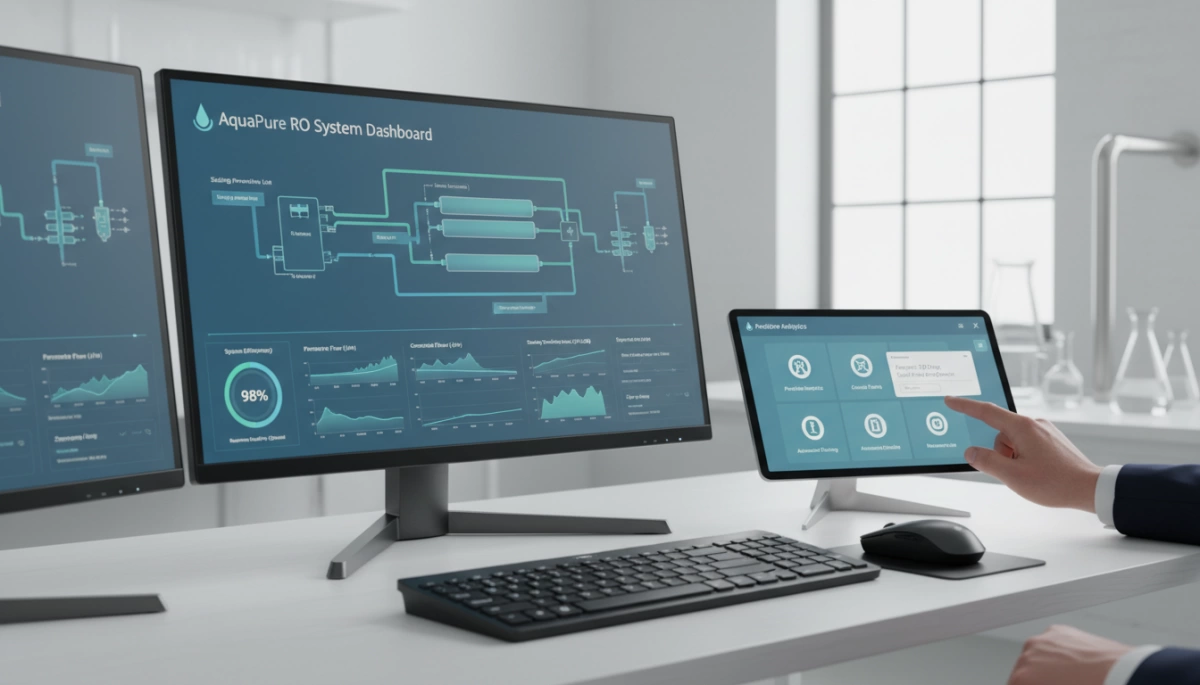
You can have the best hardware in the world, but without eyes on the system, RO Membrane Scaling Prevention Technology eventually fails. I always tell clients that predictive maintenance is significantly cheaper than emergency membrane replacement. We rely on hard data, not guesswork, to keep these systems running efficiently in the long run.
Real-time Analytics: Pressure and Flow
The first line of defense is monitoring the system’s vitals. We utilize high-precision pressure gauges and flow meters to spot trouble before it stops production.
- Normalized Permeate Flow: If this drops by 10-15%, it is an immediate red flag.
- Pressure Drop (Delta P): A significant increase in pressure drop across the membrane stages usually indicates physical fouling or mineral scaling.
- Osmotic Pressure Management: Monitoring feed pressure ensures we aren’t fighting against rising salt concentrations unnecessarily, which accelerates scaling.
Spotting a Permeate Flux Decline early allows for a quick rinse rather than a deep chemical clean. This level of vigilance is crucial when you are explaining the benefits of RO to hard water sufferers, as they need assurance that the system can handle their specific high-mineral water conditions without constant breakdowns.
Calculated Prevention: The Langelier Saturation Index (LSI)
Chemistry doesn’t lie. We apply the Langelier Saturation Index (LSI) to mathematically predict the scaling potential of the feed water.
- Negative LSI: Indicates the water is corrosive.
- Positive LSI: Indicates the water is scale-forming (calcium carbonate will precipitate).
- Target Range: While standard water aims for zero, RO systems using advanced antiscalants can tolerate a higher LSI, provided the dosing is calculated precisely.
Clean-In-Place (CIP) Protocols
When prevention measures hit their limit, Clean-in-Place (CIP) Protocols are the reset button. This isn’t just flushing with water; it involves circulating specific cleaning chemicals—often acids for mineral scale and alkalines for organics—at low pressure and high flow. This removes buildup without damaging the delicate membrane surface. A well-designed system includes dedicated CIP ports so cleaning happens without dismantling the entire unit.
Custom Manufacturing Solutions for Hard Water
We do not believe in a “one-size-fits-all” approach, especially given the diverse water landscapes across the United States. Water in the Southwest carries a much higher risk of Calcium Carbonate Precipitation than water in the Northeast. That is why we engineer our systems based on specific regional water quality reports. By understanding the local feed water chemistry, we can customize the Feed Water Pre-treatment components to target specific hardness minerals before they ever reach the sensitive membrane layers.
Quality Assurance Standards:
- ISO-Certified Protocols: We adhere to strict manufacturing standards to ensure High-Rejection RO Membranes maintain precise pore integrity. Even microscopic defects can become nucleation sites for scale.
- Material Consistency: Using consistent, high-grade polymers ensures that the membrane surface remains smooth and resistant to mineral adhesion.
This engineering philosophy applies regardless of the system size. We implement scalable scaling prevention RO technology that works just as effectively in a compact UF kitchen faucet water purifier system as it does in large-scale industrial desalination units. From residential homes to commercial facilities, the goal remains the same: stopping scale before it stops the flow.
Frequently Asked Questions About RO Scaling
What is the main difference between fouling and scaling?
While often used interchangeably, these terms represent different threats to your system. Scaling is strictly inorganic; it occurs when dissolved salts exceed their solubility limits, leading to Calcium Carbonate Precipitation directly on the membrane surface. Fouling, on the other hand, involves organic matter, suspended solids, or bacteria. Managing scale requires chemical inhibition or softening, whereas effective Biofouling Control relies on removing organic food sources and regular sanitation to prevent slime buildup that chokes the TFC Polyamide layer.
Can antiscalants completely replace water softeners?
Antiscalant Dosing Systems are incredibly effective for high-flow commercial applications, but they do not remove hardness minerals—they simply delay the particles from bonding together. For residential settings with extremely high hardness, physical removal via ion exchange is often more reliable to protect the membrane and downstream appliances. If you are battling mineral buildup throughout your plumbing, investigating hard water modification strategies is usually a better first step than relying solely on chemical injection for your RO unit.
How does temperature affect membrane scaling rates?
Temperature fluctuations significantly impact Osmotic Pressure Management and solubility. Unlike sugar or salt, calcium carbonate has retrograde solubility, meaning it becomes less soluble as water gets hotter, increasing scaling risks during warm months. Conversely, cold water increases viscosity, which can lead to Permeate Flux Decline. To compensate, systems often increase operating pressure, which inadvertently spikes Concentration Polarization at the membrane surface, creating a perfect environment for scale to form regardless of the season.