















You might already know that acoustic performance is often the deciding factor between a 5-star review and a product return.
Putting an industrial-grade booster pump inside a compact housing sits at the very edge of physics.
But how do top-tier manufacturers achieve “library-quiet” operation without sacrificing filtration speed?
It isn’t just about adding more foam insulation.
In this post, we’re going to deconstruct the Advanced Pump Noise Reduction Engineering that powers the next generation of Countertop RO Platforms.
From brushless motor torque to hydrodynamic suspension, you’re about to learn exactly how we engineer silence.
Let’s dive right in.
Deconstructing the Noise: Where Decibels Come From
When we talk about Advanced Pump Noise Reduction Engineering in Countertop RO Platforms, we first have to understand the enemy: noise. In the world of high-efficiency filtration, silence is a luxury that requires rigorous engineering. A countertop RO system isn’t just a filter; it’s a miniature power plant sitting right next to your coffee maker. To push water through a 0.0001-micron Reverse Osmosis membrane—essential for removing 99.99% of contaminants like PFAS and lead—we need significant pressure. That pressure creates energy, and without careful management, that energy escapes as sound.
Here is exactly what generates that disruption in your kitchen:
Mechanical Vibration: The Motor’s Shake
The primary source of noise in any silent countertop water purifier is the booster pump. To achieve our industry-leading 3:1 pure-to-drain ratio, the pump must operate at high torque. In standard systems, this rotational energy translates into physical vibration. If the pump is bolted directly to the chassis without proper isolation, the entire unit becomes a speaker, amplifying the hum against your countertop. This mechanical “shake” is the low-frequency drone that travels through solid surfaces, making it the hardest sound to mask without vibration dampening mounts.
Hydraulic Pulsation: The Water Hammer Effect
Water is incompressible. When a high-pressure pump pushes water through restricted tubing and valves, it creates pressure waves. In poorly designed systems, you might hear a rhythmic thumping or clicking sound. This is known as hydraulic pulsation or the “water hammer” effect. It occurs when the flow of water is suddenly forced to stop or change direction, causing shockwaves inside the plumbing. In tankless RO noise troubleshooting, addressing these pressure spikes is critical because they don’t just create noise—they wear down internal components over time.
Cavitation: The High-Pitched Whine
The most irritating sound for users is often a high-pitched whine or screech. This is usually caused by high-pressure pump cavitation. Cavitation happens when pressure drops significantly inside the pump chamber, causing air bubbles to form and then immediately collapse (implode). These micro-implosions generate intense shockwaves. While they are microscopic, thousands of them happening per second create that piercing frequency. Eliminating this requires precise hydrodynamic flow optimization to ensure water moves smoothly through the system without creating vacuum pockets.
Core Engineering Solutions for Silent Operation
When we designed the DripLife DR3 series, we knew that simply wrapping the pump in foam wasn’t enough. True silence requires addressing the noise at its source. We focused on Advanced Pump Noise Reduction Engineering in Countertop RO Platforms to ensure our systems fit seamlessly into quiet home and office environments. By rethinking the internal mechanics, we achieved a balance where high-pressure performance doesn’t equal high-decibel disruption.
Brushless DC (BLDC) Motor Technology vs. Brushed Motors
The heart of the noise issue in most filtration systems is the motor. Traditional brushed motors rely on physical carbon brushes that create friction against the rotor. This friction generates heat, electrical sparks, and a distinct grinding noise.
We shifted to Brushless booster pump RO technology. Instead of physical contact, BLDC motors use magnetic fields to drive rotation.
- Zero Friction: Eliminates the mechanical grinding sound.
- Precision Speed: Allows for soft-start motor technology, ramping up pressure smoothly rather than jolting the system awake.
- Longevity: With no brushes to wear out, the motor maintains its silent profile for years, unlike brushed motors that get louder as they age.
Suspension Architecture: The Floating Mount System
Even the smoothest motor generates some kinetic energy. If the pump is bolted directly to the unit’s frame, the entire chassis acts like a speaker cabinet, amplifying the vibration into a low-frequency hum.
To counter this, we engineered a pump suspension system design utilizing vibration dampening mounts.
- Isolation: The pump sits on medical-grade silicone dampers, effectively “floating” inside the housing.
- Decoupling: This prevents vibrational energy from transferring to the exterior shell or the countertop surface.
- Stability: The mount secures the pump against the high torque required for 0.0001-micron filtration without rigid connections.
Hydrodynamic Flow Optimization & Bypass Valve Technology
Noise isn’t just mechanical; it’s also hydraulic. Forcing water through a dense RO membrane at high pressure can cause turbulence and cavitation—that annoying high-pitched whine or clicking sound.
We utilized hydrodynamic flow optimization to redesign the internal waterways. By smoothing out sharp angles in the tubing and manifold, we reduced turbulence significantly. Additionally, we integrated intelligent bypass valves. These valves manage internal pressure spikes automatically, preventing the “water hammer” effect when the pump engages or disengages. While this level of engineering influences the cost of water filter for home setups, the result is a premium, library-quiet experience that standard systems cannot match.
The Driplife G3 Approach: Integrated Acoustic Design
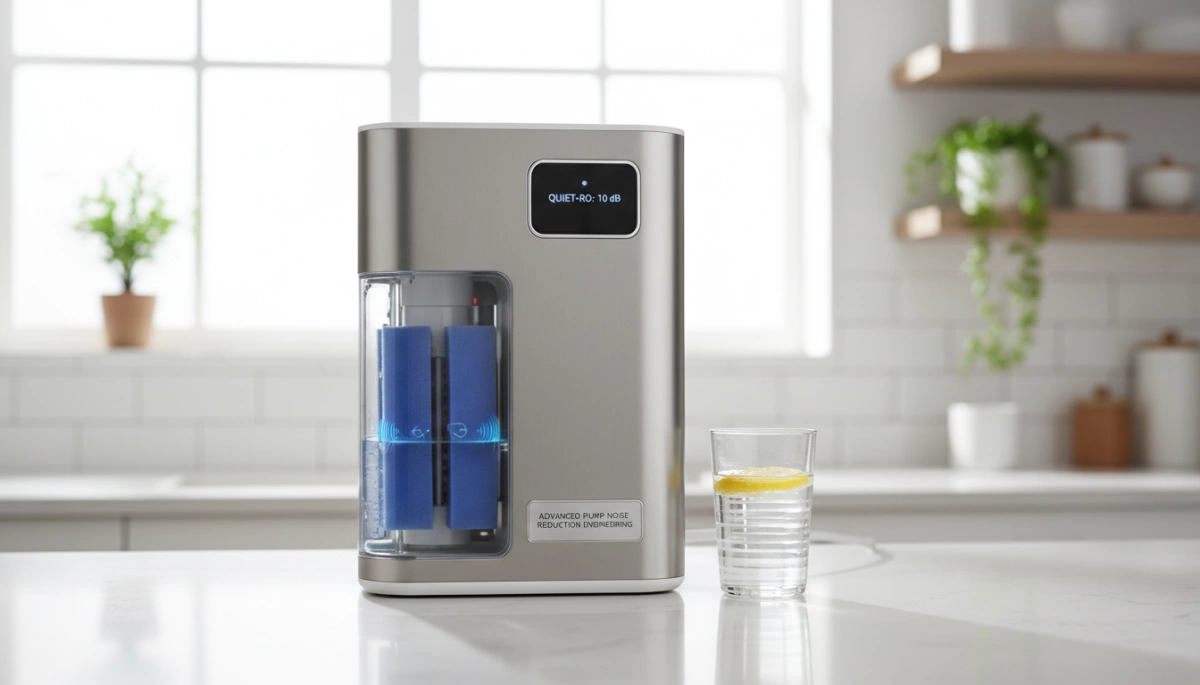
We treat silence as a core specification, not an afterthought. Our engineering team developed the G3 platform to address the unique acoustic challenges of open-plan American kitchens and quiet office spaces. By focusing on Advanced Pump Noise Reduction Engineering in Countertop RO Platforms, we ensure that high-performance filtration doesn’t come with high-decibel disruption.
Chassis Insulation & Sound Trapping Structure
The physical housing of the G3 acts as the first line of defense against noise. We don’t just use a standard plastic shell; we utilize acoustic pump chamber engineering RO purifier principles to create a sound-dampening enclosure. The internal architecture is designed to trap and dissipate sound waves before they escape the unit.
- Vibration Isolation: The chassis features internal ribbing that disrupts sound transmission paths.
- Material Density: We use high-density materials that absorb motor frequencies rather than amplifying them.
- Sealed Components: Critical noise-generating components are compartmentalized to minimize acoustic leakage.
Efficiency vs. Noise: Achieving the 3:1 Low-Drain Ratio
Typically, pushing a system to a high-efficiency 3:1 drain ratio efficiency requires higher pressure, which often results in a louder pump whine. We solved this trade-off through hydrodynamic optimization. By refining the internal water pathways, we reduced the workload on the pump without sacrificing recovery rates. This balance allows our systems to perform at the level of industrial units while maintaining the profile of a low noise pump technology countertop RO purifier.
Tankless Logic & Soft Start Technology
Traditional pumps often jolt into action with a loud “thud.” Our tankless logic incorporates soft-start motor technology, which gradually ramps up the pump speed over milliseconds rather than applying instant torque. This eliminates the mechanical shock known as the “water hammer” effect and significantly extends the lifespan of the internal components. While our sink water filter dispensers offer robust under-counter solutions, this soft-start feature is critical for the G3’s countertop application, ensuring that your cup of water is dispensed with a whisper, not a roar.
Testing and Validation: The Metrics of Silence
When we engineer our countertop water filter systems, we don’t just hope for a quiet result; we validate it through rigorous acoustic testing. The distinction between a premium appliance and a noisy distraction lies in the data. We treat sound levels as a critical performance metric, just like filtration efficiency or water flow rates.
The Anechoic Chamber Test & Noise Floors
To truly understand the acoustic footprint of our units, we utilize anechoic chambers. These isolated environments strip away all ambient background noise, allowing us to establish a true noise floor. This testing method lets us pinpoint specific frequencies generated by the pump and motor. By analyzing the noise reduction benchmark pump RO purifier data, we can identify even the faintest hydraulic pulsations or mechanical vibrations that need dampening before the product ever reaches a customer’s home.
Decibel Benchmarks: Targeting <45dB
Our internal standard is strict: the system must operate below 45 decibels. For context, a quiet library typically sits around 40dB, while a normal conversation is about 60dB. Achieving this level requires advanced pump noise reduction engineering in countertop RO platforms, ensuring that the device can sit on a nightstand, in a nursery, or on an office desk without breaking your focus. We design these systems to blend into the background, providing pure water without the sonic clutter.
Long-Term Durability: Why Quiet Means Quality
Silence is often the best indicator of mechanical health. A loud pump usually signals friction, misalignment, or cavitation—all precursors to component failure. Our silent performance engineering RO system protocols ensure that because the components run smoothly with minimal vibration, they suffer less wear and tear over time.
Why low noise equals high durability:
- Reduced Friction: Precision alignment means internal parts aren’t grinding against each other.
- Balanced Rotation: Eliminates the wobbling that leads to bearing failure.
- Consistent Pressure: Prevents the “water hammer” effect that stresses seals and tubing.
Why “Quiet” Matters for Distributors (B2B)
As a manufacturer, I’ve seen firsthand that technical specs get a product on the shelf, but user experience keeps it there. For distributors and retailers, Advanced Pump Noise Reduction Engineering in Countertop RO Platforms is not just a technical footnote—it is a critical factor in protecting margins and expanding market reach. In the competitive US appliance market, silence is a premium feature that directly impacts the bottom line.
Reducing Returns Due to Noise Complaints
One of the most common reasons for “non-defective” returns in the water filtration category is noise. American consumers often place these units in open-concept kitchens or living spaces. If a unit vibrates the counter or emits a high-pitched whine during filtration, the customer perceives it as “broken” or “cheap,” leading to costly RMAs (Return Merchandise Authorizations).
By prioritizing distributor selection silent pump RO system models, businesses can significantly lower return rates. A system that integrates seamlessly into the home environment without acoustic intrusion ensures customer satisfaction from day one. Understanding the full scope of countertop reverse osmosis water filter benefits—including silent operation—helps sales teams explain why a quiet machine is a superior choice for modern homes.
Premium Positioning & Justifying Price Points
Silence signals quality. When a customer pays between $299 and $349 for a DripLife DR3, they expect a refined experience. Loud mechanical noises suggest low-end manufacturing, whereas near-silent operation validates the high price point.
- Perceived Value: A quiet hum suggests precision engineering and durability.
- Brand Reputation: Non-intrusive kitchen appliances build trust in the brand’s engineering capabilities.
- Upsell Potential: Silence allows distributors to position the product against cheaper, louder competitors effectively.
The “Office Friendly” Market Expansion
Acoustic engineering opens doors to markets where noise is strictly prohibited. A standard, noisy RO pump cannot be placed in a quiet executive office, a library, or a nursery. However, an OEM silent water dispenser equipped with vibration dampening and brushless motor technology fits perfectly in these environments.
This expands the potential customer base beyond residential kitchen users to include:
- Corporate Offices: Desktop units for individual employees or conference rooms.
- Medical Facilities: Waiting rooms where tranquility is required.
- Bedrooms: For instant access to warm water for infant formula without waking the household.
By stocking units that master the balance of power and silence, distributors can confidently pitch to a wider array of commercial and residential clients.
Frequently Asked Questions (FAQ) regarding Silent RO Engineering
What is the ideal decibel level for a countertop RO system?
For a premium silent countertop water purifier, the industry benchmark for “quiet” operation is typically below 45 decibels (dB). To put that in perspective, a standard library operates at around 40dB, while a normal conversation is about 60dB. When we engineer our platforms, we target RO system decibel levels that blend into the background noise of a modern home. Anything above 50dB tends to be noticeable and potentially intrusive in an open-plan kitchen or office environment. Achieving this requires rigorous noise reduction benchmark pump RO purifier testing to ensure the device remains non-intrusive while delivering high-pressure filtration.
How does a brushless motor reduce pump noise compared to standard pumps?
A brushless booster pump RO system is significantly quieter than traditional brushed motors because it eliminates physical friction. In standard motors, carbon brushes physically rub against the commutator to conduct electricity, creating both mechanical noise and electrical sparks. By switching to soft-start motor technology and Brushless DC (BLDC) architecture, we rely on magnetic fields rather than physical contact to drive the pump. This results in smoother rotation, reduced high-pressure pump cavitation, and a drastic reduction in the high-pitched whine often associated with older filtration units.
Can vibration dampening mounts really make a difference in open kitchens?
Absolutely. Vibration dampening mounts are critical for pump suspension system design. Even a quiet motor will generate some vibration; if the motor is bolted directly to the hard plastic chassis, that chassis acts like a speaker cone, amplifying the sound (resonance). By using a low vibration pump mounting engineering countertop RO system, we isolate the motor on rubberized or silicone suspension points. This “floating” design prevents the transfer of kinetic energy to the housing, stopping the hum before it starts. Understanding these structural details is essential when you negotiate exclusive distribution rights with RO factories to ensure you are sourcing truly premium, quiet appliances.
Why does my RO system make a clicking sound and how do you fix it?
In tankless RO noise troubleshooting, a distinct clicking sound is usually caused by the solenoid valve opening and closing, or the low-pressure switch engaging. This is part of the system’s logic to prevent dry burning or to start the filtration cycle. However, if the clicking is rapid and continuous, it may indicate unstable water pressure or a malfunctioning switch. Our systems utilize hydrodynamic flow optimization to smooth out pressure spikes, but ensuring your feed water supply is stable is the first step in fixing this. If the noise persists in a silent performance engineering RO system, it often requires checking the inlet sensors rather than the pump itself.