
















You probably know that traditional reverse osmosis systems are bulky, slow, and prone to bacterial growth…
But have you ever looked inside the Tankless RO Filtration Architecture of a modern unit?
It is not just about removing the storage tank.
It is a complete re-engineering of the Water Filter Dispenser.
As a manufacturing expert, I can tell you that the true difference lies in the Integrated Waterway Board and the High-Flow Booster Pump working in unison.
This advanced design eliminates Secondary Pollution, maximizes space, and delivers Fresh-Direct water instantly.
In this analysis, we are going to dismantle the internal mechanics to show you exactly how this technology achieves superior purity and efficiency.
Ready to see what drives the flow?
Let’s break it down.
The Integrated Waterway Board: Core Architecture
At the heart of our Tankless RO Filtration Architecture lies a fundamental shift in engineering: the Integrated Waterway Board. We have moved away from the chaotic “spaghetti” of external tubing that plagues traditional reverse osmosis systems, replacing it with a streamlined, injection-molded solution. This solid-state design consolidates complex water channels into a single, durable block, acting as the central nervous system of the dispenser.
Replacing Messy Tubing with Solid-State Molding
In the past, routing water through multiple filtration stages required feet of flexible tubing and dozens of quick-connect fittings. We have eliminated this clutter. By utilizing advanced integrated waterway technology, we route water flows directly through precision-molded internal channels. This results in:
- Enhanced Durability: Solid-state construction withstands higher water pressures without the risk of tube degradation or kinking.
- Optimized Flow Dynamics: Internal channels are engineered to minimize friction and pressure loss, ensuring the Direct-Flow Technology operates at peak efficiency.
- Clean Aesthetics: Even the internal components reflect a modern, minimalist industrial design.
Reducing Leak Points by 70%
The most common failure point in any water filtration system is the connection between tubes and fittings. By adopting an integrated design, we have drastically reduced the number of physical connections required.
- Fewer Connectors: We have cut down connection points by approximately 70%, significantly lowering the statistical probability of leaks.
- Integrated Seals: The waterway board utilizes reinforced sealing mechanisms that are far superior to standard O-rings found in manual connections.
- Safety Assurance: This architecture works in tandem with our built-in leakage protection sensors to provide total peace of mind for residential and office users.
Space Efficiency for Compact Countertop Footprints
The Integrated Waterway Board is the key enabler for our ultra-slim product profiles. Because we no longer need to account for the bend radius of tubing or the bulk of multiple connectors, we can compress the entire filtration engine into a fraction of the space.
- Slim-Line Design: This architecture allows us to create Countertop RO Dispensers that fit easily under kitchen cabinets or in tight office corners.
- Maximized Component Density: We can fit high-capacity composite filters and powerful booster pumps into a chassis that is significantly smaller than traditional tank-based units.
- Zero-Installation Ready: The compact nature of the integrated board supports our plug-and-play philosophy, making high-end filtration accessible without complex plumbing modifications.
High-Flow Booster Pumps and GPD Membranes
To successfully eliminate the bulky storage tank, we had to fundamentally change how water moves through the system. A standard home reverse osmosis water filter often relies on a slow trickle stored over time. In our tankless architecture, we utilize high-capacity 0.0001 Micron RO Membranes with a massive Gallons Per Day (GPD) Rating typically between 600 and 800. This high specification is non-negotiable; it provides the sheer volume needed to fill a glass instantly without a reservoir.
Direct-Flow Technology relies on precise mechanical synchronization to deliver fresh water on demand:
- High-Flow Booster Pump: We integrate silence-optimized smart pumps that generate the high pressure required to push water through tight membrane pores instantly. This ensures a fast flow rate while keeping operation quiet enough for open-concept kitchens.
- Zero Storage Lag: By matching pump pressure to membrane capacity, we achieve “Fresh-Direct” delivery. The water is purified in real-time, eliminating the stale taste often associated with water sitting in a rubber bladder for hours.
Thermal Architecture: Instant Heating and Cooling
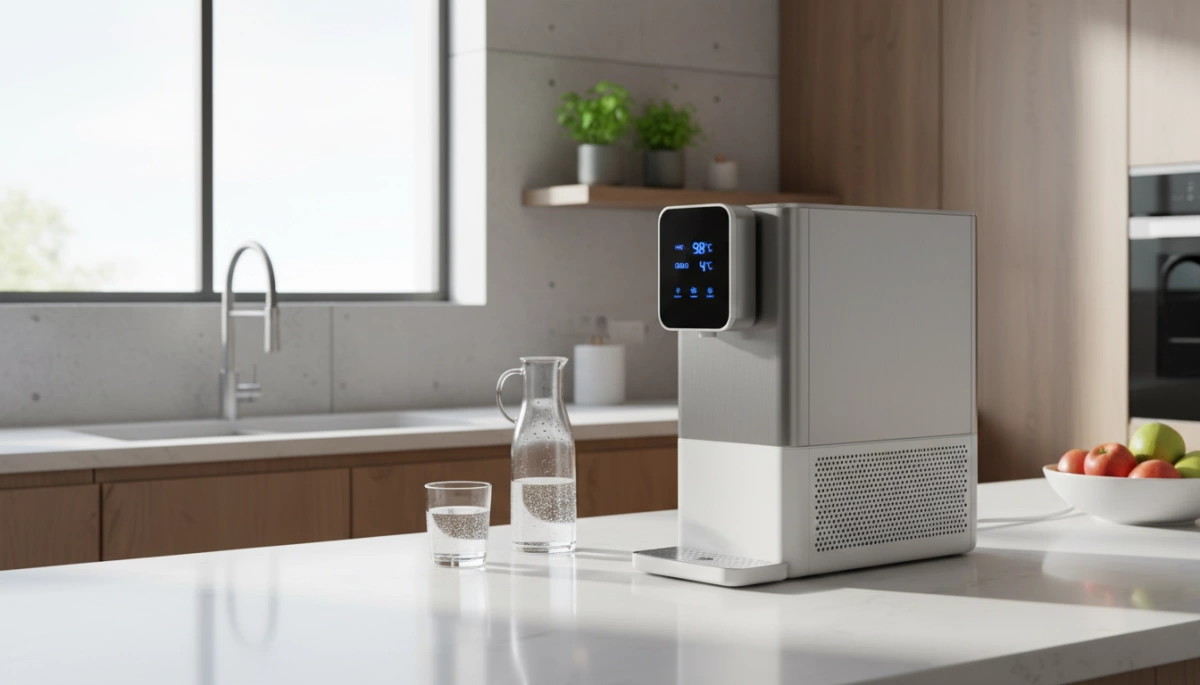
In modern Tankless RO Filtration Architecture, managing water temperature is just as critical as purification. We moved away from the energy-inefficient method of keeping liters of water boiling or freezing in internal reservoirs. Instead, we utilize Thick-Film Instant Heating, a technology that fundamentally changes how users interact with their hydration station.
Understanding Thick-Film Heating Technology
The core advantage of thick-film technology is its ability to heat water as it travels through the system, rather than heating a standing volume. This creates a true Direct-Flow Technology experience for hot water.
- 3-Second Boiling: By passing water through a 360-degree heating channel, we achieve boiling temperatures in roughly three seconds.
- Energy Efficiency: Since the system only activates when you press the button, there is zero standby energy consumption for heating.
- Precision: NTC sensors allow for specific temperature settings (like 185°F for coffee or 105°F for baby formula) rather than a generic “hot.”
This approach ensures that the high-quality output discussed in comparisons of purified water vs. filtered water maintains its integrity. The water never sits in a metal tank where it could develop a stale taste or accumulate mineral scale.
Integrating Cooling Modules
For the US market, cold water is a non-negotiable feature. Our Countertop RO Dispenser designs incorporate advanced cooling architectures without the bulk of traditional water coolers.
- Semiconductor Cooling: Used in our ultra-compact models, this solid-state cooling is silent and vibration-free, perfect for bedroom or office desktops.
- Compressor Cooling: For high-traffic environments requiring icy temperatures (down to 41°F), we integrate miniaturized compressors that rival full-size refrigerators in performance but fit within a slim footprint.
By combining instant heating with rapid cooling, we eliminate the “storage lag” found in older systems, ensuring every drop is fresh, temperature-perfect, and safe.
Eliminating Secondary Pollution via Tankless Design
One of the most critical advancements in our Tankless RO Filtration Architecture is the complete removal of the storage tank. In traditional systems, the filtration process was slow, requiring a pressurized bladder tank to store water for later use. While this ensured you had water when you opened the tap, it introduced a major flaw: secondary pollution.
When water sits stagnant in a rubber bladder for hours or days, it becomes susceptible to bacterial growth and re-contamination. We have engineered our systems to bypass this risk entirely through Direct-Flow Technology. By utilizing high-capacity membranes that filter water instantly upon demand, we ensure that the water you drink is fresh and has never been sitting in a dark, stagnant container.
The Hygiene Advantage of Direct-Flow
Moving to a tankless design isn’t just about saving space; it is a health necessity. Here is how we maintain purity:
- No Stagnation: Water flows directly from the filter to your glass.
- Material Safety: Eliminates the risk of rubber degradation found in old storage bladders.
- Freshness: You get “live” water rather than “stored” water.
To further guarantee safety, we integrate UV-C LED Sterilization at the dispensing nozzle. While the 0.0001 Micron RO Membrane handles the heavy lifting of removing dissolved solids, the UV light acts as a final firewall against airborne bacteria that might exist at the outlet. This dual-layer approach—removing the tank and adding sterilization—ensures 99.99% sterility. When considering the alkaline water vs reverse osmosis key differences, the ability of modern RO systems to provide this level of on-demand biological safety is a distinct advantage for health-conscious households.
Smart Water Purification: Sensors and Logic
Modern Tankless RO Filtration Architecture isn’t just about plumbing; it is about the digital brain managing the flow. We moved past simple mechanical valves to integrate intelligent sensors that provide total control over water quality and system health. This ensures that the Smart Water Purification system works proactively rather than reactively.
Real-Time TDS Monitoring
We embed dual TDS (Total Dissolved Solids) probes directly into the waterway. One sensor reads the raw tap water input, and the second reads the purified output. This allows the system to display a live comparison on the interface, giving you immediate visual proof that the 0.0001 Micron RO Membrane is doing its job. For homeowners who want to verify these readings manually, understanding how to use a TDS tester confirms the drastic reduction in dissolved solids achieved by our direct-flow design.
Flow-Based Filter Life Tracking
Old-school filters used simple timers that guessed when a cartridge was done, often leading to premature waste. Our logic board uses flow-based algorithms to track the actual volume of water passing through the system.
- Volume Tracking: Counts every gallon dispensed, not just days on a calendar.
- Usage Accuracy: If you go on vacation, your filter life doesn’t degrade.
- Cost Efficiency: You only replace filters when they have truly reached capacity.
NTC Temperature Precision
To support instant heating without a tank, we utilize NTC (Negative Temperature Coefficient) sensors. These sensors monitor water temperature changes in milliseconds, communicating with the thick-film heater to adjust power instantly. This ensures that when you select a specific temperature for coffee or tea, the output is precise, eliminating the temperature fluctuations common in traditional boiler-based dispensers.
Eco-Efficiency: Drain Ratios and Energy
We know that traditional Reverse Osmosis systems have a bad reputation for water waste, often dumping three gallons down the drain for every single gallon of drinkable water produced. That is simply not sustainable. By utilizing advanced Tankless RO Filtration Architecture, we have completely engineered out that inefficiency. Our systems utilize high-pressure dynamics to achieve an impressive 2:1 Pure to Drain Ratio. This means you get two cups of purified water for every one cup of wastewater—a massive upgrade over the wasteful 1:3 ratios of the past.
This shift significantly reduces your household water footprint while maintaining the highest purity standards. Beyond water conservation, the on-demand heating architecture drastically cuts energy consumption. Unlike old coolers that constantly reheat a stagnant internal tank, our thick-film technology only consumes power when you actually dispense hot water. This combination of low wastewater and zero standby heating makes the ROI on RO systems undeniable for families looking to save money and resources.
FAQs About Tankless RO Filtration Architecture
How does the integrated waterway prevent leaks?
We moved away from the chaotic web of plastic tubing found in traditional setups. By utilizing an Integrated Waterway Board, we mold the water channels into a single, solid-state piece. This engineering choice drastically reduces the number of connections, cutting potential leak points by over 70% and ensuring a safer, drier kitchen environment.
Does the booster pump consume high electricity?
Not at all. While the High-Flow Booster Pump is powerful enough to push water through the 0.0001 Micron RO Membrane instantly, it operates strictly on-demand. Unlike older systems that waste energy maintaining pressure in a storage tank, our Tankless RO Filtration Architecture only draws power when you are actively dispensing water.
Is thick-film heating reliable for daily use?
Absolutely. Thick-Film Instant Heating is designed specifically for rapid thermal cycling. It heats water to boiling in just 3 seconds without the wear and tear associated with keeping an internal tank hot all day. This technology offers precise temperature control while significantly extending the lifespan of the heating element compared to conventional coils.
What is the advantage of zero-installation design?
It comes down to freedom and ease. A Zero-Installation Design means you don’t need to drill into countertops or mess with complex plumbing codes. While a dedicated under-sink reverse osmosis filtration system is great for permanent setups, our Countertop RO Dispenser models are plug-and-play, making them perfect for renters or offices that need immediate, high-quality hydration.