















Did you just install a premium tankless RO system, turn on the tap, and panic at a shockingly high TDS number?
You’re not alone.
The sudden spike on your smart faucet TDS reading—especially when it completely contradicts your trusty handheld TDS meter—is enough to make anyone question their drinking water.
But is your water quality display system actually broken?
Usually, no. It’s a completely normal, scientific occurrence known as the TDS creep phenomenon.
As an industry expert with years of experience engineering these purification systems, I know exactly what causes this frustrating discrepancy. I also know that true measurement reliability goes far beyond a simple digital screen—it requires an advanced accuracy calibration design built straight into the core of the unit.
In this post, you’re going to learn exactly why these startup fluctuations happen, how to quickly verify your system\’s performance, and what separates a cheap gimmick from a trustworthy TDS sensing system.
Whether you\’re a homeowner trying to troubleshoot your kitchen tap, or a brand owner searching for a dependable OEM water filter manufacturer capable of delivering flawless real time TDS monitoring, this guide is for you.
Let’s dive right in.
Smart Faucet TDS Reading Differences
I get this question all the time: why does the number on my new smart faucet look different than the reading on my trusty handheld TDS pen? If you are questioning the TDS display accuracy of your tankless RO dispenser, rest assured your system is likely functioning perfectly. The discrepancy usually comes down to exactly how, where, and when the water is being measured.
Handheld TDS Meter vs Built-in Sensors
Understanding the testing environment is the first step to trusting your water quality display system. The physics of the tests are fundamentally different.
- In-Line Flow Testing: A built-in TDS sensing system relies on real time TDS monitoring. It measures water dynamically as it actively flows at high speeds through the internal plumbing.
- Static Cup Testing: A handheld meter tests still, stagnant water sitting in a drinking glass. Flowing water interacts with electrical sensor currents differently than still water, creating a completely natural variance.
Accuracy Calibration Design
The physical location of the sensor inside the machine heavily impacts the reading. A premium tankless RO system uses an internal accuracy calibration design that places the probes immediately after the membrane. It reads the water at its absolute purest point. Conversely, your handheld meter measures water after it has traveled up the tubing, out the faucet, through the room\’s air, and into a glass that almost certainly contains microscopic trace dust or dried dish soap residue.
The Remineralization Factor
Here is the most common—and most misunderstood—reason for a higher-than-expected reading on your display.
- The Process: Many high-end systems route pure RO water through a final remineralization stage before it reaches the tap.
- The Science: This filter intentionally adds healthy, natural minerals like calcium and magnesium back into your purified water to improve taste and balance pH.
- The Result: Because minerals are dissolved solids, your smart faucet will accurately detect them and display a higher TDS number.
In this case, a higher reading is completely intentional. It does not mean your water is dirty; it means you are drinking healthy, alkaline, mineral-rich water.
Unpacking the TDS Creep Phenomenon
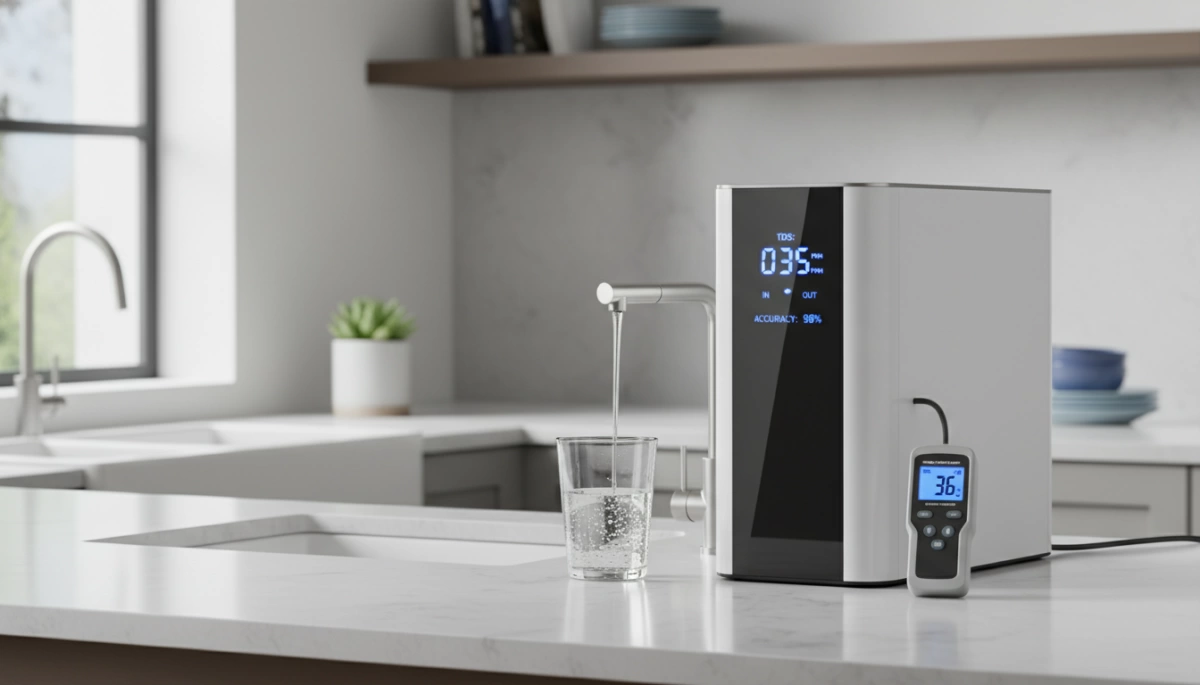
When we discuss TDS display accuracy in tankless RO systems, one of the most common questions I get from homeowners involves a sudden spike in the numbers when they first turn on the tap. This isn\’t a malfunction; it is a natural scientific process known as the TDS creep phenomenon.
What is TDS Creep?
Here is the straightforward science behind what happens inside your plumbing:
- The Idle State: When your tankless RO system sits idle between uses, the active water pressure drops.
- Natural Osmosis: Without pressure pushing water forward, natural osmosis kicks in. This pulls dissolved solids from the unfiltered, \”dirty\” side of the RO membrane into the clean, filtered side.
- Standing Water: This creates a small pocket of standing water with a naturally higher concentration of dissolved solids.
The First-Pour Spike
Because of this temporary mineral buildup, the first 10 to 30 seconds of dispensed water will trigger a high smart faucet TDS reading. It is easy to assume the filter is failing or the sensor is broken. In reality, it proves the exact opposite.
Your system\’s real time TDS monitoring is working perfectly. It is giving you an accurate measurement of that standing water. Understanding this process helps reinforce exactly why a high-quality water filter is important—it removes the guesswork and tells you the exact condition of the water flowing into your glass.
The Simple Solution
You do not need a repair or a replacement cartridge; you just need to wait a few seconds.
- Run the tap: Let the water flow for about 30 seconds to clear the lines.
- Watch the display: You will see the water quality visualization on your built-in screen quickly drop and stabilize.
- Pour: Once the system flushes out the standing water and the numbers level off, you are getting a highly accurate reading of freshly purified, low-TDS water.
Setting Realistic Expectations for RO Water Quality
Many homeowners expect a brand-new system to dispense water with absolute zero dissolved solids. Let\’s clear up that misconception right now.
The Zero PPM Myth
When evaluating TDS Display Accuracy in Tankless RO Systems, expecting a flat 0 ppm reading is unrealistic. Reverse osmosis is incredibly effective, but it does not strip water down to an absolute vacuum. A healthy, high-functioning RO membrane leaves a tiny trace of harmless minerals behind. If your smart faucet shows a low single-digit or double-digit number, the system is doing exactly what it was engineered to do.
TDS Rejection Rate Calculation
Instead of chasing zero, focus on the actual rejection rate. This is the true metric of your system\’s performance. You can easily verify this at home using your baseline tap water reading and the real time TDS monitoring on your dispenser.
Here is the straightforward formula:
- ((Tap Water TDS – RO Water TDS) / Tap Water TDS) x 100
For example, if your incoming tap water is 300 ppm and your filtered RO water is 15 ppm:
- ((300 – 15) / 300) x 100 = 95% Rejection Rate
In the US market, especially when evaluating the benefits of RO to hard water sufferers, the industry standard for a premium high-performance membrane sits squarely between 90% and 95%. Anything in this range guarantees exceptional water purity.
The User Trust Display
A modern water quality display system delivers crucial dual functionality. The screen on your unit serves as a reliable user trust display. Not only does it provide instant water quality visualization, but it also actively tracks cartridge lifespan. Instead of guessing or relying on an arbitrary calendar date, the built-in lifespan indicator alerts you exactly when it is time to replace the filters. This measurement reliability ensures your system continuously operates at peak efficiency.
How Advanced Manufacturing Guarantees Measurement Reliability
When it comes to TDS display accuracy in tankless RO systems, the build quality of the internal components makes all the difference. Cheap sensors in standard water filters often lag or fail entirely under pressure.
Accuracy Calibration Design
- The Problem with Cheap Sensors: Low-grade sensors fail because they simply cannot process data quickly enough.
- High Flow Rate Demands: High GPD RO systems push water rapidly, often hitting flow rates of 5.2 L/min or higher. This requires highly responsive components to track water quality on the fly.
- The Fix: We utilize an advanced accuracy calibration design within our TDS sensing system to instantly read fast-moving water without lagging or providing false numbers.
Tankless RO Membrane Flush
To stop TDS creep at the source, top-tier engineering is a must. We design our units to run an automatic tankless RO membrane flush right after you finish dispensing water. By rinsing the membrane automatically, the system clears out leftover dissolved solids on the unfiltered side. This smart feature drastically cuts down on TDS creep and ensures your real time TDS monitoring is reliable the next time you turn on the tap.
The Driplife Advantage
American homeowners need to trust what they drink, which is exactly why water filtration is crucial for everyday health. We back our hardware with serious manufacturing expertise to deliver a flawless water quality display system:
- 15+ Years OEM/ODM Experience: We build filtration units engineered to perform under heavy, daily household use.
- World-Class Laboratory: Our in-house lab runs rigorous stress tests to ensure peak measurement reliability.
- Strict Online Inspection: We guarantee that the digital readouts on our products are lab-accurate, highly responsive, and built to last.


