
















If you’re designing reverse osmosis (RO) systems, you already know one thing: the system is only as good as its flow control valve.
Because in modern countertop RO purifiers and point-of-use dispensers, users don’t judge you by salt rejection curves or recovery rate. They judge you by one experience:
“Did this system dispense the right amount of water, fast, every single time?”
This is where advanced flow control valve engineering becomes a real competitive advantage—not a checkbox.
In this article, we’ll break down how to achieve precise dispense control in RO systems using smart valve design: from micro flow regulation and high turn-down ratio valves, to stable flow under variable inlet pressure, fast valve response time, and long-term durability in real-world RO conditions.
And we’ll show how manufacturers like Driplife engineer precision flow control valves for RO that solve the problems most teams struggle with: inconsistent dispense volume, unstable flow, membrane stress, and unnecessary water waste.
If you’re looking to build RO systems that feel “lab-grade” in everyday use, while staying scalable and cost-effective, you’re in the right place.
Fundamentals of Flow Control in Reverse Osmosis Systems
When I talk with RO engineers and product managers, the same concern keeps coming up: “We tuned the membrane and pump, but users still complain that the dispense feels slow, inconsistent, or ‘off’.” That almost always comes back to how we engineer the flow control valve at the post‑membrane stage.
RO process basics and the post‑membrane dispense stage
In a typical residential or countertop RO purifier, the process is straightforward:
- Feed water is pressurized and driven across the RO membrane.
- Permeate (product water) is collected in a tank or flows directly to the faucet.
- A flow restrictor or concentrate valve controls the waste/brine side.
- At the end, a precision flow control valve manages the final dispense to the user.
That last step—the post‑membrane dispense stage—is where the user judges the whole system. Even if your TDS performance is perfect, a poor dispense control valve makes the system feel cheap, slow, or unreliable. This is why advanced flow control valve engineering for RO systems focuses so heavily on that final micro‑flow section.
Why precise flow regulation matters
Precise flow regulation is not just a “nice to have” for countertop and point‑of‑use RO systems; it directly affects:
- User experience – Smooth, predictable flow, no sudden surges, no “trickling” at the end of a glass.
- Perceived quality – Consistent dispense rate signals a well‑engineered product, especially in the US market where users compare against premium appliances.
- System efficiency – Stable flow helps maintain optimal back pressure across the RO membrane, improving recovery and water use.
If the precision flow control valve in an RO system is undersized, poorly tuned, or unstable, you see:
- Long fill times and user frustration.
- Inconsistent cup volumes in auto‑dispense or measured‑fill modes.
- Extra wear on pumps and membranes due to unstable operating conditions.
Key metrics: dispense accuracy, stability, pressure independence
When I evaluate or design a flow control valve for RO systems, I always measure against a few core metrics:
Dispense volume accuracy
- How close is the actual volume to the target over hundreds or thousands of dispense cycles?
- For premium countertop RO purifiers, we typically target ±2–3% accuracy for common volumes (e.g., 200–500 mL).
Flow rate stability
- How much does the flow rate vary over a single dispense, as pressure and tank levels change?
- A well‑engineered micro flow regulation valve keeps the dispense feeling consistent from start to finish, even at low flow.
Pressure independence
- How sensitive is flow to variations in inlet pressure, tank pressure, or municipal supply conditions?
- Advanced designs (using regulator geometry, multi‑orifice paths, or dome‑loaded concepts) maintain RO system pressure independence, which is critical for consistent performance across regions and buildings.
These are the metrics that define real‑world RO system dispense accuracy and RO flow rate stability, and they’re exactly what product reviewers and end‑users notice, even if they don’t have the technical vocabulary.
Impact on RO membrane longevity and protection
Flow control is also a membrane protection tool. The right RO flow control valve:
- Maintains proper back pressure on the membrane via tightly controlled concentrate and permeate flows.
- Prevents rapid cycling and hydraulic shocks that fatigue the membrane and housing.
- Helps keep operation in the membrane’s optimal pressure and recovery window, reducing fouling and scaling.
When flow stability in reverse osmosis is poor, you get:
- Repeated high‑to‑low pressure swings.
- Over‑concentration at the membrane surface.
- Shorter membrane life and more warranty issues.
By engineering a stable, predictable dispense control valve and pairing it carefully with the flow restrictor and any back pressure regulator on the concentrate side, we actively extend RO membrane life and reduce service costs.
Role of flow control valves in point‑of‑use and countertop RO purifiers
In point‑of‑use (POU) and countertop RO systems, space is tight, power is limited, and user expectations are high. Here, the flow control valve takes on multiple roles at once:
- Final dispense regulator – Sets the user‑facing flow rate and smoothness.
- System stabilizer – Dampens fluctuations from pumps, tanks, and varying inlet pressure.
- Protection component – Works with restrictors and regulators to protect the membrane and downstream components.
For these compact systems, we design countertop RO purifier valve engineering around:
- Compact geometry with low pressure drop.
- Fine micro flow regulation in the 0.1–1.5 L/min range.
- High repeatability over tens of thousands of dispense cycles.
- Compatibility with quick‑connect fittings for fast assembly and servicing.
Well‑designed precision flow control valves for RO purifiers are not just another component. They are the interface between your process design and your customer’s daily experience—and they’re one of the most cost‑effective levers you have to improve both product perception and system reliability.
Engineering Principles Behind Advanced Flow Control Valves
Core Valve Design for Precise RO Dispense Control
For our countertop and point-of-use RO purifiers, I engineer advanced flow control valves around three core designs:
- Needle valves – fine, screw-like tip for micro flow regulation and stable low-flow dispensing.
- Pressure regulators / back-pressure regulators – keep flow and pressure steady even when city pressure changes.
- Proportional control valves – match valve opening to signal input for precision flow control valve RO applications and smart dispensers.
These designs let us dial in RO system dispense accuracy without making the system complicated for U.S. homeowners or office users.
Multi-Orifice and High Turn-Down Ratio Low-Flow Control
To get smooth, drip-free dispensing at very low flow rates, our countertop RO purifier valve engineering focuses on:
- Multi-orifice seats – several tiny ports instead of one larger port to smooth out flow.
- High turn-down ratio (e.g., 50:1 or higher) – one valve can control both micro-dosing and full-glass fills.
This keeps low flow precision dispensing RO stable, even when users tap the dispenser multiple times per day.
| Design Feature | Benefit for RO Users |
|---|---|
| Multi-orifice seat | Less pulsing, smoother stream |
| High turn-down ratio valve | One valve for rinse, flush, and drinking use |
| Fine-thread adjustment | Easier factory calibration and repeatability |
Traditional vs Advanced Flow Control Valves in RO Systems
Older RO systems often rely on simple fixed orifices or basic restrictors. Our advanced flow control valve engineering improves on that with:
Traditional valves
- Fixed orifice, limited range, sensitive to pressure swings
- More variation in cup-to-cup dispense volumes
Advanced RO valves
- Tuned geometry, high turn-down ratio valve RO designs
- Better RO flow rate stability and RO system pressure independence
- More consistent volumes for bottle fill, coffee, and cooking use
For businesses building countertop coolers and dispensers, these upgrades directly support more premium products similar to a high-end countertop water cooler dispenser.
Zero-Deadband, High-Resolution RO Dispense Control
For precision dispense valve engineering RO system designs, I target:
- Zero-deadband behavior – the valve starts responding as soon as the control signal or handle moves; no “dead zone.”
- High resolution – small changes in signal = small, predictable changes in flow.
This is key when we optimize valve response time RO system performance for U.S. users who expect instant start/stop and accurate auto-fill.
Valve Geometry and Internal Flow Path for Micro Flow Regulation
The internal layout of the valve is what makes or breaks micro flow regulation valve performance:
- Streamlined internal flow paths cut turbulence and noise.
- Optimized seat angle and tip geometry stabilize the flow at tiny openings.
- Controlled pressure drop zones help avoid cavitation and protect the RO membrane and downstream components.
By carefully engineering these geometries, we keep flow stability in reverse osmosis systems high while holding tight tolerances on dispense accuracy valve control RO system performance over the product’s life.
Key Requirements for Precise Dispense Control in RO Systems
When I design advanced flow control valve engineering for RO systems, I’m always aiming for one thing: stable, predictable, precise dispensing in real homes and offices across the U.S. That means getting the details right on micro-flow control, response time, and long-term accuracy.
Micro-Flow Regulation for Small-Volume RO Dispensing
For countertop and point-of-use RO purifiers, users tap for a cup, not a bucket. That’s where micro flow regulation valves matter.
What we target:
- Stable flow at very low rates (e.g., 0.1–0.6 L/min)
- Accurate small-volume dispensing (e.g., 150–300 ml per press)
- Smooth flow without pulsing or spitting
Engineering focus:
- High-resolution needle valve precision geometry
- Multi-orifice and high turn-down ratio designs for wide flow range
- Tight machining tolerances for RO system dispense accuracy
Fast Valve Response Time to User Commands
In the U.S., people expect RO dispensers to feel as responsive as a kitchen faucet. That means fast valve response time when users start or stop.
Key performance targets:
- Open/close response in < 300 ms for countertop RO systems
- Minimal overshoot to avoid extra volume after shutoff
- Clean cutoff with no drip or trailing flow
How we engineer it:
- Low-mass, low-friction moving parts
- Optimized seat design for fast sealing
- Flow path tuning to balance response time and stability
Stability Under Fluctuating Inlet Pressure
In many U.S. homes, line pressure and usage vary throughout the day. A precision flow control valve for RO must hold flow rate stability even when:
- City water pressure swings
- Multiple taps or appliances run at the same time
- RO pump cycles on/off
What we build in:
- Pressure-independent flow characteristics
- Options for back pressure regulator logic to protect the RO membrane
- Valve geometry that keeps flow consistent over wide pressure bands
Low Hysteresis and High Repeatability
For reliable RO system dispense accuracy, every button press should give the same volume, day after day.
Important metrics:
- Low hysteresis: minimal difference between opening and closing paths
- High repeatability: tight tolerance over hundreds or thousands of cycles
- Stable calibration under varying temperature and pressure
Design levers:
- Low-friction seals and guided stems
- Carefully selected elastomers and food-grade materials
- Precision internal surfaces to support RO valve hysteresis and repeatability
Quick-Connect Integration for Countertop & POU RO
Installation and service are a big deal in the U.S. market. Technicians and DIY users want plug-and-play.
So we design:
- Compact, quick-connect compatible bodies for 1/4″ and 3/8″ tubing
- Modular flow control cartridges that drop into standard RO housings
- Valve layouts optimized for countertop RO purifier valve engineering and under-sink point-of-use systems
This kind of modular approach also pairs well with tankless RO system layouts where internal space is tight, similar to how we structure our tankless RO compatibility solutions with standard kitchen cabinets.
Consistent Accuracy Across Valve Service Life
Precise dispense control isn’t just about day one. It’s about holding spec for years under real-world use.
What we design for:
- Minimal drift in micro flow regulation across the valve lifecycle
- Stable calibration despite scale, minor fouling, or normal wear
- Robust materials and surfaces to handle continuous RO operation
Typical lifetime goals (for residential RO):
| Parameter | Target Range (Typical) |
|---|---|
| Volume accuracy drift | ≤ ±5% over rated lifecycle |
| Repeatable dispense cycles | 50,000+ operations |
| Flow rate stability vs. pressure | Variation ≤ ±10% across rated pressure band |
| Response time (open/close) | < 300 ms (countertop RO dispensers) |
By locking in these requirements, we keep advanced flow control valve engineering aligned with what U.S. users actually feel: fast response, accurate pours, and stable RO water flow with almost zero hassle.
Common Flow Control Challenges and Engineering Solutions in RO Systems
In real homes and offices, the most common complaint is simple: “Why doesn’t my RO dispenser give the same amount every time?” In low-flow RO scenarios, even small pressure swings or a basic restrictor can cause inconsistent dispense volumes. To keep RO system dispense accuracy tight, we engineer advanced flow control valve designs that stabilize micro flow, even when pressure changes as other taps open or the tank empties.
Slow valve reaction is another issue. If the valve responds late or overshoots, you get a burst of water at the start, a lag before shutoff, and a poor user experience. We focus on valve response time optimization by using high-resolution needle valve precision RO dispense designs and short internal flow paths, so countertop and point-of-use units feel instant and predictable when you hit the lever or touch button.
Over time, cheaper valves drift. Wear on sealing surfaces, spring fatigue, and low-grade plastics lead to calibration loss, more variation in flow, and higher waste. Our micro flow regulation valve designs use precision machining, tight tolerances, and repeatable seat geometry to cut drift and hysteresis. That keeps flow stable from the first day through thousands of dispense cycles.
Material choice is non‑negotiable. We combine food-grade engineered plastics like POM with stainless-steel internals where needed, so each durable flow control valve purifier component resists scale, chlorine, and trace contaminants while staying safe for drinking water. Elastomers are selected for low compression set and long-term seal integrity, even under typical U.S. cold-water conditions.
To stop whistling, chatter, and cavitation damage, we design internal flow paths that slow velocity, manage pressure drop, and split flow through multi-orifice valve technology RO structures. This anti-cavitation valve design RO approach keeps the system quiet on the countertop, protects the RO membrane, and keeps flow steady instead of pulsing. In our higher-capacity systems, like the under-sink RO systems designed for U.S. homes and light commercial use at Driplife, that stability directly reduces service calls.
Every one of these engineering moves targets one big outcome: less water waste. When the flow is accurate and stable, the RO doesn’t overfill bottles, doesn’t need “extra” flush to hit the target, and doesn’t dump excess concentrate. By tightening control with precision valves, we cut waste at the faucet, improve flow stability in reverse osmosis, and extend membrane life—key wins for U.S. users who care about both performance and utility bills.
Optimizing Valve Performance in Countertop and Point-of-Use RO Systems
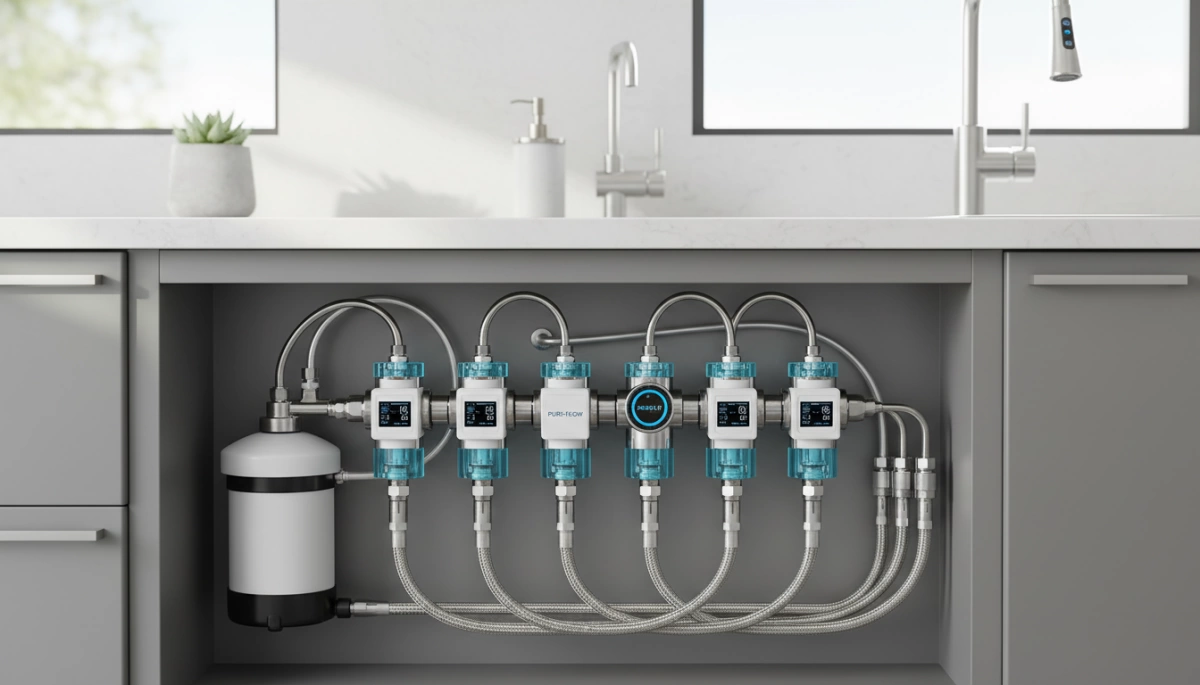
When I design advanced flow control valve engineering for countertop and point-of-use RO systems, I focus on how people in U.S. homes and offices actually use these purifiers: frequent short dispenses, quick fill-ups, and the expectation that the unit “just works” every time.
Compact, Modular Valve Architecture
For small countertop RO purifier valve engineering, the valve has to be compact but still deliver precision flow control.
- I use compact valve architectures that fit inside tight RO housings and slim dispenser heads without sacrificing flow stability in reverse osmosis operation.
- Quick-connect RO valve fittings and modular cartridges let installers swap a valve in minutes, cutting service time and avoiding leaks.
- A modular platform also supports different SKUs (countertop vs. under-sink) using the same precision flow control valve RO core, which helps keep cost under control.
If you look at real-world countertop systems, like our own countertop cold water purifier platform, this compact, modular mindset is exactly how we keep the unit small while holding tight dispense accuracy.
Low Power, Low Pressure Drop Design
For residential RO dispenser engineering, I engineer valves to be both low-power and low-pressure-drop:
- Low-power RO dispense control means the valve works with small pumps and modest power supplies, ideal for kitchens, apartments, and offices.
- A low-pressure-drop precision flow control valve RO design helps maintain RO system pressure independence, so the membrane and the flow restrictor stay in their optimal operating window.
- This also supports RO system reliability engineering, because the pump doesn’t have to work as hard to overcome unnecessary restriction.
Performance Benchmarks: Accuracy and Response Time
To judge whether a point-of-use RO dispense valve is truly “advanced,” I measure:
- RO system dispense accuracy: Typical targets are ±2–3% volume accuracy for common cup sizes and small-volume dispensing.
- Valve response time RO system: I tune the valve and control logic so dispense starts and stops feel instant, with minimal overshoot or dribble at the end of the pour.
- RO flow rate stability: The valve should hold steady flow during a dispense, even as inlet pressure or tank pressure changes.
These are the real benchmarks that matter to U.S. users: “Does the 12 oz button actually give me 12 oz, and does it start/stop cleanly?”
Balancing Precision, Cost, and Manufacturability
In consumer RO, I can’t just design the most complex valve possible. I have to balance:
- Precision vs. cost: High-precision micro flow regulation valve designs must still hit consumer price points. I favor smart geometries over exotic materials where possible.
- Manufacturability: Adjustable flow restrictor engineering and high turn-down ratio valve RO designs are optimized for injection molding, automated assembly, and consistent quality.
- Durability: I select food-grade RO valve materials and robust mechanisms so performance doesn’t drift after thousands of dispense cycles.
This balance is what makes advanced flow control valve engineering scalable for big-box retail and online RO purifier sales in the U.S.
Reducing Water Waste and Improving Reliability
Finally, precise dispense accuracy valve control in an RO system directly cuts waste and boosts reliability:
- Tight micro flow regulation engineering RO purifier designs reduce over-dispense and minimize the extra flush water that cheap valves often cause.
- Stable RO flow rate stability protects the membrane and keeps the concentrate ratio in the right range, which supports RO membrane protection through flow control.
- Better control and lower cycling stress extend pump and valve life, reducing service calls and warranty costs.
When I combine compact design, quick-connect architecture, low power draw, and high-precision RO dosing valve performance, the result is a countertop or point-of-use RO system that feels premium to use, wastes less water, and stays accurate for years.
Material And Durability In Advanced Flow Control Valve Engineering
When I design advanced flow control valves for precise RO dispense control, I’m ruthless about material and durability choices. If the valve can’t survive real U.S. home and light commercial use, it doesn’t belong in a countertop RO purifier.
Corrosion‑Resistant Valve Materials
For RO environments with low TDS but often aggressive water, I focus on:
- POM (acetal): Great dimensional stability, very low friction, and ideal for tight micro flow regulation in compact, point‑of‑use RO dispense valves.
- Engineered plastics (PPSU, PSU, high‑grade nylon): Higher temperature and chemical resistance, perfect for long‑life residential RO purifier components.
- Stainless steel (304/316): The go‑to for high‑pressure sections, back pressure regulators, and high-precision RO dosing valve components where mechanical strength and corrosion resistance are critical.
This mix lets me keep compact valve design for countertop RO units while still hitting strict safety and durability expectations for U.S. drinking water systems.
Strength, Fatigue, And Seal Choices
Continuous RO cycling is tough on parts. To keep flow stability in reverse osmosis systems over years, I optimize for:
- Mechanical strength & fatigue resistance: Load‑bearing parts (springs, seats, stems) are sized and machined to handle millions of open/close cycles without drift, so RO flow rate stability stays tight over time.
- Seal and elastomer selection: I use NSF / FDA‑compliant elastomers (EPDM, silicone, FKM where needed) to balance hygiene, low extractables, and flexibility. That keeps micro flow regulation repeatable, even with frequent start/stop dispense cycles.
- Low hysteresis design: Seal geometry and surface finish are tuned so the valve doesn’t “stick”, reducing hysteresis and boosting repeatability in RO dispense accuracy.
Testing, Standards, And Real‑World Durability
To make sure a precision flow control valve for RO actually delivers in the field, I rely on:
- Lifecycle testing: High‑cycle endurance tests under fluctuating inlet pressures and realistic dispense patterns to validate long‑term stability of micro flow regulation.
- Pressure, thermal, and chemical testing: Validates that materials and seals hold up to U.S. municipal water conditions, filter changes, and occasional disinfecting procedures.
- Compliance: Designs are aligned with common drinking water component standards (like NSF/ANSI) to support OEM certifications and brand trust.
Real‑world durability benchmarks for my RO flow control design target multi‑year service life with minimal drift in dispense volume accuracy, even in households that run their countertop RO purifier hard every day.
Long‑Term Stability Of Precise Dispense
Everything in the valve stack—material selection, surface finish, internal geometry, seals—feeds one outcome: stable, precise dispense for the entire lifecycle. A well‑engineered, durable flow control valve keeps:
- RO system dispense accuracy consistent from day one to year five
- Valve response time sharp, without sluggish behavior as parts wear
- Water waste low, by preventing over‑flush and mis‑regulation as components age
The same discipline I apply to RO valves also shows up in other water components we build, from flow control parts to high‑performance faucet and shower filtration solutions that have to survive tough U.S. water conditions without losing performance.
Selecting Distributors and Suppliers for Precision RO Flow Control Valves
Key Supplier Capabilities for Advanced RO Valve Engineering
When I pick a partner for advanced flow control valve engineering in RO systems, I focus on a few hard requirements:
- Deep experience with precision flow control valve RO design (needle valves, multi-orifice, high turn-down ratio).
- Ability to engineer micro flow regulation valves that stay stable at very low RO dispensing rates.
- Strong simulation, prototyping, and in-house testing for RO flow rate stability and pressure independence.
Customization for Specific RO Layouts and Dispense Needs
For the U.S. market, every countertop and point-of-use RO purifier layout is a bit different, so I need:
- Custom flow curves matched to my membrane, tank, and dispense concept.
- Tailored quick-connect RO valve fittings, mounting options, and compact bodies for tight housings.
- Adjustable RO flow restrictor optimization for different SKUs (residential vs light commercial).
Quality Certifications and Compliance
To sell into U.S. retail and commercial channels, my RO water purifier components must be audit-ready:
- Materials and designs that support NSF/ANSI drinking water standards and food-contact safety.
- Proven use of food-grade RO valve materials and documented compliance tests.
- Clear traceability from resin to finished valve; I like suppliers that share their food-grade material selection for RO water path approach, like what we use in our own designs at Driplife’s food-grade material program.
Supply Chain Reliability and Lead Time
For large U.S. PO drops and seasonal demand spikes, I look at:
- Stable lead times, buffer stock options, and flexible MOQs for precision flow control valve RO components.
- Mature export logistics from a B2B RO component supplier in China with on-time delivery history.
- Clear communication on EOL, redesign cycles, and any material substitutions.
Benefits of Partnering with Experienced RO Component Manufacturers Like Driplife
Working with an experienced RO valve house like Driplife gives me:
- Pre-validated countertop RO purifier valve engineering platforms to shorten my development cycle.
- Access to proven durable flow control valve purifier designs that already perform in real-world systems.
- Cost-optimized tooling and mass-production know-how for competitive U.S. price points.
How Co-Engineering Improves RO Valve Performance and Cost
Co-engineering is where the real gains happen for RO system dispense accuracy and total cost:
- We share our system data (pressures, target dispense times, user behavior), and the supplier tunes valve response time RO system and hysteresis.
- Joint DFMA reviews reduce part count, simplify assembly, and cut both BOM and labor cost.
- Continuous feedback from field performance loops back into improved high-precision RO dosing valve designs for future runs.
| Selection Focus | What I Expect from a Precision RO Valve Supplier |
|---|---|
| Engineering capability | Proven advanced flow control valve engineering and RO-specific know-how |
| Customization | Configurable flow curves, ports, and quick-connect interfaces |
| Compliance | Full drinking water certifications and food-grade documentation |
| Supply chain | Reliable lead times, flexible MOQs, and stable export operations |
| Co-engineering | Joint design, testing, and cost optimization for long-term partnership |
Future Trends in Advanced Flow Control Valve Engineering for RO Systems
In the next wave of RO dispenser design, advanced flow control valve engineering is going smart and electronic. We’re already integrating precision flow control valves in RO systems with smart control boards, so the valve doesn’t just react to pressure – it follows a programmed profile for dispense accuracy, comfort, and low waste. In tankless and high-flow setups, pairing intelligent valves with a smart control platform (similar to how we manage flows in our high-capacity under-sink RO systems) lets us coordinate pumps, sensors, and valves as one closed-loop system.
We’re also moving from purely mechanical valves to electronic pilot and piezo-actuated precision valves for micro-flow RO control. These designs use very small actuators to fine-tune micro flow regulation at low volumes, which is ideal for countertop RO purifiers where customers expect barista-style, single-cup accuracy. With high turn-down ratio valve designs, a single valve can handle everything from a slow, quiet trickle for bottle filling to a faster stream for pots, without losing flow stability in reverse osmosis conditions.
On the control side, next-gen RO systems will lean heavily on data-driven optimization of valve response time and flow stability. We’re logging flow, pressure, and valve position data to train control algorithms that cut overshoot, shorten start/stop lag, and maintain RO system pressure independence even with unstable city water. Over time, this also helps predict drift or wear so we can tune valve hysteresis and repeatability before the user ever feels a change.
Sustainability is driving a lot of this roadmap. Smarter valves and low-power RO dispense control strategies mean we can reduce pump runtime, cut pressure spikes, and optimize RO concentrate valve settings to lower water waste. For U.S. homeowners who care about both utility bills and drought conditions, that matters just as much as taste. As user expectations grow – instant response, consistent flow, app-level insights, and quieter operation – precision flow control valve RO technology will keep shifting toward compact, smart, and connected components that deliver reliable, high-precision dispensing with less water and energy wasted.