

















Are you wondering how to filter water naturally without relying on harsh chemicals or complex machinery?
Whether you’re preparing for an off-grid adventure, building an emergency kit, or just want cleaner, better-tasting tap water at home, knowing how to harness nature’s tools is a game-changer.
But here is the truth: there is a critical difference between removing visible dirt and making water truly safe to drink.
In this guide, you’re going to learn proven natural water purification methods that actually work.
From building a layered DIY water filter with sand and gravel to mastering solar water disinfection and activated charcoal filtration, we cover it all.
We’ll even look at how modern solutions like Driplife utilize biomimicry to bring nature’s most effective filtration processes right to your kitchen faucet.
Ready to turn cloudy water into crystal-clear refreshment?
Let’s dive right in.
Natural Water Filtration: Understanding the Science Behind the Purity
Have you ever stood by a mountain stream and wondered how that water looks so crystal clear without a single chemical treatment plant in sight? I’ve always been fascinated by how the Earth acts as a massive, self-regulating purification system. Before we try to replicate these methods at home, it is crucial to understand exactly how to filter water naturally using the principles of geology and biology.
Mother Nature’s Filtration System
Nature doesn’t just rely on one trick; it uses a multi-barrier approach. When rainwater falls, it doesn’t just sit there—it travels. As it seeps through layers of soil, sand, and bedrock, or flows through wetlands, it undergoes a rigorous cleaning process.
Here is a breakdown of the four key mechanisms nature uses to turn muddy runoff into a refreshing spring:
| Mechanism | How It Works | Natural Example |
|---|---|---|
| Mechanical Filtration | Physical debris and particles are strained out as water passes through tight spaces. | Water flowing through dense layers of sand and gravel. |
| Adsorption | Impurities stick to the surface of porous materials, effectively trapping chemicals. | Carbon-rich soil and organic matter trapping toxins. |
| Biological Processing | Beneficial microorganisms break down harmful organic matter and pathogens. | Plant roots and healthy bacteria in wetlands consuming nitrates. |
| Natural Disinfection | UV radiation penetrates water to neutralize harmful bacteria and viruses. | Intense sunlight hitting slow-moving surface water. |
The Mineral Benefit
One of the biggest advantages of these natural water purification methods is what they don’t remove. Unlike harsh industrial processes that often strip water of everything—including the good stuff—nature is selective.
By filtering water through mineral-rich rocks like limestone and basalt, the earth naturally retains essential electrolytes like calcium and magnesium. This process not only removes contaminants but also improves the taste and health profile of the water. Understanding these biological and geological systems is the first step in mastering survival filtration or simply appreciating the glass of water on your desk.
Proven Natural Filtration Methods
When we talk about getting clean hydration off the grid or in an emergency, we have to rely on physics and biology. Here are the most effective natural water purification methods that I’ve seen work, ranging from simple survival water filtration hacks to techniques used by communities around the world.
The Layered Gravity Filter (Sand and Gravel)
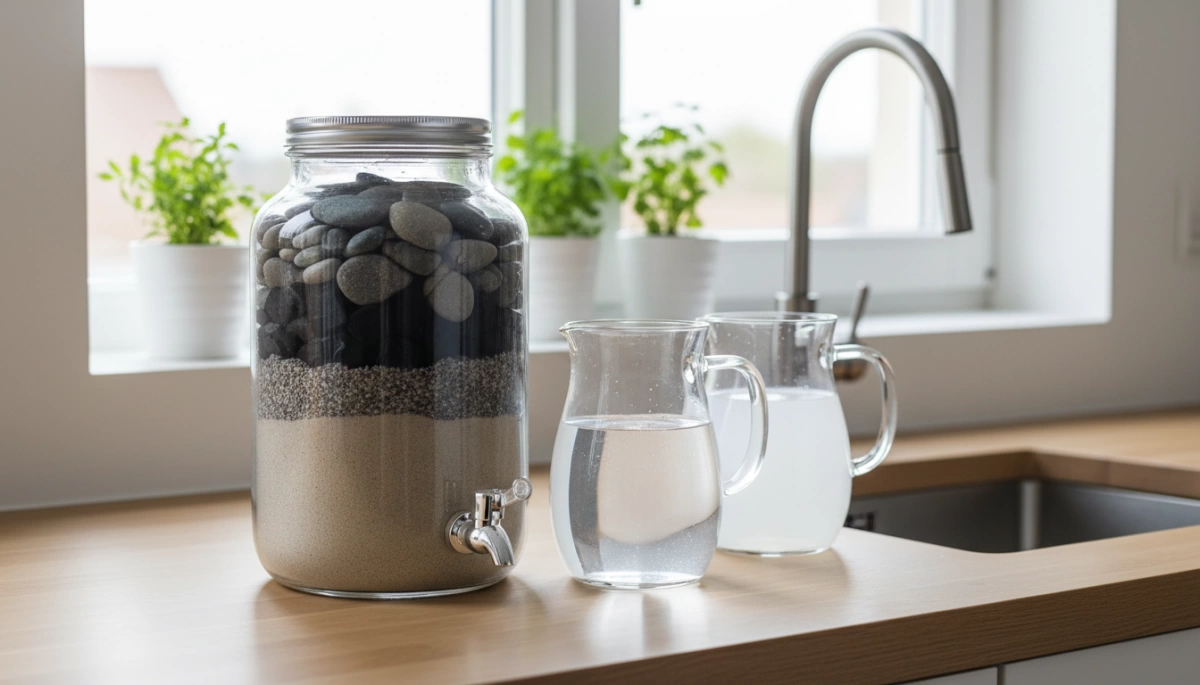
This is the classic “science fair” project that actually works in the wild. By stacking materials of different densities, you create a homemade water purifier that mimics how the earth filters groundwater.
How to build it:
- The Vessel: Cut the bottom off a plastic bottle and flip it upside down.
- Base Layer: Stuff a piece of cloth or a coffee filter into the neck to catch fine sediment.
- Active Layer: Add a layer of crushed charcoal (activated is best) to absorb chemicals.
- Filtration Layers: Add sand on top of the charcoal, followed by small gravel on top of the sand.
Pour dirty water through the top. The gravel catches big debris, the sand catches smaller particles, and the charcoal handles some impurities. While this clears up the water visually, remember that it doesn’t kill viruses.
Activated Charcoal Adsorption
If your water looks clear but tastes like a swimming pool or a swamp, activated charcoal filtration is your best bet. Unlike regular BBQ briquettes (which are toxic), activated charcoal—like Japanese Binchotan—has millions of tiny pores that trap contaminants through adsorption.
- Usage: Drop a stick of Binchotan or a pouch of granular activated carbon into your container.
- Result: It effectively reduces chlorine, volatile organic compounds (VOCs), and bad odors, making it a great step towards improving still water vs tap water differences in terms of taste and chemical safety.
Solar Water Disinfection (SODIS)
This is one of the simplest methods for off-grid water treatment endorsed by the WHO. It utilizes UV radiation from the sun to neutralize pathogens.
- The Method: Fill clear PET plastic bottles (under 2 liters) with water. Shake them to oxygenate.
- Exposure: Lay them horizontally on a roof or rack in direct sunlight.
- Time: Leave them for at least 6 hours (or 2 days if it’s cloudy).
Boiling Water Purification
When in doubt, heat it up. Boiling water purification is the gold standard for killing biological nasties like bacteria, viruses, and parasites.
- Rolling Boil: Bring the water to a rolling boil for at least 1 minute.
- Altitude Adjustment: If you are above 6,500 feet (2,000 meters), boil for 3 minutes because water boils at a lower temperature up there.
Plant-Based and Biological Options
Nature provides its own flocculants (substances that make particles clump together).
- Moringa Seeds: Crushed seeds from the Moringa oleifera tree can clarify turbid water and reduce bacteria by up to 90%.
- Xylem Filtration: A peeled branch of white pine can filter out bacteria when attached to a tube. The wood’s xylem tissue acts as a microscopic sieve, a fascinating example of a plant-based water purifier.
Quick Comparison of Natural Methods
| Method | Best For | Removes | Limitations |
|---|---|---|---|
| Sand & Gravel Filter | Sediment & debris removal | Particulates, some chemicals | Does not kill viruses/bacteria |
| Activated Charcoal | Taste & odor improvement | Chlorine, VOCs, bad taste | Does not remove minerals or salts |
| SODIS (Solar) | Disinfection in sunny climates | Bacteria, viruses, protozoa | Requires clear water & sun; slow |
| Boiling | Biological safety | 100% of pathogens | Does not remove chemical toxins |
| Moringa/Plants | Clarifying cloudy water | Suspended particles | Variable effectiveness |
Limitations of Natural Methods

While I appreciate the ingenuity behind survival water filtration and the back-to-basics approach, we have to be realistic about what these methods can and cannot do. A homemade water purifier built from plastic bottles and gravel is a fantastic life skill for emergencies, but it is not a replacement for a verified safety barrier in daily life. The biggest drawback is simple: nature is variable, but safety standards shouldn’t be.
The “Invisible” Risks
The most dangerous contaminants are the ones you can’t see. A DIY sand filter does an excellent job of clarifying murky water by removing sediment and large particles, but “clear” does not equal “safe.”
Here is where purely natural methods often fall short:
- Pathogens: While soil layers can trap bacteria, they are often ineffective against microscopic viruses. Unless you follow up with boiling water purification or solar water disinfection, you are still at risk of waterborne illness.
- Heavy Metals & Chemicals: Mechanical filtration through sand or cloth cannot remove dissolved chemicals. Things like lead, arsenic, or agricultural runoff pass right through. This is why it is crucial to understand that simple filtration doesn’t handle complex chemistry; for instance, you need to know if your water filters filter out fluoride and other dissolved solids, which usually requires denser media than just charcoal and sand.
- Inconsistency: Nature is unpredictable. The flow rate of a gravity filter can vary wildly, and channeling (water finding the path of least resistance) can allow contaminants to bypass the filtration media entirely.
Consistency Issues
Reliability is a major hurdle with off-grid water treatment. Building a system takes significant time, and maintenance is labor-intensive. You have to constantly clean the top layers of sand and replace the charcoal to prevent bacterial growth inside the filter. In a modern US household, we need water that is safe 100% of the time, not just when the sun is shining enough for UV treatment or when we have time to boil a pot. While natural methods are better than nothing in a crisis, relying on them long-term leaves too much to chance.
From Nature to Technology
Biomimicry Water Filtration
We have learned a massive amount by simply watching how the Earth cleans itself. This concept is called biomimicry water filtration—engineering that mimics natural biology to solve modern problems. Instead of waiting days for water to trickle through bedrock, we use advanced pressure systems to guide water through semi-permeable membranes, replicating the way plant roots selectively absorb nutrients while blocking toxins.
Think of an ultrafiltration home system as a high-speed, turbocharged version of nature’s process:
- Multi-stage layering: Just like soil, sand, and rock layers in the ground, modern filters use sediment and carbon blocks to physically trap debris and absorb chemicals.
- Membrane technology: We replicate cellular walls to stop bacteria and cysts without adding harsh chemicals like bleach.
Enhanced Safety and Mineral Retention
While I appreciate the simplicity of a DIY gravity filter, modern life in the U.S. demands reliability. The massive advantage of tech-assisted natural filtration is consistency. You get the same safety standard in every glass, eliminating the “wait and see” risk of outdoor methods.
Crucially, these systems differ from aggressive purification (like distillation) because they generally preserve magnesium and calcium, ensuring you still get mineral-rich drinking water.
Nature vs. Biomimicry: A Quick Comparison
| Feature | Natural Process (Soil/Plants) | Biomimicry Tech (Home Filters) |
|---|---|---|
| Speed | Very Slow (Days to Weeks) | Instant (Gallons per minute) |
| Consistency | Variable (Depends on environment) | High (Standardized microns) |
| Minerals | Retains Minerals | Retains Minerals |
| Pathogens | Partial removal | High removal (99.9%+) |
If you want this level of purity without the hassle of a slow-drip countertop pitcher, you might look into installing a kitchen faucet with filtration features directly at your sink. It perfectly bridges the gap between raw natural science and our modern need for on-demand hydration.
Driplife’s Approach to Natural-Inspired Purification
At Driplife, we believe the best water shouldn’t require a science experiment in your kitchen. We have taken the core principles of how nature filters water—purifying it through layers of rock and soil—and engineered them into a reliable ultrafiltration home system. Our goal is to bridge the gap between the raw effectiveness of the earth and the safety standards of modern living.
We don’t just strip water down to nothing; we focus on replicating the biological balance found in nature. By utilizing advanced filtration stages that mimic plant root absorption and soil layers, our systems effectively handle chlorine removal naturally while ensuring the water remains safe to drink instantly.
Why Our Systems Beat the DIY Effort
Living off-grid is great, but in a modern home, you need speed and reliability. We offer high-flow solutions—including countertop, under-sink, and faucet options—that deliver fresh water without the wait time of gravity filters.
Here is how we bring natural quality to your tap:
- Ultrafiltration: Blocks contaminants down to the microscopic level, acting like the earth’s finest sand layers.
- Mineral Retention: Unlike reverse osmosis which can strip everything, we prioritize mineral-rich drinking water. Understanding the hard vs soft water key differences highlights why retaining magnesium and calcium is vital for your health.
- pH Balance: Our alkaline stages restore the water’s natural pH, giving you that crisp, mountain-spring taste.
You get the peace of mind that comes with laboratory-grade safety, combined with the wholesome profile of naturally filtered water.