
















ADA vs. ANSI: Getting the Regulations Right
When we collaborate with commercial partners to design custom hydration solutions, the first hurdle is often deciphering the regulatory landscape. A common point of confusion lies in the relationship between federal laws and technical standards. The Americans with Disabilities Act (ADA) is a civil rights law that prohibits discrimination, mandating equal access in public spaces. In contrast, ICC/ANSI A117.1 provides the specific technical criteria—the exact dimensions and mechanics—required to achieve that accessibility.
For facility managers and developers, understanding this distinction is vital. The 2010 ADA Standards for Accessible Design serve as the legal baseline for federal compliance. However, many local building codes adopt ANSI A117.1 plumbing requirements to define the precise geometry for installations. This dual requirement heavily influences the design and placement of cantilevered water station clearance and wall-mounted units.
Scope of Application for Commercial Units
Compliance isn’t just about lowering a spout; it requires a holistic approach to the entire hydration station. The scope of these regulations covers:
- Wall-Mounted Cantilevered Units: Ensuring the unit projects from the wall correctly to allow for wheelchair approach without obstruction.
- Bottle Filling Stations: Regulating the height of sensors and activation mechanisms to ensure they are usable by everyone.
- Integrated Systems: Applying standards to both the drinking fountain bubbler and any auxiliary dispensing points.
By strictly adhering to both the civil rights mandates of the ADA and the technical specifications of ANSI, we ensure that every ADA compliance checklist for commercial wall-mounted water stations results in a facility that is legally sound and universally accessible.
The Hi-Lo Rule: Why One Fountain Isn’t Enough
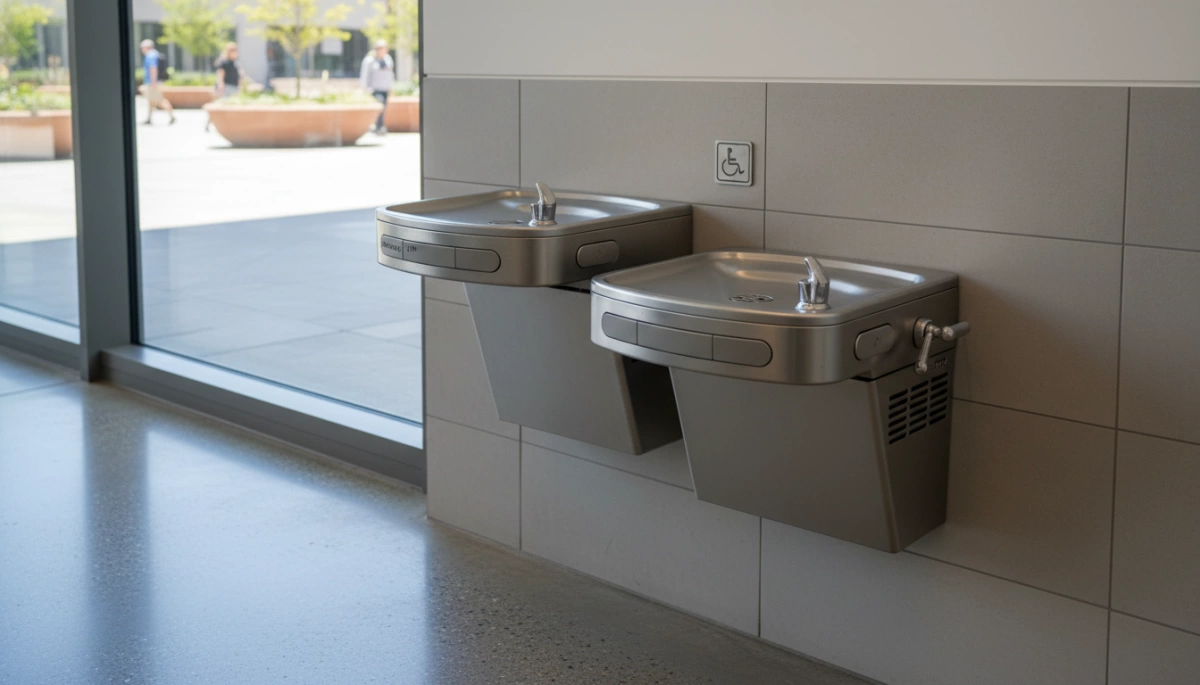
Many facility managers mistakenly believe that installing a single water station at a “medium” height satisfies everyone. However, under the 2010 ADA Standards for Accessible Design, this “one-size-fits-all” approach often results in a violation. The regulations enforce a specific “Hi-Lo” requirement to ensure dual access. This is commonly known as the 50/50 rule: where drinking fountains are provided, at least 50% must be a wheelchair accessible drinking fountain, and 50% must serve standing persons.
Efficiency of Bi-Level Configurations
To achieve compliance without doubling your plumbing infrastructure, the bi-level drinking fountain configuration is the industry standard. This design integrates two spouts at different elevations into a single cohesive unit, often powered by a shared internal cooling and purification engine, such as a high-capacity under-sink reverse osmosis filtration system.
Key Access Requirements:
- The Low Unit (Wheelchair Access): This unit is strictly regulated for height and knee clearance. It must allow a person in a wheelchair to approach the fountain comfortably without obstruction, ensuring barrier-free access.
- The High Unit (Standing Access): ADA regulations also protect individuals who have difficulty bending or stooping. A unit that is too low is inaccessible to these users. The high unit provides a convenient hydration point for standing adults, ensuring the facility caters to the full spectrum of mobility needs.
Vertical Height and Reach Ranges: Measuring Up
Precision is non-negotiable when manufacturing compliant hydration stations. We engineer our systems to ensure that every dispenser meets the 2010 ADA Standards for Accessible Design, specifically focusing on vertical placement to accommodate all users. Whether we are integrating a standard bubbler or a modern tap with filter water system, the spout outlet height regulations dictate the design framework.
For a unit to be considered “wheelchair accessible,” the spout outlet must be located no higher than 36 inches (915 mm) above the finish floor. This maximum height ensures that individuals in a seated position can access the water stream without strain. Conversely, for standing users, the spout on the high unit typically falls within the 38 to 43-inch range, tailored for standard bending heights.
Beyond the water outlet, the controls themselves must fall within specific forward reach range limits.
- Operable Parts Maximum Height: Any physical button, sensor, or activation mechanism must be placed no higher than 48 inches (1220 mm) above the floor.
- Minimum Height: These controls should generally be no lower than 15 inches (380 mm).
- Bottle Filler Activation: For units with integrated bottle fillers, the sensor activation zone must also reside within this 48-inch limit to remain accessible.
We strictly adhere to these vertical constraints during the R&D phase to prevent installation failures during final inspection.
Knee and Toe Clearance: The Cantilever Design
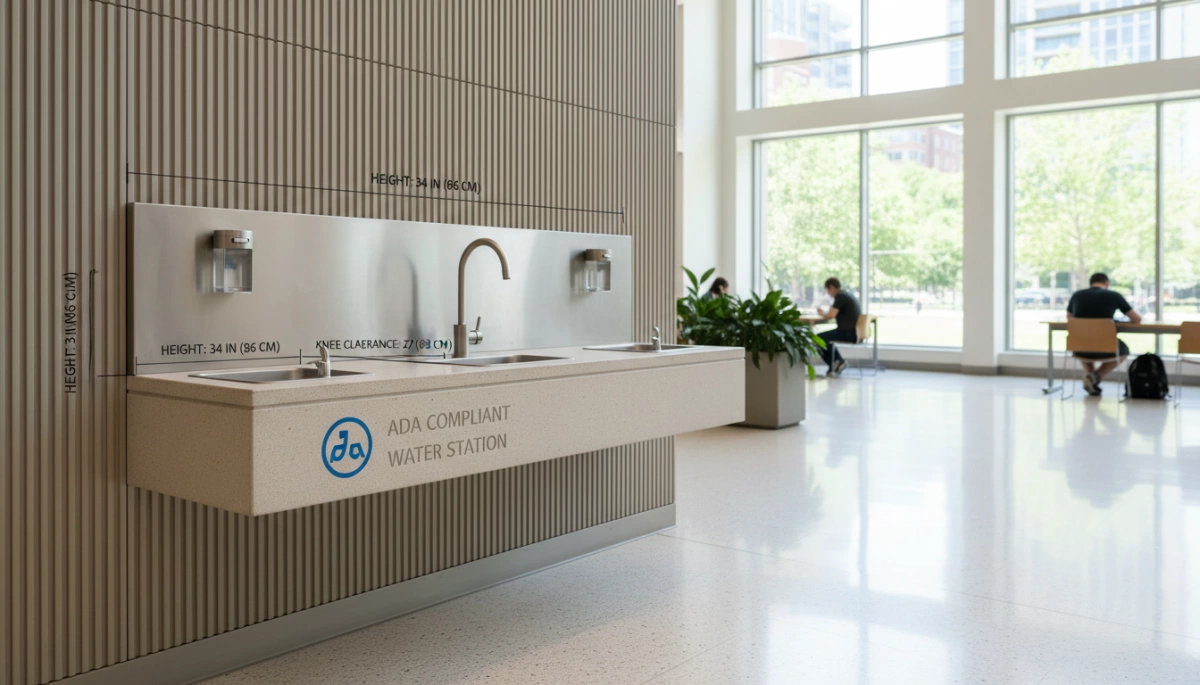
When we design a wheelchair accessible drinking fountain, the “void” space underneath the unit is just as important as the hardware itself. For a wall-mounted unit to be truly compliant with the 2010 ADA Standards for Accessible Design, it must feature a cantilevered design that allows a wheelchair user to pull forward comfortably without obstruction. This isn’t just about bolting a machine to the wall; it requires precise engineering of the housing to ensure internal components—like pumps and cooling tanks—don’t encroach on the required clear space.
To ensure your commercial installation meets the knee clearance depth and height regulations, we adhere to a strict set of dimensional mandates during the OEM design phase:
- Minimum Vertical Clearance: The space from the floor to the bottom of the apron (the lowest structural part of the fountain) must be at least 27 inches high. This provides the necessary room for a user’s knees.
- Depth Requirements: The knee clearance must extend at least 8 inches deep under the unit at that 27-inch height. If the unit is deeper, the clearance needs to accommodate that, reducing slightly as it goes further back toward the wall (typically allowing for toe clearance of 9 inches high at a depth of 6 inches).
- Clear Width: The open space underneath must be at least 30 inches wide to accommodate the standard width of a wheelchair.
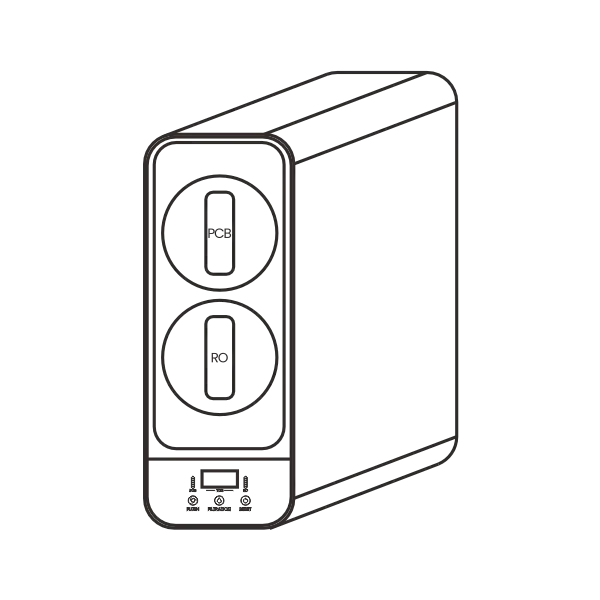
Achieving these slim profiles often requires advanced internal configurations. We frequently utilize the engineering behind integrated waterway boards in RO units to eliminate bulky tubing and reduce the vertical footprint of the filtration system. This compact internal structure allows us to maintain the sleek, compliant exterior needed for a cantilevered water station clearance without sacrificing purification capacity or water flow performance.
Protrusion and Circulation Paths: Avoiding Hazards
Safety in commercial corridors goes beyond water quality; it requires strict adherence to regulations regarding protruding objects in circulation paths. When designing or installing wall-mounted water stations, we must ensure the unit does not become an obstruction for the visually impaired. The 2010 ADA Standards enforce a “4-inch rule” to prevent injury in hallways, aisles, and passageways.
The 4-Inch Protrusion Rule
Any wall-mounted object with a leading edge between 27 inches and 80 inches above the finished floor cannot protrude more than 4 inches horizontally into the circulation path. This creates a safe zone for individuals who rely on canes for navigation. If a water cooler extends too far without a lower barrier, a person with visual impairments might not detect it with their cane before walking into it.
Engineering Solutions for Compliance
As an OEM manufacturer, we address these spatial constraints through specific structural designs:
- Semi-Recessed Installation: We design chassis that allow the bulk of the filtration and cooling engine to sit inside the wall cavity. This keeps the exterior profile flush or within the 4-inch limit while maintaining high-capacity output.
- Cane Detection Strategies: For units that cannot be recessed, we incorporate visually impaired cane detection features. This typically involves adding a “skirt” or apron to the high unit, bringing the leading edge down to 27 inches or lower. This ensures a cane strikes the unit’s base before the user’s body impacts the fountain.
Protrusion Limits by Vertical Zone
| Vertical Height (Above Floor) | Max Horizontal Protrusion | Requirement Reason |
|---|---|---|
| Below 27 Inches | Unlimited (within clear width) | Detectable by cane sweep. |
| 27 to 80 Inches | Max 4 Inches | Prevents head/body impact hazards. |
| Above 80 Inches | Unlimited | Above standard headroom clearance. |
Water Flow and Spout Location Standards
When we engineer a barrier-free water cooler design, the physical placement of the bubbler or spout is just as critical as the filtration technology inside. Under the 2010 ADA Standards for Accessible Design and ANSI A117.1 plumbing requirements, the water flow must be reachable and usable without forcing the user to strain. It is not enough for water to simply flow; it must flow correctly to ensure accessibility for all users.
Critical Spout Specifications
To meet spout outlet height regulations, manufacturers and installers must adhere to precise measurements regarding where the water exits the unit and how it behaves once activated:
- Spout Positioning: The spout outlet must be located no more than 5 inches (125 mm) from the front edge of the unit, including any bumpers. This ensures that a person using a wheelchair does not have to lean dangerously far forward to reach the water source.
- Stream Height: The water stream must rise at least 4 inches (100 mm) high. This vertical clearance allows a user to insert a cup or bottle beneath the stream without touching the spout, maintaining hygiene.
- Flow Angle: The trajectory of the water stream must be parallel to the front of the unit or within 30 degrees of parallel. This specific angle is required to prevent the water from splashing the user during activation.
Proper flow calibration is vital for commercial hydration station installation. Whether we are manufacturing a standard wall-mounted fountain or a custom sink water filter dispenser, maintaining consistent water pressure is key. Without regulated pressure, the stream height can drop below the 4-inch requirement, rendering the unit non-compliant and difficult to use.
Controls and Operation: User Interface Requirements
For a commercial water station to be truly accessible, the mechanism used to dispense water must be usable by everyone, regardless of physical ability. The 2010 ADA Standards for Accessible Design place strict regulations on “operable parts,” ensuring that users with limited dexterity or strength can easily access hydration.
One-Hand Operation Mandates
The core requirement for manual controls is that they must be operable with one hand. We design our systems to ensure that activation does not require tight grasping, pinching, or twisting of the wrist. This is critical for users who may have limited motor control. Whether it is a push-bar or a button on our stainless steel water dispensers, the interface must function smoothly without complex manipulation.
Force Limit Requirements
To meet the 5 lbs force activation requirement, the physical effort needed to start the water flow must be minimal. During our strict online inspection and testing phases, we measure the resistance of mechanical buttons to ensure they fall well below this threshold. If a button is too stiff, it creates a barrier to entry that violates civil rights standards.
| Control Type | ADA Requirement | Manufacturing Standard |
|---|---|---|
| Mechanical Push-Button | Max 5 lbs force | Calibrated spring tension < 4.8 lbs |
| Twist Knobs | Prohibited | Replaced with push-bars or sensors |
| Grip Type | No tight grasping | Large surface area contact points |
Advantages of Touchless IR Sensor Technology
Integrating touchless bottle filler sensors is the most effective way to guarantee compliance with operation standards. By removing the need for physical contact entirely, we eliminate issues related to grasping force or wrist twisting. Our R&D team prioritizes infrared (IR) sensor integration in modern OEM designs, providing a sanitary, barrier-free solution that automatically meets the “operable parts” criteria while enhancing the user experience in high-traffic commercial environments.
Clear Floor Space and Approach: Room to Move
For any commercial installation, the “invisible box” on the floor is just as critical as the hardware on the wall. We treat the clear floor space as a fundamental part of the installation footprint. Under the 2010 ADA Standards for Accessible Design, a user in a wheelchair must have a clear path to interact with the hydration station without obstruction.
To ensure barrier-free access, you must adhere to specific dimensional requirements for the approach:
- Forward Approach Dimensions: The clear floor space must be at least 30 inches wide by 48 inches deep. This rectangular space allows a wheelchair user to face the unit directly and extend their legs into the knee clearance area underneath the cantilevered water station.
- Centering: This 30×48 inch space should be centered on the unit to ensure the spout and controls are within easy reach.
While the forward approach is the standard for drinking fountains requiring knee clearance, there are exceptions for the parallel approach. A parallel approach (where the user pulls up alongside the unit) is typically permitted only for components that do not require knee clearance, such as certain high-reach bottle fillers or retrofit units installed on existing walls without recessed cavities. However, for the primary accessible drinking fountain, the forward approach is the mandatory standard to ensure the user can properly access the water stream.
Manufacturing Compliance: The R&D Advantage
Compliance doesn’t happen on the job site; it happens on the drawing board. As a manufacturer, I can tell you that meeting the ADA Compliance Checklist for Commercial Wall-Mounted Water Stations starts long before the metal is cut. We rely heavily on R&D to ensure that every dimension—from the knee and toe clearance depth to the angle of the stream—is baked into the blueprint. If the geometry is off by a fraction of an inch, the unit fails inspection.
Blueprint Precision and Regional Codes
We calculate exact spout outlet height regulations during the design phase to avoid costly retrofits later. It’s not just about federal standards, either. We often have to customize designs to meet stricter regional codes, such as California Title 24, which has specific demands for “high-low” configurations and spout locations that go beyond standard ADA requirements.
Integrating 4-in-1 Systems
The biggest challenge today is packing more technology into a barrier-free water cooler design. We are now integrating 4-in-1 systems that dispense Hot, Cold, Ice, and Sparkling water without compromising the unit’s physical footprint.
- Space Management: Fitting chillers, heaters, and carbonators inside the housing without violating the 27-inch vertical knee space.
- Safety Protocols: Ensuring hot water controls meet operable parts maximum height rules while utilizing safety interlocks to prevent burns.
- User Interface: Keeping the activation simple enough for one-hand operation despite the complex dispensing options.
By solving these geometry puzzles in the R&D lab, we ensure the final product is a compliant, high-performance hydration station that serves everyone safely.
Maintenance for Continued Compliance: Keeping It Legal
Achieving an ADA Compliance Checklist for Commercial Wall-Mounted Water Stations isn’t a “set it and forget it” task. Once the unit is bolted to the wall, ongoing maintenance is critical to ensure the facility remains accessible and avoids liability. A compliant design can quickly become non-compliant if the mechanical performance degrades or if the physical space is cluttered.
Maintaining Stream Height and Pressure
The ADA mandates a water stream height of at least 4 inches to allow users to insert a cup or drink without touching the spout. Over time, sediment buildup can restrict flow, causing the arc to drop below legal limits.
- Filter Schedules: Clogged filters drastically reduce water pressure. Regularly servicing your under-counter water filter ensures the system maintains the necessary pressure to meet that 4-inch vertical trajectory.
- Valve Checks: We recommend periodic testing of the stop valve and flow regulator to ensure the stream doesn’t drift below the required height or splash out of the basin.
Preserving Clear Floor Space
Physical barrier-free access is often compromised by daily operations rather than the installation itself.
- No Obstructions: The 30-inch by 48-inch clear floor space must remain empty. Placing trash bins, recycling containers, or potted plants under the cantilevered knee space violates the clearance requirement.
- Wet Floors: Immediate attention to leaks or spills is vital not just for safety, but to ensure the approach path remains usable for those with mobility devices.
By sticking to a strict maintenance routine, facility managers protect their investment and ensure equal access for all users.
Frequently Asked Questions (FAQs)
Are older water fountains grandfathered in under ADA?
Generally, yes, thanks to the “Safe Harbor” provision in the 2010 ADA Standards for Accessible Design. If your commercial hydration station was built to comply with the 1991 standards and hasn’t been altered, you aren’t immediately required to tear it out. However, this changes the moment you renovate or alter the facility. Once you touch that area, the “grandfather” status usually vanishes, and you must upgrade to current standards. For public entities, there is also a requirement to remove barriers where it is “readily achievable,” meaning easy to do without much difficulty or expense.
Do bottle fillers have different ADA requirements than fountains?
Bottle fillers are treated as “operable parts” and must adhere to specific reach ranges. While they don’t have a specific spout height requirement like a bubbler, the activation sensor or button and the water dispensing area must be located within valid reach ranges. This typically means the controls and filler area cannot be higher than 48 inches above the floor for a forward approach. Touchless bottle filler sensors are highly recommended here because they eliminate the need for grasping or twisting, satisfying the requirement for operation with less than 5 lbs force.
What is the difference between ADA and OSHA requirements for water?
These are two different regulatory animals. OSHA (Occupational Safety and Health Administration) mandates that employers provide potable drinking water that is sanitary and available to all employees. While OSHA focuses on sanitation and ensuring you have a water filter to remove PFAS or lead for employee safety, the ADA focuses strictly on the physical accessibility of the unit. A station can be perfectly safe to drink from (OSHA compliant) but illegal if a wheelchair user cannot reach it (ADA non-compliant). You need to satisfy both to avoid fines.
Can a single unit satisfy both standing and wheelchair requirements?
Technically, it is extremely difficult for a single fixed unit to satisfy both user groups simultaneously. The 2010 ADA Standards require a spout height of no more than 36 inches for wheelchair users, which is uncomfortably low for a standing adult (who typically needs a height between 38 and 43 inches). This is why the bi-level drinking fountain configuration (Hi-Lo design) is the industry standard. It provides two separate basins at different heights to ensure everyone is accommodated without forcing standing users to stoop awkwardly or blocking access for wheelchair users.