


















You already know the water purification market is saturated.
Basic RO filtration? That’s just the entry fee.
To dominate the high-end segment, you need more than just clean water—you need visible proof.
That’s where Smart TDS Monitoring changes the game.
It isn’t just a hardware spec. It is the strategic bridge between a commodity product and a premium lifestyle appliance.
Consumers today are anxious about what they can’t see. By transforming invisible filtration into real-time water quality data, you don’t just sell a filter; you sell verified trust.
In this guide, I’m going to show you exactly how to leverage digital monitoring to differentiate your brand, justify a higher price point, and secure your spot as a market leader.
Ready to turn data into your ultimate Brand USP?
Let’s dive in.
The Psychology Behind “Seeing is Believing”
Solving “Black Box” Anxiety: Why guessing kills consumer confidence
In the premium appliance sector, uncertainty is the ultimate deal-breaker. Traditional RO systems function as “black boxes”—users install them and simply hope the filtration works. This lack of transparency breeds low-level anxiety and skepticism. By integrating Real-time Digital TDS Monitoring, we effectively remove the blindfold. When a customer looks at a Drip Life unit and sees the live purity levels, the machine isn’t just filtering water; it is actively communicating performance. This transparency shifts the user experience from passive hope to active verification, establishing the consumer trust indicators necessary for a high-ticket sale.
Data as Luxury: Transforming hardware specs into emotional value
We must treat data as a luxury finish, equivalent to our sleek black-and-gold aesthetics. Digital intelligence transforms raw hardware specifications into emotional value. To the modern consumer, a static filter is a commodity, but a smart sensor that reports back to the user is a sophisticated partner in health.
- Commodity: “This filter removes 99% of impurities.”
- Luxury: “Your water is currently at 50 TDS, optimized for health.”
This shift allows us to position models like the Drip Elite not merely as kitchen utilities, but as essential health technology. By visualizing the invisible, we justify the premium positioning of IoT-enabled water purification.
The Digital Seal of Approval: Using LED readouts to reduce buyer remorse
Buyer remorse often stems from the inability to verify quality immediately after purchase. The LED readout on our units acts as a constant “digital seal of approval.” Every time a user fills a glass and sees the TDS number stabilize, the purchase decision is validated. This visible purity verification turns an intangible benefit—clean water—into a tangible metric. It provides immediate ROI (Return on Investment) confirmation, reinforcing trust in the brand long after the unboxing experience and reducing the likelihood of product returns.
Technical Implementation: Dual-Sensing for Maximum Impact
When we position a water purifier as a premium appliance, the hardware must back up the promise. We don’t just rely on a single sensor at the end of the line; we utilize dual-sensing TDS accuracy to provide a complete picture of water quality. This involves placing industrial-grade sensors at both the inlet (raw water) and the outlet (purified water). By monitoring the differential, we offer users a real-time performance report of the RO membrane integrity check, proving that the system is actively working every second it runs.
Input vs. Output: Visualizing the Drop
The most powerful marketing tool in our arsenal is the visual contrast on the digital TDS display technology. There is a profound psychological impact when a customer sees their tap water reading of 300+ ppm (parts per million) instantly drop to a safe, mineral-balanced 30 ppm on the output screen. This isn’t just data; it is visible proof of purity.
To truly appreciate this feature, customers need to understand the filtration process. By engineering the perfect kitchen water filter, we ensure that the drop in TDS represents the removal of harmful contaminants while retaining essential minerals like Copper and Zinc. The dual-display turns an invisible chemical process into a tangible benefit.
Precision Engineering and Reliability
For a premium brand, data glitches are unacceptable. Cheap sensors that drift or provide erratic readings destroy consumer confidence faster than a leak. We invest in precision engineering for our sensors to ensure they distinguish between harmful dissolved solids and the healthy alkaline minerals we intentionally add back into the water.
Why Industrial-Grade Sensors Matter:
| Feature | Standard Consumer Sensor | Premium Dual-Sensing Tech |
|---|---|---|
| Accuracy | +/- 20% deviation | +/- 2% precision accuracy |
| Response Time | Laggy (10-30 seconds) | Real-time water quality monitoring |
| Durability | Prone to scaling/corrosion | Anti-scaling coating for longevity |
| Data Type | Single output reading | Comparative (Input vs. Output) |
Maintaining this level of consistency is crucial. If a user sees the numbers jumping wildly without cause, they assume the machine is broken. By using high-fidelity sensors, we ensure the visible purity verification remains a constant reassurance of health, rather than a source of anxiety.
Positioning Smart TDS in Your Marketing Mix
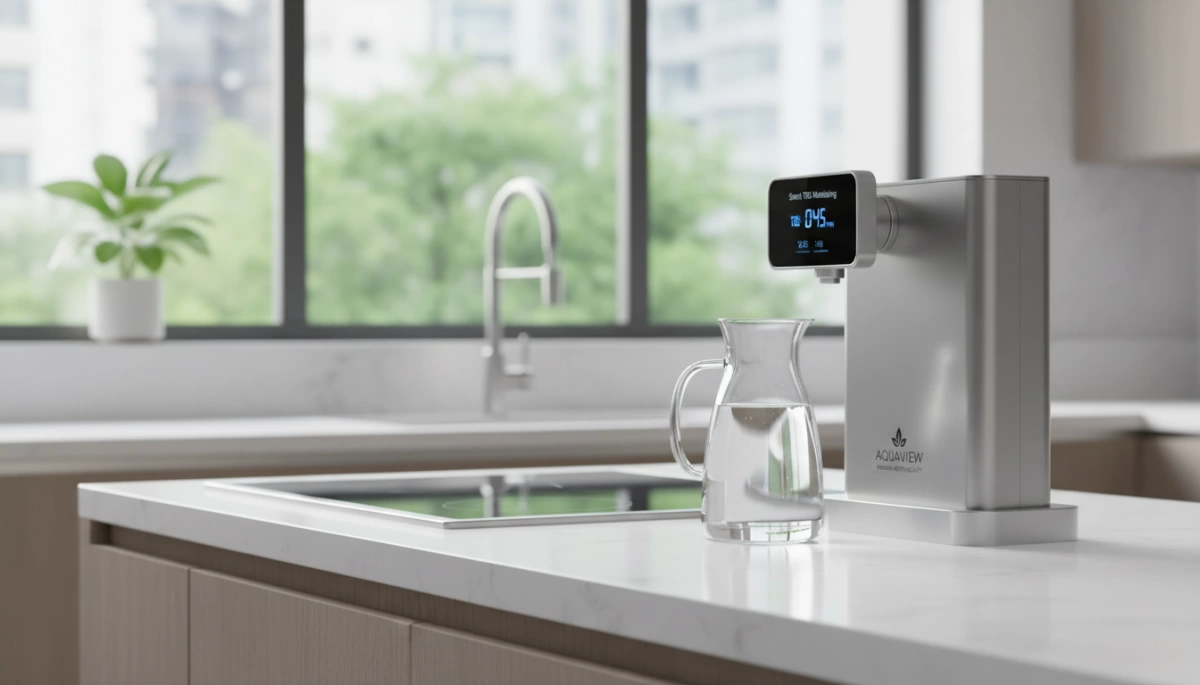
The Wellness Narrative: Verifying Mineral Balance
When I position our purifiers, I move beyond the basic promise of “clean water.” In the premium segment, customers are educated; they know that stripping water completely results in “dead” water. I use Smart TDS monitoring to prove that our multi-stage filtration—specifically the Alkaline, Copper, and Zinc stages—is actually doing its job. The digital readout isn’t just showing low contaminant levels; it serves as mineral balance verification. It confirms that while the reverse osmosis process has removed the harmful solids, the essential minerals remain. This shifts the conversation from simple safety to active wellness.
Smart Home Integration in the IoT Ecosystem
Modern American kitchens are evolving into connected hubs. A standard plastic filter looks out of place next to a smart fridge or a Wi-Fi-enabled oven. By integrating digital TDS display technology, we ensure our units fit seamlessly into the smart home ecosystem.
- Tech-Savvy Branding: Alerts for filter life and purity levels align with the expectations of IoT-savvy homeowners.
- Visual Consistency: The device feels like a gadget, not just a utility.
- User Confidence: Real-time feedback bridges the gap between traditional plumbing and modern tech.
UI and Aesthetics: High-End Interface Design
The user interface is where value perception is built. We moved away from mechanical buttons and analog gauges to create a luxury kitchen appliance aesthetic. Using sleek, black-and-gold or silver finishes paired with crisp LED indicators transforms the purifier into a design statement.
- Digital Intelligence: The screen provides immediate clarity on tank status and purification progress.
- Premium Feel: Touch-sensitive controls and bright data readouts scream quality.
- Design Synergy: The unit complements high-end countertops and fixtures rather than cluttering them.
This approach turns the hardware into a centerpiece, using visible purity verification to justify a premium price point.
The Business Case: Predictive Maintenance & Loyalty
For a premium brand, the relationship with the customer shouldn’t end at the point of sale. We use Smart TDS Monitoring not just as a flashy feature, but as a tool to secure long-term revenue and trust. By integrating predictive maintenance sensors, we eliminate the guesswork of filter changes. Instead of waiting for the water to taste bad—which damages brand reputation—the system proactively alerts the user when maintenance is actually required. This strategy is essential for expanding your market share with smart countertop RO water filter technology, as it positions the device as a self-managing asset rather than a maintenance burden.
Automating After-Sales
We leverage digital intelligence to streamline the ownership experience. Whether it is through a sophisticated on-device LED interface or a connected mobile sync, post-sales service automation ensures filters are replaced based on actual filtration load and water quality data, not just an arbitrary calendar date. This creates a recurring revenue loop that feels like a premium concierge service rather than a hassle.
Remote Diagnostics
Service calls are one of the biggest operational costs for water purification brands. When a unit features digital TDS display technology, we can often diagnose issues remotely. If the output TDS spikes unexpectedly, we know the RO membrane integrity might be compromised. If the TDS remains stable but flow restricts, it points to pre-filter issues. This data-first approach drastically cuts down unnecessary technician visits, saving time for both the business and the consumer.
Retention Strategy
Ultimately, this technology transforms a standard appliance into an active health partner. When customers see their purifier actively monitoring their water quality—verifying that the mineral balance of Copper and Zinc is optimized—they aren’t just drinking water; they are engaging with a wellness lifestyle. This constant, visible verification builds a level of loyalty that standard “black box” filters simply cannot match.
FAQs: Leveraging Smart TDS for Business Growth
Does adding Smart TDS significantly increase manufacturing costs?
Integrating digital TDS display technology does increase the initial bill of materials (BOM), primarily due to the addition of industrial-grade sensors and the PCB interface. However, looking at this solely as a cost is a mistake; it is an investment in value perception. By shifting the product from a standard utility to a smart home appliance, we can command a higher retail price point. The ROI comes from reduced customer anxiety and the ability to compete in the luxury segment where consumer trust indicators drive sales.
How do I explain TDS readings to non-technical customers?
The key is simplicity. I tell customers to think of the display as a “health scorecard.” The input number shows the dissolved solids entering the system, while the output number confirms the purification process. It is vital to educate them that “lower” isn’t always “zero.” Since our systems focus on health, a balanced reading indicates that we have successfully removed harmful contaminants while retaining essential minerals. This distinction is crucial when discussing why 0.0001 micron filtration is the gold standard for safety without stripping water of its nutritional value.
Can Smart TDS be integrated into existing product lines?
Retrofitting real-time water quality monitoring into older molds is technically possible but often inefficient. True premium appliance differentiation requires a holistic design approach where the user interface (UI) is seamless, not an afterthought. For maximum impact, the sensors and the LED display need to be part of the core engineering, ensuring accurate dual-sensing TDS accuracy and a sleek aesthetic that aligns with modern kitchen interiors.

