
















Reliability Testing Water Dispenser
When we manufacture a water filter dispenser, we don’t just guess if it’s going to last—we prove it. Are you worried about your new system leaking all over your kitchen floor or leaching chemicals into your glass? You should be. That is exactly why we rely on the three core pillars of reliability testing water dispenser standards to guarantee absolute safety and performance.
Material Safety Testing
1. Preventing Toxic Leaching
We conduct rigorous material safety testing on every single component. We ensure that the plastics, metals, and O-rings inside the dispenser absolutely do not leach harmful chemicals, like BPA or heavy metals, into your filtered water over time.
Structural Integrity Validation
2. Stress and Endurance Tests
We apply a brutal stress testing methodology to guarantee the housing stays intact under extreme conditions. Our endurance testing standards include:
- Hydrostatic Pressure Tests: We push the system well beyond standard municipal water pressure limits to ensure the housings will never burst.
- Cyclic Testing: By strictly following a lifecycle testing protocol, we simulate years of heavy household use. We slam the water pressure on and off 10,000 to 100,000 times to expose any potential fatigue or leaks.
Contaminant Reduction Performance
3. End-of-Life Effectiveness
A filter that only works on day one is completely useless. We demand consistent contaminant reduction performance. We validate that the filters actually remove the specific impurities they claim to—from aesthetic issues like chlorine to hazardous threats like lead and arsenic—at the very end of the filter’s lifecycle.
Decoding the Alphabet Soup: Key Certifications You Must Know
When evaluating reliability testing standards for water filter dispensers, you immediately run into a wall of acronyms. Here in the US market, these certifications aren’t just suggestions—they are the foundation of our quality validation process. We rely on them to prove a system actually does what it claims on the box.
Let’s break down the essential NSF/ANSI standards you need to look for:
- NSF/ANSI Standard 42 (Aesthetic Effects): This covers the basics. It guarantees the filter reduces non-health-related impurities like chlorine, clearing up bad taste and odor.
- NSF/ANSI Standard 53 (Health Effects): This is strictly about safety. It ensures the system effectively traps dangerous health-harming contaminants like lead, VOCs, and cysts.
- NSF/ANSI Standard 58 (Reverse Osmosis): Built specifically for RO systems. It validates reverse osmosis stability and confirms the filtration membrane actually strips out heavy-duty impurities under pressure.
- NSF/ANSI Standard 61 (Material Safety): This standard guarantees the physical components of the drinking water system won’t leach heavy metals or harmful plastics back into your clean water.
Independent Performance Assurance
Passing a test on day one isn’t enough. We look to independent laboratories for ongoing performance assurance.
- WQA Certification: The Water Quality Association’s Gold Seal proves the product has survived rigorous, continuous testing and meets strict industry water standards.
- UL Evaluation: An Underwriters Laboratories rating ensures the electrical and mechanical safety of the dispenser. It guarantees the appliance is built tough and won’t fail or short out under heavy daily use.
Advanced Lifecycle and Stress Testing Methodology in Manufacturing
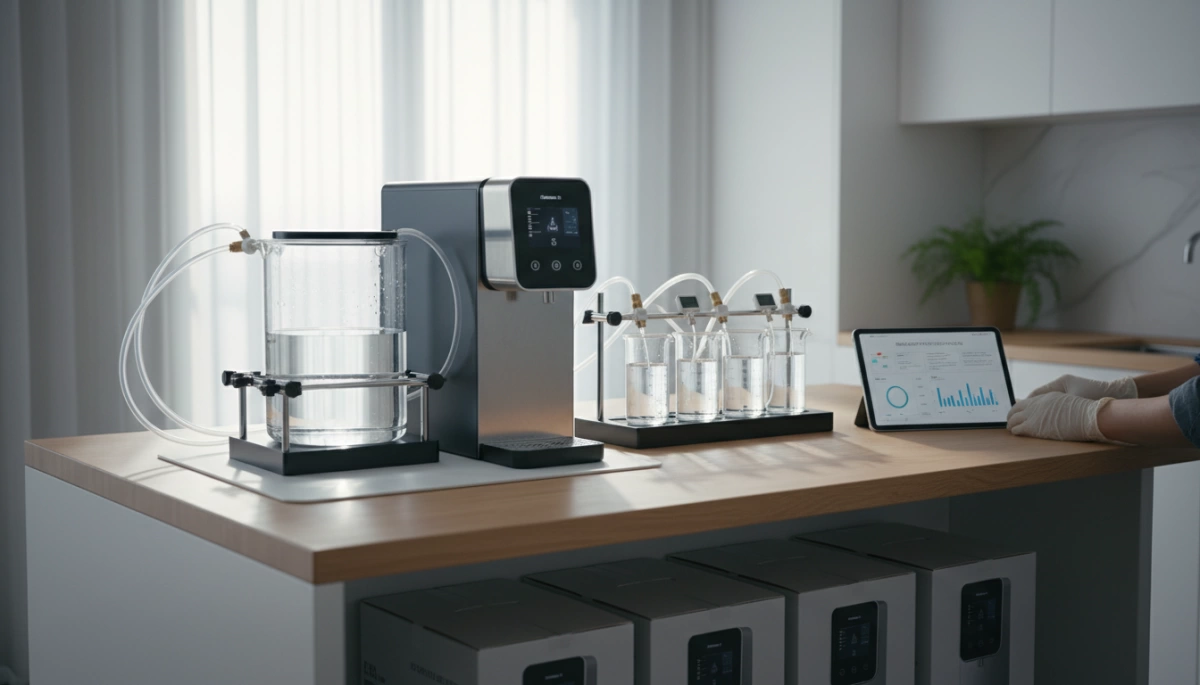
To guarantee true household appliance reliability, we don’t just assemble water filter dispensers—we push them to their absolute limits. Our stress testing methodology is designed to mimic years of heavy daily use in a typical American home or office. We rely on a strict lifecycle testing protocol to ensure every unit can handle the everyday wear and tear of real life.
Here is how our quality validation process works on the manufacturing floor:
- Thermal Shock Testing: We expose both the hot and cold water dispenser components to rapid, extreme temperature fluctuations. This is a crucial part of our endurance testing standards, ensuring that internal valves, tanks, and seals won’t crack or degrade when constantly switching between near-boiling and ice-cold water.
- Component Qualification Testing: Every individual part has to prove its worth. For instance, we validate reverse osmosis stability by heavily testing RO membranes to ensure they maintain strong flow rates (such as 5.2L/min) over a massive 10,000L service life. To achieve and maintain this kind of sustained water pressure without system fatigue, understanding the importance of large-diameter tubing for high-flow RO is a key part of our structural design and testing phase.
- Smart Technology Validation: A smart water dispenser is only as reliable as its electronics. We rigorously test all digital components for long-term performance assurance. This means repeatedly triggering smart filter replacement alerts and cycling through multi-functional 4-in-1 dispensing mechanisms to guarantee the sensors and motherboards stay accurate in a moisture-rich environment.
By strictly enforcing these Reliability Testing Standards for Water Filter Dispensers, we deliver a final product that performs exactly as promised, from the first drop to the ten-thousandth gallon.
Reliability Testing Standards for Water Filter Dispensers: The “Certified” Loophole
The “NSF Certified” Illusion
As a manufacturer, I see consumers fall into a common trap every day. You see a generic “NSF Certified” logo on a box and automatically assume your drinking water is entirely safe. Here is the warning: that single badge can be highly misleading.
A water system might pass structural integrity validation—meaning the plastic housing won’t crack or leak under pressure—but completely lack proper contaminant reduction performance. It might make the water taste a little better by removing chlorine, but leave hazardous heavy metals untouched. Whether you are investing in a whole-house system or just a compact bathroom sink water filter, you simply cannot rely on the marketing logo alone to guarantee safety.
Reading the Performance Data Sheet
The only way to verify true household appliance reliability is by reading the fine print. To understand a system’s actual capabilities, you must locate its Performance Data Sheet. This document is the ultimate proof of a filter’s effectiveness.
Here is exactly what you need to look for to guarantee performance assurance:
- Find the Exact NSF/ANSI Standards: Do not settle for a vague “NSF Certified” claim. Look for the specific numbers. Standard 42 only covers aesthetic effects like taste and odor. You need Standard 53 to verify the removal of serious health hazards like VOCs, lead, and cysts.
- Verify Actual Reduction Rates: Does the filter remove 99% of a specific impurity, or just 50%? The data sheet clearly lists the exact reduction percentages achieved during the strict quality validation process.
- Check the Capacity Limits: A filter might perform flawlessly on day one, but what about gallon 500? The performance data sheet specifies exactly how many gallons the system can safely process before the filter media is exhausted and requires replacement.
How Driplife Sets the Standard for Dispenser Reliability
When it comes to reliability testing standards for water filter dispensers, we don’t just follow the rules—we help set the benchmark. With over 15 years of R&D and manufacturing experience, we know exactly what it takes to build systems that global brands and distributors can trust.
State-of-the-Art R&D Labs
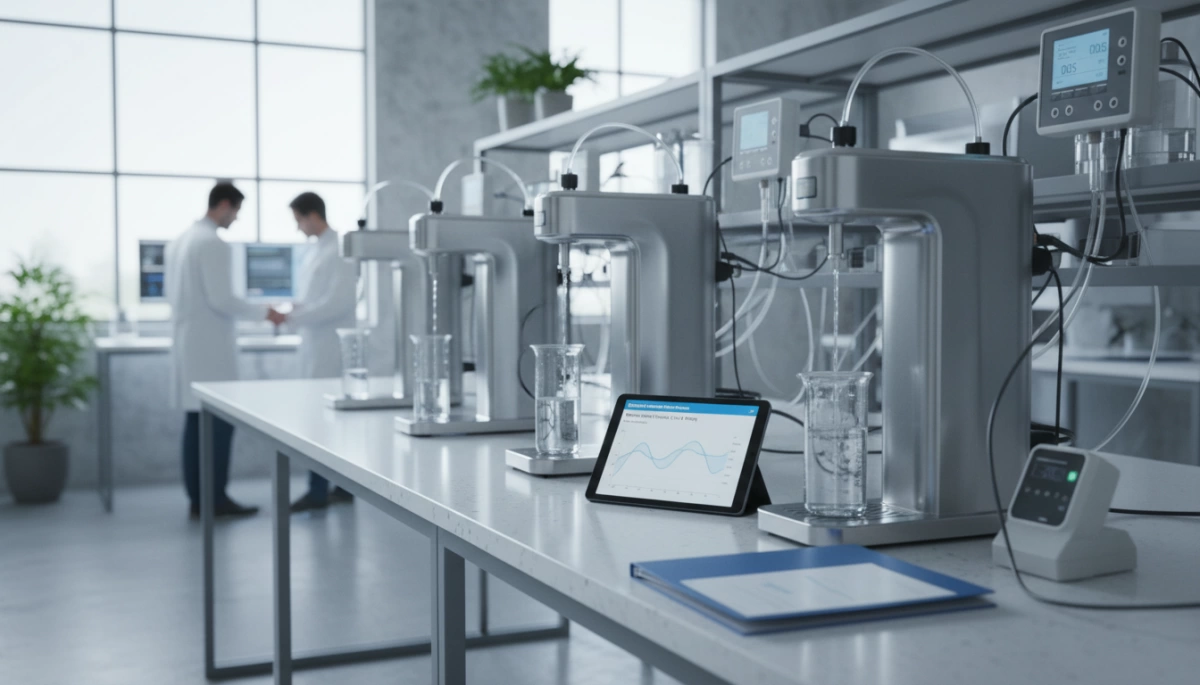
Our dedicated research and software laboratories are the backbone of our operation. This is where we push our systems to the limit to guarantee long-term household appliance reliability.
- Smart Tech Validation: We rigorously test electronic components, ensuring our Smart Alert Systems for filter replacement trigger accurately every single time.
- Membrane Stability: We run extensive lifecycle testing protocols to ensure our high GPD RO membranes maintain a consistent 5.2 L/min flow rate without degrading.
- Multi-Function Testing: Our 4-in-1 systems (filtration, cold, hot, ice making) undergo an intense stress testing methodology to survive years of heavy daily use.
Strict Quality Validation Process
Scaling up production shouldn’t mean scaling down quality. We maintain flawless performance assurance across massive production runs.
- Massive Scale: Our operations run out of a state-of-the-art 60,000 ㎡ manufacturing facility.
- High Output: We confidently handle an annual production capacity of 500,000 units without compromising on precision.
- Defect Prevention: Every single unit passes through a strict quality validation process before it ever leaves the factory floor.
OEM/ODM Excellence
Global brands partner with us because we deliver consistency. Whether we are designing custom under-sink systems or manufacturing advanced countertop water filters, we ensure every product meets the strictest international qualification testing standards. From initial product design to large-scale global distribution, we provide the endurance testing standards necessary to protect your brand’s reputation in a competitive market.