
















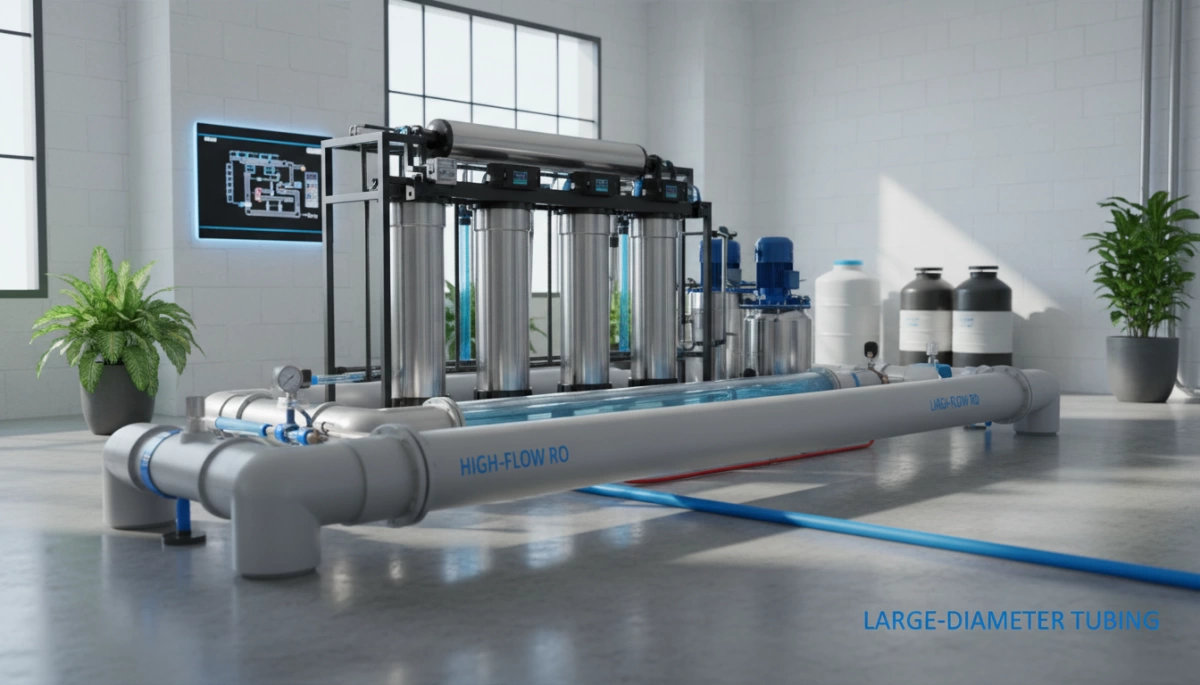
The Physics of Flow: Friction Loss Explained
When we engineer high-performance water filtration, we often obsess over the membrane capacity, but the delivery system is just as critical. You can have the most powerful engine in the world, but if you restrict the exhaust, you lose power. The same principle applies to fast flow reverse osmosis. The tubing acts as the highway for your water; if the lanes are too narrow, traffic jams are inevitable.
Standard 1/4 Inch OD Tubing Limitations
For decades, the industry standard for residential RO systems has been 1/4 inch OD tubing. This size works adequately for traditional systems that slowly fill a storage tank over several hours. However, in the era of tankless water filter efficiency, this narrow diameter is a major handicap.
Using 1/4 inch tubing on a high-output system creates a severe bottleneck. The internal diameter (ID) of these tubes is so small that it physically restricts the volume of water that can pass through, regardless of how much pressure the internal pump generates.
Understanding Friction Loss and Pressure Drop
Fluid dynamics dictates that as water moves through a pipe, it experiences friction against the tube walls. This flow resistance results in a significant pressure drop over distance.
- Narrow Tubing: Higher velocity but significantly higher friction, leading to drastic pressure loss before the water reaches your glass.
- Wide Tubing: Lower friction allows the system to maintain the pressure generated by the pump, delivering water smoothly and quickly.
If you try to push 800 GPD through a standard 1/4 inch line, you are forcing the system to fight against itself, wasting energy and reducing the flow rate at the faucet.
The Math: 3/8 Inch vs 1/4 Inch Tubing
The difference between 1/4 inch and 3/8 inch might seem negligible to the naked eye, but mathematically, it is a game-changer. The flow capacity is determined by the cross-sectional area of the internal diameter (ID), not just the outer width.
Here is why we prioritize larger tubing:
- Geometry: A small increase in diameter results in a squared increase in area ($A = \pi r^2$).
- Capacity: Moving to 3/8 inch tubing roughly doubles the cross-sectional area available for water flow compared to 1/4 inch lines.
- Result: This allows for double the volume movement with significantly less friction loss in water pipes.
By upgrading the plumbing architecture to 3/8 inch, we ensure that the high GPD RO membrane operates at peak potential, delivering the rapid fill times our customers expect.
Why Tankless RO Needs Large-Diameter Tubing
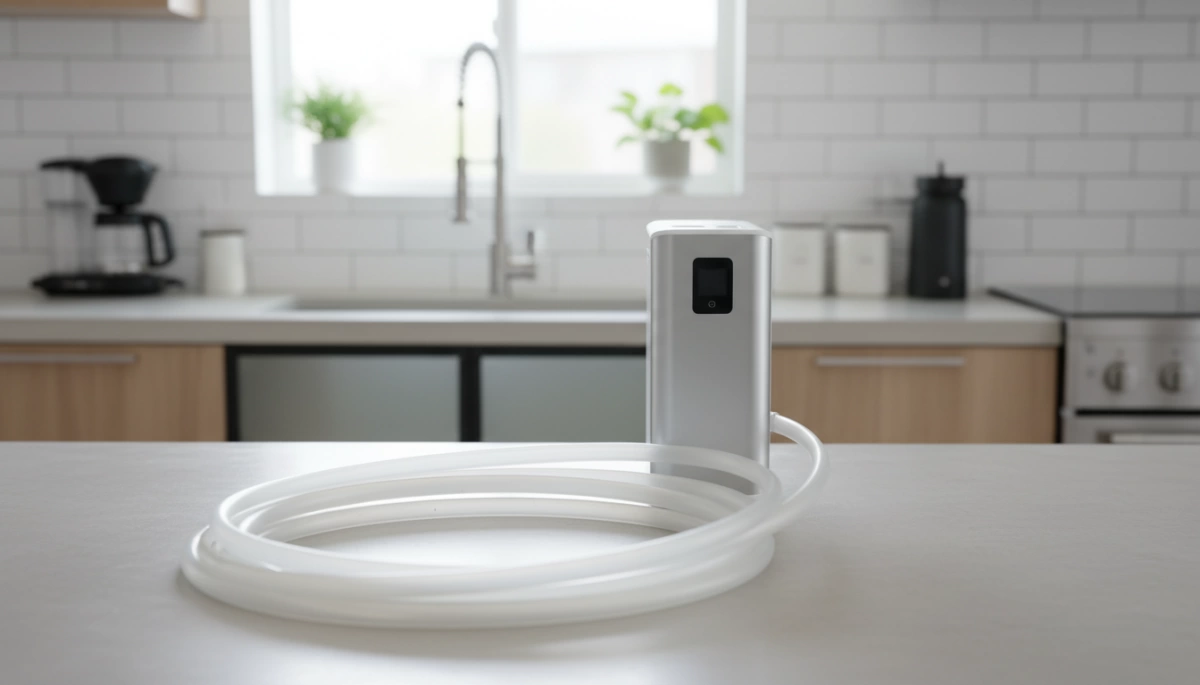
When we design high-capacity water systems, we aren’t just upgrading the filter; we are completely changing the physics of how water is delivered. The shift from traditional tank-based units to modern tankless systems requires a fundamental change in plumbing architecture, specifically regarding internal diameter (ID) and tubing width.
Real-Time Production vs. Storage Buffers
In a traditional system, the RO membrane produces water very slowly—drop by drop—into a storage tank. The pressure you feel at the faucet comes from the tank’s air bladder, not the filter itself. This allows them to get away with narrow tubing.
Tankless water filter efficiency relies on real-time production. When you open the tap on our units, the system must instantly produce and push water at a usable speed. There is no buffer. If the tubing is too narrow, it acts like a bottleneck, strangling the flow rate regardless of how fast the membrane can purify water.
The Role of Internal Booster Pumps
To achieve fast dispensing, we equip our 600 GPD and 1000 GPD models with powerful internal booster pumps. These pumps generate significant pressure to drive water through the 0.0001-micron RO membrane.
- Standard 1/4″ Tubing: Creates high friction. The pump has to work harder to push water through the narrow channel, leading to heat buildup and potential wear.
- Larger 3/8″ Tubing: Reduces flow resistance. The pump operates efficiently, pushing water smoothly to the faucet without fighting against the plumbing.
Managing High Volume and Backpressure
When dealing with a 600 GPD tankless system or higher, managing volume is critical. Forcing high volumes of water through narrow lines creates backpressure. This doesn’t just slow down your cup fill time; it creates noise and vibration.
By utilizing large-diameter tubing, we ensure backpressure reduction. This keeps the system quiet and ensures that the pressure generated by the pump translates directly into flow at your faucet, rather than being lost to friction inside the tubes.
| Feature | Traditional Tank RO | High-Flow Tankless RO |
|---|---|---|
| Production Speed | Slow (Drop-by-drop) | Instant (Real-time) |
| Pressure Source | Storage Tank Bladder | Internal High-Pressure Pump |
| Tubing Requirement | Standard 1/4″ OD | Large 3/8″ OD |
| Risk of Backpressure | Low | High (if tubing is too narrow) |
The Delivery Side: System to Faucet Connection
We often focus heavily on the filtration engine, but the critical path from the RO system to your glass is where the user experience is actually made. You can have the most powerful pump in the world, but if the water delivery side is choked by narrow plumbing, that power is wasted. That is why we treat the connection between the unit and the faucet as a vital component of the system’s overall performance.
Dedicated High-Flow Hardware
It is not enough to just upgrade the tubing; the exit point matters just as much. We utilize dedicated high-flow faucets with wider shanks designed specifically to handle the volume of fast flow reverse osmosis. A standard faucet often acts as a restrictor plate, creating unnecessary backpressure. Unlike older water filter types that trickle water out via gravity or stored pressure, our setup ensures the hardware matches the 3/8″ tubing architecture, allowing the water to flow freely without resistance.
Real-World Speed Differences
The difference in water dispenser speed is immediately noticeable in daily use. When we compare 3/8 inch vs 1/4 inch tubing configurations, the time savings are significant:
- Standard 1/4″ Setup: Fills a cup in roughly 12–15 seconds.
- High-Flow 3/8″ Setup: Fills a cup in just 5–8 seconds.
This speed transforms kitchen tasks. Whether you are filling a large stockpot for a pasta dinner or grabbing a quick glass of water, the increased flow rate eliminates the frustration of waiting. It turns a RO faucet upgrade kit from a luxury into a necessity for modern, busy kitchens.
Boosting System Longevity and Efficiency
When we engineer high-capacity water filtration systems, we aren’t just looking at speed; we are focused on the total lifespan of the unit. The diameter of your tubing directly impacts the health of the internal components, specifically the high-pressure pumps required for tankless operation.
Reducing Pump Workload and Heat
In a tankless RO system, the internal booster pump is the heart of the operation. If you restrict the output with narrow internal diameter tubing, you create significant flow resistance. This forces the pump to work harder to push the same volume of water, leading to increased operating temperatures.
- Lower Stress: Using 3/8 inch tubing allows water to exit the membrane housing freely, significantly reducing the load on the motor.
- Heat Management: Less resistance means the pump runs cooler, preventing premature wear on electronic components and seals.
Maintaining the 2:1 Pure-to-Drain Ratio
Our systems are designed for high efficiency, typically achieving a 2:1 pure-to-drain ratio. This balance relies on precise pressure management across the RO membrane. If the permeate (clean water) line suffers from high backpressure reduction issues due to friction loss, the system equilibrium is disrupted.
Restricted flow on the clean water side can inadvertently force the system to bypass more water to the drain to maintain the osmotic process. By ensuring the delivery side has adequate volume capacity, we protect the system’s efficiency rating. To keep track of how well your system is performing over time, customizing the filter life indicator ensures you know exactly when maintenance is due without guessing, helping you maintain that optimal efficiency for years.
Driplife’s High-Flow Engineering Approach
At DripLife, we understand that achieving true fast dispensing requires more than just a powerful pump; it demands a complete overhaul of the system’s internal plumbing. Our High-Flow Engineering Approach ensures that the benefits of Large-Diameter Tubing for High-Flow RO are not lost the moment water enters the unit. Traditional systems often suffer from internal bottlenecks where wide external hoses meet narrow internal ports. We solved this by utilizing an integrated design with optimized internal waterways. By molding the water path directly into the composite manifold, we eliminate the maze of small tubes and sharp bends that typically cause friction loss and pressure drop.
Our architecture is standardized for high-capacity performance right out of the box. You do not need to worry about retrofitting adapters or dealing with incompatible parts. This seamless integration makes it easier to install top under-counter water filters that deliver immediate results without complex modifications.
Key Engineering Advantages:
- The G2/G3 Series Edge: These models are specifically calibrated to maximize the volume output supported by 3/8″ tubing, allowing the internal booster pump to run cooler and quieter.
- Smart TDS Precision: Our Smart TDS faucets rely on steady, non-turbulent flow to provide accurate real-time purity readings. The optimized internal diameter of our waterways ensures the sensors get a consistent sample every time.
- Leak-Free Reliability: By reducing the number of internal connections and utilizing integrated waterways, we minimize potential leak points while maintaining the high velocity needed for tankless systems.
Frequently Asked Questions About RO Tubing
Can I upgrade my old RO system to 3/8 inch tubing?
Technically, you can, but it often doesn’t solve the core issue. Most traditional tank-based systems are built with internal ports and housings designed strictly for 1/4 inch tubing. Even if you swap the external lines for wider 3/8 inch tubing, the internal connections still act as a bottleneck, restricting the reverse osmosis flow rate. To get true high-speed delivery, you generally need a modern system engineered with wider internal waterways from the start, rather than trying to retrofit an obsolete unit.
Does larger tubing affect water quality or taste?
No, the diameter of the tubing has zero impact on taste or purity. The internal diameter (ID) only dictates how fast the water travels, not how well it is filtered. As long as the tubing is made from food-grade, BPA-free materials—which is standard for our high-capacity units—your water quality remains safe. The only tangible difference you will notice is the fast flow reverse osmosis speed, allowing you to fill pots and pitchers without the wait.
Is 3/8 inch tubing compatible with standard refrigerators?
Most refrigerators in the US are factory-plumbed for standard 1/4 inch lines. If you are connecting a high-flow DripLife RO system to your fridge, you will likely need a simple quick connect fitting (reducer) to step the line down from 3/8″ to 1/4″ right before the connection point. This allows you to maintain high pressure in the main line for your faucet while safely feeding your ice maker.
How do I know if my system is restricting flow?
The easiest test is timing your output. If filling a standard 8oz cup takes longer than 10-12 seconds, your system is likely suffering from friction loss or narrow tubing restrictions. You might also hear the internal pump straining, which indicates it is fighting against high flow resistance. A proper 600 GPD tankless system with the right tubing should fill that same cup in about 5-8 seconds effortlessly.