
















The Hard Water Reality Check: Why Your RO Struggles
Water hardness is the silent killer of high-performance filtration. When we talk about water hardness grains per gallon (GPG), we aren’t just discussing taste; we are measuring the concentration of dissolved calcium and magnesium that threatens your system’s hardware. In many US regions, tap water exceeds 7-10 GPG, creating an environment where standard filtration setups inevitably fail.
The Mismatch: 0.0001 Micron Pores vs. Sticky Minerals
The core conflict lies in the engineering of the Reverse Osmosis membrane. To achieve purity, our RO membranes utilize a pore size of 0.0001 microns—tight enough to strip out heavy metals and bacteria. However, this precision creates a vulnerability in hard water environments.
As water is forced through these microscopic pores, hardness minerals are left behind on the membrane surface. Unlike sediment that simply sits there, calcium and magnesium undergo mineral crystallization, forming a hard, sticky scale layer. This is not just debris; it is a physical blockage that cements over the pores, preventing water molecules from passing through.
Recognizing Early Signs of Membrane Fouling
If your system lacks adequate hard water pre-treatment, the decline in performance is predictable and rapid. You will likely notice these symptoms long before the rated filter life expires:
- Drastic Flow Reduction: The “clogged artery” effect causes the pure water output to trickle rather than flow.
- TDS Creep: As the membrane fouls, its rejection rate drops, leading to higher Total Dissolved Solids in your glass.
- Constant Pump Activity: The system works harder and longer to push water through the scaling, straining internal components.
Without intervention, RO membrane fouling turns a high-efficiency appliance into a maintenance nightmare, forcing premature and costly replacements.
The Science of Scaling: How Minerals Kill Membranes
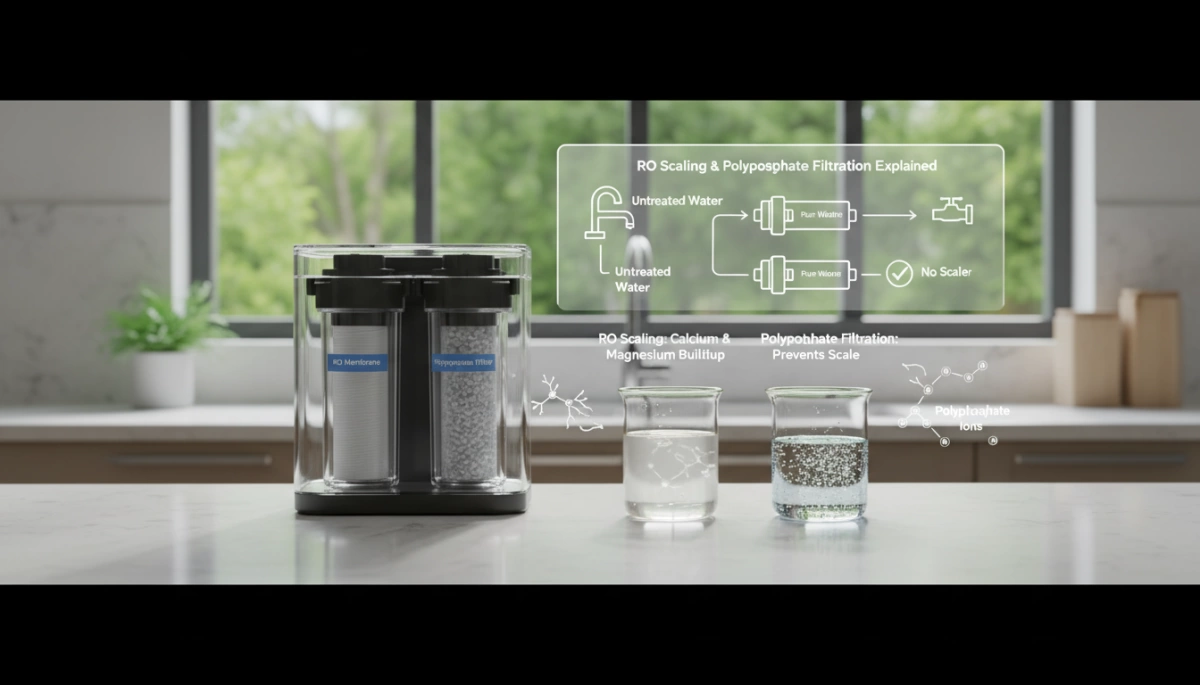
To understand why hard water destroys filtration systems, you have to look at concentration polarization. As water is forced through the 0.0001-micron pores of an RO membrane, pure water passes through while calcium and magnesium are left behind on the surface. Without proper hard water pre-treatment, these minerals become super-concentrated. Eventually, they exceed their saturation point and crystallize, turning back into solid rock right on top of your filter.
Think of this process like a clogged artery. Just as plaque restricts blood flow, limescale restricts water flow. The scale forms a hard, crusty layer that chokes the membrane’s pores. This leads to severe RO membrane fouling, which causes two immediate performance issues:
- Reduced Flux: The system struggles to push water through the blocked pores, drastically slowing down your flow rate.
- TDS Creep: As the membrane degrades under the pressure of the scale, it loses its ability to reject salts, causing the Total Dissolved Solids in your glass to rise.
If you ignore these signs, you aren’t just losing water pressure; you are compromising the purity of your output. Maintaining consistent TDS reduction is critical, especially if you plan to use reverse osmosis water in your humidifier or high-end appliances that require mineral-free water to function correctly.
Enter Polyphosphate: The Anti-Scale Bodyguard
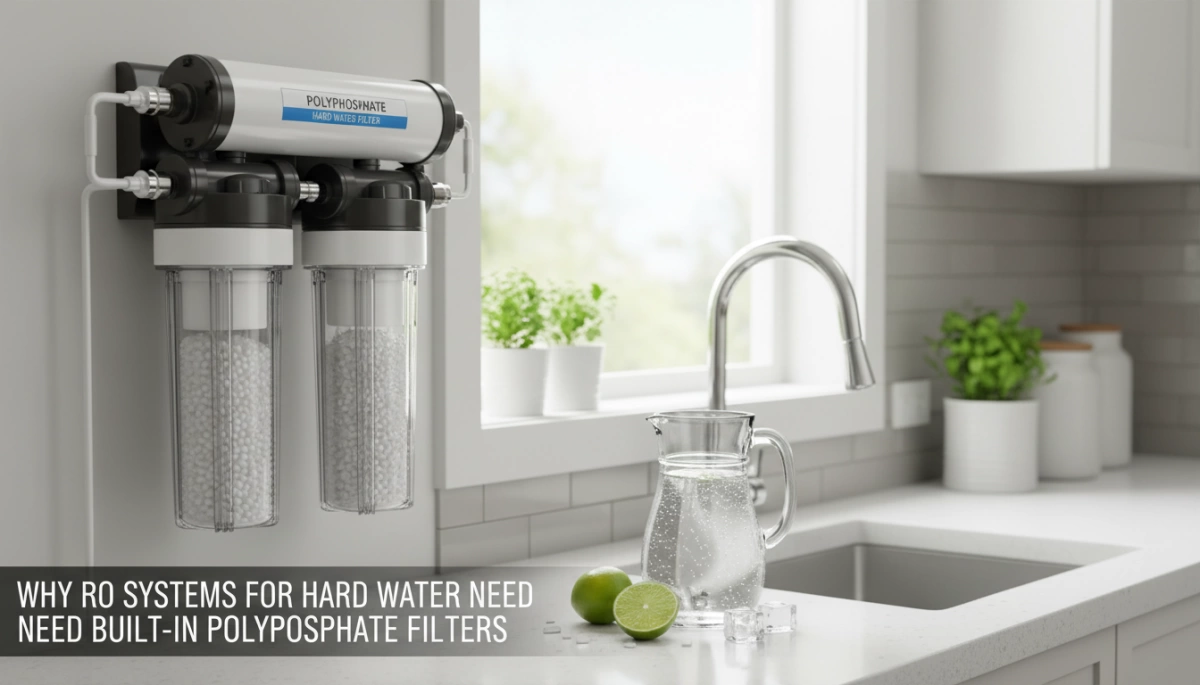
When we engineer systems for the US market, we know that standard filtration often fails in hard water zones. That is why we integrate polyphosphate, specifically slow-release Siliphos anti-scale media, directly into our composite pre-filters. This isn’t about removing minerals through bulky ion exchange; it is about changing how those minerals behave chemically to protect your investment.
The Science of Sequestration
We utilize a process technically known as calcium and magnesium sequestration, but I prefer to call it the “coat and float” method. As water flows through the initial filter stage, the polyphosphate beads slowly dissolve, releasing a food-grade inhibitor.
Here is how this scale inhibition technology works inside the system:
- Coating: The dissolved polyphosphate wraps around hard mineral ions (calcium and magnesium).
- Neutralization: This coating prevents the ions from interacting with other particles to form solid crystals.
- Suspension: Instead of turning into sticky limescale, the minerals remain suspended in the water.
Preventing Adhesion in the Brine Stream
The real magic happens when this treated water hits the tight pores of the RO membrane. Without protection, high pressure forces minerals to crystallize and clog the membrane surface. With our integrated scale inhibitor, those minerals are rendered inert. They cannot stick to the membrane sheets or internal plumbing.
Instead of causing blockages, the hardness minerals simply float harmlessly in the wastewater (brine) stream and are flushed down the drain. This is critical for longevity. Much like observing the impact of hard water on internal chiller components, we see that preventing adhesion is the only way to maintain high flow rates and prevent system failure in hard water environments.
Why Built-in Pre-Filters Beat External Add-ons
Space-Saving Advantages Over Traditional Water Softeners
In many US households, the space under the kitchen sink is prime real estate, often crowded with garbage disposals and cleaning supplies. Traditional hard water solutions usually involve installing a bulky external pre-filter housing or relying on a massive whole-house water softener loop just to protect the drinking water unit. We take a different approach by designing compact under-sink distribution systems that eliminate the need for extra hardware. By integrating scale inhibition technology directly into the unit, we remove the clutter of external canisters, keeping the installation footprint minimal without sacrificing membrane protection.
Engineering Integration: Placing Protection in Stage 1 or 2
Effective hard water treatment relies on precise placement of the anti-scale media. Instead of bolting on an aftermarket filter, we engineer our composite filters to include polyphosphate beads within the initial filtration stages. Typically, this integrated scale inhibitor is embedded within the Stage 1 (PP Cotton) or Stage 2 (Carbon Block) composite cartridge. This strategic positioning ensures that calcium and magnesium are sequestered immediately upon entering the system, preventing mineral crystallization before the water ever reaches the delicate RO membrane. This “all-in-one” engineering optimizes internal flow dynamics and prevents pressure drops common with external add-ons.
Simplifying Maintenance for DIY Water Treatment Enthusiasts
External housings often require heavy filter wrenches and messy bucket brigades to change cartridges. Our integrated design focuses on the user experience, utilizing a “twist-and-pull” mechanism for filter replacements. Because the polyphosphate scale inhibitor is part of the standard composite pre-filter, you don’t have to track a separate maintenance schedule for a hard water filter. When the system alerts you to change the pre-filter, you are automatically refreshing the scale protection. This streamlines maintenance, ensuring that the RO membrane lifespan is protected without requiring professional plumbing skills or complex tools.
The Payoff: Longevity and Performance Gains
When you ignore hard water, you pay for it in replacement filters. Without protection, calcium deposits can choke a standard RO membrane in as little as three months in areas with high grain hardness. By integrating scale inhibition technology, we effectively prevent those minerals from crystallizing on the membrane surface. This simple addition acts as a shield, significantly extending reverse osmosis membrane lifespan—often pushing replacement intervals from a few months to over two years.
This protection is critical for maintaining the speed of modern filtration setups. A tankless RO system relies on high pressure to deliver water instantly without a storage tank. If the membrane pores get clogged with scale, your flow rate plummets, and the internal pump has to work overtime. Our under-sink 800-2000GPD reverse osmosis filtration systems utilize built-in anti-scale media to ensure that the rated High GPD performance remains consistent throughout the filter’s life, rather than slowing down to a trickle after a few weeks of use.
Efficiency and Waste Reduction
Beyond just saving the hardware, preventing scale buildup directly impacts your utility bills and environmental footprint.
- Wastewater Ratio Optimization: A clean membrane operates at peak efficiency, maintaining a low drain ratio (often 2:1 or better). A scaled membrane rejects more water, sending gallons down the drain for every cup you drink.
- Energy Consumption: When flow is restricted by mineral buildup, the system’s booster pump draws more power to force water through the blockage.
- Consistent Purity: Keeping the membrane surface clean ensures stable TDS reduction over time, rather than seeing a spike in dissolved solids as the filter degrades.
Safety First: Is Polyphosphate Safe to Drink?
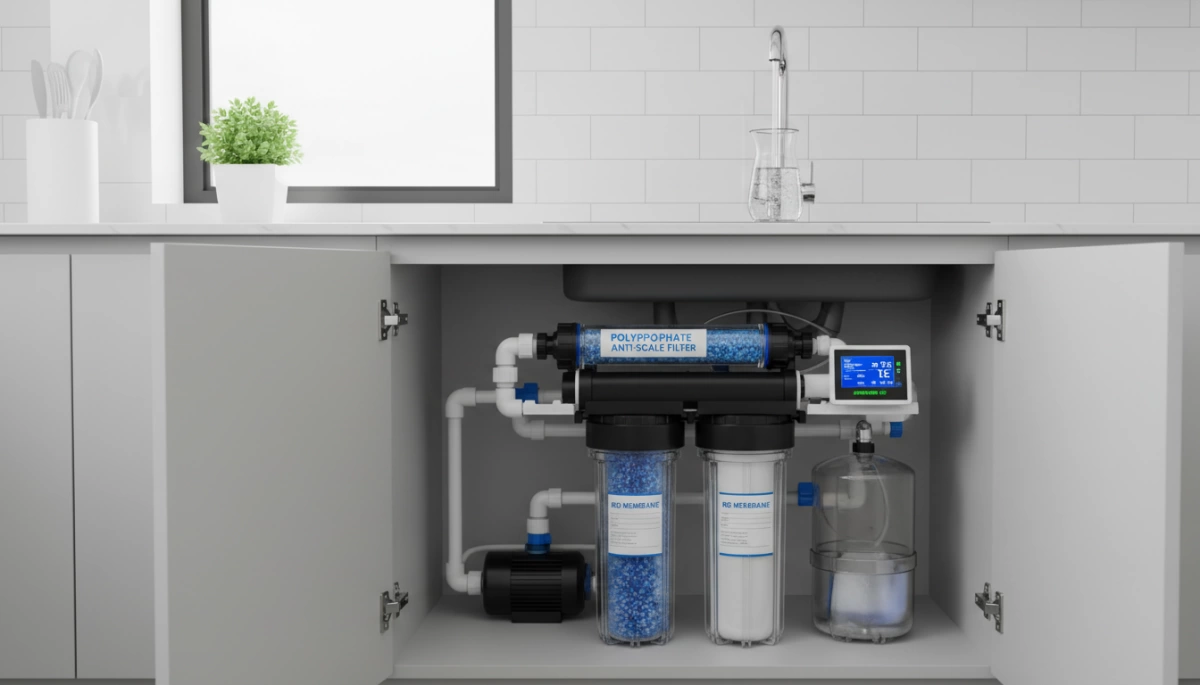
When we engineer systems for hard water areas, safety is the baseline. A common concern is whether adding a scale inhibitor introduces unwanted chemicals into your drinking water. The short answer is that the polyphosphate media we use is strictly food-grade and non-toxic. It is a standard additive used safely in the food and beverage industry for decades to prevent spoilage and texture changes.
However, the real safety net lies in the Reverse Osmosis process itself. In our systems, the polyphosphate serves a sacrificial role during the pre-treatment phase.
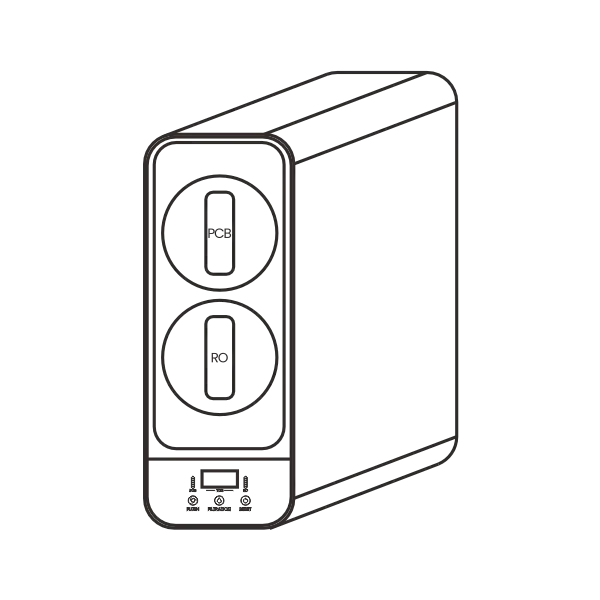
- Sequestration: The media binds to calcium and magnesium in the pre-filter stages (PCB/PCT) to prevent them from crystallizing.
- Rejection: When this water reaches the RO membrane, the 0.0001-micron pores block virtually all dissolved solids.
- Flushing: The membrane rejects the mineral-polyphosphate compounds, flushing them out with the wastewater.
Because the RO membrane acts as the ultimate barrier, the anti-scale beads do not pass through to your faucet. You get the protection of a softener without drinking the additive. This approach is central to designing a brand story around water purity and family safety, ensuring that the only thing in your glass is clean, fresh water.
Taste Profile: Polyphosphate vs. Salt-Based Softeners
Unlike traditional whole-home softeners, our method does not alter the taste of your water.
- Salt-Based Softeners: Replace calcium with sodium through ion exchange, often leaving water tasting slightly salty or feeling “slippery.”
- Polyphosphate Inhibition: Keeps minerals suspended until the RO membrane removes them entirely.
The result is a crisp, neutral taste profile typical of high-quality RO water, without the sodium spike associated with salt softeners.
How We Engineer Systems for Hard Water Areas
At Driplife, we design our filtration architecture specifically to handle the aggressive mineral content found in many American homes. We move beyond basic filtration by embedding scale inhibition technology directly into the system’s core logic.
- Integrated Composite Pre-filters: We utilize advanced PCT or PCB composite filters that combine sediment removal, carbon filtration, and slow-release polyphosphate beads into a single unit. This “all-in-one” approach ensures that calcium and magnesium are sequestered immediately, preventing them from crystallizing on the RO membrane further down the line.
- Intelligent System Monitoring: Protecting your membrane requires timely maintenance. Our systems feature smart displays and faucets that provide real-time data on filter life. You aren’t left guessing when the anti-scale media is used up; the system alerts you exactly when a swap is needed to maintain peak performance.
- Space-Efficient Architecture: By integrating the softener stage inside the filter cartridge, we eliminate the need for bulky external housings. This results in sleek, tankless units that maximize the benefits of under-sink water purifier systems, keeping your kitchen cabinet organized while delivering high-flow purification.
FAQ: Common Concerns About Hard Water ROs
Can I use an RO system without a whole-house water softener?
Yes, provided you choose the right hardware. Standard RO units often fail quickly in hard water environments because calcium and magnesium destroy the membrane. We engineer our systems specifically for this challenge by integrating scale inhibition technology directly into the pre-filters. This built-in protection allows the system to handle hard water without requiring a bulky, expensive external softener, which helps manage the long-term cost of your home water filtration setup.
How often should I replace the polyphosphate cartridge?
We have simplified this process by embedding the anti-scale media within our multi-stage composite filters. You do not need to mess with loose beads or track grains per gallon manually. Our systems feature smart monitoring that tracks actual usage and water quality. Typically, the system will alert you to replace the composite filter every 6 to 12 months. The “twist-and-pull” design ensures you can swap the filter in seconds without tools.
Does polyphosphate add chemicals to my drinking water?
No. The polyphosphate serves a functional, “sacrificial” role during hard water pre-treatment. It binds to hardness minerals to keep them suspended in the water so they don’t crystallize on the system components. Crucially, the Reverse Osmosis membrane—which filters down to 0.0001 microns—rejects these sequestered minerals and the polyphosphate itself, flushing them out through the drain. The final product is pure water, free from chemical additives.

