














Deep Dive: What is Burst Pressure Testing?
For distributors and OEMs, the ultimate nightmare scenario isn’t a clogged filter—it’s a catastrophic housing failure that floods a customer’s property. At Driplife, we view hydrostatic burst testing as the definitive verification of our manufacturing quality. This process involves filling the RO system with water and steadily increasing the internal pressure until the structural limit is reached, measuring the static load capacity of our components.
Understanding the Physics of Hydrostatic Pressure
Hydrostatic pressure refers to the force exerted by a fluid at rest. In the context of Reverse Osmosis (RO) systems, the filter housings and manifolds are under constant stress from the municipal water supply. Burst pressure testing pushes materials beyond their yield strength to determine the exact point of physical failure. This data is critical for validating that our Integrated Water Path design can withstand pressures far exceeding typical residential environments.
The Safety Factor Ratio: Why 4x is the Standard
Engineering safety relies on a robust Safety Factor Ratio, typically set at 4:1 for pressurized water vessels.
- Operating Pressure: Most residential systems operate between 40 and 80 PSI.
- Burst Requirement: To ensure safety, the system must withstand at least four times the maximum operating pressure (MOP).
If a system is rated for 100 PSI, it must not fail below 400 PSI during static pressure tests. This buffer accounts for material variances, temperature fluctuations, and unexpected pressure spikes from the main line.
Analyzing Failure Modes
When an RO system fails under pressure, it typically occurs in one of three ways. Understanding these failure modes allows us to reinforce our leak-proof engineering:
- Micro-Cracks: Invisible hairline fractures that weep water slowly over time.
- Splits: Structural separation along the mold seam of the housing.
- Explosive Decompression: A catastrophic failure where the housing shatters under extreme load.
Driplife’s Benchmark: Exceeding Standards with 500 PSI Testing
While industry baselines are necessary, we believe they are insufficient for premium B2B solutions. We push our tankless RO systems beyond the standard requirements.
- The 500 PSI Standard: We subject our reinforced housings and integrated manifolds to 500 PSI—significantly higher than the standard 4x requirement.
- Material Verification: This extreme testing validates the consistency of our lead-free, food-grade materials.
By rigorously testing to 500 PSI, we ensure that every Driplife unit leaving our factory possesses the structural integrity required to prevent water damage liabilities for our partners.
The Silent Killer: Understanding Water Hammer and Cyclic Fatigue
Water hammer is often ignored until a puddle appears on the kitchen floor. It is a hydraulic shockwave created when water in motion is forced to stop or change direction abruptly. In Reverse Osmosis applications, this typically happens when the solenoid valves snap shut after the tank fills or the faucet is closed. This sudden stop sends a high-velocity pressure spike rattling through the system, often exceeding the standard line pressure by significant margins.
While we design our advanced filtration membranes to handle contaminants and explain how RO systems eliminate the chemical taste of city water, the physical housing must survive the invisible stress of these daily pressure spikes to keep your home dry.
Fatigue vs. Burst: Differentiating Stress Types
It is crucial to distinguish between a one-time failure and cumulative damage. Burst pressure refers to the immediate failure point under a massive static load, whereas cyclic pressure fatigue is the result of repetitive stress over time—like bending a paperclip back and forth until it snaps.
| Feature | Burst Pressure Failure | Cyclic Fatigue Failure |
|---|---|---|
| Cause | Single extreme pressure event | Repetitive dynamic pressure surge |
| Timeframe | Instantaneous | Cumulative (Years of use) |
| Trigger | Main line surge or regulator failure | Solenoid valve cycling (On/Off) |
| Prevention | High wall thickness & material strength | Flexible material properties & structural ribbing |
The Cycle Test Protocol: 0 to 150 PSI
To guarantee our Integrated Water Path manifolds can withstand the rigors of US municipal water grids, we don’t rely on guesswork. We implement a rigorous cycle test protocol that subjects the unit to rapid pressure cycling.
During this test, the system is not just pressurized; it is pulsed. We rapidly fluctuate the internal pressure from 0 PSI to 150 PSI. This expansion and contraction mimic the breathing motion of the manifold every time you turn on the tap.
The 100,000 Cycle Standard
Passing a short-term test isn’t enough for a product meant to last a decade. We adhere to the 100,000 cycle test standard. By surviving 100,000 rapid cycles without leaking, cracking, or deforming, we simulate over 10 years of heavy residential use. This verification process ensures that the fatigue resistance of our reinforced polypropylene housing is sufficient to handle the constant hydraulic hammering of a busy household.
Material Science: Engineering for Durability in RO Systems
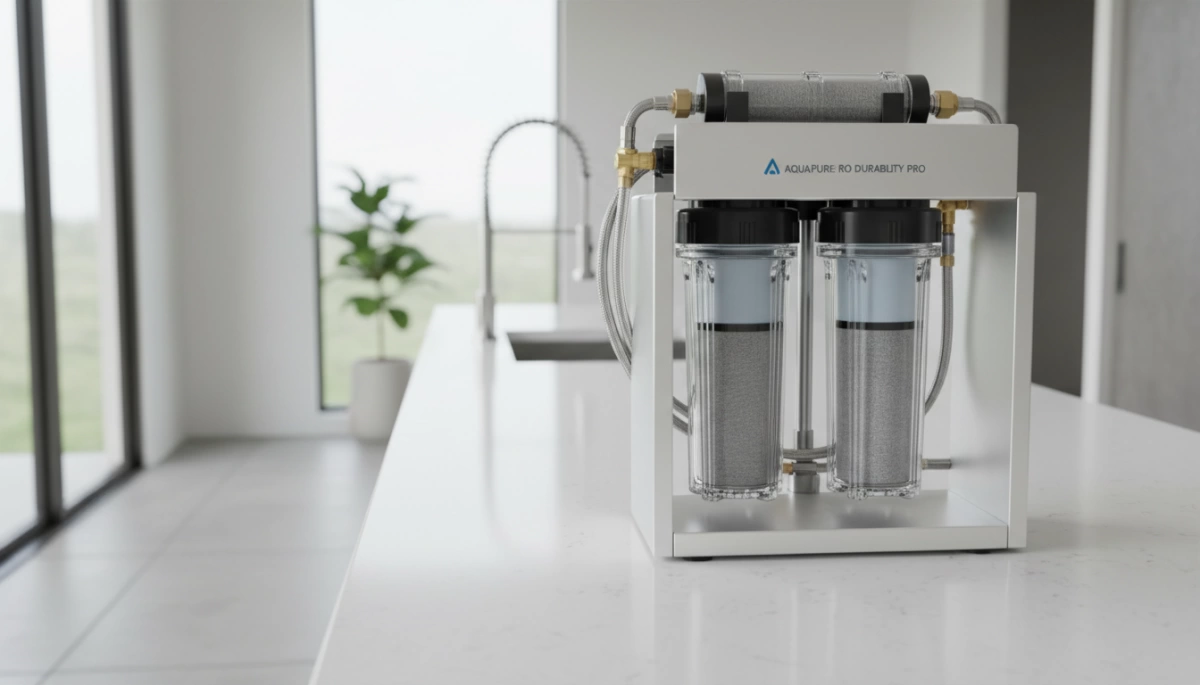
Choosing the right materials is the difference between a system that lasts a decade and one that floods a kitchen. We don’t take shortcuts here; structural integrity verification is baked into our design process. The goal is simple: create a housing that withstands constant hydrostatic pressure without yielding.
Reinforced Polypropylene (PP): Balancing Rigidity and Flexibility
We rely heavily on reinforced Polypropylene (PP) for our housings. This material offers the perfect balance. It has the yield strength of polymers needed to remain rigid under high pressure, yet retains enough flexibility to absorb minor fluctuations without cracking. This polypropylene housing durability is essential for ensuring safety in US homes where water pressure can vary significantly.
Structural Design and Leak-Proof Engineering
It’s not just about the plastic; it’s about how we shape it. Our engineering team focuses on three critical physical attributes to ensure leak-proof engineering:
- Integrated Water Path: Unlike traditional systems with messy tubing, our manifold design minimizes connection points. This drastically reduces the risk of leaks and improves flow efficiency.
- Strategic Ribbing: We add external ribbing to high-stress areas. This reinforces the housing against expansion without adding unnecessary bulk.
- Optimized Wall Thickness: We calculate the exact thickness required to handle burst pressures well above standard operating limits.
Using superior materials and smart design ultimately lowers the total cost of water filter for home ownership by eliminating the expense of premature repairs or water damage cleanup.
Industry Standards and Compliance: Navigating NSF/ANSI 58
When we talk about the NSF/ANSI 58 standard, we aren’t just discussing a certificate on a box; we are talking about the definitive playbook for structural integrity verification in Reverse Osmosis systems. For any serious manufacturer or distributor in the United States, this standard dictates the baseline for safety, ensuring that the system can handle the rigors of daily household pressure without failing.
Why Compliance is Non-Negotiable for B2B Brands
For our B2B partners and distributors, compliance isn’t optional—it’s a survival strategy. Selling non-compliant units opens the door to catastrophic liability. If a housing cracks and floods a customer’s kitchen, the damage goes beyond the floorboards; it destroys brand trust. That is why our OEM quality assurance protocols align strictly with industry benchmarks. We ensure that every unit leaving the factory is built to withstand pressures far exceeding typical municipal supplies. While consumers might focus on performance metrics like alkaline water vs reverse osmosis key differences, our priority as engineers is ensuring the physical hardware never compromises the home’s safety.
Inside the Testing Rig: Automated Cycling and Leak Detection
To guarantee leak-proof engineering, we don’t rely on manual checks alone. Our lab testing standards involve sophisticated, automated rigs designed to push systems to their breaking points.
- Automated Cycling: Robots simulate years of faucet usage in a matter of days, rapidly opening and closing valves to trigger pressure spikes.
- Precision Sensors: Digital monitors detect even the slightest drop in pressure, identifying micro-leaks that the human eye would miss.
- Data Logging: Every test cycle is recorded to track performance trends and material fatigue over time.
By rigorously adhering to these testing frameworks, we provide partners with the confidence that our tankless and countertop RO solutions are built for the long haul.
Mitigating Risks in System Design and Installation
Even with rigorous lab testing, the real world throws curveballs. Proper installation is the final defense against leaks and bursts. We approach this by engineering out failure points and advising on proper pressure management to protect the system’s structural integrity.
The Critical Role of Pressure Regulators
In many US municipalities, street water pressure can fluctuate wildly, sometimes exceeding the Maximum Operating Pressure (MOP) of residential appliances. A pressure regulator is non-negotiable in these high-pressure zones. It acts as a gatekeeper, ensuring the incoming flow never exceeds safe limits (usually capped around 60-80 PSI). Without this, you are subjecting the system to unnecessary static load that eats away at the safety factor and risks overpowering the housing.
Absorbing Shock with Water Hammer Arrestors
Water hammer arrestor integration is the most effective way to neutralize dynamic pressure surges. When a solenoid valve slams shut, that energy has to go somewhere. An arrestor provides a cushion of air to absorb the hydraulic shock, preventing it from hammering the filter housing. This simple addition can significantly extend the lifespan of components in complex setups, such as those found in our UF kitchen faucet water purifier system.
Stress Testing Tubing and Fittings
The weakest link in traditional RO systems is often the connection point. We focus on leak-proof engineering by reducing the number of connections through our Integrated Water Path design. However, for external connections, ensuring tubing and quick-connect fittings pass stress tests is vital.
- Secure Locking: Fittings must grip the tubing securely without scoring it so deeply that it creates a weak point.
- Vibration Resistance: Connections must withstand the minor vibrations caused by pump operation without loosening.
- Material Compatibility: Tubing must match the fitting’s grip specifications to prevent blowouts under pressure.
By combining robust structural integrity verification with smart installation practices, we ensure that systems like our countertop 3-in-1 RO purifiers operate safely for years.
Frequently Asked Questions About RO System Testing
What is the difference between burst pressure and operating pressure?
Operating pressure is the standard range your system handles daily, typically between 40 and 80 PSI in most US households. Burst pressure, on the other hand, is the absolute limit the housing can withstand before catastrophic failure. To ensure safety, we engineer our systems with a safety factor ratio (4:1). This means if the Maximum Operating Pressure (MOP) is rated at 125 PSI, the unit must pass hydrostatic burst testing at 500 PSI. This buffer protects your home against unexpected municipal pressure spikes.
Why is the 100,000 cycle test important for RO systems?
A single pressure test doesn’t tell the whole story. Real-world usage involves turning the faucet on and off thousands of times, creating constant stress fluctuations. The 100,000 cycle test simulates over a decade of heavy use by rapidly cycling pressure from 0 to 150 PSI. This process exposes any potential weaknesses related to cyclic pressure fatigue. If a system can survive this durability cycle, it proves that the manifold and connections are built to last, far beyond the standard warranty period.
How does water hammer damage filtration housings over time?
Water hammer occurs when a valve closes suddenly, sending a shockwave back through the water line. This creates a dynamic pressure surge that can momentarily exceed the system’s rating. While one hit might not break the housing, repeated hydraulic shock causes cumulative stress. Over time, this leads to micro-cracks in the material, eventually resulting in a split or leak. Our designs, including our compact water filter systems, utilize an integrated water path to minimize the connection points susceptible to this type of damage.
What materials are best for high-pressure filter housings?
Material selection is the backbone of structural integrity verification. We prefer reinforced Polypropylene (PP) because of its superior yield strength of polymers. Unlike brittle plastics that crack under stress, high-grade PP offers the necessary polypropylene housing durability to absorb pressure fluctuations without deforming. This ensures the system remains leak-proof and compliant with rigorous safety standards, providing peace of mind for both installers and end-users.