
















Design Philosophy & Form Factor: Space vs. Volume
In our analysis of the global Under-sink Water Filtration Market, we observe a distinct divergence in how different regions approach product design. While the core function—purifying water—remains the same, the form factor is heavily influenced by local housing infrastructure and consumer expectations. We are seeing a clash between the utilitarian “hidden plumbing” approach of the US and the sleek “appliance” aesthetic favored in Europe.
The “American Style”: Utility Approach and Large Tanks
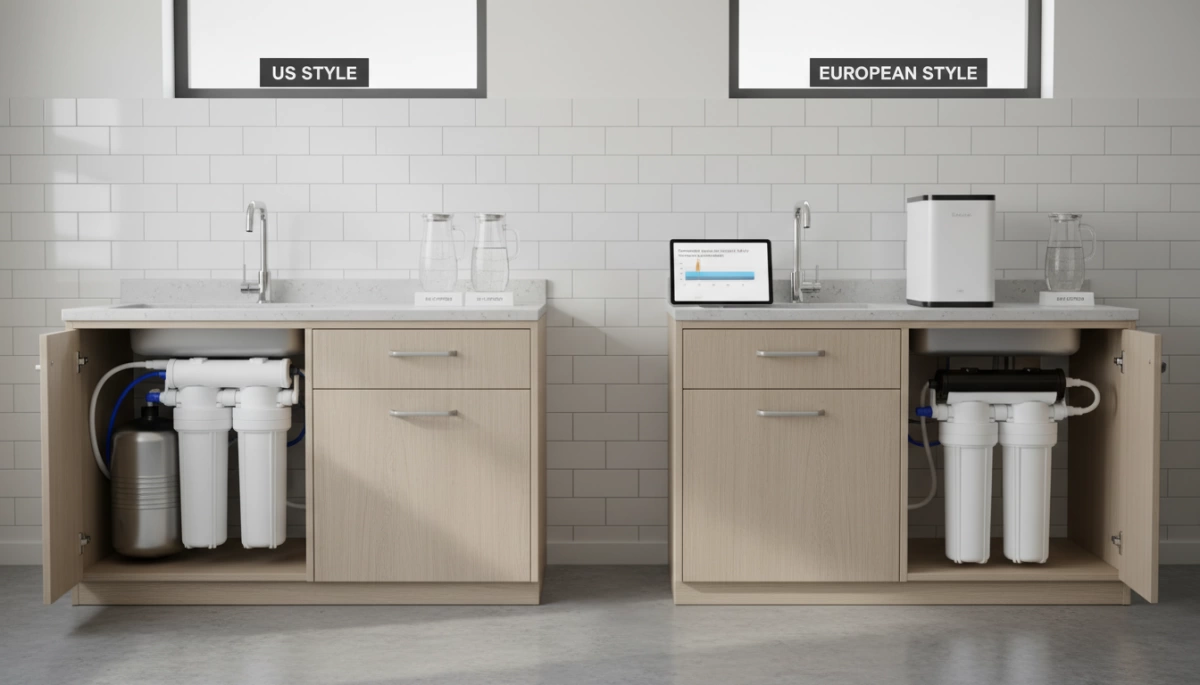
Historically, the US market has prioritized capacity and proven utility over aesthetics. American homes typically feature larger kitchens with ample under-sink cabinetry, allowing for bulky setups. The traditional American RO system is defined by:
- Component Separation: A manifold hanging on the wall, separate filter housings, and a large pressurized storage tank.
- Volume Reliance: The system relies on a 3-5 gallon tank to buffer low production rates (typically 50-75 GPD), ensuring water is available when the tap is opened.
- Space Consumption: These units often occupy 50% to 70% of the available under-sink storage space.
From a manufacturing perspective, we see this as a functional but outdated model. While reliable, the “American Style” introduces risks of secondary pollution due to stagnant water sitting in rubber-lined tanks, a concern modern consumers are increasingly vocal about.
The “European Style”: Appliance Approach and Compactness
Conversely, the European market operates under stricter spatial constraints. With smaller urban apartments and compact kitchen layouts, there is no room for bulky tanks. This has driven the evolution of the Integrated Waterway Manifold and “all-in-one” box designs.
- Integrated Design: Filters, pumps, and circuits are enclosed in a single, sleek casing that hides the “plumbing mess.”
- Space Efficiency: These units are designed to fit into narrow cabinets (often less than 200mm wide), maximizing storage for other kitchen essentials.
- Aesthetic Focus: The unit looks like a high-end home appliance rather than industrial equipment, appealing to design-conscious homeowners.
We have adopted this philosophy in our product lines, utilizing composite filter technology to reduce the physical footprint while maintaining high filtration standards.
The Convergence: Shifting Toward Tankless Technology
The most significant trend we are driving is the convergence of these two philosophies through Tankless Reverse Osmosis Systems. By leveraging High GPD RO Membranes (ranging from 600GPD to 1000GPD), we can now deliver the high flow rates American consumers demand without the bulky tanks they dislike.
Why the market is shifting to Tankless:
- Instant Freshness: Water is filtered on-demand, eliminating the need for storage and the risk of bacterial growth in tanks.
- Simplified Maintenance: Our “Twist-and-Pull” filter replacement systems remove the need for heavy tools or professional plumbing services.
- Sustainability: Tankless systems significantly reduce the RO Waste Water Ratio, often achieving 2:1 (Pure:Drain) efficiency compared to the 1:3 ratio of traditional tank systems.
This shift represents the future of residential filtration: combining the high-volume output expected in the US with the compact, hygienic engineering pioneered in Europe.
Technical Specifications & Installation Standards
When we analyze the Under-sink Water Filtration Market, the divergence between traditional US specifications and modern European standards often comes down to installation complexity and component integration. While the end goal is pure water, the engineering paths taken to get there differ significantly.
Plumbing & Connectivity: US NPT vs. European Metric
In the United States, plumbing infrastructure relies heavily on NPT (National Pipe Taper) threads. Conversely, the European market utilizes BSP (British Standard Pipe) metric threads. For a global manufacturer, this presents a compatibility challenge.
However, the actual tubing used for water transport has standardized globally around 1/4″ and 3/8″ PE tubing. To bridge the gap between regional plumbing codes, we utilize Integrated Waterway Manifolds. Instead of relying on dozens of individual connectors—which are prone to leaking—we mold the water path directly into the system board. This reduces the risk of water damage and simplifies installation, regardless of whether the feed water adapter is NPT or Metric.
Filtration Stages: 5-Stage Standard vs. Composite Filters
The classic “American style” RO system is easily recognizable: a row of five distinct vertical canisters hanging off a bracket. While this allows for granular customization, it creates a massive footprint and makes filter changes a labor-intensive process requiring housing wrenches.
We have shifted toward Composite Filter Technology, a design philosophy often seen in compact European appliances. By combining filtration media—such as folding PP cotton and Carbon Block—into a single composite unit, we reduce the physical size of the system without sacrificing performance. This engineering enables our “Twist-and-pull” filter replacement mechanism, allowing users to swap filters in three seconds without shutting off the main water supply or calling a plumber.
Water Efficiency: Drain Ratios and Sustainability
Sustainability is no longer just a European priority; it is a global demand. Traditional tank-based systems found in many US homes operate with a poor RO Waste Water Ratio, often wasting 3 gallons of water for every 1 gallon of purified water produced (1:3 ratio).
Our Tankless Reverse Osmosis System designs aggressively target water conservation. By utilizing high-efficiency booster pumps and advanced membrane technology, we achieve pure-to-drain ratios as high as 2:1 or even 3:1. This means we produce two to three cups of pure water for every cup of wastewater. This efficiency is a critical factor when families calculate the long-term ROI of RO systems compared to bottled water or less efficient filtration methods.
Comparison of Technical Standards:
| Feature | Traditional US Style | Modern European / DripLife Style |
|---|---|---|
| Manifold Design | External tubing & multiple fittings | Integrated Waterway Manifold (Leak-proof) |
| Filter Architecture | 5+ Separate Housings | Composite Filter Technology (2-3 Units) |
| Drain Ratio | High Waste (1:3) | High Efficiency (2:1 to 3:1) |
| Maintenance | Requires tools & housing wrenches | Tool-free “Twist-and-Pull” |
| Space Requirement | Large (Tank + Unit) | Compact (All-in-one Box) |
Water Quality Preferences: Purity vs. Mineralization
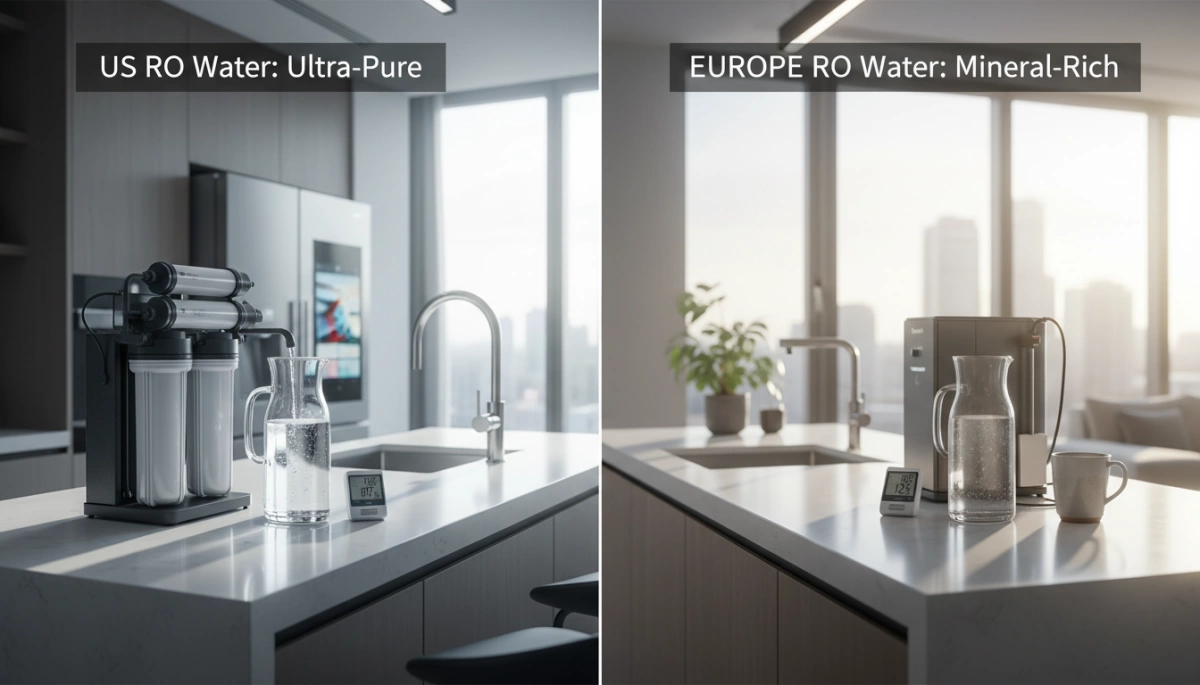
When we analyze the Comparative Study: US vs European Style Under-sink RO Market, the starkest contrast lies in how we define “perfect water.” In the United States, the historical focus has been on subtraction—removing every possible contaminant. In Europe, the focus shifts toward balance and biological value. At DripLife, we engineer our systems to satisfy both rigorous purification standards and the growing demand for health-conscious hydration.
The “Zero TDS” Obsession: US Focus on Chemical Removal
In the US market, the gold standard for Reverse Osmosis has long been achieving the lowest possible TDS (Total Dissolved Solids) reading. American consumers are rightfully concerned about industrial runoff, lead, and emerging contaminants like PFAS. Consequently, the priority is PFOS/PFOA removal efficiency and stripping water down to its bare H2O molecules.
We see this driven by a desire for safety above all else. Traditional US systems often market 0.0001-micron filtration capability as a means to achieve “Zero TDS.” While this guarantees the removal of heavy metals and bacteria, it can result in slightly acidic water that tastes “flat.” For homeowners dealing with harsh supply lines, managing high TDS source water with RO technology is essential to protect appliances and health, but extreme purification shouldn’t come at the cost of water quality.
The “Healthy Water” Approach: European Demand for Remineralization
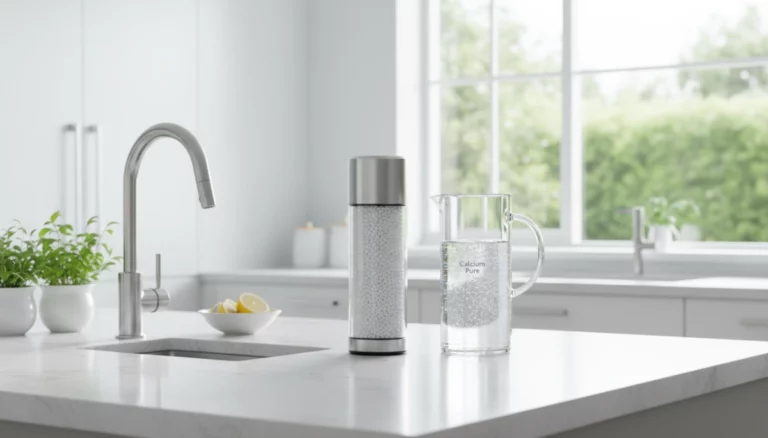
Conversely, the European market—and increasingly the modern US consumer—views water as a source of nutrition. Stripping water of everything removes harmful toxins, but it also removes beneficial minerals like Calcium, Magnesium, and Potassium. This is where the Remineralization Post-Filter becomes a critical component in our design philosophy.
We have integrated remineralization technology into our advanced RO systems to bridge this gap. Instead of leaving the water slightly acidic and empty, our systems restore essential minerals to balance the pH levels.
Why Remineralization Matters:
- Taste Profile: Restores the natural, sweet taste of spring water, eliminating the flatness of pure RO water.
- pH Balance: Shifts water from acidic to neutral or slightly alkaline, which is better for the body.
- Health Benefits: Provides trace amounts of essential minerals daily.
By combining the high-precision filtration required by US standards with the mineral preservation preferred in Europe, we offer a solution that doesn’t force you to choose between safety and health.
Regulatory Landscape & Certifications
Navigating the global water filtration market requires a deep understanding of regional compliance. As a manufacturer, we know that a sticker on a box isn’t just decoration; it’s the license to sell. The regulatory frameworks in the US and Europe differ significantly, reflecting their unique priorities regarding water safety and appliance standards.
United States Standards: NSF/ANSI 58 and WQA
In the US market, consumer trust hinges on third-party validation of performance. The gold standard here is the NSF/ANSI 58 Standards specifically designed for Reverse Osmosis systems. This certification doesn’t just check if the machine turns on; it rigorously tests the reduction of specific contaminants.
For American buyers, the focus is heavily on material safety and verified reduction claims. We prioritize using lead-free RO components to ensure structural integrity and safety. The Water Quality Association (WQA) often validates these claims, focusing on critical metrics like PFOS/PFOA removal efficiency and dissolved solids reduction. Since many US households deal with municipal additives, ensuring our systems are among the best water filters to remove fluoride and other dissolved chemicals is a core part of meeting these rigorous North American standards.
European Compliance: CE Marking, RoHS, and REACH
The European market approaches regulation with a broader focus on environmental health and electrical safety. For any modern, powered RO system—especially the smart, tankless models we specialize in—being a CE Certified Water Filter is mandatory. This indicates conformity with health, safety, and environmental protection standards for products sold within the European Economic Area.
Beyond the CE mark, European regulations like RoHS (Restriction of Hazardous Substances) and REACH strictly control the chemical composition of the materials used in manufacturing.
- RoHS: Ensures electronic components (like smart faucets and pumps) are free from hazardous substances like lead and mercury.
- REACH: Addresses the production and use of chemical substances, ensuring no harmful chemicals leach from the plastic housing into the water.
While the US focuses intensely on the output water quality data, Europe places equal weight on the device’s safety and its lifecycle impact. Understanding these nuances allows us to engineer platforms that satisfy the strict certification requirements of both continents.
The Driplife Advantage: Bridging the Gap
At DripLife, we recognize that the divide between American durability and European compactness is narrowing. Our manufacturing philosophy focuses on merging the best of both worlds to create versatile, high-performance water filtration solutions. By moving away from bulky, multi-component setups, we engineer systems that fit the modern water filter from sink requirements of diverse global markets. Our integrated waterway designs replace complex tubing connections, significantly reducing leak risks while maximizing under-sink storage space.
Innovation in Manufacturing for Global Markets
We utilize advanced composite filter technology to streamline maintenance without sacrificing filtration accuracy. Traditional systems often require tools and professional help, but our “twist-and-pull” design empowers users to handle replacements in seconds. This user-centric approach appeals to the DIY culture prevalent in the US while satisfying the European demand for appliance-like simplicity.
Core Manufacturing Innovations:
- Integrated Manifolds: Reduces leak points compared to traditional tubing clusters.
- Space Efficiency: Compact housing fits narrow European cabinetry and crowded US kitchen islands.
- Automated Production: Ensures consistent quality control for high-volume export.
Key Features for Global Sourcing: High GPD and Smart Tech
The demand for Tankless Reverse Osmosis Systems is driven by a desire for freshness and speed. We focus on High GPD RO Membrane technology—ranging from 600GPD to 1000GPD—to deliver instant pure water without the need for a storage tank. This eliminates the secondary pollution risks associated with stagnant water in traditional tanks.
To meet the modern consumer’s need for data, we integrate Smart Water Faucets with TDS Display. This allows users to see real-time water quality readings, bridging the trust gap often found in residential water treatment.
| Feature | Traditional Market Standard | DripLife Solution |
|---|---|---|
| Flow Rate | 50-75 GPD (Slow, requires tank) | 600-1000 GPD (Instant flow) |
| Waste Ratio | 1:3 (High waste) | 2:1 or 3:1 (High efficiency) |
| Monitoring | None or basic LED | Real-time TDS & Filter Life |
| Footprint | Bulky tank + manifold | All-in-one compact box |
OEM/ODM Flexibility for Export Markets
As a Water Purifier OEM Manufacturer, we understand that a one-size-fits-all approach does not work for global distribution. We offer extensive customization to ensure compliance with local standards, whether it is adjusting voltage for European grids or ensuring NPT thread compatibility for US plumbing.
Our role as a Wholesale Water Filtration Supplier involves more than just hardware; we provide the flexibility to adapt filtration stages—such as adding a Remineralization Post-Filter—to meet specific regional taste preferences.
- Custom Branding: Private labeling for housing, packaging, and smart display interfaces.
- Regional Compliance: Adaptation for CE, RoHS, and electrical standards.
- Rapid Prototyping: Fast-tracking new designs to keep partners ahead of market trends.
Frequently Asked Questions (FAQs)
What is the main difference between US and European under-sink RO systems?
The biggest differentiator is the form factor and storage method. Traditional US-style systems often rely on a bulky storage tank to hold filtered water, which takes up significant cabinet space. In contrast, the European style—which aligns with our design philosophy—favors a “tankless” approach. These units are compact, all-in-one appliances that filter water on demand rather than storing it. This shift not only saves space but also prevents the secondary pollution risks associated with water sitting in a rubber-lined tank for days.
Why are tankless RO systems becoming popular in both markets?
Homeowners everywhere are realizing that under-sink real estate is valuable. A Tankless Reverse Osmosis System eliminates the massive storage tank, freeing up room for cleaners and kitchen tools. Beyond space, it’s about freshness and efficiency. With a High GPD RO Membrane (like our 600GPD to 1000GPD models), you get instant flow without the wait. These modern systems also offer a superior RO Waste Water Ratio—often 2:1 or better—making them far more sustainable than older tank-based setups that wasted gallons of water for every gallon produced.
Do European RO systems require different plumbing adapters?
Yes, there is often a mismatch in thread standards. The US market relies on NPT (National Pipe Taper) threads and imperial tubing sizes (typically 3/8″ or 1/2″ connections), while European plumbing uses BSP (British Standard Pipe) and metric sizing. However, high-quality manufacturing bridges this gap. We utilize precision engineering mold accuracy in RO housing to ensure our integrated manifolds and connectors fit securely, regardless of the regional standard. Most of our export-ready units come with versatile adapter kits to ensure a leak-free, DIY-friendly installation in American homes.
Is remineralization necessary for US-style RO systems?
While not strictly necessary for safety, a Remineralization Post-Filter is highly recommended for taste and health. Standard RO filtration is so effective that it strips away beneficial minerals like calcium and magnesium, often leaving the water slightly acidic. Adding a remineralization stage restores the pH balance to a neutral or slightly alkaline level and brings back that crisp, natural spring water taste. This is becoming a standard expectation in the Under-sink Water Filtration Market, moving beyond just “pure” water to “healthy” water.