














2000 GPD Flow Rate Dynamics
When we engineer a 2000 gpd tankless ro system, the focus isn’t just on total daily capacity—it is about the immediate user experience. The most critical metric for homeowners and business owners isn’t the daily total, but the flow rate at the faucet.
Understanding the 1.4 GPM Conversion
To truly grasp the power of high output under sink RO units, we have to look at the math. A standard 75 GPD system produces a trickle. By stepping up to 2000 GPD, we achieve a 1.4 GPM water flow rate.
- Standard RO: ~0.05 GPM (Requires a storage tank to buffer flow)
- 2000 GPD RO: ~1.4 GPM (Real-time, faucet-speed delivery)
This flow rate rivals standard kitchen faucets, meaning direct flow RO technology has finally bridged the gap between filtration quality and convenience.
Real-World Speed: Filling Pots vs. Waiting
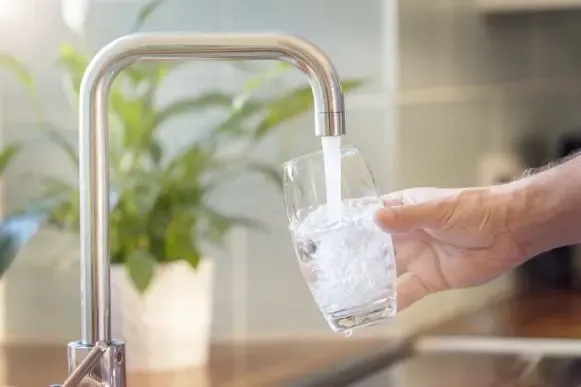
In practical terms, instant RO water delivery changes how you cook and hydrate. We know that waiting 60 seconds to fill a glass of water is unacceptable in a busy kitchen.
With a 1.4 GPM flow rate, the difference is tangible:
- 8oz Glass: Fills in under 3 seconds.
- 1-Gallon Pitcher: Fills in roughly 45 seconds.
- Large Stockpot: Fills immediately without the “sputtering” common in smaller systems.
Eliminating Pressure Drops
Traditional tank-based systems rely on an internal air bladder to push water out. As the tank empties, the pressure drops significantly, resulting in a weak stream just when you need water the most.
Our tankless water purification design utilizes an integrated booster pump performance mechanism to solve this. By bypassing the storage tank entirely, we ensure a linear, consistent flow curve. Whether you are drawing the first cup or the tenth gallon, the pressure remains high and steady, delivering a true commercial grade RO membrane experience right at your sink.
Tankless Water Purification Design & Hygiene Benefits
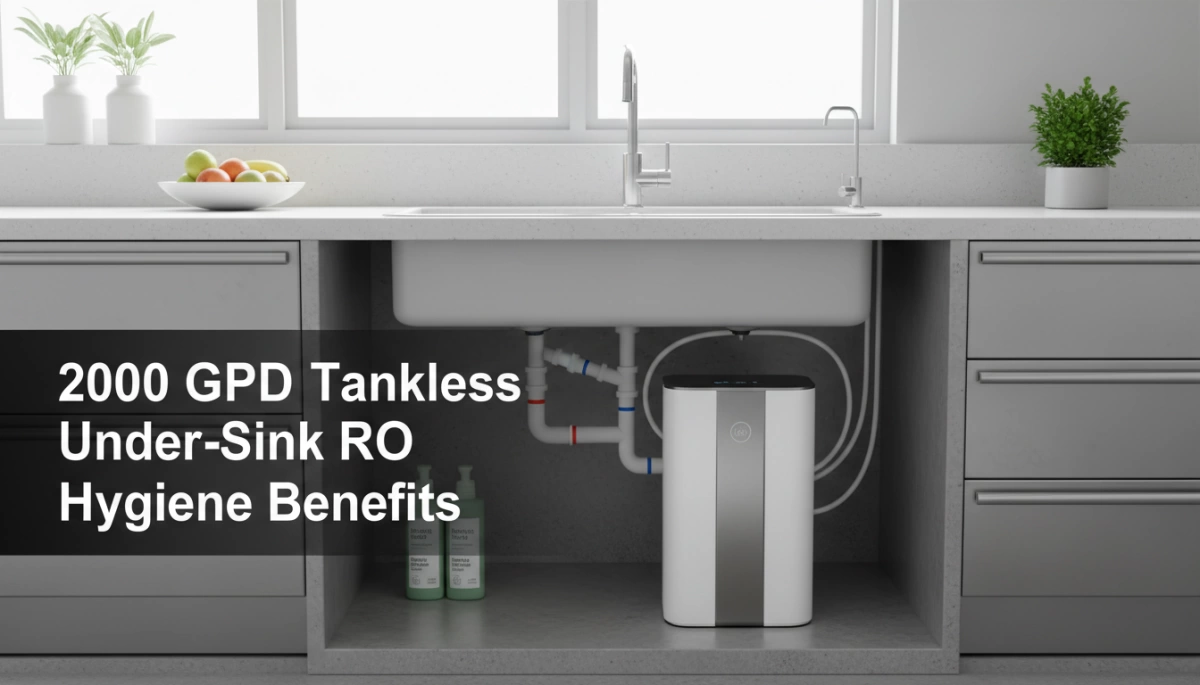
When we look at traditional RO setups, the storage tank is often the weak link. In those older systems, purified water sits in a rubber bladder for hours or even days before you drink it. This stagnation leads to “secondary pollution,” where bacteria can breed, and the water picks up a stale, rubbery taste. I prefer the tankless water purification design because it guarantees every drop is filtered the second you open the faucet. This direct flow RO technology completely solves the stale water problem, ensuring you are never drinking water that has been sitting in a dark container.
Compact Under-Sink Water Filter Efficiency
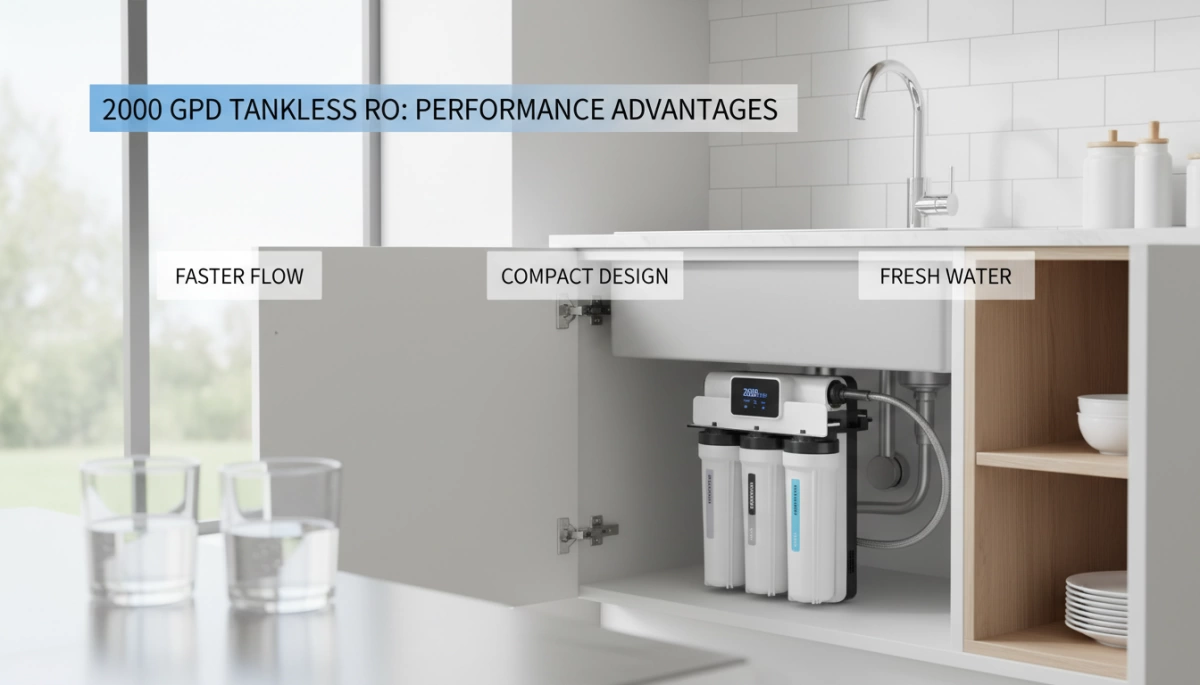
In most American kitchens, under-sink space is premium real estate. Between the garbage disposal, trash cans, and cleaning supplies, there is rarely room for a bulky 4-gallon storage tank. Our 2000 GPD tankless RO system saves approximately 70% of under-sink space compared to tank-based models. The slim profile allows for a neat installation that leaves plenty of room for storage.
Tank vs. Tankless Comparison:
| Feature | Traditional Tank RO | 2000 GPD Tankless RO |
|---|---|---|
| Water Freshness | Stored (Risk of Stagnation) | Instant (Always Fresh) |
| Hygiene | Risk of Bacterial Growth | Secondary Pollution Prevention |
| Space Required | High (Filter + Bulky Tank) | Low (Compact Unit Only) |
| Water Supply | Limited by Tank Capacity | Unlimited Continuous Flow |
Installation Versatility for Homes and Businesses
Because this system pushes 1.4 GPM, it bridges the gap between residential and commercial needs. It is robust enough to serve as a light commercial RO system for coffee shops, offices, or luxury homes with high water demand. Whether you are outfitting a busy family kitchen or a small business, installing a high-capacity under-sink reverse osmosis filtration system ensures you get commercial-grade performance without the industrial footprint.
3:1 Pure-to-Drain Ratio Efficiency
When analyzing 2000 GPD tankless under sink RO system performance advantages, efficiency is often the deciding factor for smart buyers. Traditional reverse osmosis setups were notorious water hogs, often running at a dismal 1:3 ratio. That means for every single gallon of pure water you collected, you were flushing three gallons straight down the drain. In today’s economy, that level of waste is simply unacceptable.
Flipping the Script on Water Waste
We utilize high-flow reverse osmosis engineering to completely reverse those numbers. Instead of wasting water, our systems operate at an impressive pure-to-drain ratio 3:1.
- Traditional RO: 1 Gallon Pure = 3 Gallons Wasted
- 2000 GPD Tankless: 3 Gallons Pure = 1 Gallon Wasted
This massive leap in efficiency is driven by advanced spiral-wound membrane technology. We use a commercial grade RO membrane that maximizes surface area and pressure application, ensuring we extract the maximum amount of clean water from the feed supply without clogging the system.
Real Savings for Your Wallet and the Environment
For homeowners and business owners alike, this translates to tangible value. In regions with high water tariffs, upgrading to a sustainable water filtration system drastically reduces your utility bills over time. You aren’t just paying for filtration; you are paying for smart water management. When evaluating the best under-sink RO system features, this level of waste reduction is a critical factor for calculating long-term return on investment.
Commercial-Grade Build Quality
When we step up to a 2000 GPD unit, we are moving away from standard residential plastics and into the realm of a dealer grade ro system. The build quality has to match the performance output. We aren’t just filtering water; we are managing high-pressure flow that demands structural integrity.
Stainless Steel Housing and Durability
Cheap plastic housings often crack under sustained high pressure. That is why many of these high-capacity systems utilize stainless steel or reinforced composite bodies. It prevents leaks and ensures the system lasts for years, not just months. Our rigorous approach to manufacturing focuses on precision engineering, ensuring that these housings can withstand the stress of continuous heavy usage without warping.
Noise Management in High-Pressure Systems
A common concern with high-flow units is the noise from the pump. However, 2000 GPD Tankless Under Sink RO System Performance Advantages include sophisticated noise dampening. We focus on Integrated booster pump performance that delivers massive pressure while keeping decibels low. By using shock-absorbing mounts and advanced motor designs, we ensure the system hums quietly rather than vibrating the entire cabinet.
Smart TDS Monitoring and Indicators
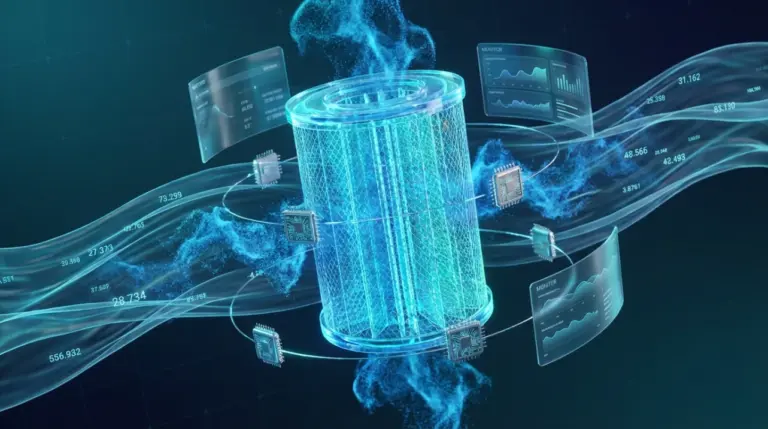
Gone are the days of guessing when to change a filter. These systems come equipped with a Real-time TDS monitoring display right on the smart faucet or the unit itself.
- Instant Feedback: You see the exact purity level of your water as you pour.
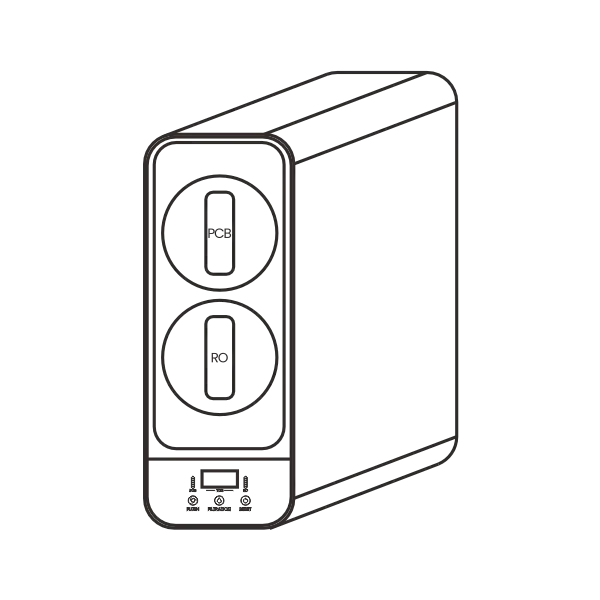
- Precise Filter Tracking: Instead of a generic timer, the system monitors actual usage volume to tell you exactly when the Commercial grade RO membrane or pre-filters need replacement.
- Leak Detection: Integrated sensors often shut the system down automatically if moisture is detected, preventing water damage.
Maintenance & Long-Term Costs
When we analyze the 2000 GPD Tankless Under Sink RO System Performance Advantages, the conversation eventually turns to the bottom line. Many customers initially balk at the higher upfront price tag compared to standard residential units, but the math changes when you look at the long-term operational costs. Because these systems utilize high-capacity, commercial grade RO membranes, they do not clog nearly as fast as the smaller filters found in big-box store units. You are effectively getting industrial longevity in a compact package, drastically lowering your cost-per-gallon over a five-year period.
3-Second Quick-Twist Filter Replacement
Time is money, especially if you are using this as a light commercial RO system in a coffee shop or restaurant. We designed these units to eliminate the need for expensive service calls.
- No Tools Required: The quick-twist filter replacement design allows anyone to swap a cartridge in under three seconds.
- Auto-Shutoff: You do not need to shut off the main water line; the system handles the pressure change automatically.
- Hygiene: You never touch the filter media, keeping the process sanitary.
Versatility: From Luxury Homes to Coffee Shops
The beauty of a 2000 GPD system is its flexibility. It bridges the gap between high-end residential needs and small business demands. Whether you are setting this up in a busy cafe or integrating it into a comprehensive under-sink distribution system for a large residence, the maintenance logic remains the same: high output, low hassle. This is a sustainable water filtration system that grows with your needs, providing massive throughput without the massive maintenance headache of traditional tank-based setups.
Frequently Asked Questions (FAQs)
Is a 2000 GPD system too loud for a residential kitchen?
This is a valid concern given the power involved. Because high-flow reverse osmosis requires significant pressure to push water through the membrane instantly, these units use an internal pump. However, modern integrated booster pump performance is engineered with vibration dampening. Most units run at about 45-50 decibels—comparable to a quiet refrigerator hum. Unlike tank systems that might vibrate for an hour to refill a reservoir, this system only runs while the faucet is open.
Do I really need 2000 GPD for a standard family?
Don’t let the “2000 Gallons Per Day” rating confuse you. You aren’t buying total volume; you are buying speed. A 2000 GPD tankless under sink RO system delivers approximately 1.4 gallons per minute (GPM).
- Standard RO: Trickles out and takes minutes to fill a pot.
- 2000 GPD RO: Fills a pasta pot in seconds, matching standard faucet flow.
If you value your time and cook frequently, the speed advantage is essential.
How does the tankless design affect water pressure during peak use?
It actually solves the pressure drop issues found in older systems. Traditional tanks lose pressure as they empty, leading to a weak trickle if you use too much water at once. With direct flow RO technology, the pressure is generated on-demand and remains consistent. Upgrading to a tankless water purification design ensures you get the same strong flow from the first second to the last, even during high-demand times like holiday dinners.
What is the actual lifespan of a 2000 GPD membrane?
These systems utilize a commercial grade RO membrane built to withstand high pressure and high volume. In a typical US household with municipal water, you can expect:
- RO Membrane: 24 to 36 months of life.
- Pre-filters: 6 to 12 months depending on sediment levels.
Many units feature smart monitoring that tracks actual usage rather than just time, ensuring you get the most out of your filters before swapping them.