Understanding the Core Technologies: RO and UF Explained
As engineers with over 15 years of R&D experience in water purification, we know that selecting the right filter isn’t just about the brand—it’s about the physics inside the cartridge. When we design systems at our 60,000 sq. ft. facility, the choice between Reverse Osmosis (RO) and Ultrafiltration (UF) defines the entire architecture of the machine. Let’s strip away the marketing fluff and look at the engineering.
How Reverse Osmosis (RO) Works
Reverse osmosis vs ultrafiltration starts with pressure. In our high-performance RO designs, such as our 150GPD countertop units, we utilize a semipermeable membrane. This isn’t just a net; it’s a molecular gatekeeper. By applying pressure that exceeds natural osmotic pressure, we force water molecules through the membrane while rejecting dissolved solids, heavy metals, and salts.
- Mechanism: Pressure-driven diffusion.
- Target: Dissolved inorganics and removing TDS from water.
- Result: Pure H2O, ideal for our 4-in-1 heating and ice-making systems where mineral buildup could damage internal components.
How Ultrafiltration (UF) Works
Ultrafiltration membrane pore size operates on a different principle: mechanical size exclusion. We utilize hollow fiber membrane filtration technology in our compact faucet and bathroom devices. Imagine bundles of microscopic straws with porous walls. Water flows through, but contaminants larger than the pore size are physically blocked.
- Mechanism: Low-pressure sieving.
- Target: Suspended solids, bacteria, and rust.
- Result: Clean water that retains beneficial minerals, delivered at high speeds (up to 5.2L/min in our under-sink configurations).
Key Technical Comparison: RO vs UF Water Filter
To help you engineer the perfect setup for your home, here is how the flow dynamics and filtration spectrums compare directly.
| Feature | Reverse Osmosis (RO) | Ultrafiltration (UF) |
|---|---|---|
| Filtration Precision | High (Removes dissolved solids) | Medium (Removes suspended solids) |
| Flow Dynamics | Requires pressure; generates wastewater | High flow rate water filter; zero wastewater |
| Mineral Content | Strips minerals (Low TDS) | Retains natural minerals |
| Best Application | Drinking, Ice Making, Coffee | Washing, Cooking, Bathroom/Shower |
| Driplife Solution | 4-in-1 Countertop Systems | Under-sink & Faucet Filters |
We design our multi-stage composite filtration systems to leverage the strengths of both technologies, ensuring that whether you need the purity of RO or the speed of UF, the engineering holds up to daily use.
Pros and Cons: A Real-World Breakdown
Reverse Osmosis Advantages and Limitations
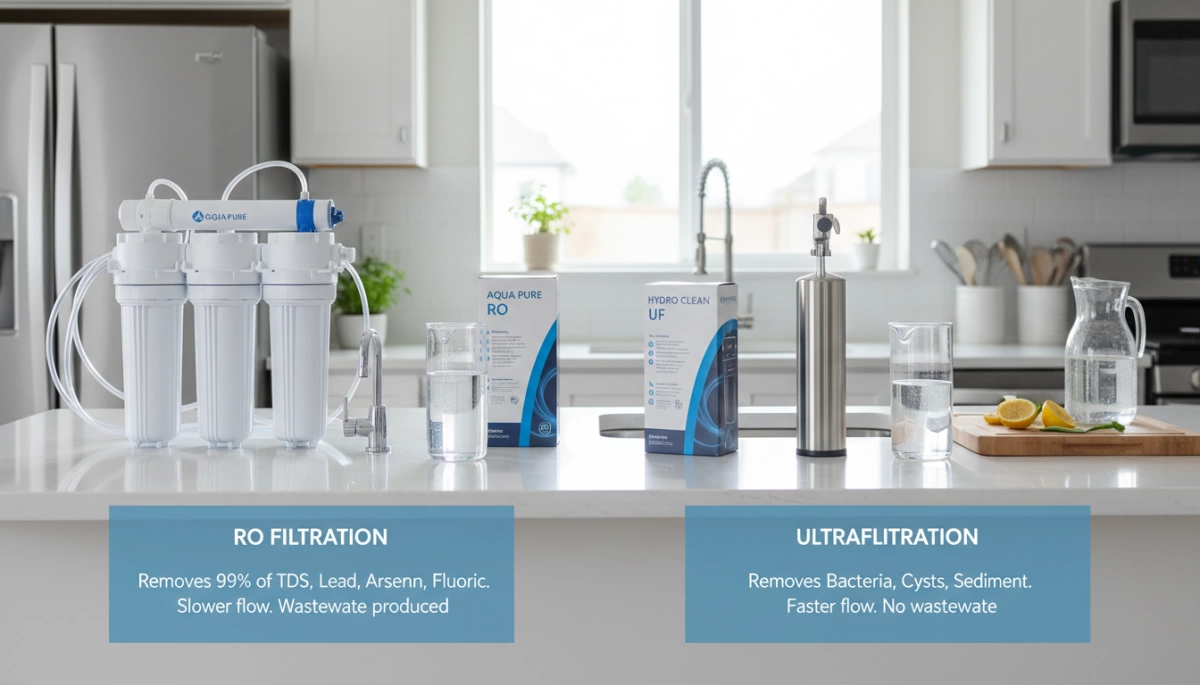
When we engineer high-performance filtration, Reverse Osmosis (RO) stands out for its sheer cleaning power. The primary advantage is its ability to remove TDS from water (Total Dissolved Solids) more effectively than any other residential technology. By forcing water through a semipermeable membrane, we can strip away heavy metals, bacteria, and dissolved salts. This makes it the ideal choice for anyone prioritizing absolute purity.
However, we have to be transparent about the trade-offs. The reverse osmosis wastewater ratio is a physical reality of the process—impurities need to be flushed away. While traditional systems were inefficient, our modern designs, such as our 150GPD countertop RO water filter system, are engineered to maximize water recovery, significantly reducing waste compared to older models.
Ultrafiltration Advantages and Limitations
Ultrafiltration (UF) takes a different approach. Instead of stripping everything out, it uses hollow fiber membrane filtration to mechanically screen out suspended solids, bacteria, and sediment while allowing dissolved ions to pass through. The biggest pro here is the ability to retain minerals in drinking water. If you want to keep beneficial minerals calcium magnesium in your diet, UF is the superior option.
From an engineering standpoint, UF systems are also simpler to install and maintain. They typically offer a high flow rate water filter experience—our under-sink units can deliver up to 5.2L/min—and they produce zero wastewater. The limitation is that UF cannot remove dissolved chemicals or lower TDS, meaning it won’t change the “hardness” of your water.
Decision Framework: Choosing Based on Source Water
Selecting the right point of use water filter ultimately depends on what is coming out of your pipes. We use a simple framework to guide our OEM partners and end-users:
- City Water: If the municipal supply is biologically safe but tastes like chlorine, UF is often the most efficient choice. It improves taste and removes sediment without wasting water or removing healthy minerals.
- Well Water: Groundwater is unpredictable. If there is any risk of heavy metals, arsenic, or agricultural runoff, an RO vs UF water filter comparison isn’t even close—you need the molecular-level protection of Reverse Osmosis to ensure safety.
Engineering Innovations: Bridging the Gap for Modern Kitchens
We have moved far beyond simple charcoal sticks. Today, water filtration is about precision engineering that fits seamlessly into a modern lifestyle. At Driplife, our 15+ years of R&D focus on creating systems that balance purity, speed, and convenience without dominating your cabinet space.
The Shift to Tankless and High-Efficiency RO Designs
Traditional Reverse Osmosis systems were often criticized for being bulky and slow. We addressed this by engineering tankless RO systems that prioritize under-sink space optimization. By eliminating the storage tank, we reduce the risk of secondary contamination and free up valuable kitchen real estate. Our advanced under-sink water purification systems are designed to deliver a robust flow rate of up to 5.2L/min, ensuring you aren’t waiting around for a glass of clean water.
UF as a Standalone or Pre-Filter Solution
While RO offers the highest purity, Ultrafiltration (UF) excels in flow dynamics. We utilize UF technology as a high flow rate water filter solution where maintaining water pressure is critical.
- Standalone Efficiency: Perfect for bathroom faucets or secondary sinks where you need filtered water instantly for washing or brushing.
- Pre-Filtration: In complex systems, UF membranes act as a critical barrier, protecting finer membranes from clogging and extending the overall system life.
Multi-Stage Hybrid Systems
The most effective filtration often comes from multi-stage composite filtration. We don’t rely on a single method. Instead, we layer technologies—combining the chemical adsorption of activated carbon with the mechanical precision of RO or UF membranes. This hybrid approach ensures comprehensive contaminant removal while improving taste and odor.
Driplife’s Engineering Edge: High-Capacity Components
Our manufacturing power—backed by a 60,000 sq. ft. facility—allows us to produce components that handle heavy usage. We test our filters to endure a 2000-gallon cycle life, ensuring longevity for the end-user.
Our flagship innovation is the Point-of-Use (POU) delivery found in our countertop reverse osmosis hot and cold water filter systems. These 4-in-1 units go beyond basic filtration by integrating:
- Purification: High-efficiency 150 GPD capacity.
- Temperature Control: Instant hot and cold water options.
- Ice Making: Built-in capabilities for modern convenience.
By controlling the entire process from design to strict online inspection, we ensure every unit meets the rigorous demands of the US market.
Matching the System to Your Home: Practical Use Cases

Choosing between reverse osmosis vs ultrafiltration isn’t just about pore sizes; it’s about matching the engineering to your specific living situation. At Driplife, we design our systems with distinct user scenarios in mind, ensuring that whether you are in a downtown apartment or a rural farmhouse, the water quality meets your exact standards. Here is how we recommend pairing our technology with your home environment.
City Water: Prioritizing Taste and Efficiency
For homes supplied by municipal water, the primary concerns are usually chlorine taste, odor, and sediment. If your local water report confirms that heavy metals and TDS (Total Dissolved Solids) are within safe limits, an ultrafiltration membrane pore size of 0.01 microns is often the perfect fit.
- Why UF Wins Here: It effectively removes bacteria and suspended solids while allowing you to retain minerals in drinking water like calcium and magnesium.
- Efficiency: Unlike RO, UF produces no wastewater, making it a highly efficient choice for city dwellers who want to polish their water without complex plumbing.
Well Water and Hard Water Solutions
If you are dealing with well water or areas with high mineral content, the strategy changes. You need to determine if your water is hard or soft before selecting a filter. For these scenarios, a robust RO vs UF water filter comparison heavily favors Reverse Osmosis.
- High TDS Removal: Our high-capacity RO systems are engineered to remove TDS from water, tackling the dissolved minerals that cause scaling and the potential contaminants found in untreated well sources.
- Hard Water Defense: Water purification for hard water requires the semipermeable membrane of an RO system to effectively reduce hardness that UF simply lets pass through.
Small Households and Renters: The Countertop Advantage
Not everyone can modify their plumbing. For renters, students, or small apartments, we developed our 4-in-1 countertop purifiers. These point of use water filter systems deliver 150 GPD (Gallons Per Day) capacity without requiring under-sink installation.
- Multifunctionality: These units don’t just filter; they integrate purification, heating, cooling, and ice-making into one compact footprint.
- Portability: You get the benefits of advanced filtration with the flexibility to move the unit when you move homes.
Large Families: High-Flow Under-Sink Engineering
When you have a full house, waiting for a pitcher to fill isn’t an option. Large families need a high flow rate water filter that keeps up with demand. Our under-sink systems are engineered to deliver up to 5.2 liters per minute.
- Volume & Speed: This flow rate ensures you can fill pots for cooking instantly, eliminating the bottleneck typical of older filtration systems.
- Under Sink Optimization: By utilizing an under sink water purifier with a 2000-gallon cycle life, we minimize maintenance frequency, ensuring consistent performance for busy kitchens.
Eco-Conscious Homes: Sustainable Filtration
For the environmentally focused homeowner, the choice often lands on an eco-friendly home water filter setup.
- Zero Waste: UF systems are naturally zero-waste, using mechanical size exclusion without generating runoff.
- Efficient RO: For those who need RO purity, we focus on tankless RO system designs. By eliminating the storage tank and optimizing internal pressure, we significantly reduce the wastewater ratio compared to traditional systems, bridging the gap between high purity and environmental responsibility.
Installation, Maintenance, and Long-Term Value
Streamlined Setup: DIY-Friendly vs. Professional Integration
We engineer our systems with low-cost installation logic at the forefront. Whether you are setting up a compact countertop unit or a high-capacity under sink water purifier, the goal is to minimize complexity. Modern engineering has shifted away from requiring extensive plumbing knowledge. Many of our point of use water filter designs utilize quick-connect fittings and integrated manifolds that reduce leak points and simplify the connection process.
For standard filtration, a homeowner can often handle the setup in under 30 minutes. However, for more advanced systems that dispense multiple temperatures, such as a specialized hot water filter under sink, professional installation might be preferred to ensure electrical safety and optimal flow dynamics. Our focus on under-sink space optimization ensures that even high-output units fit comfortably in standard American cabinets without dominating storage space.
Filter Lifespan and Maintenance Schedules
Reliability is defined by how long a system performs before needing attention. We design our high-performance filters to handle substantial volume, with some under-sink units rated for a 2000-gallon cycle life. This longevity reduces the frequency of maintenance, making the system less of a chore for the end-user.
Routine maintenance is critical for water quality. When installing new carbon filters, it is essential to flush the system properly to avoid seeing black stuff from water filter outlets, which is simply loose carbon dust.
- Pre-Filters (Sediment/Carbon): Typically replaced every 6–12 months depending on sediment levels.
- RO Membranes: Can last 24–36 months due to their self-cleaning cross-flow design.
- UF Membranes: Generally require replacement annually to maintain a high flow rate water filter output without pressure drops.
For our business partners, this structure provides a steady stream of recurring cartridge replacement revenue, while customers benefit from a predictable maintenance schedule that ensures consistent water safety.
Total Cost of Ownership: A Smart Investment
When evaluating RO vs UF water filter options, the initial price tag is only part of the equation. A high flow rate water filter might have a higher upfront cost due to the engineering required to achieve 5.2L/min throughput, but the long-term value is undeniable. By eliminating the need for bottled water, households save significantly over the lifespan of the machine.
We also prioritize durability through rigorous hydrostatic burst pressure testing and the use of food-grade polymer materials. This ensures that the initial investment is protected against leaks and cracks, providing years of service. An eco-friendly home water filter isn’t just about reducing plastic waste; it’s about engineering a durable appliance that doesn’t end up in a landfill prematurely.
Frequently Asked Questions About Kitchen Water Filtration
What is the difference between RO and Ultrafiltration pore sizes?
The main distinction lies in the engineering of the membrane barrier. Ultrafiltration membrane pore size typically sits around 0.01 microns. This mechanical barrier is tight enough to block bacteria, viruses, and suspended solids, but it allows dissolved salts to pass through. In contrast, a reverse osmosis vs ultrafiltration comparison shows that RO membranes are significantly tighter, rated at 0.0001 microns. This microscopic precision removes dissolved solids (TDS), heavy metals, and salts, providing the highest level of purity possible in a residential setting.
Does Reverse Osmosis remove beneficial minerals from water?
Yes, the standard RO process is non-discriminatory; it removes up to 99% of all contaminants, including dissolved minerals like calcium and magnesium. While some homeowners prefer to retain minerals in drinking water for taste, others prioritize the absolute purity that reverse osmosis (RO) water provides. For those who want the best of both worlds, we often see the industry moving toward remineralization stages post-filtration, though a standalone UF system is the natural choice if mineral retention is your primary goal.
Which filter is better for hard water: RO or UF?
When discussing water purification for hard water, Reverse Osmosis is the superior engineering choice. Hard water contains high levels of dissolved calcium and magnesium ions. An RO vs UF water filter setup reveals that UF cannot remove these dissolved minerals, meaning scale buildup will persist. RO membranes effectively separate these dissolved solids from the water molecules, significantly lowering the hardness and protecting your coffee makers and kettles from scale.
How often do I need to replace the membranes in these systems?
Maintenance schedules depend on your local water quality and daily usage. Generally, pre-filters (sediment and carbon) require changing every 6 to 12 months. However, the core membranes are built for durability. In our high-capacity engineering designs, such as those with a 2000-gallon cycle life, RO membranes can often last between 12 to 24 months. UF hollow fiber membranes also offer longevity but should be monitored for flow rate reduction, which indicates clogging. Consistent batch consistency protocols (QC) ensure that replacement cartridges maintain the same hydrostatic burst pressure testing standards as the original unit.