What Does “Audit Readiness” Mean in Water Filtration Manufacturing?
Are your supply chains actually secure, or are you just one surprise inspection away from a major product delay? In the water purification industry, hoping for the best isn’t a strategy. For global brands sourcing from overseas, factory audit RO readiness is the ultimate proof of a supplier’s operational integrity.
Continuous Readiness vs. Reactive Preparation
We see too many facilities scrambling at the last minute for OEM audit preparation. True readiness means operating every single day as if an auditor is walking the shop floor.
- Reactive Preparation: A stressful, week-long scramble to update neglected logs, fake process documentation RO, and hide manufacturing flaws.
- Continuous Readiness: Your Quality Management System (QMS) water filtration protocols are actively lived out by the staff. Data is logged in real-time, making a water purification factory inspection a routine event rather than a crisis.
Regulatory Pressures in Reverse Osmosis Production
Manufacturing compliance for reverse osmosis is uniquely strict because we are dealing directly with public health. A standard electronics audit won’t cut it. We must consistently adhere to a complex, non-negotiable web of global standards:
- NSF/ANSI Standards: The absolute baseline for the US market to guarantee material safety and certified contaminant reduction.
- UK Drinking Water Regulations (WRAS/Reg 4): Strict material and water contact compliance necessary for global OEM expansion.
- ISO 9001: The foundational framework that proves our quality systems RO are structured, repeatable, and documented.
The Business Value of Inspection Readiness RO
Maintaining constant readiness isn’t just an administrative chore to pass supplier audits RO—it directly impacts your bottom line and market positioning.
- Faster Time-to-Market: When compliance is baked into the daily routine, there are no unexpected regulatory delays when launching new RO systems.
- Reduced Compliance Penalties: Eliminates the risk of costly fines, product recalls, or shipment rejections at customs.
- Stronger OEM-Brand Trust: Global brands stick with suppliers who consistently demonstrate total control over their manufacturing environment.
The 4 Pillars of a Successful RO OEM Factory Audit
When US brands vet an OEM water filter supplier, they look for hard proof, not empty promises. We build our factory audit readiness for RO OEM manufacturing on four solid pillars to ensure we clear every third-party factory inspection without a hitch.
Component Traceability
You cannot control what you cannot track. Complete component traceability means we map every single part back to its raw material source. Whether we are managing RO membrane quality control or verifying REACH and RoHS compliance for plastic shower components and under-sink housings, we know exactly where every batch originated. If an issue arises, we can pinpoint and isolate the specific raw material batch in minutes.
Robust Document Control (QMS)
A highly organized Quality Management System (QMS) for water filtration is the backbone of our manufacturing compliance. We keep our paperwork tight and accessible:
- Standard Operating Procedures (SOPs): Clear, updated instructions at every assembly station.
- Calibration Records: Hard proof that our testing and flow-rate equipment reads accurately.
- MSDS Tracking: Material safety data sheets meticulously filed and readily available.
Shop Floor Implementation
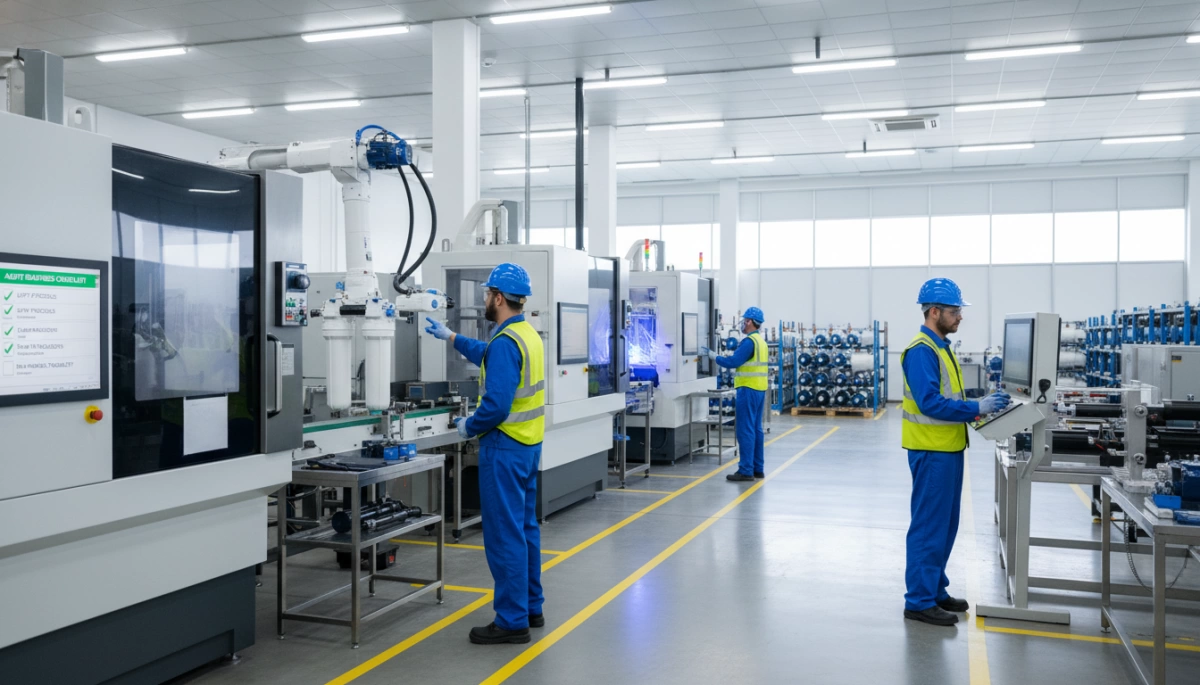
Documents mean nothing if the production team ignores them. During the Gemba Walk—where auditors inspect the actual work environment—we demonstrate real-time adherence to our QMS. This includes enforcing strict cleanroom protocols and running live reverse osmosis production line testing. What auditors read in our manuals is exactly what they see happening on the factory floor.
Proactive CAPA Management
Internal defects happen in manufacturing, but how a factory handles them separates the good from the great. A proactive CAPA (Corrective and Preventive Action) process in water treatment stops issues before they ever reach a shipping container. We do not just patch the immediate problem; we trace the root cause and overhaul the process so that specific defect never occurs again.
Factory Audit Readiness for RO OEM Manufacturing: The Definitive Checklist
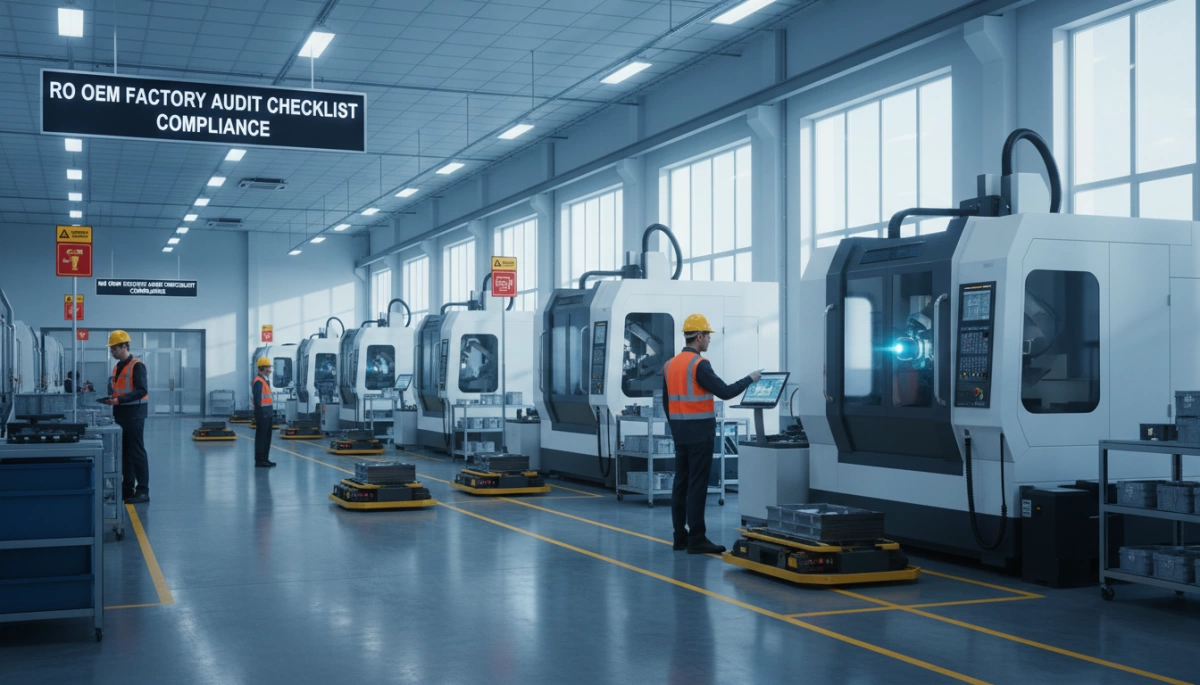
When we prepare for a water purification factory inspection, relying on guesswork is a quick way to fail. Securing OEM brand trust requires a rigid, repeatable structure. A reliable supplier audit checklist for RO systems breaks down into three non-negotiable phases that verify everything from raw material sourcing to final packaging.
Pre-Audit Preparation Manufacturing
Before an inspector ever steps onto the factory floor, the paperwork must be bulletproof. This phase proves that our quality systems for RO are functional and actively managed.
- Quality Manuals: Comprehensive, up-to-date documentation that outlines every standard operating procedure.
- Mock Audit Results: Internal dry runs that identify and fix vulnerabilities long before the actual audit day.
- Training Logs: Concrete proof that every line operator understands RO membrane quality control and specific assembly standards.
Reverse Osmosis Production Line Testing
This is the core of the on-site inspection. The auditor walks the floor to verify that our manufacturing compliance for reverse osmosis holds up under real-world production speeds.
- Incoming Quality Control (IQC) Filtration: Strict vetting and material verification for all parts entering the facility. Catching bad materials early is critical, whether we are building standard under-sink models or specialized, high-capacity components like a commercial water fountain filter.
- In-Process Quality Control (IPQC): Real-time monitoring during the assembly process to guarantee proper routing, secure electrical connections, and correct membrane seating.
- Quality Control (FQC) & Leak Testing: Every unit undergoes rigorous wet testing and high-pressure checks before boxing. If it leaks, it doesn’t leave.
Post-Audit Improvement & CAPA
A successful factory audit RO readiness check doesn’t end when the inspector leaves the building. How a facility handles the aftermath dictates its long-term reliability as an OEM partner.
- Gap Analysis Reporting: A transparent, honest breakdown of any minor deficiencies found during the inspection.
- Continuous Improvement Timelines: Establishing strict, accountable schedules for resolving flagged items. We immediately trigger our CAPA process in water treatment (Corrective and Preventive Action) to ensure the same issue never happens twice.
Common Pitfalls in Water Purifier Manufacturing Audits
I’ve seen plenty of facilities fail a routine RO water filter OEM audit simply because they tripped over avoidable mistakes. Achieving true factory audit RO readiness means facing these operational blind spots head-on. Here is where most suppliers fall short and exactly how we eliminate these risks.
Disconnected Data Silos and Spreadsheets
Running your Quality Management System (QMS) on paper and scattered Excel files is a massive liability. When an inspector demands an immediate batch history, digging through physical filing cabinets immediately signals a lack of operational control.
- The Fix: Centralize your data. Every data point, from raw material intake to final packaging, must live in a unified, instantly searchable digital dashboard.
Lack of Equipment Calibration
Reverse osmosis production line testing is completely useless if your measurement tools aren’t perfectly accurate. I constantly see facilities using pressure gauges, flow meters, and TDS sensors that haven’t been calibrated in months, instantly compromising their manufacturing compliance for reverse osmosis.
- The Fix: Enforce a strict, documented calibration schedule for every single piece of testing equipment on the floor. If a tool misses its scheduled calibration date, it gets pulled from the assembly line immediately.
Poor Sub-Tier Vendor Management
Your final purification system is only as reliable as its cheapest part. Blindly trusting sub-tier component vendors without conducting rigorous supplier audits is a recipe for compliance failure. Whether we are engineering a multi-stage under-sink RO unit or manufacturing a commercial bottle filling station, failing to vet upstream suppliers inevitably leads to uncertified plastics and critical membrane failures down the line.
- The Fix: Extend your internal water purification factory inspection standards to your entire supply chain. Demand full component traceability, active certifications, and regular performance scorecards from every vendor providing raw materials.
Factory Audit Readiness for RO OEM Manufacturing: The Driplife Standard
At Driplife, manufacturing compliance for reverse osmosis isn’t a last-minute scramble before an inspector arrives—it is built directly into our daily operations. We maintain constant factory audit readiness for RO OEM manufacturing, ensuring our US and global partners can trust our processes from day one.
Here is how we keep our production lines in an “always-ready” state:
- Unmatched Scale & Structure: Our 60,000 ㎡ facility is built to handle high-volume demands with absolute precision. Backed by over 15 years of OEM/ODM expertise, we consistently pass rigorous OEM water filter supplier vetting processes by enforcing strict, scalable quality control systems across the entire floor.
- In-House R&D and Lab Testing: We do not rely on outside labs to tell us our products work. We use our own advanced laboratories for continuous IPQC and FQC. Our reverse osmosis production line testing is thorough, covering everything from core RO membranes to advanced sterilization add-ons. For instance, we rigorously validate all integrated technologies in-house, including evaluating exactly how UV light works in a water purifier, to guarantee complete system safety before it ever ships.
- Global Standard Adherence: We build systems meant to dominate the global stage. Our production protocols are designed around strict NSF WRAS compliance manufacturing guidelines and UK drinking water regulations. Even with a massive 500,000-unit annual capacity, high production volume never compromises our compliance standards.
- Total Transparency: We operate with a strict open-door policy. Whether you need to schedule a comprehensive third-party factory inspection in China or prefer to conduct a detailed virtual factory tour from your office in the US, we give you full, unrestricted visibility into our operations.
By embedding quality control directly into our everyday culture, we ensure every water purification factory inspection is a smooth, straightforward validation of what we already do every single day.
FAQs About RO OEM Factory Audits
How long does it take to prepare for an RO OEM factory audit?
True OEM audit preparation is not an overnight task. If a supplier is building their Quality Management System (QMS) from the ground up, expect the process to take anywhere from 3 to 6 months to organize properly. However, for manufacturers who maintain continuous factory audit RO readiness, preparing for a specific visit takes just a few days. By keeping an up-to-date audit checklist RO and maintaining strict internal controls year-round, we ensure the factory floor is always ready for walk-throughs and document reviews.
What is the most critical compliance standard for reverse osmosis manufacturing?
For the United States market, NSF/ANSI 58 is the gold standard specifically for reverse osmosis systems, as it verifies the safe reduction of heavy metals and contaminants. Alongside this, maintaining an ISO 9001 certification for quality systems RO is absolutely mandatory to guarantee consistent, defect-free production. Strict manufacturing compliance RO is exactly what separates premium, reliable counter water filter systems from low-tier alternatives that fail under pressure.
How often should water filtration suppliers undergo third-party inspections?
We firmly believe suppliers should undergo comprehensive third-party inspections at least once a year. This annual baseline ensures strict inspection readiness RO across all departments. But top-tier facilities don’t just wait around for a yearly checkup. We run routine internal supplier audits RO and regularly update our process documentation RO every quarter. Constant internal vetting keeps the assembly lines sharp, ensuring continuous compliance with global standards.