














The Physics of Filtration: Analyzing the Weight
Understanding Dry Weight vs. Wet Weight
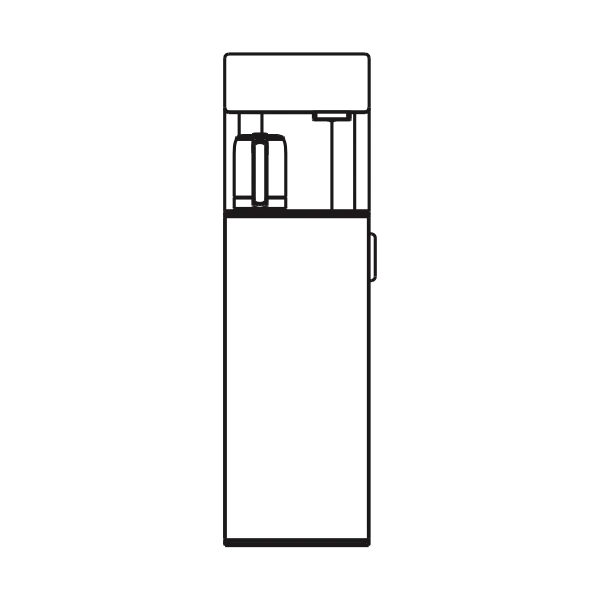
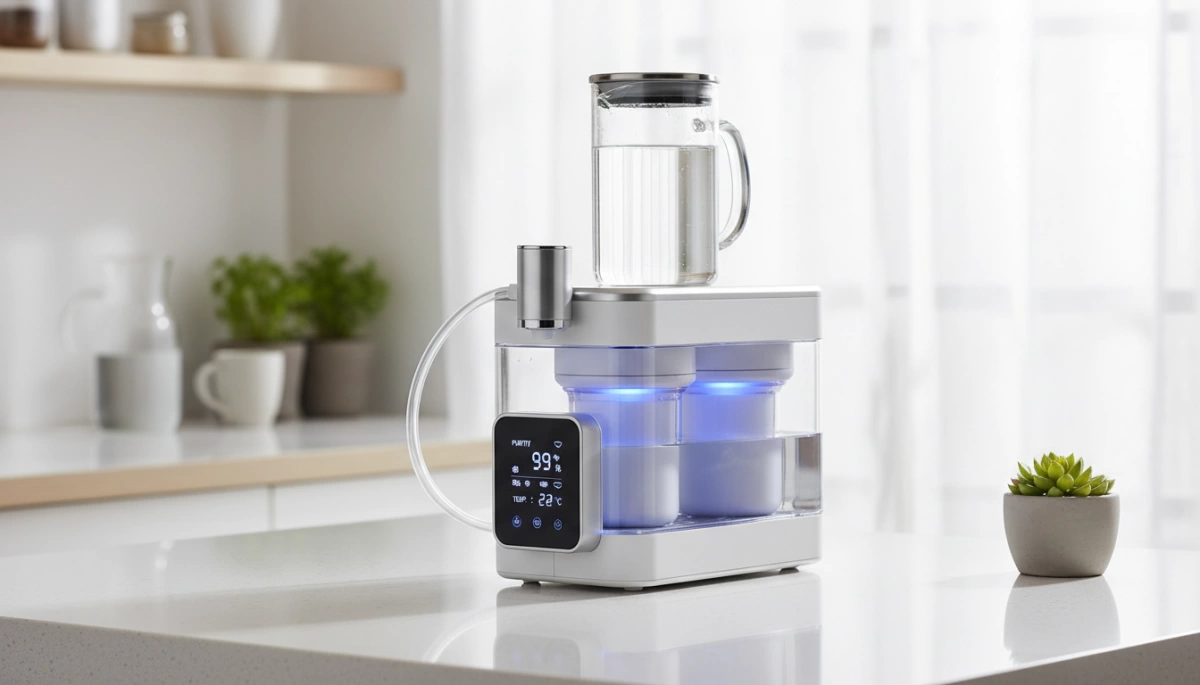
When we engineer our Driplife countertop RO systems, there is a critical distinction between the specifications on the box and the reality on your counter. The dry weight refers to the unit as shipped—typically ranging between 15 to 20 lbs depending on whether you choose a base model like the Clover or a premium unit like the Glacier. However, for practical user logistics, the wet weight is the metric that matters. This includes the unit fully primed with filters saturated and tanks filled to capacity. We design these systems to be portable enough to move when empty, but substantial enough to remain stable during operation.
Calculating Real-World Load
Water is surprisingly heavy, weighing approximately 8.34 lbs per gallon. When you set up a zero installation unit, you are essentially placing a miniature water processing plant on your desk or counter. Here is how the weight adds up once the system is “plug-and-play” ready:
- Raw Water Tank (4L – 5L): Filling the main feed tank adds approximately 8.8 to 11 lbs of immediate weight.
- Internal Pure Water Tank (1.2L – 1.5L): Our systems store filtered water internally for immediate dispensing, adding another 2.6 to 3.3 lbs.
- Filter Saturation: The composite filters hold residual water, slightly increasing the total mass.
Component Weight Breakdown
The density of a desktop RO unit comes from the precision components required to deliver 0.0001-micron filtration and instant heating. Unlike a simple gravity pitcher, our units pack industrial-grade technology into a compact footprint:
- High-Pressure Pumps: Essential for forcing water through the tight RO membrane, these motors add necessary heft.
- Thermal Elements: The 3-second instant heating system requires specialized heating cores that are denser than standard plastic tubing.
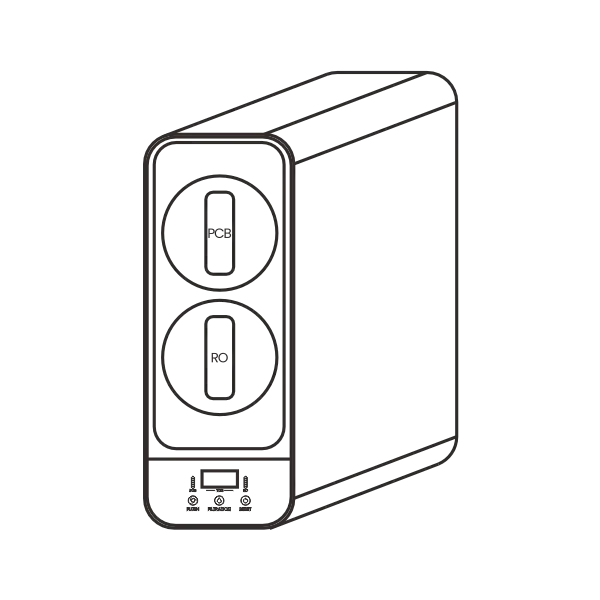
- Dense Carbon Filters: Our multi-stage filters (PAC and CF) use compressed carbon blocks to remove sediment and improve taste, contributing to the overall dry weight.
Advanced Materials: Durability Without Bulk
To ensure our units remain portable without feeling flimsy, we utilize high-grade, food-safe ABS materials for the chassis. This material choice allows us to shave off unnecessary pounds that metal casings would add, keeping the shipping impact low and making the unit liftable by a single person. This balance ensures that while the internal components are heavy duty, the external shell provides a lightweight, durable housing that fits perfectly under standard kitchen cabinets.
Dimensions and Footprint: Will It Fit Your Space?
The Under-Cabinet Test: Navigating Standard 18-Inch Kitchen Clearance
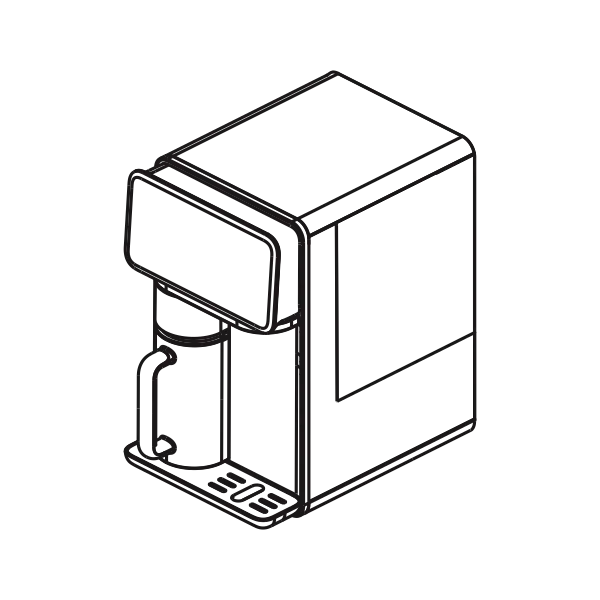
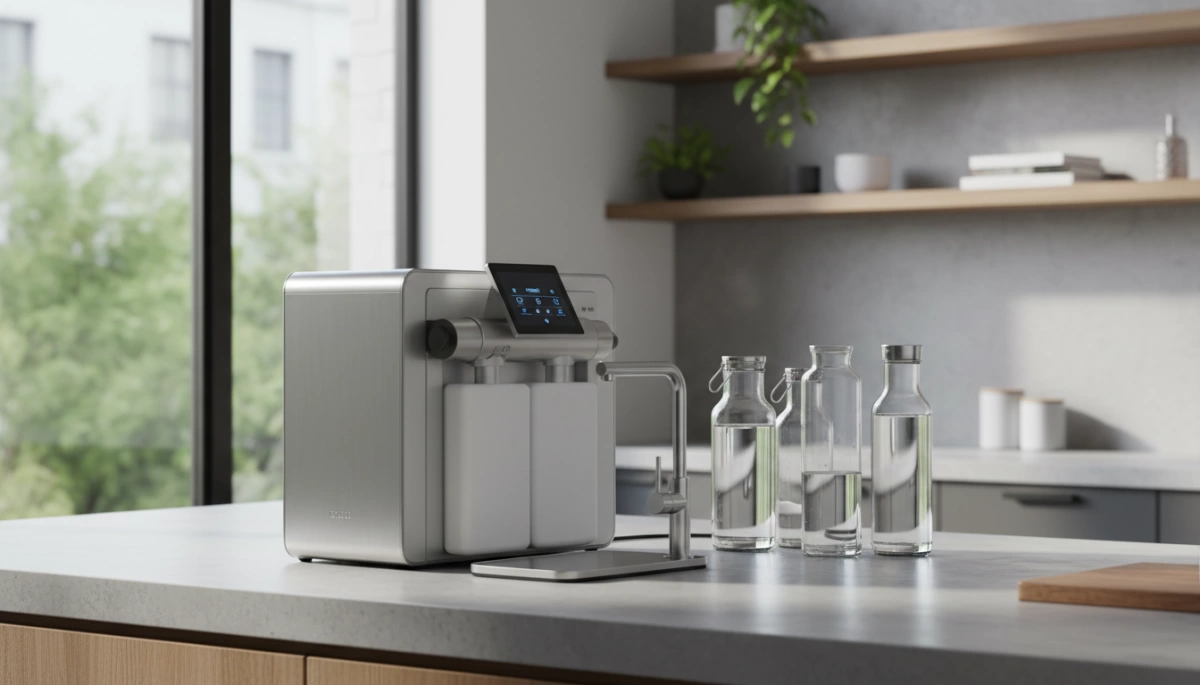
When we evaluate countertop RO system dimensions, the most critical metric is vertical clearance. In standard United States housing construction, the distance between the countertop and the bottom of the upper cabinets is typically 18 inches. We design our units to pass this “under-cabinet test” with room to spare. Unlike a permanent undersink reverse osmosis water filter that requires dedicated cabinet space below, a desktop unit needs to be accessible from the top or front. We ensure the height allows you to easily remove the raw water tank for refilling without dragging the entire machine out from the wall.
Depth vs. Width: Analyzing the “Slim Profile” Trend
Counter space is premium real estate, whether you are in a sprawling suburban home or a compact city apartment. We focus on a “slim profile” design philosophy where width is minimized—often keeping the unit between 7 to 10 inches wide. By prioritizing depth over width, we reduce the perceived desktop water dispenser footprint. This allows the filtration system to sit unobtrusively alongside other appliances like coffee makers or toasters, ensuring you get high-precision filtration without sacrificing your prep area.
Placement Scenarios Beyond the Kitchen
Because our systems require zero installation, they aren’t tethered to the kitchen sink. The compact under-cabinet clearance for RO units also translates well to other areas of the home or office:
- Nightstands: The footprint is small enough for a bedside table, providing instant warm water for medication or baby formula at night.
- Office Desks: A slim unit fits on a standard workstation, offering personal hydration without the need to visit a communal breakroom.
- Kitchen Islands: Perfect for rental properties or homes where running plumbing to a center island is impossible or too expensive.
Portability in Practice: The Real User Logistics
When we talk about moving a filtration system, the experience depends entirely on how the components interact. Portable water station logistics aren’t just about total mass; they are about how easily you can disassemble and grip the unit. We designed our desktop RO systems to ensure that daily maintenance doesn’t feel like a workout, separating the heavy lifting from the routine refilling process.
The “Tank Carry” Factor
The most frequent interaction you will have with the machine is refilling the raw water tank. A fully loaded detachable water tank capacity of 4L to 5L weighs roughly 8 to 11 lbs. We engineer these tanks with ergonomic handles and balanced centers of gravity. This ensures that when you lift the tank from the back of the unit to walk to the sink, it feels stable in one hand. You aren’t dragging the entire machine; you are simply shuttling a manageable water container.
Modular Design: Detachable Drip Trays and Tanks
True portability comes from modularity. Unlike permanent undersink reverse osmosis systems that are bolted down and plumbed in, our desktop units feature a “break-down” design for easy relocation.
- Drip Trays: These magnetically or mechanically detach, preventing spills when moving the unit between rooms.
- Internal Tanks: The separation of the raw water tank and the internal pure water tank allows you to empty the system quickly, significantly reducing the carrying weight during transport.
- Compact Footprint: The modular nature allows the unit to fit into tight spaces, like RV counters or nightstands, without permanent modification to the furniture.
Power Cord Logistics
The final piece of the puzzle is power. Our plug-and-play RO unit operates on a standard 110V-120V outlet, eliminating the need for specialized electrical work. The cord is designed to be flexible yet durable, allowing you to position the unit on a kitchen island or office desk without being tethered too closely to the wall. This electrical simplicity is what truly categorizes the device as an appliance rather than a fixture.
| Feature | Impact on Portability | User Benefit |
|---|---|---|
| Removable Tank | Separates water weight from unit weight | Easy refilling at any sink |
| Detachable Tray | Reduces footprint during packing | Prevents residual water spills |
| Standard Plug | Universal compatibility (110V) | Use in kitchens, bedrooms, or RVs |
| Integrated Handle | Improves grip stability | Safe one-handed transport |
Performance vs. Portability: Debunking the Trade-Off Myth
Does Lighter Mean Weaker? Comparing Compact Units to Under-Sink Systems
There is a lingering belief that high-performance filtration requires heavy, permanent machinery. In reality, the weight of traditional under-sink systems often comes from bulky external pressure tanks and metal plumbing fixtures, not the filtration technology itself. We have engineered desktop units that strip away this excess “dead weight” while maintaining the rigorous standards of Reverse Osmosis.
By optimizing internal components and comparing booster pump tech in compact RO units, we achieve the necessary water pressure for effective filtration without the heavy footprint of industrial-style pumps. A lighter unit simply means smarter packaging, not lower quality.
Technical Deep Dive: How Compact 0.0001 Micron RO Membranes Function
The heart of our system is the RO membrane, and size does not compromise its precision. Despite fitting into a sleek, countertop-friendly housing, the membrane utilizes a 0.0001-micron rating. This is the exact same standard used in large-scale systems to remove heavy metals, bacteria, and dissolved solids.
- Spiral-Wound Efficiency: We use advanced winding techniques to maximize the surface area of the membrane within a compact cartridge.
- 3-in-1 Composite Design: By integrating the sediment (PAC) and carbon fiber (CF) stages with the RO membrane or placing them in a unified workflow, we reduce the physical space required for multi-stage filtration.
Feature Density: Packing Instant Heating, Cooling, and UV into Portable Frames
Portability usually implies a “basic” product, but our desktop RO systems are actually more feature-dense than their bulky predecessors. We don’t just filter water; we condition it. A standard under-sink unit filters water, but you still need a kettle to boil it or a pitcher to cool it.
Our “plug-and-play” units consolidate these appliances into one 15–30 lb frame. This concept of Feature Density allows us to deliver a complete hydration station that fits under a standard kitchen cabinet.
Comparison of Feature Integration:
| Feature | Traditional Under-Sink RO | Driplife Desktop RO |
|---|---|---|
| Heating | Requires separate kettle/pot | 3-Second Instant Heating |
| Cooling | Requires fridge pitcher | Built-in Cooling (Select Models) |
| Sterilization | Rare/Add-on | Integrated UV-C LED |
| Installation | Heavy drilling & plumbing | Zero Installation |
This high level of integration ensures that choosing a portable, lightweight option upgrades your experience rather than limiting it.
Ideal Use Cases for Lightweight Desktop RO Systems
When we engineer desktop reverse osmosis systems, we aren’t just thinking about filtration specs; we are thinking about where these units will actually live. The true value of a lightweight water purification system lies in its ability to adapt to your environment, not the other way around. By eliminating the need for plumbing connections and keeping the form factor compact, we open up high-quality hydration to users who were previously stuck with pitchers or bottled water.
The Renter and Student Guide: Zero Installation Means No Deposit Deductions
For anyone leasing an apartment or living in a dorm, drilling a hole in a granite countertop for a dedicated faucet is simply not an option. That is the quickest way to lose a security deposit. This is where the renter-friendly water filter design becomes a game changer. Because our units operate on a “plug-and-play” basis, there is absolutely zero installation reverse osmosis hardware required.
You simply place the unit on the counter, plug it into a standard 110V-120V outlet, and fill the raw water tank. There are no hoses to hide and no diverter valves to screw onto the kitchen faucet. When it’s time to move out, you just unplug the unit, empty the tanks, and carry it to your next location. It effectively decouples your access to pure water from the permanent infrastructure of the building.
RV and Van-Life Enthusiasts: Why Weight Distribution Matters on the Road
The “Van Life” and RV community faces a unique challenge: balancing the need for clean water with strict weight and space limits. A standard under-sink system with a pressurized tank is bulky and difficult to winterize. In contrast, a portable reverse osmosis for RV use offers a self-contained solution. With a footprint roughly 7–10 inches wide, these units fit easily on small galley counters or stow away in a cabinet during transit.
Weight distribution is critical in mobile living. Our systems allow you to control the load; you can travel with the tanks empty to keep the vehicle light and fill them only when you reach a water source. Furthermore, since environmental conditions change constantly on the road, understanding the impact of water temperature on filtration efficiency helps users maintain optimal performance whether they are parked in the desert or the mountains. The integrated handle design on the raw water tank makes refilling at a campground spigot effortless.
The Office Worker: Setting Up Personal Hydration Stations Without Facility Approval
Corporate offices often have lackluster water options—usually a dusty cooler or tap water that tastes like chlorine. Installing a commercial filtration system requires facility management approval, plumbing permits, and a significant budget. A portable water station logistics approach solves this by bringing the filtration directly to your desk or breakroom cubicle.
Because our desktop RO units feature 3-second instant heating, they replace both the water cooler and the office kettle. You get ambient water for hydration and instant hot water for coffee or tea without leaving your workspace. Safety is also paramount in shared environments; that is why we integrate UV water sterilizers inside the pure water tank to prevent secondary pollution, ensuring that the water sitting on your desk remains pristine throughout the workday. This independence from the building’s main water line gives you total control over your water quality.
Smart Engineering: Prioritizing Portability and Safety
Installation-Free Engineering: The Mechanics of “Plug and Play” Systems
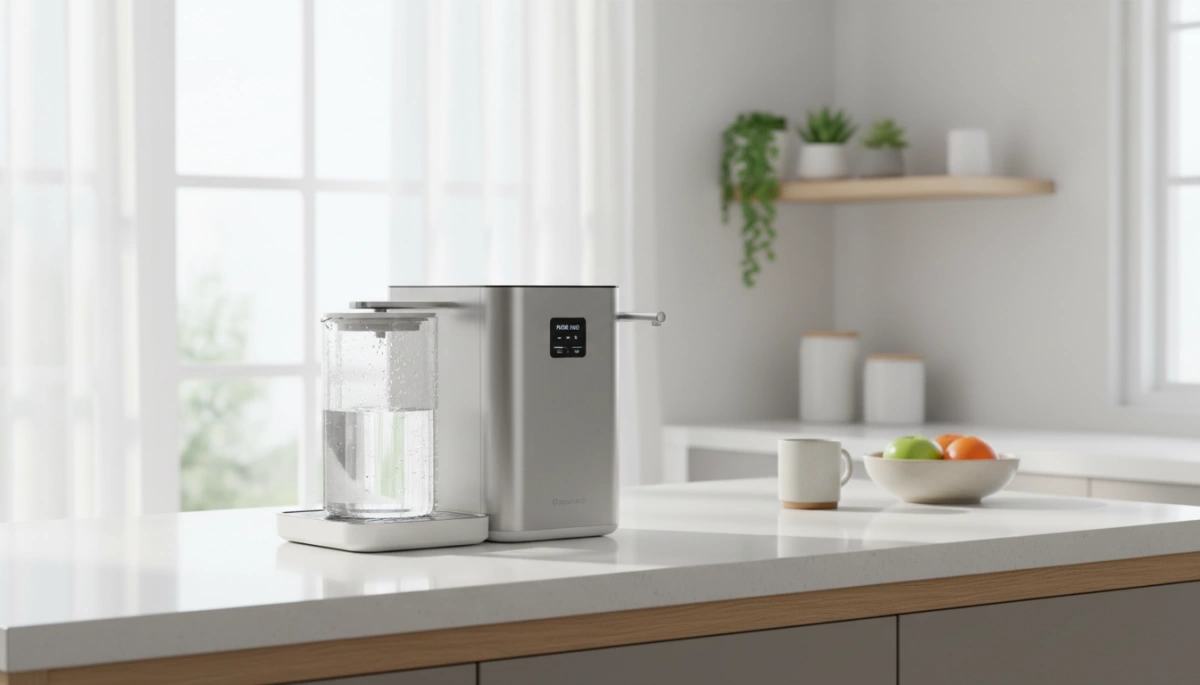
We designed our systems to completely bypass the heavy infrastructure required by traditional under-sink units. By eliminating the need for copper piping, diverter valves, and permanent drainage lines, we achieve a true plug-and-play RO unit. This isn’t just about saving time; it is a structural advantage. The integration of a 4L to 5L raw water tank directly into the chassis removes the bulk of external hardware. You simply plug the unit into a standard 110V-120V outlet and fill the tank. This self-contained approach delivers the core benefits of countertop reverse osmosis water filters, offering high-precision filtration without the anchor of plumbing.
Smart Monitoring on the Move
Portability requires adaptability. When you move a filtration system from a kitchen to an office or RV, the water source and environment change. Our units feature integrated LED displays that provide real-time data on Total Dissolved Solids (TDS) and filter lifespan. This smart monitoring ensures you have immediate visibility into water quality without needing external testing tools. Furthermore, safety during transport and intermittent use is managed by built-in UV-C LED sterilization. This technology actively prevents secondary pollution in the internal tank, ensuring the water remains pure even after the unit has been relocated.
Material Choice: Lightweight Durability
To ensure lightweight water purification, we utilize high-grade, food-safe ABS materials for the unit’s body. This material selection is critical for reducing the dry weight to a manageable 15–30 lbs range while maintaining high durability. Unlike metal-heavy appliances, this construction allows the unit to be easily lifted by one person while remaining sturdy enough to support the internal pressure of the RO process and the thermal demands of the 3-second instant heating system. This balance of material science ensures the device is stable on your counter but light enough to ship and move without hassle.
Frequently Asked Questions About Desktop RO Portability
Is a filled countertop RO system too heavy for a standard shelf?
When analyzing dry weight vs. wet weight, most users are surprised by how manageable these units remain even when fully operational. A standard desktop water dispenser footprint is engineered to distribute weight evenly. Our base models typically weigh between 15 to 20 lbs when empty. Once you fill the 4L to 5L raw water tank and the internal pure water reservoir fills up, you are adding approximately 11 to 13 lbs of water weight.
This brings the total operating weight to roughly 30 lbs. Most standard kitchen shelves, nightstands, and office desks are rated to hold significantly more than this—often upwards of 50 lbs. However, if you are placing the unit on a floating shelf or a temporary structure, I always recommend checking the weight rating first to ensure stability for your installation-free water purifier.
Can I easily transport a desktop RO unit to my RV for weekend trips?
Absolutely. One of the primary design goals for the portable reverse osmosis for RV market is true mobility. Since these systems require zero installation reverse osmosis technology, there is no plumbing to disconnect. You simply empty the raw water tank and the internal clean water tank (using the drain outlet if available on your specific model), unplug the power cord, and you are ready to move.
For those living the van life or taking weekend trips, the plug-and-play RO unit acts just like a coffee maker. It is compact enough to stow away securely during transit. To ensure the unit remains pristine during travel, understanding the importance of packaging design in premium filter sales can give you insight into how to protect the exterior and internal components if you plan to move it frequently.
Does the “portable” designation mean the filtration quality is lower?
This is a common misconception. A lightweight water purification system does not mean “lightweight” performance. Our desktop units utilize the exact same high-grade 0.0001-micron RO membranes found in massive under-sink systems. The reduction in size comes from eliminating the bulky pressure tank and long tubing runs, not by reducing filtration stages.
You get a full 4-stage countertop filtration process—including sediment removal, carbon filtration, RO membrane separation, and UV sterilization—packed into a smaller frame. In fact, these compact units often rival the performance of larger industrial TDS water filter systems with 99% salt rejection, ensuring that portability never compromises your health.
How much counter space do I actually need for a plug-and-play unit?
Space efficiency is critical for modern kitchens. We specifically design these units to pass the under-cabinet clearance for RO test. Most standard kitchen cabinets are installed about 18 inches above the counter. Our units, like the Clover or Glacier series, are designed with a height that fits comfortably within this gap while still allowing access to the water tank lid.
Regarding width, the compact water filtration system usually takes up about 7 to 10 inches of horizontal space—roughly the same as a standard toaster or blender. This slim profile allows you to slide the unit into corners or tight spaces without sacrificing your prep area. Because it is a smart water purifier portability solution, you are not tethered to the sink, giving you the freedom to place it on a side table or island if your main counter is crowded.