















The Anatomy of Contamination: Where Biofilm Hides
Public water infrastructure faces a silent adversary that standard cleaning often misses: biofilm. We know that simply filtering water isn’t enough if the delivery system itself becomes a breeding ground. Understanding biofilm prevention water path engineering starts with identifying the structural vulnerabilities in traditional designs where bacteria colonize and thrive.
The “Dead Leg” Problem in Plumbing
The most significant engineering flaw in hydration stations is the “dead leg”—a section of piping where water flow is stagnant or non-existent. In these distinct pockets, residual chlorine from municipal treatment dissipates, creating a safe haven for microbial growth.
- Stagnant Water Elimination: Without continuous flow, water sits and spoils.
- Hydraulic Dead Leg Removal: We view every millimeter of tubing that doesn’t actively circulate water as a potential biological risk.
- Retrograde Contamination: Stagnant zones allow bacteria to grow upstream, eventually compromising the main supply line.
Surface Roughness and Bacterial Adhesion
Microscopic topography matters. In standard plastic tubing or low-grade metal components, surface roughness provides the necessary “anchors” for bacteria to attach. Once attached, these microorganisms secrete a protective slime matrix—biofilm—that shields them from sanitizing agents. We prioritize sanitary stainless steel piping and high-grade internal components because smooth surfaces drastically reduce the surface area available for bacterial adhesion. If the water path isn’t microscopically smooth, it’s essentially a trap for organic debris.
Temperature Fluctuations in Internal Lines
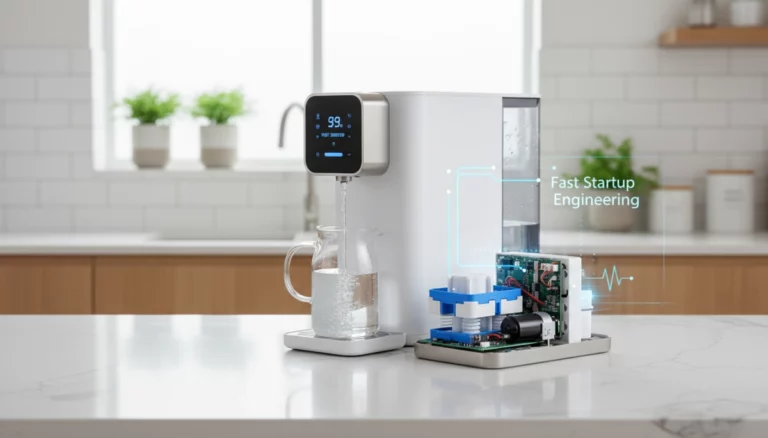
Biofilm thrives in warmth. A major oversight in many public bottle fillers is the proximity of water lines to heat-generating electronic components.
- Thermal Bleed: Internal motors and sensors generate heat that can warm adjacent water lines if not properly insulated.
- The Incubation Zone: Water sitting at room temperature or slightly above accelerates Legionella mitigation strategies failure.
- Cooling Consistency: Maintaining a consistently low temperature throughout the entire dispense path is critical for slowing microbial reproduction.
Material Science: The First Line of Defense
When we engineer public hydration solutions like the Drip Station, the materials we choose are the foundation of Water Path Hygiene Design. We don’t just pick materials that look good; we select them based on their ability to resist colonization at a microscopic level. If the physical structure of the station allows bacteria to grip the surface, no amount of flushing can fully solve the problem.
Why 304 Stainless Steel Matters
We rely heavily on commercial-grade sanitary stainless steel piping and housing components because they offer the best defense against biofilm formation. Unlike porous plastics that can degrade and create microscopic fissures where bacteria hide, 304 stainless steel provides a non-porous, smooth surface.
- Corrosion Resistance: It withstands constant exposure to moisture and cleaning agents without rusting, ensuring the water path remains chemically inert.
- Surface Smoothness: The low surface roughness prevents organic matter from adhering to the walls of the unit, which is critical for effective biofilm control in plumbing.
- Durability: In high-traffic public spaces, the material must resist physical damage that could compromise the hygienic seal of the unit.
Antimicrobial Components & Compliance
Beyond the steel housing, every component that touches the water is selected for safety and compliance. We ensure our systems align with standards like NSF/ANSI 61 compliance, which dictates that materials must not leach contaminants into the drinking water.
While we utilize antimicrobial surface technology principles by keeping surfaces smooth and cleanable, we also design the internal architecture to minimize “dead zones.” By combining high-grade materials with our integrated UVC-LED purification, we create a hostile environment for pathogens. The result is a robust infrastructure that supports the NSF-certified filtration system, ensuring that the water remains as pure at the nozzle as it was when it passed through the filter.
Flow Dynamics and Smart Engineering
When we design public water infrastructure, we have to fight physics. The biggest enemy of a clean water path is stillness. Stagnant water elimination is the core objective of our hydraulic engineering because water that stops moving becomes a breeding ground for bacteria. We design our internal plumbing to minimize “dead legs”—those sections of pipe where water gets trapped and creates a biofilm hazard.
Eliminating Stagnation with Continuous Loops
To ensure biofilm control in plumbing, the internal architecture must encourage constant movement. We utilize short, direct routing from the filtration unit to the dispense point. This approach aids in hydraulic dead leg removal, ensuring that fresh, filtered water is always ready to dispense. By keeping the volume of water stored in the lines low, we reduce the surface area available for bacterial adhesion.
- Direct Routing: Minimizes bends and crevices where pathogens hide.
- Low Retention Volume: Ensures water is cycled through frequently.
- Advanced Filtration: We utilize antifouling water filter membrane technology to maintain consistent pressure and prevent organic buildup that slows down flow.
IoT and Auto-Flushing Capabilities
Hardware is only half the battle; intelligence is the other. We integrate IoT water station monitoring to give facility managers real-time visibility into usage patterns. If a station sits unused for an extended period—like over a school break or a long weekend—the risk of contamination rises.
Our smart dashboard tracks filter life and system health via cellular connectivity. This data is crucial for implementing auto-flush water systems protocols or manual maintenance schedules. Instead of guessing when the water path needs attention, our system provides the data needed to keep the hydration station safe, efficient, and clean.
The Kill Step: Active Disinfection Technology
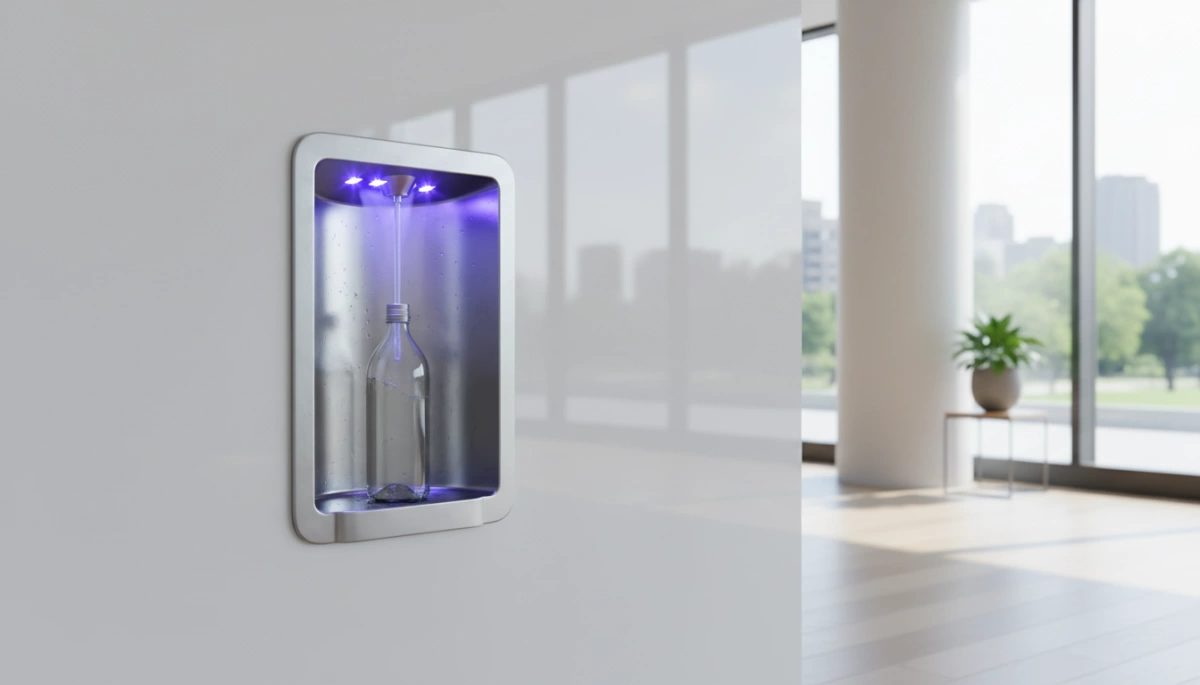
UV-C LED Water Sterilization at the Point of Dispense
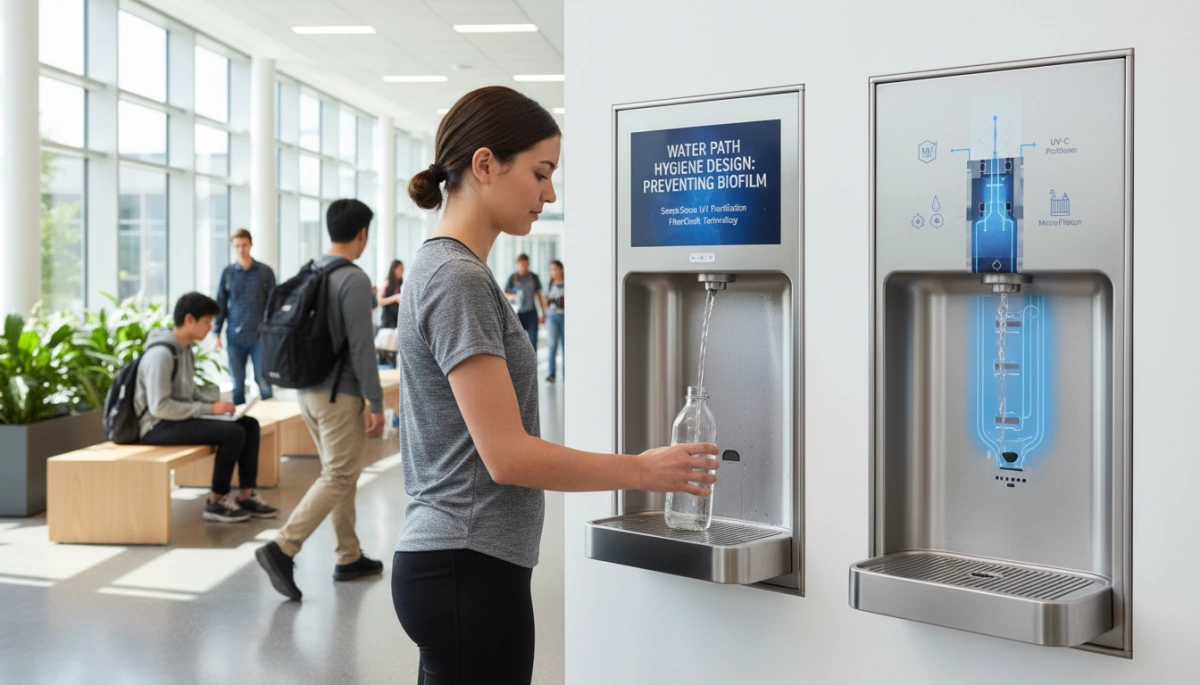
We know that relying solely on mechanical filtration isn’t enough to guarantee safety in high-traffic public spaces. That is why we integrated UV-C LED water sterilization directly at the point of dispense. Unlike older systems that might blast UV light deep inside a hidden tank, our design targets the “last inch” of the water path. This critical placement neutralizes pathogens immediately before the water hits your bottle, effectively stopping retrograde contamination where airborne bacteria attempt to enter the nozzle.
This method provides a robust point-of-use water treatment solution that operates without chemicals. By positioning the UVC-LED right at the outlet, we ensure that the water is purified at the exact moment of consumption, leaving no opportunity for re-contamination in the dispensing arm.
Multi-Stage Filtration vs Biofilm
To support the sterilization process, our commercial water filtration systems act as the primary barrier against the organic nutrients that feed biofilm. By utilizing high-performance, NSF-certified filtration, we strip out lead, chlorine, cysts, and particulate matter. This effectively starves potential bacterial colonies by removing their food source before they can adhere to internal surfaces.
Our approach to biofilm control in plumbing relies on a dual-action strategy:
- Nutrient Removal: Filters eliminate organic contaminants that facilitate slime growth.
- Active Neutralization: UVC-LEDs destroy the DNA of bacteria and viruses at the exit point.
- System Efficiency: This streamlined architecture mirrors why tankless designs offer a competitive edge by minimizing stagnant reservoirs where bacteria typically thrive.
External Hygiene: Reducing the Biological Load
Touchless Hydration Systems
We know that even the most advanced internal filtration is useless if the user interface acts as a vector for pathogens. The most effective way to maintain Water Path Hygiene Design on the outside is by removing physical contact entirely. Our stations utilize touchless activation sensors (IR) to trigger water flow. This eliminates the need for buttons or levers, which are notorious hotspots for cross-contamination in high-traffic public spaces. By switching to touchless hydration systems, we break the primary chain of infection before the user even takes a sip.
Recessed Nozzle Design Benefits
The physical architecture of the dispense point is just as critical as the sensor technology. We employ a recessed nozzle design to solve the issue of “retrograde contamination”—where bacteria travel from a user’s bottle back up into the water line. By positioning the dispense head well above the fill area and shielding it within the housing, we physically prevent users from touching the nozzle with their bottle rims or mouths.
Whether you are engineering a commercial station or selecting specific types of kitchen sink filtered water faucet setups, the principle remains the same: protect the outlet to maintain purity.
Design Features for External Hygiene:
| Feature | Function | Hygiene Benefit |
|---|---|---|
| Touchless IR Sensors | Activates flow without contact | Eliminates surface-to-hand germ transfer. |
| Recessed Nozzle | Hides the outlet inside housing | Prevents direct contact with dirty bottles. |
| Sloped Drain Tray | Rapidly clears spilled water | Reduces standing water and bacterial growth. |
| Smooth Stainless Steel | Exterior housing material | Easy to wipe down and resistant to grime. |
This approach ensures that our hygienic dispensing design acts as a physical firewall, keeping external contaminants away from the sterile water path.
Maintenance: The Human Factor
Even the most advanced Water Path Hygiene Design will fail if we don’t account for the people taking care of it. We can engineer the perfect flow, but eventually, a technician needs to open that unit up. If maintenance is difficult, it gets skipped. That is where biology beats engineering. To win this battle, we have to focus on sanitation design bottle filler features that make the human job easier and more effective.
Design for Serviceability
We design for the technician, not just the user. If a maintenance crew needs special tools or thirty minutes just to access the filter, that filter isn’t getting changed on time. Proper cleaning protocol design relies on accessibility. We prioritize tool-free access panels and modular components that slide out for quick servicing.
When internal components are buried behind complex casing, biofilm prevention water path strategies fall apart. Routine maintenance, like swapping out filtration cartridges, must be seamless. Understanding how does charcoal filter water helps us realize that once carbon blocks are saturated, they stop protecting the user and can actually become a breeding ground for bacteria if not replaced immediately. Easy access ensures these critical swaps happen on schedule.
Predictive Maintenance via IoT
We are moving away from clipboards and guessing games. IoT water station monitoring is the brain behind the brawn. By integrating smart sensors, the unit tells facility managers exactly what it needs before a problem occurs. This is long-term hygiene engineering at its finest.
Instead of relying on a generic calendar, predictive maintenance uses real-time data to trigger service calls.
- Real-time Filter Tracking: Monitors actual gallon usage rather than just time elapsed.
- UV-C Diagnostics: Alerts the system immediately if the LED disinfection unit malfunctions.
- Flow Rate Analysis: Detects clogs or leaks that could indicate internal stagnation.
This technology bridges the gap between mechanical design and human action, ensuring that sanitation design bottle filler protocols are proactive rather than reactive.
Frequently Asked Questions About Water Path Hygiene
How often should public bottle fillers be sanitized?
In high-traffic public facilities, surface cleaning should happen daily to handle external grime on the housing and drain tray. However, deep internal sanitization depends on usage volume and water quality. We recommend a rigorous cleaning protocol design that aligns with filter changes—typically every 6 months or 3,0