

















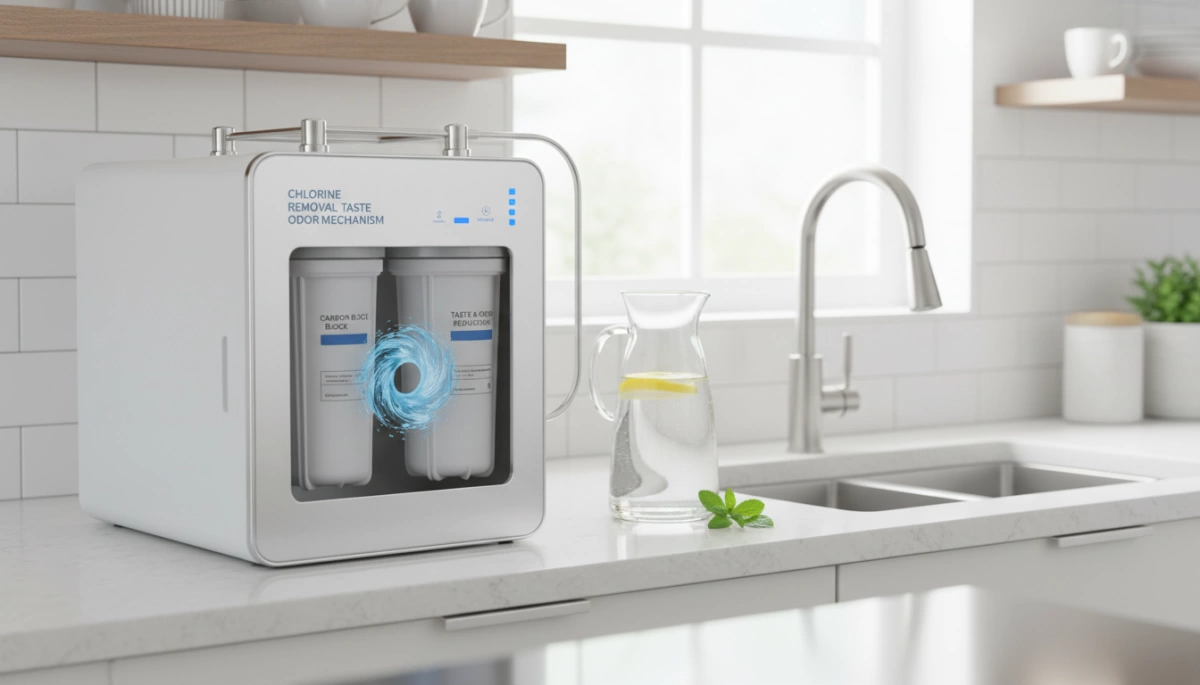
If you’ve ever poured a glass of tap water and caught that sharp “pool-like” smell, you’re already familiar with the problem this article solves: chlorine taste and odor.
Most guides tell you how to get rid of it. Pitchers, cartridges, faucet mounts. But very few explain the chlorine taste and odor reduction mechanism itself—what actually happens inside activated carbon, carbon fiber, or KDF media when water hits the filter.
This guide is different.
You’re going to see exactly how free chlorine is adsorbed, catalytically reduced, and converted into chloride ions, how microporous carbon structures reshape the water’s sensory profile, and why technologies like carbon fiber composites and KDF redox media are changing what’s possible in point-of-use filtration.
So if you want a clear, scientific breakdown of the real mechanisms behind chlorine taste and odor reduction—not marketing fluff—you’re in the right place.
Chlorine Taste And Odor Reduction Mechanism Starts With Your Senses
Most people in the US notice it right away: tap water that smells like a swimming pool or has a sharp, chemical edge. Even though municipal water is disinfected and technically safe, that chlorine taste and odor can make a glass of water feel anything but “clean.”
Treated water still tastes chemical because of how chlorine behaves in water:
- When utilities dose chlorine, it forms hypochlorous acid (HOCl) and hypochlorite ions (OCl⁻).
- These are the active disinfectant species that kill bacteria and viruses, but they also create that “bleachy,” swimming pool water taste.
- When chlorine reacts with natural organic matter or ammonia in the water, it can form chloramines and other byproducts that push the odor toward musty, medicinal, or rubbery notes.
In simple terms:
- Hypochlorous acid (HOCl) – powerful disinfectant, harsher taste and smell, dominant at lower pH.
- Hypochlorite ion (OCl⁻) – still disinfects, but with a different, “flat chemical” taste, more common at higher pH.
- Chloramines – formed when chlorine bonds with ammonia; more stable, weaker disinfectant, but harder to remove and often responsible for that lingering chlorine smell in tap water.
I focus heavily on the chlorine taste and odor reduction mechanism in our filtration designs because it directly affects kitchen water quality, everyday drinking comfort, and overall trust in your tap. When you understand how these species behave, it’s much easier to appreciate why you need the right carbon fiber odor adsorption, chlorine smell removal, and faucet taste odor filter technology to turn “safe but smelly” water into a premium drinking water experience.
Activated Carbon Chlorine Taste and Odor Reduction Mechanism
Activated carbon is charcoal that’s been “activated” with steam or gas at very high temperatures to create a microporous carbon structure with a massive internal surface area. We typically use high-iodine number coconut shell carbon because it delivers strong activated carbon adsorption performance and long life in compact faucet taste odor filters for U.S. homes.
Inside each grain or carbon block, you have three main pore types working together to cut chlorine taste and odor:
- Macropores act like highways, moving chlorinated tap water quickly into the media.
- Mesopores handle most of the taste and odor molecules, including musty and earthy odor compounds.
- Micropores provide the huge surface area where free chlorine and tiny organics are captured or reacted.
First, activated carbon removes many chlorine-related smells through physical adsorption. Taste and odor compounds stick to the carbon surface, which is why surface area to volume ratio in filters is a big deal. GAC granular activated carbon and dense carbon block CTO filters both use this process, but carbon block and carbon fiber odor adsorption media pack more surface into a smaller space for better kitchen water quality at typical U.S. flow rates.
On top of adsorption, high-quality carbon provides catalytic chlorine reduction. Free chlorine (as hypochlorous acid and hypochlorite ions) is not just trapped; it’s chemically changed. Through chemisorption, chlorine is reduced to harmless chloride ions, improving chlorine smell removal and overall tap water odor improvement. A simplified pathway looks like this:
- Chlorine (Cl₂ or HOCl/OCl⁻) contacts the carbon surface
- The carbon surface donates electrons (a catalytic reduction process)
- Chlorine is converted to chloride ion (Cl⁻), which has no strong taste or odor
This is the core chlorine taste odor reduction mechanism behind modern point of use POU water filtration systems and carbon block CTO filters that help deliver a more premium drinking water experience at home. If you’re also comparing how different types of treated water feel and taste at the tap, it’s worth understanding how carbon filtration fits alongside options like purified vs filtered water in home kitchens.
Advanced Carbon Fiber Chlorine Reduction Mechanism
Granular Activated Carbon vs Carbon Fiber Media
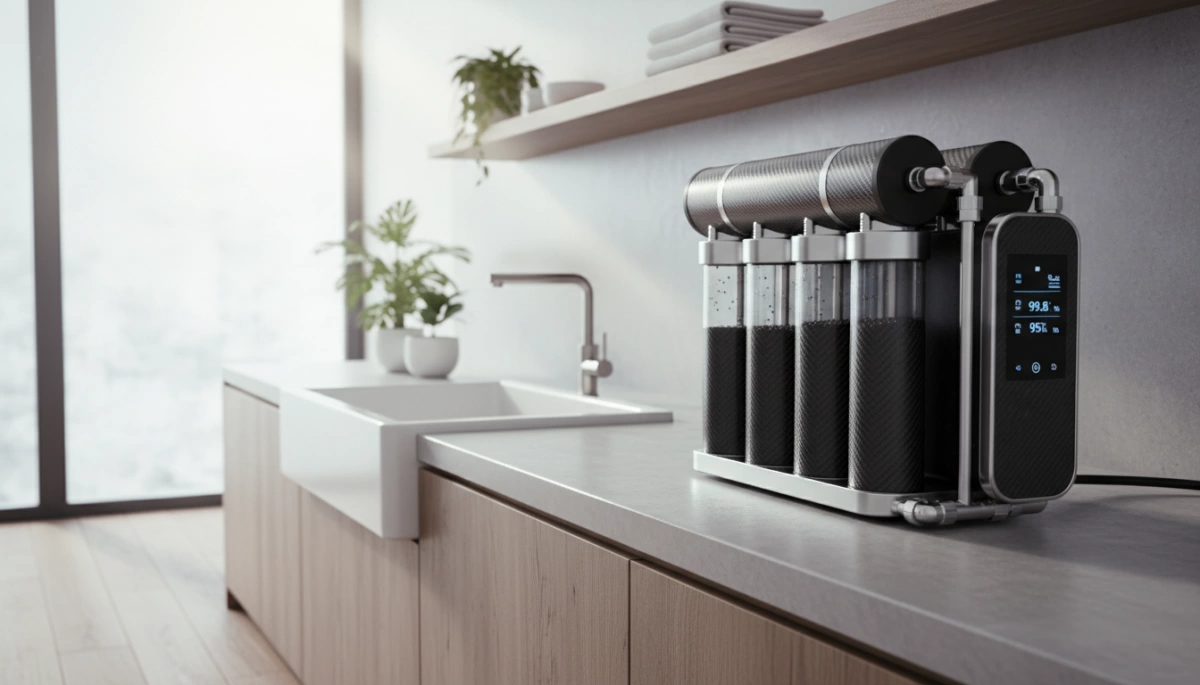
In our filters, I use both GAC (granular activated carbon) and advanced carbon fiber media, but they behave very differently:
| Feature | GAC (Granular Carbon) | Carbon Fiber Media |
|---|---|---|
| Particle shape | Loose granules | Tight woven / molded fibers |
| Diffusion distance | Longer path through each granule | Ultra‑short path across thin fibers |
| Reaction speed (adsorption/redox) | Moderate | Very fast, especially for chlorine taste and odor |
| Best use case | Lower flow, long contact time | High flow, point of use (POU) faucet applications |
GAC is great for bulk chlorine taste and odor reduction, but carbon fiber media gives me much tighter control over kitchen water quality and faucet flow behavior.
Shorter Diffusion Distance = Faster Chlorine Removal
With carbon fiber filtration media, chlorine and odor molecules don’t have to travel deep into a big granule. They hit a huge surface area almost immediately:
- Short diffusion path means faster activated carbon adsorption and catalytic reduction.
- This improves chlorine smell removal and tap water odor improvement in the first seconds of flow.
- At typical U.S. faucet flow rates, the water feels “cleaner” faster, even when someone opens the tap all the way.
If you’re pushing higher flow through a compact faucet taste odor filter, this fast path is what keeps the sensory performance high instead of “chlorine breakthrough.”
High Flow Rates, Pressure Drop, and Sensory Performance
The challenge is simple: U.S. households want strong flow, but also premium taste. I design the carbon fiber layers to balance:
- Pressure drop vs filtration efficiency: Enough media depth for strong chlorine taste odor reduction, but not so tight that it chokes your faucet.
- Contact time and flow rate trade off: Carbon fiber lets me keep a reasonable empty bed contact time (EBCT) even in slim, modern housings.
- Surface area to volume ratio in filters: More active sites per cubic inch for better household odor reduction without bulky cartridges.
For homeowners who care about both flow and taste, pairing carbon fiber with smart POU design—like a well‑matched faucet purifier as explained in our guide on the principle behind installing a water purifier on a faucet—delivers a clear sensory improvement filtration experience at the sink.
KDF Redox Chlorine Taste and Odor Reduction Mechanism
KDF redox media is a high-purity copper–zinc alloy that works like a tiny electrochemical cell inside your faucet taste odor filter. When tap water flows through this bed of granules, a redox (reduction–oxidation) reaction kicks in, changing the chemistry of the water instead of just “masking” the chlorine taste and odor.
How KDF Converts Chlorine to Chloride
In normal chlorinated tap water, you mainly have free chlorine (as hypochlorous acid and hypochlorite). As water passes over KDF:
- The copper–zinc pair transfers electrons to free chlorine.
- This catalytic reduction process turns aggressive chlorine into harmless chloride ions.
- As the oxidation reduction potential (ORP) of the water drops, the swimming pool water taste and sharp chlorine smell are dramatically reduced.
This is a true chemical conversion, not simple chlorine smell removal by trapping.
Why KDF Plus Carbon Works So Well
On its own, KDF helps with chlorine taste and odor reduction, but it really shines when we combine it with activated carbon adsorption in a composite carbon KDF filter design:
- KDF handles the heavy lifting on free chlorine and protects the carbon from early burnout.
- Lower ORP and less free chlorine mean the carbon block CTO filters can focus on musty and earthy odor removal and other organics.
- This combo extends filter life, stabilizes sensory improvement filtration, and delivers more consistent kitchen water quality between cartridge changes.
Extra Benefit: Bacteria and Heavy Chlorine Loads
Because of the strong redox environment, KDF media also helps:
- Inhibit bacterial growth on the media surface, supporting better bacteria control in carbon filters.
- Handle heavy chlorine loads without the sudden drop in performance you often see in basic faucet filters.
For households that want a premium drinking water experience at the sink without going all the way to a full reverse osmosis setup, pairing KDF with high-quality carbon or even a portable RO system can deliver a noticeable upgrade in chlorine taste odor reduction and overall tap water odor improvement. If you’re comparing options, it’s worth looking at how KDF-based filters stack up against other technologies used in portable reverse osmosis systems so you can choose the right balance of cost, performance, and maintenance for your home.
Key Factors That Affect Chlorine Taste and Odor Reduction
When I design chlorine taste and odor reduction filters, I focus on a few key variables that directly impact what you taste and smell at the tap.
Empty Bed Contact Time (EBCT)
The longer water stays in contact with the carbon media, the better the chlorine taste and odor reduction.
- Longer EBCT gives activated carbon more time to adsorb musty and earthy compounds and complete the catalytic reduction of free chlorine to chloride ions.
- Short undersink or faucet filters with very high flow can struggle here, because water simply moves too fast for full chlorine smell removal.
Surface Area, Pore Structure, and Iodine Number
Chlorine capacity is strongly tied to carbon surface area.
- A higher iodine number (often 900–1100 mg/g for premium coconut shell carbon) usually means more microporous carbon structure and more sites for activated carbon adsorption.
- This directly improves chlorine taste odor reduction, especially in compact point of use filters where every cubic inch of carbon counts.
Water Temperature and Kinetics
Water temperature changes how fast adsorption and redox happen.
- Warmer water speeds up both adsorption and catalytic reduction, so chlorine and odor removal often look better in summer.
- Colder tap water slows kinetics, which is one reason we test our media across a range of temperatures and track how water temperature impacts filtration efficiency.
pH, Hypochlorous Acid, and Hypochlorite
The balance between hypochlorous acid (HOCl) and hypochlorite ion (OCl⁻) shifts with pH.
- At lower pH, more HOCl is present and is easier for catalytic carbon for chlorine to reduce.
- At higher pH, more OCl⁻ forms, which is harder to remove and can leave more “swimming pool water taste” at the faucet.
Real-World Taste and Odor Results
In real U.S. homes, these variables work together.
- Flow rate and EBCT, surface area to volume ratio in filters, water temperature, and pH all decide how much chlorine taste and odor you actually notice.
- That’s why we match carbon type, pore structure, and media volume to local water conditions—to deliver real sensory improvement filtration, not just lab numbers.
Chloramine Reduction Mechanism Versus Free Chlorine
Chloramine is simply tougher to deal with than free chlorine. Free chlorine (mostly hypochlorous acid and hypochlorite) reacts quickly and is easy to convert to harmless chloride ions. Chloramine, on the other hand, is a bonded mix of chlorine and ammonia. That chlorine–ammonia bond is more stable, which makes chloramine harder to remove and more likely to hang around as a lingering “chemical” taste and odor in tap water.
Standard granular activated carbon (GAC) and basic carbon block CTO filters do a great job with free chlorine taste and odor reduction, but they move slower on chloramine. Regular activated carbon adsorption is mostly physical, so it struggles with the stronger bond in chloramine, especially at typical U.S. kitchen flow rates where empty bed contact time (EBCT) is short.
Catalytic carbon is built to solve this. It’s still activated carbon, but its surface is modified to speed up redox reactions. Instead of just holding onto chloramine, catalytic carbon helps break the chlorine–ammonia bond and drive a catalytic reduction process that converts chlorine into chloride ions and neutralizes much of the chloramine-related taste and odor. This is key for customers on city water systems that rely heavily on chloramine instead of free chlorine.
When I design faucet taste and odor filters for U.S. homes that specifically target chloramine reduction, I focus on:
- Using high-activity catalytic carbon rather than standard GAC
- Increasing contact time without causing a big pressure drop
- Pairing with other tech (like carbon fiber odor adsorption or KDF redox filtration media) when chloramine levels are high
That combination gives a noticeable upgrade in chlorine smell removal, tap water odor improvement, and overall kitchen water quality for families who want a premium drinking water experience from a simple point of use setup. If you’re comparing options, it’s the same mindset we use when building household water purifiers designed for taste and odor improvement.
Manufacturing Design Behind Chlorine Taste and Odor Reduction
When I design a chlorine taste and odor reduction filter, I focus first on the carbon block itself. Precision sintered carbon block CTO filters pack activated carbon into a dense, molded structure that controls how water moves through the media. That tight, engineered path increases contact time without killing your flow, which is key for real chlorine smell removal at the kitchen sink.
A uniform microporous carbon structure is just as important. When the pore size is consistent, water can’t “channel” through easy shortcuts, leaving dead zones where chlorine taste and odor compounds slip by untouched. Instead, every drop is forced across fresh adsorption sites, which boosts chlorine taste and odor reduction and keeps sensory performance stable as the filter ages.
For serious tap water odor improvement, I usually choose high iodine number coconut shell carbon. Its higher surface area and tighter pore distribution give it more capacity to grab chlorine, chlorinated organics, and musty or earthy odor molecules. That’s what makes the difference between “better than before” and a premium drinking water experience that actually tastes clean.
On top of that, I like to engineer composite media—combining carbon with KDF redox filtration media and targeted scavengers—based on local water profiles. In a U.S. city with higher chlorine, using a carbon/KDF stack can extend filter life, help with bacteria control in carbon filters, and keep chlorine taste and odor reduction strong between changes. These B2B design choices directly show up at the faucet: smoother taste, less “swimming pool” smell, and more confidence every time someone fills a glass or uses a glass water filter pitcher designed for better kitchen water quality.