
















The Physics: Henry’s Law & Cold Carbonation Logic
Ever wonder why some sparkling water tastes crisp while others go flat immediately? It isn’t magic; it’s physics. At Drip Life, we engineer our systems around Henry’s Law carbonation. This principle states that the amount of gas dissolved in a liquid is directly proportional to the partial pressure of that gas above the liquid. Simply put, to get premium bubbles, we have to force CO2 into the water under pressure. However, pressure is only half the battle. Without the right thermal conditions, even high pressure won’t save a drink from being lackluster.
Why Temperature Rules the Carbonation Process
You cannot cheat physics when it comes to heat. The carbonation saturation point—the maximum amount of CO2 the water can hold—is strictly dictated by temperature. CO2 molecules are naturally energetic; in warm water, they move too fast to stay trapped, escaping the moment they hit your glass.
This is why cold carbonation technology is the backbone of our system architecture. We prioritize chilling the water before the carbonation process begins.
- Warm Water: Low gas solubility, resulting in large, aggressive bubbles that burst quickly.
- Cold Water: High gas solubility, creating tiny, dense bubbles for a smooth, lasting fizz.
The Ideal PSI Sweet Spot (40-60 PSI)
Integrating a CO2 integration sparkling water dispenser requires finding the perfect pressure balance. If the pressure is too low, the water feels weak. If it’s too high, the dispense becomes chaotic and wasteful.
Through rigorous testing, we find that the operational sweet spot for a robust commercial system typically lands between 40-60 PSI. This range ensures the gas penetrates the water effectively without creating dangerous over-pressure situations or “wild” dispensing flow. It delivers that sharp, refreshing “bite” our users expect from a high-end tap.
Balancing Surface Tension and Gas Absorption
Getting gas into water is a battle against surface tension. Water molecules naturally want to stick together, resisting the intrusion of CO2. Our sparkling water integration logic focuses on overcoming this resistance smoothly.
We don’t just blast gas into the line; we manage the flow to ensure the CO2 is absorbed rather than just suspended. If the integration is too turbulent, the gas separates immediately at the nozzle. By stabilizing the interaction between the gas and the water’s surface tension, we ensure the carbonation is locked in for the pour.
The Role of Pre-Cooling in Saturation Efficiency
Pre-cooling is the most critical step in our logic sequence. Attempting to carbonate ambient water and chilling it later is inefficient and results in poor texture. Our high-flow chilling engines are designed to drop the water temperature rapidly before it enters the carbonation chamber.
This pre-cooling strategy maximizes saturation efficiency, allowing the system to use CO2 more economically while delivering a superior product. It ensures that every drop dispensed via our Drip Cloud-connected taps maintains the premium quality we are known for.
System Architecture: The Mechanical Integration Flow
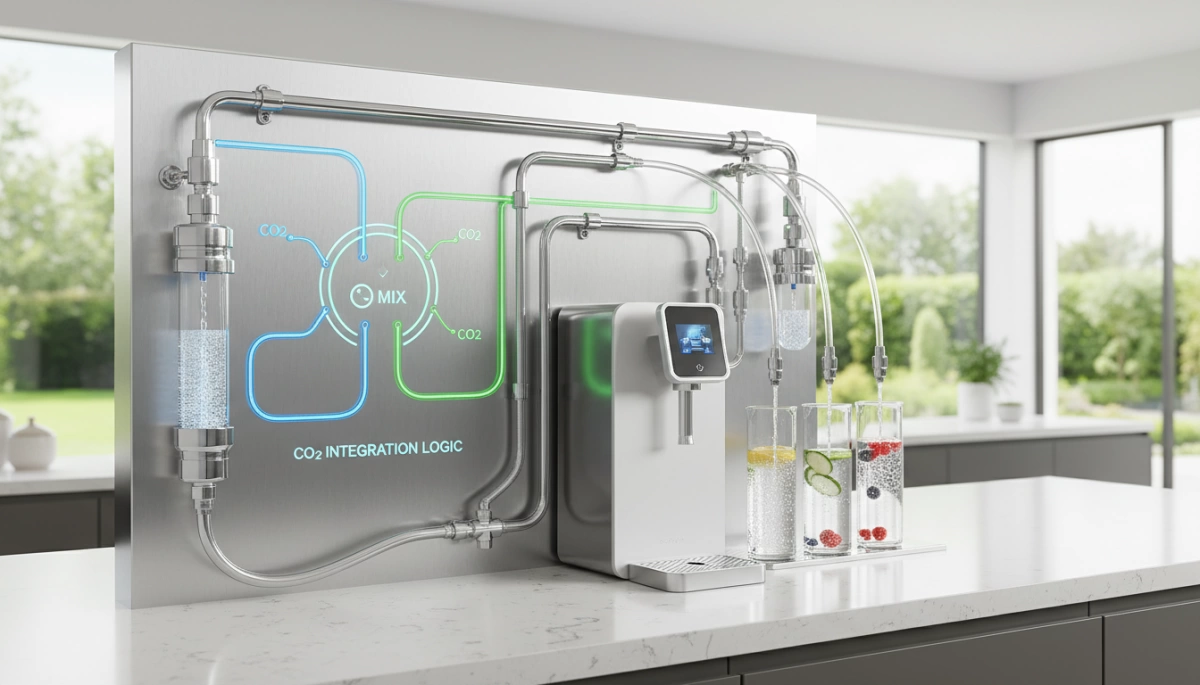
When we look under the hood of a premium CO2 integration sparkling water dispenser, we aren’t just connecting pipes; we are orchestrating a precise mechanical ballet. The architecture relies on a strict sparkling water integration logic that synchronizes three critical inputs: filtered water, food-grade CO2 gas, and electrical power. If the balance between these inputs wavers, you end up with sputtering flow or weak fizz.
Managing the Triad: Water, Gas, and Power Inputs
The core of our gas cylinder integration design is the management of the “Triad.” We can’t simply rely on passive intake. The system actively monitors the incoming water line to ensure it meets the flow rate requirements before it ever touches the gas.
- Water: Must be chilled and purified. We often pair these systems with engineering-grade kitchen water filters to ensure no sediment damages the pump.
- Gas: The CO2 regulator manifold must step down high tank pressure to a usable working pressure (typically 40-60 PSI).
- Power: Drives the solenoid valves and pumps that force these elements together.
Why Standard Water Pressure Fails (Booster Pump Logic)
A common misconception is that standard municipal water pressure is sufficient for carbonation. It isn’t. To achieve a high carbonation saturation point, the water pressure must exceed the gas pressure in the tank. Since most US homes run between 40-60 PSI, and we need stable injection pressure, we integrate a booster pump. This mechanical logic ensures that water is forced into the sparkling water mixing chamber with enough authority to overcome the resistance of the CO2 gas, preventing “gas-lock” where CO2 pushes back into the water line.
Rotary Vane Pumps vs. Diaphragm Pumps
In the world of OEM sparkling water components, the choice of pump defines the user experience.
- Diaphragm Pumps: Common in cheaper units. They pulse, creating an uneven flow and significant noise.
- Rotary Vane Pumps: The gold standard for our co2 module architecture. They provide a smooth, continuous pressure curve. This allows for consistent rotary vane pump pressure, ensuring that every ounce of water dispensed has the exact same mouthfeel, without the aggressive vibration found in lower-end setups.
The Carbonator Bowl: Atomization vs. Agitation Methods
Once the water and gas meet inside the carbonator, the gas handling design dictates how they bond. We generally move away from simple agitation (stirring) in favor of atomization. By spraying water through a nozzle into a pressurized CO2 environment, we maximize the surface area instantly. This safe co2 management system allows for rapid absorption, meaning the dispenser can recover faster and keep up with high demand without serving flat water.
The Electronic Brain: PCB and Sensor Logic
At the core of our Drip System isn’t just a pump—it’s a sophisticated dispenser PCB controller. This electronic brain manages the delicate dance between high-pressure gas and fluid dynamics. We moved away from purely mechanical systems because they lack the precision required for the modern, connected office. The PCB handles the CO2 integration logic, ensuring that every glass of sparkling water is consistent, whether it’s the first pour of the day or the hundredth.
Solenoid Valve Synchronization and Timing
The secret to a smooth pour lies in solenoid valve timing. If the gas and water valves open simultaneously without a programmed delay, you risk sputtering or an uneven mix. Our logic sequences synchronize these events:
- Pre-infusion: The system stabilizes pressure before the main valve opens.
- Dispense Cycle: Gas and water flow are modulated to maintain the set carbonation level.
- Post-dispense: A slight delay in valve closure ensures the line is cleared, preventing drips.
Preventing Water Hammer with Logic Sequences
Sudden valve closures in high-pressure systems can cause hydraulic shock, known as water hammer, which damages internal plumbing over time. We utilize logic sequences that “soft close” or stage the shutoff process. By electronically ramping down the flow rather than slamming a valve shut, we protect the hardware and reduce noise. This is particularly important when integrating with high-flow filtration, where choosing the right setup, like a carbon water filter vs reverse osmosis system, dictates the baseline pressure the system must handle.
Digital Pressure Transducers vs. Mechanical Switches
Old-school dispensers rely on mechanical pressure switches—simple “on/off” triggers that are prone to wear and drift. We utilize an electronic pressure transducer approach. These sensors provide continuous, real-time voltage feedback to the PCB.
- Accuracy: We can detect pressure changes as small as 1 PSI.
- Diagnostics: Instead of just failing, the system can alert the Drip Cloud if pressure trends indicate a potential leak or an empty CO2 tank before the system stops working.
Flow Rate Calculations for Consistent Fizz
To maintain the perfect saturation point, the system must know exactly how much water is passing through the carbonator. Our logic calculates flow rates dynamically. If the flow slows down—perhaps due to a filter needing replacement—the system adjusts the CO2 injection duration to compensate. This ensures the ratio of gas to water remains constant, delivering that signature crisp “mouthfeel” our clients expect from a premium sparkling water dispenser.
Safety Protocols: Fail-Safe Integration Logic
When we design a CO2 integration sparkling water dispenser, safety isn’t just a feature; it is the absolute foundation. Dealing with pressurized gas and water in a confined chassis requires a robust safe CO2 management system. If the logic fails, you risk equipment damage or leaks, so we build in redundancy at every step of the co2 module architecture.
Backflow Prevention: Protecting the CO2 Regulator
The quickest way to ruin a CO2 regulator manifold is letting water creep back into the gas line. This usually happens when the CO2 cylinder runs empty, creating a pressure vacuum that sucks liquid backward. To stop this, we install a dual backflow prevention check valve system. This mechanical barrier ensures that even if gas pressure drops to zero, the water stays in the carbonator bowl where it belongs, preserving the integrity of the gas handling design.
Over-Pressure Release Valves (Mechanical & Electronic)
We never rely on a single failure point. In a proper gas-over-water system, we use a two-tier approach to manage pressure:
- Mechanical: A spring-loaded over-pressure relief valve physically vents excess gas if the tank pressure exceeds safety limits (usually set around 100 PSI).
- Electronic: An electronic pressure transducer constantly feeds data to the dispenser PCB controller. If the logic detects a spike above the operating range, it immediately cuts power to the solenoid and pump.
Leak Detection Algorithms and Auto-Shutoff
Modern controllers are smart enough to know when something feels off. By monitoring the duty cycle of the pump, we can identify leaks before they become floods. For instance, if the system detects a pressure drop without a dispense command, it triggers an auto-shutoff. Advanced setups now utilize IoT-integrated smart water filter solutions to send real-time alerts to your dashboard, allowing for remote diagnostics of the sparkling water integration logic.
Handling “Continuous Run” Errors
A pump running non-stop is a clear sign of a sensor failure, an air-lock, or a massive leak. To prevent the pump from burning out, we program a “time-out” logic. If the carbonation pump runs for more than 120 seconds continuously without reaching the cut-off pressure, the system assumes a fault and enters a hard lockout mode. This simple logic saves hardware and prevents the home carbonation system from overheating.
Smart Integration: IoT and Telemetry Features
We have moved beyond simple mechanical valves. In the modern Drip System, CO2 integration logic is fundamentally tied to the Drip Cloud, our proprietary IoT platform. This connectivity transforms a standard water dispenser into a data-driven hydration station. By integrating telemetry directly into the carbonation engine, we ensure consistent performance and eliminate the guesswork typically associated with managing gas canisters in high-traffic US offices and commercial spaces.
Real-Time CO2 Inventory Monitoring
The biggest pain point in sparkling water service is running out of gas unexpectedly. Our IoT water dispenser monitoring solves this by tracking consumption data in real-time. The system logic correlates water flow volume with gas usage rates to estimate remaining CO2 levels. This digital inventory management ensures facility managers can view the status of every machine across a campus from a single dashboard, rather than physically checking gauges under every sink.
Predictive Maintenance Alerts for Gas Refills
Reactive maintenance is costly and inefficient. Our integration logic utilizes predictive algorithms to trigger alerts before the system fails. When the calculated gas volume drops below a specific threshold, the Drip Cloud automatically notifies the maintenance team. This ensures that a replacement cylinder is on-site and ready to swap before the current one runs dry, maintaining 100% uptime for the end-user. To ensure the entire system runs smoothly, pairing this monitoring with a reliable RO membrane brand for the base water filtration is essential for protecting internal components from scale and debris.
Customizing Carbonation Levels via Touchscreen Logic
One size does not fit all when it comes to fizz. Our hardware-software synergy allows for carbonation level customization directly through the user interface or mobile app. The logic works by adjusting the solenoid valve timing and flow rate ratios dynamically.
- Light Carbonation: Shorter gas injection cycles for a subtle effervescence.
- Standard Sparkling: Balanced pressure for the classic bite.
- Intense: Maximum saturation allowed by the cold carbonation technology parameters.
Remote Diagnostics for Dispenser Health
When a dispenser acts up, sending a technician immediately is inefficient. Our remote diagnostics capabilities allow us to interrogate the machine’s logic board from the cloud. We can identify if a backflow prevention check valve is failing or if there is a pressure anomaly in the mixing chamber. Often, issues like sensor drift or software glitches can be resolved over the air without ever opening the cabinet.
| Feature | Mechanical System | Smart IoT Integration |
|---|---|---|
| Inventory Tracking | Manual visual check | Real-time digital monitoring |
| Refill Strategy | Run-to-failure (Reactive) | Predictive alerts (Proactive) |
| Diagnostics | On-site technician required | Remote cloud analysis |
| User Control | Fixed pressure setting | App-based customization |
By leveraging these telemetry features, we turn the CO2 integration logic into a tool for operational efficiency, ensuring that the sparkling water experience is as reliable as it is refreshing.
Troubleshooting Common Integration Logic Failures
When the CO2 Integration Logic for Sparkling Water Dispensers acts up, it is usually a conflict between physics and the electronic controls. We aren’t just looking for broken parts; we are looking for flaws in the logic sequence or environmental variables that the Dispenser PCB controller wasn’t programmed to handle. Here is how we break down the most common failures in the field.
Diagnosing “Flat Water” (Temperature vs. Pressure)
The most frequent complaint is water that lacks fizz. Before you blame the CO2 regulator manifold, you have to look at the thermodynamics. The logic here is binary: it’s either too hot, or the pressure is too low.
- Temperature Check: Cold carbonation technology relies on the water being between 36°F and 40°F. If your chiller loop is failing and the water hits 45°F, the Carbonation saturation point drops drastically. The gas simply won’t stay in the solution, no matter the PSI.
- Pressure Verification: If the temperature is verified cold, then we look at the Rotary vane pump pressure. The system logic should maintain a differential where water pressure is slightly higher than gas pressure (typically 10-15 PSI higher) to force entry into the Sparkling water mixing chamber.
If the supply flow is inconsistent, the pump cavitates, killing carbonation. This is why we emphasize robust upstream setups, similar to how we design premium faucet water filter system solutions to ensure stable water delivery pressure before the carbonation stage.
Fixing Gas Sputtering and Air-Locks
Sputtering at the nozzle usually indicates a breach in the Gas-over-water system logic. This means gas is escaping faster than the water, or a pocket of air is trapped in the line.
- Air-Locks: These occur when the carbonator bowl empties completely, allowing CO2 to fill the pickup tube. The system logic must have a “refill timeout” to prevent the pump from running dry. To fix this, you often need to purge the relief valve manually.
- Check Valve Failure: If the Backflow prevention check valve fails, high-pressure gas can push back into the water line. This creates a “stutter” when the solenoid opens because the line is filled with gas pockets instead of a solid column of water.
Resolving Dispensing Lag and Valve Delays
When a user taps the screen but water doesn’t flow immediately, it is a Solenoid valve timing issue. The integration logic usually includes a slight delay (milliseconds) to energize the valve, but significant lag points to pressure locking.
If the pressure inside the Sparkling water mixing chamber is significantly higher than the line pressure, the solenoid pilot might not have enough force to open against the internal PSI. The fix involves adjusting the logic to pulse the valve or lowering the static pressure on the CO2 regulator manifold to ensure the solenoid can actuate instantly.
Identifying Sensor Drift Issues
Modern systems rely on an Electronic pressure transducer rather than mechanical switches. Over time, these sensors drift. The logic might read “60 PSI” and shut off the pump, while the physical reality is only 40 PSI.
- Symptoms: The pump cycles on and off rapidly (short-cycling) or the carbonation is weak despite “normal” readings.
- Diagnosis: Compare the digital reading on the IoT water dispenser monitoring dashboard against a manual analog gauge. If they don’t match, the sensor needs recalibration or replacement.
Drift is dangerous because it can mask a failing Over-pressure relief valve. The controller thinks everything is safe, but the tank is actually over-pressurized. Regular calibration of these inputs is non-negotiable for safety.
FAQ: Common Questions on CO2 Dispenser Logic
Understanding the CO2 integration logic for sparkling water dispensers helps you troubleshoot issues and optimize performance. Here are the answers to the most frequent technical questions we get about maintaining that perfect fizz.
How does temperature affect CO2 saturation levels?
Temperature is the single biggest factor in carbonation quality due to Henry’s Law carbonation principles. Simply put, cold water holds gas; warm water rejects it. As water temperature rises, the solubility of CO2 decreases drastically. For a commercial-grade sting, the water must be chilled before or during the carbonation process. If your chiller is failing, your sparkling water will inevitably taste flat, regardless of how high you crank the PSI.
What is the difference between cold carbonation and ambient carbonation?
Cold carbonation technology mixes CO2 with water that has already been chilled (usually between 36°F and 40°F). This allows for deep saturation and small, tight bubbles that last. Ambient carbonation injects gas into room-temperature water. Since warm water cannot hold the gas well, the result is often large, aggressive bubbles that dissipate quickly, leaving the drink flat within minutes. Ensuring you have a proper under-counter water filter installation helps maintain the consistent flow and temperature required for effective cold carbonation.
Why does my sparkling water dispenser sputter?
Sputtering is usually a symptom of a pressure imbalance or an air pocket in the system (often called an air-lock).
- Gas Pressure Too High: If the CO2 PSI is set significantly higher than the water supply pressure, gas will blow through the line without mixing properly.
- Empty Tank: As a CO2 cylinder nears empty, the pressure fluctuates, causing inconsistent bursts.
- Air Locks: Trapped air in the water line prevents smooth flow. Purging the system usually fixes this.
How often should safety relief valves be tested?
You should inspect the over-pressure relief valve at least once a year. In a gas-over-water system, this valve is the primary fail-safe that prevents the carbonator bowl from exploding if the regulator fails. A quick manual check ensures the valve isn’t stuck and will vent excess gas if the pressure spikes dangerously high.
Can IoT integration save money on CO2 refills?
Yes, IoT water dispenser monitoring significantly reduces operational costs. Systems like our Drip Cloud track real-time consumption data. Instead of swapping out CO2 tanks on a fixed schedule (which often leads to returning tanks that are still 20% full), you get predictive alerts exactly when a refill is needed. This logic prevents gas waste and eliminates the downtime caused by unexpected empty cylinders.