














You might love the taste of pure water, but do you trust the mechanics inside the machine sitting on your counter?
It’s a valid concern.
Inside that sleek shell, water is being forced through membranes at pressures exceeding 60 PSI. In traditional systems, that pressure was held back by a messy web of plastic tubes and manual clips—a recipe for a kitchen disaster.
But the industry has evolved.
We aren’t just talking about tighter screws anymore; we are talking about Anti Leakage Fluid Connection Engineering.
This isn’t marketing fluff. It is the structural difference between a reliable appliance and a flooded countertop.
In this breakdown, I’m going to show you exactly how modern Integrated Waterway designs and Ultrasonic Welding have replaced the “spaghetti tubing” of the past to create virtually leak-proof systems.
Let’s get into the engineering.
The Evolution of Fluid Connections: Tubing vs. Integrated Manifolds
Ever worried about coming home to a flooded kitchen? It’s the number one fear for anyone installing a water filtration system. For years, the industry standard was a tangled mess of plastic tubes and push-fit connectors. While functional, these traditional setups relied heavily on manual assembly, leaving massive room for human error.
Today, we are seeing a massive shift in anti leakage fluid connection engineering in countertop RO water systems. We aren’t just connecting pipes anymore; we are engineering monolithic fluid structures. The evolution from loose, flexible tubing to solid-state integrated manifolds is the single biggest leap in water safety standards this decade.
The “Spaghetti” Design Risks: Understanding Creep and Fatigue
If you open up an older RO unit, it looks like a bowl of spaghetti. You have feet of polyethylene (PE) tubing crisscrossing everywhere. This design is a ticking time bomb due to two engineering realities: creep and fatigue.
- Creep: Over time, plastic tubing deforms under constant internal pressure. That tight seal you had on day one loosens as the material slowly stretches.
- Fatigue: Every time the pump turns on and off, pressure spikes and drops. This cycle stresses the connection points, eventually causing hairline cracks.
When you rely on push-fit vs. integrated connections, you are gambling on the longevity of dozens of individual seals.
Modern Integrated Waterway Technology (IWT) Explained
We solved the spaghetti problem by getting rid of the tubes entirely. Integrated waterway technology (IWT) replaces the maze of hoses with a single, solid unit. Think of it like a printed circuit board, but for water.
Instead of routing water through flexible pipes that can kink or burst, the water flows through permanent channels designed directly into the structural core of the machine. This internal fluidic circuit manages flow dynamics with rigid precision, removing the variables that usually lead to leaks.
The 3D Molded Concept: Eliminating External Tubes
The heart of this design is the injection molded fluid manifold. By using advanced 3D molding techniques, we create a complex network of water channels inside a single block of BPA-free reinforced material.
Why this matters:
- Zero Kinking: There are no tubes to bend or pinch.
- Structural Rigidity: The water path is encased in solid plastic, making it virtually immune to external physical damage.
- Leak-Stop Mechanism: With no external joints between stages, the path for water to escape is effectively sealed off within the mold itself.
The Math of Safety: Reducing Connection Points
Engineering safety is often a numbers game. Every time you cut a tube and add a fitting, you create a potential failure point.
Let’s look at the math:
- Traditional RO System: ~30 to 40 connection points (tubes, elbows, tees, housing connectors).
- Integrated Manifold System: ~6 to 8 connection points (mostly just the inlet, outlet, and filter interfaces).
By reducing the number of connections by over 75%, we mathematically slash the probability of a leak. This reduction is the core principle of anti leakage fluid connection engineering in countertop RO water systems. Fewer parts mean fewer problems. It is that simple.
Engineering Mechanics of Anti-Leakage Design
We don’t just guess where the water goes; we calculate it. The difference between a flooded kitchen and a reliable appliance comes down to the Anti Leakage Fluid Connection Engineering in Countertop RO Water Systems. We moved away from the “hope it holds” approach of cheap tubing and adopted rigorous mechanical standards used in industrial hydraulics. By controlling the physics of water flow, we eliminate the variables that typically lead to failure.
Fluid Dynamic Optimization and Pressure Management
Water under pressure seeks the path of least resistance, and in poorly designed systems, that path is often a weak joint. We utilize integrated waterway technology to create a seamless internal fluidic circuit. Instead of forcing water through sharp 90-degree turns in flexible tubing—which creates turbulence and stress points—our molded manifolds guide water smoothly.
This fluid dynamic optimization ensures that pressure is distributed evenly across the entire system. By eliminating pressure spikes at connection points, we drastically reduce the mechanical load on the structure. Whether the water is moving through the membrane or a charcoal filtration stage, the flow remains laminar and controlled, preventing the material fatigue that causes cracks over time.
Double O-Ring Architecture and Sealing Technology
A single barrier is never enough when dealing with pressurized water in a home environment. We implement a double O-ring seal architecture at every critical junction. This provides a fail-safe redundancy:
- Primary Seal: Takes the brunt of the hydrostatic pressure.
- Secondary Seal: Acts as a backup and stabilizes the connection to prevent wobbling.
This fluid seal design RO water system approach ensures that even if the primary seal degrades slightly over years of use, the system remains watertight. We use high-grade EPDM or silicone materials that resist compression set, meaning they bounce back and maintain their shape rather than flattening out.
Quick-Connect Interfaces: Twist-and-Pull Security
Maintenance shouldn’t require a plumber’s license. Traditional threaded fittings are prone to overtightening (which cracks the housing) or cross-threading (which causes leaks). We utilize high reliability quick connector RO system designs that rely on a twist-and-pull mechanism.
This interface locks the filter cartridge directly into the manifold with a tactile “click.” It eliminates the guesswork. The engineering behind this push-fit vs. integrated connection ensures that the seal is perfectly aligned every time you change a filter, maintaining the leak resistance benchmark of the countertop RO system without relying on user skill.
Solenoid Valve Integration to Prevent Water Hammer
One of the biggest silent killers of water systems is water hammer—the shockwave caused when water flow stops suddenly. This spike can momentarily double the pressure inside the unit, blowing out seals.
To counter this, we integrate an automatic shut-off valve (ASO) and solenoid valves that manage flow transitions electronically. This water hammer protection softens the “stop” and “start” sequences, preventing shockwaves from traveling through the BPA-free flow path. By structurally dampening these forces, we protect the fluid joint durability engineering from the inside out, ensuring the system can survive hundreds of thousands of cycles without developing a drip.
Material Science: What Holds the Water?
When we talk about anti leakage fluid connection engineering, the geometry of the manifold is only half the battle. The raw materials we choose are the first line of defense against leaks. If the material cannot handle the stress of daily operation, even the best design will fail. We focus on the chemistry of the components to ensure long-term reliability.
BPA-Free Reinforced PP/ABS for High Burst Pressure
We don’t cut corners with cheap plastics. Our integrated waterways are crafted from reinforced food-grade PP (Polypropylene) and ABS. These materials are specifically selected for their high burst pressure resistance. In a high-performance countertop reverse osmosis hot and cold water filter system, the internal pressure can spike during the filtration process. Reinforced materials ensure the manifold doesn’t crack, bulge, or warp under this stress, maintaining a safe, BPA-free flow path for your drinking water.
- High Tensile Strength: Resists physical deformation under load.
- Food-Grade Safety: Ensures no chemical leaching into the purified water.
- Thermal Stability: Maintains integrity even when processing hot water.
Hydrolysis Resistance: Durability Against Water Degradation
Water is a universal solvent, and over time, it is incredibly tough on materials. Constant exposure can cause standard plastics to absorb moisture, swell, and eventually become brittle—a process known as hydrolysis. We prioritize materials with superior hydrolysis resistance. This ensures the RO system structural integrity remains uncompromised even after years of continuous water contact. By preventing material degradation at the molecular level, we stop hairline cracks before they can ever form.
Ultrasonic Welding for Monolithic Structure Integrity
To create a truly leak-proof seal, we utilize advanced ultrasonic welding technology. Instead of relying on gaskets, screws, or adhesives that can degrade or loosen over time, this process uses high-frequency vibrations to fuse the manifold components into a single, monolithic unit.
This creates a permanent bond that is often stronger than the material itself. By turning multiple parts into one solid piece, we effectively eliminate the risk of separation at the seams, setting a new standard for anti leakage fluid connection engineering in the industry.
Testing Protocols: Validating Connection Engineering
We don’t just design for theory; we build for the harsh reality of daily use. To ensure our anti leakage fluid connection engineering holds up over years of service, every unit undergoes a punishing series of stress tests before it ever reaches a customer’s kitchen. We treat our countertop systems with the same rigor applied to permanently installed under sink reverse osmosis filtration systems, ensuring the internal fluidic circuit is virtually indestructible under normal operating conditions.
The Water Hammer Test: Surviving 100,000 Cycles
Water pressure in a home isn’t static; it spikes and drops rapidly—a phenomenon known as water hammer. To guarantee water hammer protection, we subject our integrated waterways to a cyclic pressure test.
- Cycle Count: The system endures over 100,000 rapid pressure impacts (0 to 150 PSI).
- Simulation: This mimics decades of turning faucets on and off, ensuring the injection molded fluid manifold doesn’t develop fatigue cracks.
- Outcome: Only manifolds that show zero signs of stress or deformation pass the NSF/ANSI 58 structural integrity standards.
Burst Pressure Testing: Ensuring Safety Margins
While standard operating pressure for a countertop RO system is relatively low, we engineer our components to withstand extreme extremes. We push the burst pressure resistance to limits far exceeding what any household pump could generate. By pressurizing the internal fluidic circuit to over 450 PSI—more than four times the typical working pressure—we verify that the BPA-free reinforced materials and ultrasonic welds maintain a complete seal without rupturing. This creates a massive safety margin for the end-user.
Vacuum Leak Testing: Detecting Microscopic Issues
High pressure reveals big cracks, but hydrostatic pressure testing isn’t enough to catch microscopic imperfections. We utilize advanced vacuum decay testing to identify the tiniest anomalies in the leak-stop mechanism.
- Process: The system is evacuated of air, and sensitive sensors monitor for any pressure rise that indicates air entering the system.
- Precision: This method detects potential leak points that are invisible to the naked eye and too small for water to pass through initially but could widen over time.
- Result: This ensures a leak resistance benchmark countertop RO system that is sealed tight from the factory floor to your countertop.
The Engineering Advantage for Daily Use
When we discuss anti leakage fluid connection engineering in countertop RO water systems, it’s easy to get lost in the technical specs of polymers and pressure ratings. However, for the end-user, this engineering translates directly into usability and peace of mind. We aren’t just building a machine that holds water; we are designing an appliance that fits seamlessly into a modern lifestyle.
Compact Efficiency: Sleek Designs Without Tangled Tubes
The most visible benefit of moving away from traditional tubing to integrated waterway technology is the dramatic reduction in size. Old-school reverse osmosis setups required significant internal volume to accommodate the “bend radius” of various tubes to prevent kinking. By utilizing an injection molded fluid manifold, we eliminate that dead space entirely.
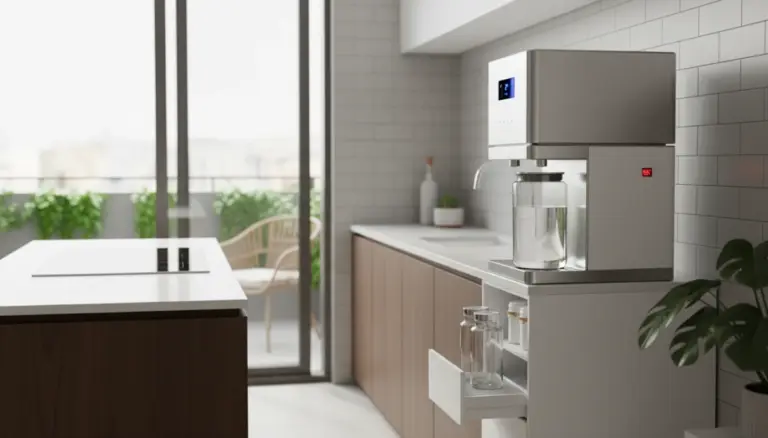
This allows us to engineer chassis that are significantly slimmer and more aesthetically pleasing. It’s the difference between a bulky industrial box and the sleek, space-saving designs found in modern portable reverse osmosis systems that look right at home in a high-end kitchen or a compact RV. The internal fluidic circuit is routed through a solid plate, meaning the system takes up less counter space while delivering higher reliability.
Maintenance Simplicity for Filter Changes
Complex engineering should result in simple user experiences. One of the biggest pain points for customers is countertop RO maintenance. In traditional systems, changing a filter often meant wrestling with housing wrenches and worrying about disturbing a fragile web of connections.
With our advanced connection engineering, we’ve streamlined this process:
- Fixed Connection Points: The manifold holds the ports rigidly in place, so there is no flexing or stress on the plumbing when you twist a filter.
- Quick-Connect Interfaces: We use high-precision push-fit or twist-lock mechanisms that require zero tools.
- Error-Proof Design: The structure physically prevents filters from being installed incorrectly, protecting the RO system structural integrity.
You don’t need to be a plumber to maintain these systems. The robust engineering ensures that the leak-stop mechanism remains effective even after years of filter swaps.
The Zero-Leak Commitment and QA Processes
We don’t just design for safety; we manufacture for certainty. A “Zero-Leak” label isn’t marketing fluff—it is the result of aggressive Quality Assurance (QA) protocols. Every anti leakage fluid connection engineering in countertop RO water systems design undergoes stress testing that far exceeds what a typical home would ever produce.
Our QA process focuses on three critical pillars:
- Hydrostatic Pressure Testing: We subject the manifold to pressures significantly higher than standard mains pressure to verify burst pressure resistance.
- Cyclic Stress Testing: We simulate the rapid opening and closing of valves to ensure water hammer protection is functioning correctly.
- Vacuum Decay Checks: Before water ever touches the system, we use air vacuum tests to detect microscopic leaks in the double O-ring seal assemblies.
To truly understand the rigor involved, you have to look at the data behind testing RO systems for burst pressure and water hammer. By validating the BPA-free flow path under these extreme conditions, we ensure that when the unit sits on a customer’s countertop, it stays dry, safe, and efficient.
FAQs About Anti-Leakage Engineering in RO Systems
We receive plenty of questions about how we ensure our countertop units stay dry and durable. Here is the breakdown of the engineering principles that keep the water where it belongs—inside the system.
Why do traditional RO systems eventually leak?
The primary culprit in traditional setups is the sheer number of connection points. A standard under-sink RO system often relies on a “spaghetti” design of loose PE tubing and multiple push-fit joints. Over time, constant water pressure fluctuations and material fatigue cause these tubes to degrade or slip. Our anti leakage fluid connection engineering in countertop RO water systems specifically addresses this by removing those vulnerable external tubes entirely, eliminating the most common points of failure found in older filtration designs.
What exactly is an Integrated Waterway?
Think of an Integrated Waterway as a circuit board, but for water. Instead of connecting components with flimsy hoses, we use injection molded fluid manifolds to create a solid, monolithic block with internal water channels. This design drastically reduces the risk of leaks because there are no loose tubes to crack or disconnect. Our advanced R&D software and engineering processes allow us to simulate flow dynamics within this manifold to ensure it can withstand high pressure without compromising structural integrity.
How does water hammer protection work?
Water hammer occurs when a valve closes suddenly, sending a shockwave through the water line that can blow out seals. In our systems, we integrate water hammer protection logic and physical buffers into the fluid circuit. This setup absorbs sudden pressure spikes, protecting the internal fluidic circuit from stress damage. It is a critical safety layer that ensures the burst pressure resistance of the unit remains high, even after thousands of operational cycles.
Are quick-connect fittings reliable under high pressure?
Absolutely, provided they are engineered correctly. We utilize a high reliability quick connector RO system design featuring a double O-ring seal. Unlike standard single-seal fittings, our connections provide a backup layer of security. This leak-stop mechanism is essential because the Reverse Osmosis membrane operates under significant pressure to filter out contaminants like lead and fluoride. The dual-seal approach ensures that the interface between the filter and the manifold remains watertight, offering a true leak resistance benchmark for countertop RO systems.