












Marketing vs. Math: The 3-Month Myth
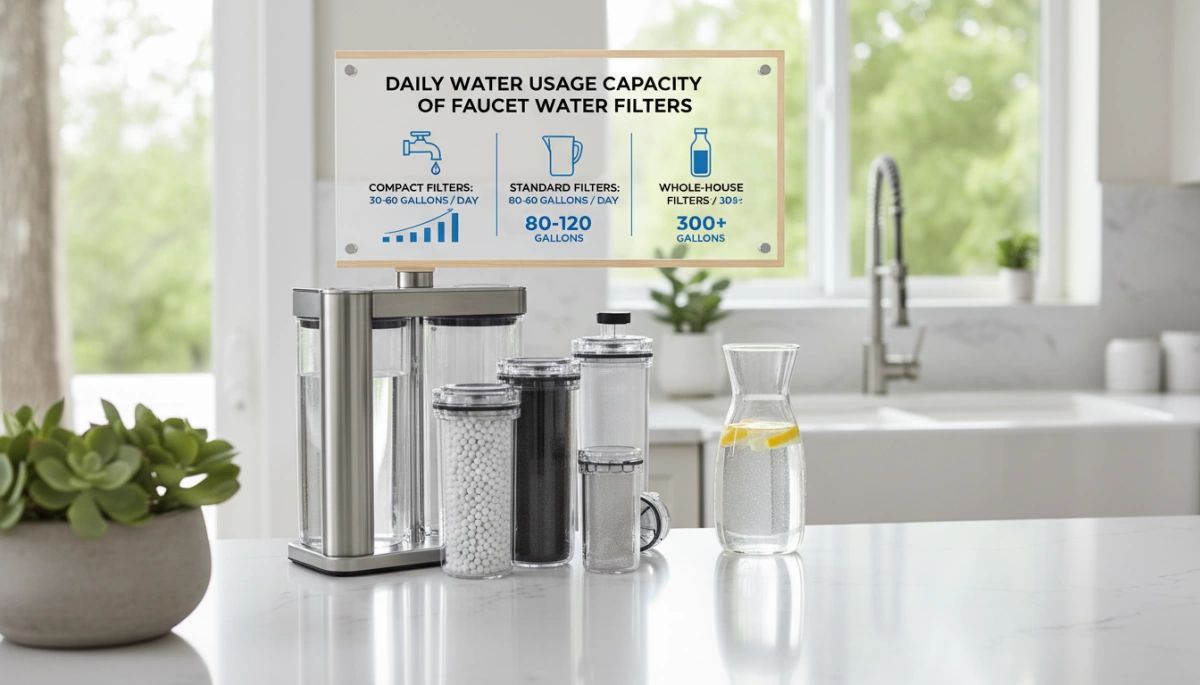
We need to have a serious conversation about the “3-month lifespan” sticker found on almost every filtration box. As manufacturers, we use time estimates as a general guideline for the average household, but strictly relying on the calendar is a mistake. The Daily Water Usage Capacity of Faucet Water Filters is not determined by the passage of time; it is determined by total volumetric throughput. The “3-month” standard is essentially a statistical guess based on average consumption, not a hard expiry date. If your household consumes water aggressively, that date arrives much sooner.
Breaking Down the Standard Equation (Gallons vs. Days)
To understand your actual filter life, we have to look at the math behind the marketing. Most standard faucet filters on the market are rated for roughly 100 gallons. However, our Activated Carbon Fiber (ACF) systems are engineered for a 320-gallon filter life. Here is how that translates to your daily allowance:
- Standard Competitor (100 Gallons): ~1.1 gallons per day over 3 months.
- Driplife ACF System (320 Gallons): ~3.55 gallons per day over 3 months.
If you are using a standard 100-gallon filter for cooking, drinking, and filling pet bowls, you are likely exceeding that 1.1-gallon daily limit, meaning your filter is effectively dead in 30 to 45 days. With our high-capacity 320-gallon units, we provide a much larger “bank” of clean water, allowing for realistic family usage without premature burnout.
Impact of Exceeding Daily Volume on Filtration Efficiency
Pushing a filter beyond its daily volume capacity doesn’t just shorten its lifespan; it can compromise water purity. Filtration relies on contact time—the duration water spends interacting with the carbon media. Our systems operate at a steady 0.5 GPM flow rate, which is optimized to ensure the ACF media has enough time to adsorb contaminants like chlorine and lead.
If you force more water through an exhausted cartridge, or if the media becomes saturated because you ignored the gallon limit, adsorption efficiency plummets. The carbon pores become clogged with sediment and contaminants, leading to “breakthrough,” where harmful substances pass straight into your glass. Managing your daily water usage capacity is the only way to ensure the last glass of water is as clean as the first.
Critical Metrics: Gallons, Flow Rate, and Adsorption
Understanding the true capability of your filtration system requires looking beyond the marketing sticker and examining the technical specifications. Three core metrics determine whether a unit can handle your household’s daily water usage capacity: the total gallon rating, the flow rate, and the adsorption technology used.
Total Gallon Rating: Standard vs. High-Capacity
The total gallon rating acts as the “fuel tank” for your filter. While many standard market options cap out at around 100 gallons, high-capacity units are essential for consistent daily use. Our systems are engineered with a 320-gallon filter life (approximately 1,200 liters). This extended capacity is crucial for maintaining performance over the recommended 3-month lifespan without forcing you to replace cartridges prematurely.
Flow Rate (GPM) Analysis
The speed at which water moves through the system is measured in Gallons Per Minute (GPM).
- The Sweet Spot: We utilize a 0.5 GPM flow rate. This provides a steady, usable stream for filling pots and glasses quickly.
- Contact Time: A 0.5 GPM rate ensures the water maintains contact with the filtration media long enough to effectively remove contaminants like lead and chlorine.
- Daily Throughput: This rate supports high-volume daily tasks without the frustration of a trickle, balancing convenience with purification power.
Adsorption Speed: ACF vs. GAC
Filter adsorption efficiency is where the technology makes a massive difference in daily capacity. Traditional Granular Activated Carbon (GAC) relies on loose granules, which can allow water to channel through without being fully treated if the flow is too fast.
In contrast, we utilize Activated Carbon Fiber (ACF). This material offers a distinct advantage:
- 10x Adsorption Capacity: ACF has a significantly larger surface area than granular carbon, allowing it to trap contaminants much faster.
- Stable Performance: The uniform structure of ACF prevents channeling, ensuring that every drop of water moving at 0.5 GPM is thoroughly filtered.
- Micron Precision: With a filtration precision of 0.5 microns, ACF captures fine particles that standard carbon blocks often miss.
Calculating Your Real Daily Water Intake
To truly understand if a faucet mount system fits your lifestyle, you have to look past the marketing fluff and do the math. We rate our filters at 320 gallons, which sounds like a massive tank, but it translates to a specific daily allowance over a standard 3-month cycle. Managing this daily water usage capacity faucet filter requires a quick audit of where your water actually goes.
Conducting a Household Water Consumption Audit
You need to track every drop of purified water you demand from the tap. It adds up faster than you think. When I calculate household water consumption capacity, I break it down into three non-negotiable categories:
- Direct Drinking: The average adult needs about half a gallon to a gallon a day.
- Cooking: Boiling pasta, making soups, or washing produce can easily consume 1-2 gallons per meal.
- Pets: Don’t forget the dog bowl; filling a large bowl twice a day pulls another half-gallon from your filter throughput planning.
Estimating Needs for Small vs. Large Households
The 320-gallon filter life is a generous benchmark for a single person or a couple, often stretching beyond the 3-month mark. However, for a family of four, the math changes. If everyone fills a water bottle and you cook dinner using filtered water, you might hit 4 or 5 gallons a day. At that rate, you are prioritizing high-quality ACF filtration for ingestion, but you need to be strategic to make the cartridge last the full quarter.
The Wasted Capacity Factor: Hand Washing Mistakes
The number one reason filters die early isn’t hydration—it’s accidental waste. Running purified water to wash your hands or rinse off a plate is literally pouring money down the drain. Because our ACF filters have a high 0.5 GPM flow rate, it’s easy to forget the filter is engaged. This “phantom usage” destroys your daily use performance faucet filter metrics without giving you any health benefits.
Using the Diverter Valve to Save Filter Life
This is why the hardware design matters as much as the carbon inside. We utilize a dual-output design specifically to combat wasted capacity. The diverter valve durability is key here; it allows you to instantly toggle between filtered water for drinking and raw tap water for cleaning.
- Switch to Filtered: Only for filling glasses, pots, and pet bowls.
- Switch to Tap: For washing dishes, hands, and scrubbing the sink.
Mastering this simple switch is the only way to ensure your family water usage filter actually delivers clean water for the full 320 gallons.
Hidden Factors Killing Your Daily Capacity
Even if you calculate your usage perfectly, external variables can drastically shorten the lifespan of your filter cartridge. In my experience, the theoretical 320-gallon capacity is often reduced by local water conditions that physically block the filtration media long before the chemical adsorption runs out.
Sediment and Turbidity Risks
The biggest enemy of any 0.5-micron filter is physical debris. If your tap water carries rust, sand, or silt from aging pipes, these particles get trapped on the outer layer of the Activated Carbon Fiber (ACF). This leads to sediment clogging, which strangles the flow rate. You might only use 150 gallons, but if the outer mesh is caked with mud, the water can’t get through to be purified.
High TDS Levels and Media Lifespan
While our faucet filters are designed to target contaminants like lead and chlorine, Total Dissolved Solids (TDS)—which include minerals like calcium and magnesium—can impact performance. In areas with extremely hard water, mineral scale can coat the carbon fiber, reducing its ability to grab onto harmful chemicals. If your TDS levels are exceptionally high, you might notice a drop in performance faster than expected. For households dealing with extreme mineral content, looking into a countertop RO water purifier might be a necessary alternative to standard faucet mounts.
Water Pressure Requirements
Your home’s input pressure directly affects filtration efficiency.
- High Pressure: Forces water through the ACF too quickly, reducing the “contact time” needed for the carbon to adsorb contaminants effectively.
- Low Pressure: Makes the standard 0.5 GPM flow rate feel frustratingly slow, leading users to switch back to unfiltered tap water out of impatience.
Maintaining stable water pressure requirements ensures the filter operates within its designed parameters, protecting both the physical structure of the cartridge and the quality of the water it produces.
Filter Tech Comparison: Carbon Block vs. ACF
When calculating the daily water usage capacity of faucet water filters, the material inside the cartridge matters just as much as the gallon rating. Not all filters process water at the same speed or efficiency, and choosing the right technology is critical for maintaining a steady flow in a busy American household.
Standard Carbon Block Limitations
Traditional carbon blocks or granular activated carbon (GAC) are common, but they have distinct limits. The carbon block density required to catch fine contaminants often strangles water pressure. This results in a slower flow, making it frustrating to fill large pots for cooking. Furthermore, under high pressure, water can create “channels” through the granules, bypassing the filtration media entirely and significantly lowering filter adsorption efficiency.
Activated Carbon Fiber (ACF) Advantages
We utilize Activated Carbon Fiber (ACF) because it solves the throughput problem. ACF technology provides a massive surface area—roughly 10x better adsorption capacity than traditional carbon. This allows for a steady 0.5 GPM flow rate while maintaining a 0.5-micron filtration precision. For a busy kitchen, this means you get clean water immediately without the pressure drop associated with older tech. It effectively targets lead, chlorine, and bad tastes while supporting a substantial 320-gallon filter life.
If you are looking for a reliable water filter from sink setup, prioritizing ACF ensures you don’t sacrifice water pressure for purity.
Ceramic Hybrids for Sediment
Ceramic filters excel at acting as physical barriers. They are fantastic for stopping heavy sediment and rust that cause sediment clogging in regions with turbid water. However, for chemical reduction and speed, they are often paired with carbon to be truly effective for daily drinking needs.
Technology Performance Breakdown:
| Feature | Standard Carbon Block | Activated Carbon Fiber (ACF) |
|---|---|---|
| Adsorption Speed | Moderate | High (10x faster) |
| Flow Rate Impact | Significant pressure drop | Minimal drop (0.5 GPM) |
| Daily Capacity | Lower throughput | High volume handling |
| Primary Strength | Basic chemical reduction | High-efficiency & Speed |
Physical Signs Your Filter Is Done
Reliable filtration isn’t just about watching a calendar; it’s about observing performance. While our Activated Carbon Fiber (ACF) technology is rated for a massive 320 gallons, local water conditions often dictate the actual endpoint. Here is how to tell if your system has reached its limit before the 3-month mark.
Recognizing Flow Rate Drop
The most obvious indicator of a saturated filter is a significant reduction in speed. Our systems are engineered for a steady 0.5 GPM flow rate, providing quick access to clean water.
- Sediment Clogging: As the ACF mesh traps physical particles like rust and sand, the pathways naturally narrow.
- The Trickle Test: If filling your morning coffee pot takes twice as long as usual, the physical adsorption surface is likely full.
- Pressure Changes: A sudden drop in output pressure, even when your main faucet is fully open, confirms the cartridge has reached its holding capacity.
Taste and Odor Return (Breakthrough)
When a filter exceeds its adsorption limit, contaminant breakthrough occurs. This means the carbon structure is fully occupied and can no longer bond with incoming chemicals.
- Chlorine Reappearance: Since our filters remove up to 99% of chlorine, smelling that distinct “pool water” scent is an immediate red flag.
- Metallic Tastes: If lead or heavy metals begin to bypass the media, you might notice a subtle metallic tang.
- Clarity Issues: If the water looks cloudy or turbid compared to the crystal-clear output you had on day one, the filtration precision has been compromised.
Visual Indicators vs. Electronic Timers
Many generic units rely on simple electronic timers that count down 90 days regardless of usage. However, daily water usage capacity varies wildly between households.
- Trust the Flow: Physical resistance (slow flow) is a more accurate gauge of remaining life than a blinking light.
- Manual Tracking: For high-traffic homes, the 320-gallon limit might be reached in 2 months. Relying solely on a timer could leave you drinking unfiltered water for weeks.
- Visual Inspection: If you remove the cartridge and the outer layer is coated in dark slime or heavy sediment, it is time to swap it out, regardless of what the timer says.
Sourcing Guide: Finding High-Capacity Units
When shopping for a filtration system that can actually handle your household’s daily water usage capacity, you have to look past the marketing fluff on the front of the box. Most standard filters are rated for a mere 100 gallons, which a family of four can burn through in under a month. To get true longevity, you need to source units with a verified 320-gallon filter life. This capacity ensures that the filter maintains its adsorption efficiency for a full 3 months under normal use, rather than becoming a bottleneck for your kitchen workflow after a few weeks.
Checking NSF/ANSI 42 & 53 Capacity Claims
The most reliable way to verify a filter’s endurance is to check its testing data against industry standards. While we focus on high-performance metrics, understanding the NSF 42 capacity rating is crucial—this standard measures the reduction of aesthetic impurities like chlorine, taste, and odor over the life of the cartridge. For more serious contaminants, you want to ensure the filter holds up against rigorous demands. If you are specifically looking for the best water filters to remove fluoride or lead, the gallon rating tells you exactly how long that protection lasts before breakthrough occurs.
Key Sourcing Specs to Look For:
- Total Filtration Capacity: Ensure it is rated for at least 320 gallons (approx. 1,200 liters).
- Flow Rate: Look for a 0.5 GPM flow rate to ensure the water flows fast enough for daily tasks without dropping pressure.
- Material Certification: Verify the use of lead-free, food-grade materials.
Advantages of Advanced Manufacturing for Extended Ratings
High capacity isn’t just about making the filter bigger; it’s about better engineering. We utilize Activated Carbon Fiber (ACF) technology, which provides a massive advantage over traditional granular carbon found in cheaper OEM faucet filter specifications. Advanced manufacturing allows us to create a filter media with 10 times the adsorption capacity of standard carbon.
This structural difference is why our filters can process daily water usage more efficiently. The ACF mesh traps contaminants like lead and chlorine rapidly while allowing water to pass through quickly. This balance of speed and capacity is the hallmark of a superior manufacturing process, ensuring you get clean water instantly without constantly swapping out cartridges.
FAQ: Daily Faucet Filter Usage
Can I filter hot water through my faucet mount?
Absolutely not. You should never run hot water (above 100°F/38°C) through an Activated Carbon Fiber (ACF) cartridge. Heat damages the carbon structure and causes the pores to expand, which can release previously trapped contaminants back into your water—a process known as desorption. Always use the dual-output switch to toggle to unfiltered mode when washing dishes or using hot water. This simple habit is crucial for preserving your Daily Water Usage Capacity of Faucet Water Filters and ensuring the media lasts the full 3 months.
Does higher water pressure filter faster?
While higher pressure might physically push water through faster, it actually reduces filtration quality. Our systems are engineered for a specific 0.5 GPM flow rate. This pace is deliberate; it ensures the water maintains contact with the ACF media long enough to effectively adsorb chlorine, lead, and other impurities. Forcing water through at unsafe pressures cuts this contact time short, lowering the filter adsorption efficiency and potentially allowing contaminants to pass through untreated.
How often should I really change my filter?
While the general rule is every 3 months, the most accurate metric is the 320-gallon filter life. If your household is large and consumes more than 3.5 gallons of filtered water daily, you will reach that capacity limit sooner than the 90-day mark. Conversely, even if you haven’t hit the gallon limit, we recommend replacing the cartridge every 3 months to prevent bacterial growth inside the housing. Monitoring your flow rate is key; a noticeable drop in speed often indicates the filter cartridge lifespan has ended due to sediment accumulation.