

















This article delves into effective methods to eliminate fluoride from water, emphasizing techniques like reverse osmosis, distillation, activated alumina filters, and bone char filters. Each method has its strengths, such as reverse osmosis removing up to 99% fluoride and bone char filters offering eco-friendly solutions, providing a comprehensive guide for households seeking clean, fluoride-free water.
You will benefit from this article by understanding the nuances of each fluoride removal method, including the efficiency, cost, and maintenance involved. This detailed exploration helps individuals make informed decisions based on their specific needs, ensuring safe and purified drinking water for their families.
Key Points
- Reverse osmosis removes up to 99% fluoride.
- Distillation effectively eliminates fluoride.
- Activated alumina filters reduce fluoride by 99%.
- Bone char filters lower fluoride by 90%.
- RO systems can waste 3-4 gallons per purified gallon.
- Distillation is time-consuming and energy-intensive.
- Activated alumina works best at pH 5.5-6.5.
- Bone char filters are eco-friendly and sustainable.
- Filter replacement frequency varies by usage.
- Choose a method based on needs and budget.
Reverse Osmosis Systems
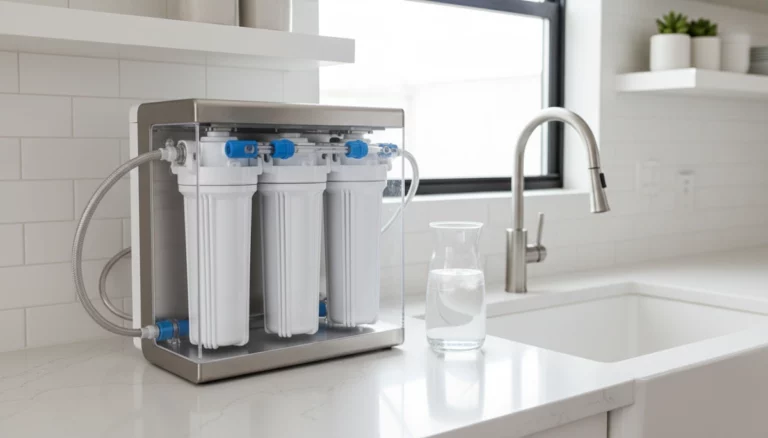
Reverse osmosis (RO) systems are extremely efficient in eliminating fluoride from water. These systems make use of a semi-permeable membrane layer to filter out contaminants, including fluoride, with a removal price of up to 99%. The membrane permits water molecules to pass via while obstructing bigger molecules, such as fluoride ions.
Nonetheless, it’s important to keep in mind that while efficient, RO systems can be pricey and lose a substantial amount of water during the filtration process. For each gallon of purified water produced, RO systems can throw away as much as three to four gallons of water. In spite of this, the high performance in contaminant elimination typically justifies the expense and water usage for numerous houses.
RO systems come in different forms, accommodating different needs and budgets:
| Type | Summary | Cost | Efficiency |
|---|---|---|---|
| Under-sink units | Set up under the cooking area sink, these units supply detoxified water straight from an assigned faucet. | Modest to High | High |
| Countertop filters | Mobile and very easy to install, these filters remain on the counter and attach to the faucet. | Low to Moderate | Modest |
| Whole-house systems | Installed at the point of access, these systems offer filtered water to the entire house. | High | High |
Each kind of RO system has its advantages and factors to consider:
- Under-sink units: Convenient for giving alcohol consumption and cooking water straight from the sink, but they require professional setup and routine maintenance.
- Counter top filters: Easy to set up and make use of, making them suitable for occupants or those that move often, though they may have a reduced purification capability compared to under-sink devices.
- Whole-house systems: Provide comprehensive filtration for all water resources in the home, making sure all water utilized for showering, cooking, and drinking is fluoride-free, but they are one of the most expensive choice and need considerable setup effort.
Distillation
Purification is one more efficient method for fluoride elimination. This procedure includes boiling water and after that condensing the steam back right into fluid, leaving fluoride and other pollutants behind. The purification procedure functions by heating water until it turns right into vapor. As the vapor rises, it leaves behind contaminants, consisting of fluoride, which have greater steaming points and do not vaporize. The heavy steam is then caught and cooled down, transforming it back right into liquid form.
Although distillation properly eliminates fluoride, it is a lengthy procedure and might not be practical for filtering large amounts of water. The procedure can take a number of hours to create a restricted quantity of pure water, making it much less effective for families with high water consumption. Additionally, purification calls for a significant amount of power to heat up the water, which can cause higher energy costs.
Distillers can be acquired for home use and are suitable for those that need tiny amounts of fluoride-free water. Home purification systems can be found in various dimensions and abilities, from small counter top versions to larger, much more robust systems. These devices are made to be straightforward, with many featuring automated shut-off systems once the distillation process is total.
While utilizing a distiller, it’s vital to consider the quality of the water being refined. Purification gets rid of most contaminations, yet it can likewise strip water of beneficial minerals, leading to very pure but possibly flat-tasting water. To reduce this, some individuals add mineral drops or utilize a post-distillation filtration system to reintroduce helpful minerals right into the water.
In recap, purification is a dependable method for getting rid of fluoride from water, suitable for individuals or homes requiring percentages of highly detoxified water. In spite of its drawbacks, such as time consumption and energy usage, the process makes certain that most impurities, consisting of fluoride, are effectively gotten rid of from the water system.
Activated Alumina Filters
Triggered alumina filters are a prominent choice for fluoride removal, efficient in reducing fluoride degrees by approximately 99%. These filters resolve adsorption, where fluoride ions are attracted to and held by the triggered alumina product. The performance of these filters makes them a typical remedy in both whole-house and point-of-use filtration systems.
The adsorption process entails passing water with the activated alumina, which has a high surface area and porous framework that efficiently catches fluoride ions. This approach is not only effective but likewise cost-efficient, making it obtainable for lots of families. To preserve optimal efficiency, it is vital to keep track of the pH degree of the water, as the adsorption capacity of activated alumina is highly pH-dependent. Preferably, the pH needs to be kept between 5.5 and 6.5 for the best outcomes.
Routine maintenance of activated alumina filters is vital. In time, the product comes to be saturated with fluoride ions, decreasing its efficiency. As a result, it is needed to change the filters occasionally. The regularity of substitute relies on a number of aspects, consisting of the preliminary fluoride concentration in the water, the quantity of water refined, and the certain filter design. Makers normally give guidelines on replacement periods, which must be closely followed to ensure continued fluoride removal performance.
| Element | Details |
|---|---|
| Fluoride Reduction Efficiency | As much as 99% |
| Optimal pH Range | 5.5 – 6.5 |
| Replacement Frequency | Depend upon fluoride degrees, water quantity, and filter design; follow supplier standards |
Along with fluoride, turned on alumina filters can get rid of other impurities, such as arsenic and selenium, making them a versatile alternative for improving overall water high quality. Nevertheless, the main emphasis stays on fluoride elimination, which is a significant issue for numerous areas.
In summary, activated alumina filters offer a trusted and reliable technique for removing fluoride from water. Their use in numerous filtering systems, incorporated with the relevance of keeping correct pH levels and regular filter replacement, makes sure that households can appreciate secure and tidy alcohol consumption water.
Bone Char Carbon Filters
Bone char carbon filters are an reliable and lasting option for removing fluoride from water. These filters are made from animal bones that have been charred, leading to a high-surface-area carbon structure efficient in adsorbing fluoride ions. This adsorption process is effective, allowing bone char filters to minimize fluoride levels by as much as 90%, making them a reliable choice for houses looking for an eco-friendly purification approach.
Among the key advantages of bone char carbon filters is their capacity to target fluoride particularly, while also getting rid of various other pollutants such as hefty steels and particular natural compounds. The high surface of the carbon structure enhances the filter’s capacity to catch fluoride ions, ensuring that the water that goes through is considerably lower in fluoride content.
Nevertheless, it’s important to keep in mind that the efficiency of bone char filters can vary depending on the water’s first fluoride focus, pH levels, and the flow rate via the filter. To optimize their performance, bone char filters are commonly used in mix with various other filtration media, such as activated carbon or turn around osmosis systems, to improve the total impurity removal capacities.
Bone char carbon filters are offered in various forms, including point-of-use filters for details faucets and whole-house systems that deal with all the water entering a home. While these filters provide a lasting option for fluoride removal, they might need normal substitute depending upon the water high quality and usage, which can influence the lasting prices related to this method.
Below is a table summing up the essential attributes of bone char carbon filters:
| Feature | Information |
|---|---|
| Fluoride Reduction Efficiency | Up to 90% |
| Sustainability | Green, made from animal bones |
| Various Other Contaminants Removed | Hefty metals, natural compounds |
| System Types | Point-of-use, whole-house |
| Upkeep | Regular substitute needed |
Picking the appropriate fluoride elimination method is critical for making sure the safety and sanitation of your drinking water. Bone char carbon filters provide a balance of effectiveness, sustainability, and versatility, making them a beneficial choice for lots of households.
FAQs on Eliminating Fluoride from Water
What are the most effective methods to eliminate fluoride from water?
There are several effective methods to remove fluoride from water, including Reverse Osmosis (RO) Systems, Distillation, Activated Alumina Filters, and Bone Char Carbon Filters. Each method has its advantages and considerations depending on your specific needs and budget.
How do Reverse Osmosis (RO) systems work for fluoride removal?
RO systems use a semi-permeable membrane to filter out contaminants, including fluoride, with a removal rate of up to 99%. The membrane allows water molecules to pass through while blocking larger molecules, such as fluoride ions. Despite being effective, RO systems can be costly and waste significant amounts of water during the filtration process.
What types of Reverse Osmosis (RO) systems are available?
There are three main types of RO systems:
- Under-sink units: Installed under the kitchen sink, providing purified water directly from a designated faucet. These units are moderate to high in cost and high in efficiency.
- Countertop filters: Portable and easy to install, these filters connect to the faucet. They are low to moderate in cost and moderate in efficiency.
- Whole-house systems: Installed at the point of entry, providing filtered water to the entire household. These systems are high in cost and high in efficiency.
How does distillation remove fluoride from water?
Distillation involves boiling water and then condensing the steam back into liquid, leaving fluoride and other impurities behind. While effective, this process is time-consuming and may not be practical for filtering large quantities of water.
What are the advantages and disadvantages of using distillation for fluoride removal?
Distillation effectively removes fluoride but is time-consuming and requires a significant amount of energy, leading to higher utility bills. It is suitable for producing small amounts of highly purified water, but not practical for households with high water consumption.
What are Activated Alumina Filters, and how do they work?
Activated Alumina Filters use adsorption to reduce fluoride levels by up to 99%. Water passes through activated alumina, which traps fluoride ions due to its high surface area and porous structure. Maintaining an optimal pH level (5.5 to 6.5) is crucial for the best results.
How often should Activated Alumina Filters be replaced?
Activated Alumina Filters should be replaced periodically, depending on the initial fluoride concentration in the water, the volume of water processed, and the specific filter design. Following the manufacturer’s guidelines on replacement intervals is essential to ensure continued effectiveness.
Can Activated Alumina Filters remove other contaminants besides fluoride?
Yes, in addition to fluoride, Activated Alumina Filters can remove other contaminants such as arsenic and selenium, improving overall water quality.
What are Bone Char Carbon Filters, and how do they function?
Bone Char Carbon Filters are made from animal bones that have been charred, creating a high-surface-area carbon structure that adsorbs fluoride ions. They can reduce fluoride levels by up to 90% and also remove other contaminants like heavy metals and certain organic compounds.
Are Bone Char Carbon Filters eco-friendly?
Yes, Bone Char Carbon Filters are considered eco-friendly as they are made from natural materials (animal bones). They offer a sustainable option for fluoride removal.
What factors affect the efficiency of Bone Char Carbon Filters?
The efficiency of Bone Char Carbon Filters can vary based on the initial fluoride concentration, pH levels, and the flow rate through the filter. Combining them with other filtration media can enhance their overall contaminant removal capabilities.
What types of systems use Bone Char Carbon Filters?
Bone Char Carbon Filters are available in point-of-use filters for specific taps and whole-house systems that treat all the water entering a home. Regular replacement is necessary to maintain their effectiveness.
Which fluoride removal method is best for my household?
The best method depends on your specific needs, water usage, and budget. Reverse Osmosis and Activated Alumina Filters are highly effective but may be costly. Distillation is suitable for small quantities of water, while Bone Char Carbon Filters offer a sustainable solution. Consider the advantages and drawbacks of each method to make an informed decision.