














The Science of the Sieve: Understanding 0.1 Micron Precision
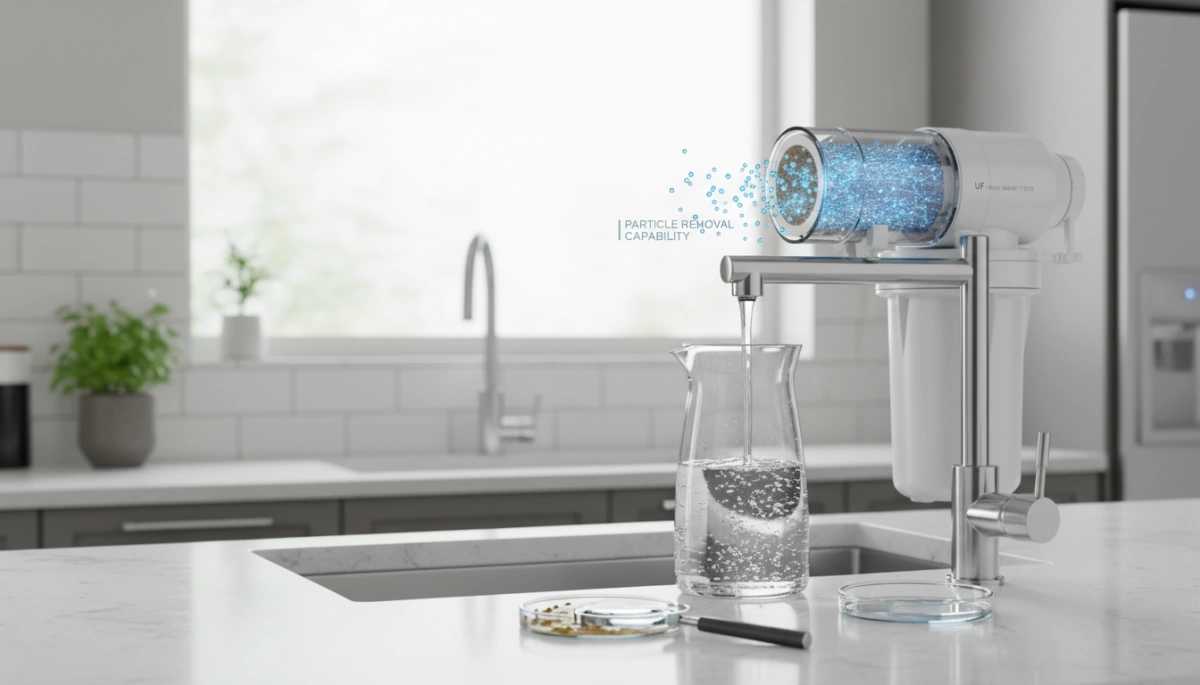
Have you ever stopped to consider what is actually floating in your tap water that your eyes cannot see? While standard filters might catch visible dirt, the real danger often lies in the microscopic world. At DripLife, we utilize Ultra-Filtration (UF) membrane technology to establish a definitive physical barrier against these invisible threats. Unlike basic filtration that relies solely on chemical absorption, our approach is engineered around precise particle exclusion.
The Scale of Filtration: Visualizing Microscopic Precision
To understand the particle removal capability of UF faucet water filters, we have to look at the numbers. A single strand of human hair is approximately 70 microns in diameter. Standard carbon filters typically operate in the 1 to 5-micron range, which is decent for basic sediment but leaves gaps for finer contaminants.
Our DripLife system tightens this mesh significantly, utilizing a 0.1-micron filtration accuracy. This is a level of fineness that fundamentally changes water quality.
| Object / Filter Type | Size (Microns) | Status |
|---|---|---|
| Human Hair | 70.0 | Visible |
| Fine Sand | 60.0 | Visible |
| Standard Carbon Filter | 5.0 – 10.0 | Coarse Filtration |
| DripLife UF Membrane | 0.1 | Precision Filtration |
| Bacteria / Colloids | 0.2 – 1.0 | Blocked by UF |
Hollow Fiber Membrane Mechanics: The Straw Structure Explained
The core of our hollow fiber membrane technology resembles a bundle of microscopic straws. This isn’t just a mesh screen; it is a complex, porous structure. Water is forced through the sidewalls of these hollow fibers by your home’s water pressure.
- Exterior-In Flow: Water pushes from the outside of the fiber to the inside.
- Physical Barrier: The 0.1-micron pores on the fiber walls act as a gatekeeper.
- Contaminant Trapping: Particles larger than 0.1 microns—including rust, suspended solids, and micro-sediments—are physically unable to pass through and are trapped on the surface.
This mechanical structure ensures that the particulate removal performance remains consistent throughout the filter’s 320-gallon lifespan, unlike depth filters that can channel and lose efficiency.
Mechanical vs. Chemical Filtration: The Difference Matters
Effective water purification requires a dual approach. Most generic filters rely heavily on chemical filtration (Activated Carbon) to adsorb taste and odors like chlorine. While we include high-quality silver ion carbon in our 5-stage system, the heavy lifting regarding particles is done by mechanical filtration.
Mechanical filtration is strictly about size exclusion. It does not rely on chemical reactions; it relies on physics. By combining these two methods, we achieve a superior result:
- Mechanical (UF): Blocks physical contaminants (Rust, Sand, Dirt, Colloids).
- Chemical (Carbon): Adsorbs dissolved chemicals (Chlorine, Fluoride, Odors).
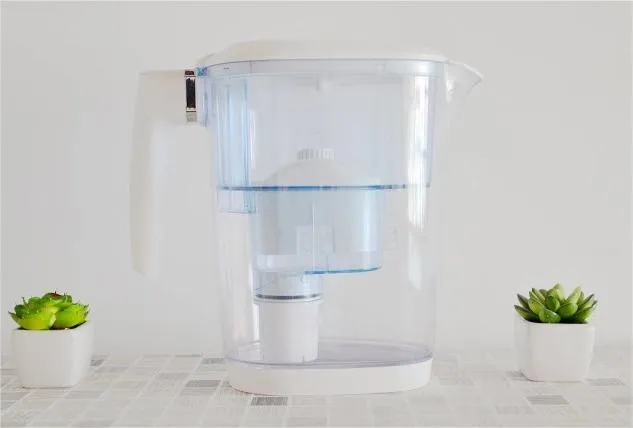
This synergy is why UF faucet water filters provide a clarity and safety level that simple charcoal pitchers cannot match. We strip the water of physical impurities while retaining essential minerals like calcium and magnesium, hitting the sweet spot for healthy hydration.
Specific Particle Removal Capabilities: The Hit List
When we talk about the particle removal capability of UF faucet water filters, we aren’t just talking about making water look clear. We are talking about a mechanical sieve that physically blocks contaminants based on size. Unlike chemical absorption alone, our Ultra-Filtration (UF) technology acts as a strict gatekeeper. If a particle is larger than 0.1 microns, it simply cannot pass through. Here is exactly what gets stopped at the gate.
Sediment and Suspended Solids: Tackling Turbidity
The most immediate impact of installing our system is the elimination of turbidity—that cloudy, hazy look water gets when it is full of suspended solids. Our household sediment filter faucet units use a multi-stage defense, starting with a stainless steel mesh to catch large debris and moving to the UF membrane for fine particulates.
We effectively remove:
- Dirt and Sand: Common in well water or after municipal pipe repairs.
- Silt: Fine granular material that causes cloudiness.
- Colloidal Particles: Suspended matter that doesn’t settle easily.
By handling these suspended solids removal tasks, we protect your drinking water from the gritty texture that ruins the experience of a fresh glass of water. This level of clarity is just as important for your hygiene routines, which is why many customers also install a bathroom faucet water filter to protect their skin from abrasive sediments.
Rust and Pipe Corrosion: Solving the Red Water Issue
Aging infrastructure in the United States is a major culprit for tap water contamination. As iron pipes degrade, they flake off rust particles into the water supply, leading to reddish-brown discoloration and a metallic taste. Our rust reduction faucet filter technology captures these oxidized iron particles before they reach your glass.
The 0.1-micron precision of our UF membrane is significantly smaller than rust flakes. This means we don’t just mask the color; we physically extract the corrosion byproducts. If you have ever noticed unexpected dark specks in your water, you might want to read about black stuff from water filter issues, which often stem from pipe corrosion or carbon release—both of which our systems are designed to manage effectively.
Microplastics: The Invisible Plastic Pollution Barrier
Microplastic water filtration is becoming a standard requirement for modern homes. These tiny plastic fragments, resulting from the breakdown of larger consumer products, are now pervasive in municipal water supplies. Because microplastics generally range from 2.5 microns and up, our fine particle filtration tap water systems act as an absolute barrier. The 0.1-micron pore size of our UF membrane is tight enough to block these synthetic intruders, ensuring your hydration is free from plastic pollution.
Biological Contaminants: Blocking Bacteria and Cysts
While we always recommend using municipally treated water, the journey from the treatment plant to your tap can introduce biological risks. The core strength of our technology lies in its 0.1 micron filtration accuracy. This pore size is smaller than many common bacteria and parasitic cysts.
By functioning as a physical barrier, the UF membrane traps these microscopic impurities on the surface of the hollow fibers while allowing clean water and essential minerals like calcium and magnesium to flow through. This provides a layer of particulate removal performance that standard carbon-only filters simply cannot match, giving you peace of mind with every turn of the tap.
UF vs. The Alternatives: Where Does Ultrafiltration Stand?
When we look at the landscape of water purification, Ultrafiltration (UF) occupies a unique position. It isn’t just about making water taste better; it is about physically excluding contaminants that other methods miss. Understanding where UF stands compared to standard carbon filters and Reverse Osmosis (RO) systems helps clarify why this technology is often the most practical choice for American households.
UF vs. Standard Activated Carbon: Beyond Taste Improvement
Standard faucet filters typically rely on a single stage of activated carbon. While Activated Carbon Fiber (ACF) is fantastic for chemical adsorption—specifically for removing chlorine and eliminating bad odors—it has limitations regarding physical particle removal. A standard carbon filter might have a pore size of 1 to 5 microns. This is small, but not small enough to catch fine sediment, microplastics, or certain bacteria.
Our UF membrane technology changes the game by introducing a physical barrier with 0.1-micron filtration accuracy. Think of it this way: carbon acts like a sponge for chemicals, while the UF membrane acts like a security gate for solids. By combining these technologies in our 5-stage system, we achieve superior suspended solids removal and turbidity reduction that a simple carbon block simply cannot match.
UF vs. Reverse Osmosis (RO): The Battle for Healthy Minerals
Reverse Osmosis is often cited as the gold standard for purity because it removes everything. However, that “everything” includes beneficial minerals like calcium and magnesium. RO systems also typically require under-sink installation, electricity, and a storage tank, and they produce wastewater during the process.
For many families, the goal is mineral retention water filter capability. We want the lead and rust out, but we want the healthy minerals to stay. UF membranes are engineered to block heavy metals and microscopic particles while allowing dissolved minerals to pass through. If you are evaluating the long-term value of your water setup and considering why every family should replace bottled water with a sustainable home solution, the choice often comes down to whether you want “dead” water (RO) or mineral-rich water (UF).
Why UF is the Sweet Spot for Living Water
Ultrafiltration represents the “sweet spot” in point-of-use (POU) filtration. It offers significantly higher particulate removal performance than standard pitchers or faucet mounts without the complexity and water waste of RO systems.
- Efficiency: You get a fast flow rate (0.5 GPM) without waiting for a tank to fill.
- Simplicity: Tool-free installation on standard faucets.
- Health: Rejection of harmful contaminants while retaining the minerals your body needs.
By utilizing a hollow fiber membrane, we provide a solution that balances high-level protection with the convenience required for a busy kitchen. It is the practical, effective middle ground for ensuring your tap water is safe, clear, and healthy.
The Driplife Advantage: Enhancing Particle Removal Integrity
At DripLife, we know that particle removal capability of UF faucet water filters isn’t just about the membrane; it’s about the entire vessel holding that technology. If the housing fails, the filtration fails. We engineer our systems to ensure that the water flowing into your glass has passed strictly through our filtration media, with zero bypass.
The Critical Role of Housing Material: Why Stainless Steel Wins
The housing of your filter is the first line of defense against leaks and pressure fatigue. While standard filters often rely on basic polymers, the structural integrity of the unit dictates how well it maintains the seal around the filter cartridge. If the housing flexes under water pressure, it can create microscopic gaps where untreated water slips past the filter—rendering the 0.1 micron filtration accuracy useless. We prioritize materials that withstand the daily rigors of high-pressure tap water without compromising the filtration seal.
304 Food-Grade Stainless Steel vs. Plastic Distortion
When we compare 304 stainless steel filter housing against standard plastic, the difference is clear in both longevity and hygiene. Plastic housings are prone to “water hammer” damage and thermal expansion, which can lead to distortion over time. Once a plastic housing warps, the internal seal is broken, allowing sediment and rust to bypass the ultrafiltration membrane technology.
Stainless steel maintains its shape rigidly, ensuring that every drop of water is forced through the filtration stages. Furthermore, 304 food-grade steel prevents secondary pollution; it doesn’t degrade or leach chemicals back into your purified water. For families concerned about synthetic materials, exploring plastic-free water filter options is a smart move to ensure that the hardware itself is as clean as the water it produces.
Dual-Action Filtration: Combining ACF and UF Technology
We don’t rely on a single barrier. Our systems utilize a powerful dual-action approach. While the hollow fiber membrane acts as the physical gatekeeper for suspended solids removal, we pair it with Activated Carbon Fiber (ACF) or silver ion carbon.
- The UF Role: The 0.1-micron membrane physically blocks rust, sand, dirt, and turbidity. It is the “sieve” that catches the physical contaminants.
- The Carbon Role: The carbon layer handles the chemical side, absorbing chlorine, odors, and improving taste.
This combination ensures comprehensive purification. The UF membrane protects the carbon from getting clogged with large debris, while the carbon polishes the water that passes through the UF barrier. This synergy extends the life of the cartridge (up to 320 gallons) and ensures that you aren’t just drinking clear water, but water that is chemically cleaner and tastes crisp.
Performance Factors: Flow Rate and Lifespan
Debunking the Low Flow Rate Myth
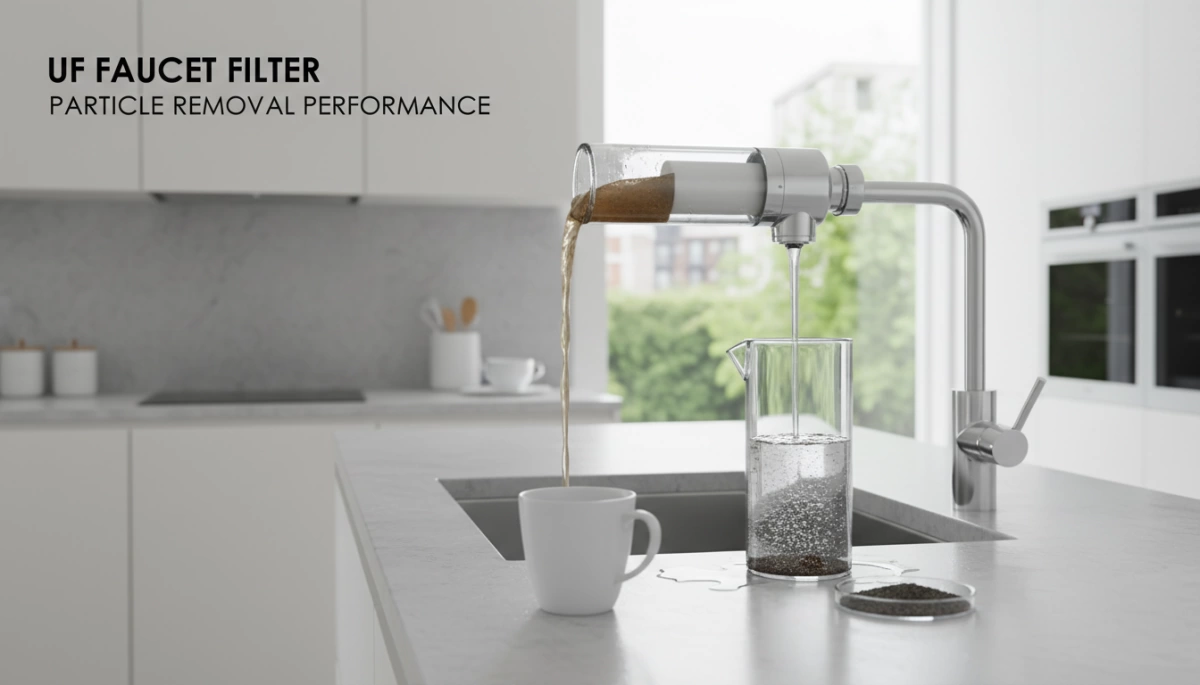
There is a common misconception that high-precision filtration turns your tap into a trickle. While it is true that tighter pores create more resistance, modern ultrafiltration membrane technology has solved the speed issue. We designed our systems to deliver a steady 0.5 Gallons Per Minute (GPM) at 60 psi. This balance ensures you get the particle removal capability of UF faucet water filters without waiting forever to fill a glass. You get the clarity improvement of a 0.1-micron barrier with the convenience needed for a busy kitchen.
Understanding Membrane Fouling and Clogging
If your filter slows down over time, that is actually a good sign—it means the particulate removal performance is working. Membrane fouling occurs when the hollow fibers physically trap rust, sediment, and suspended solids. Unlike chemical filters that just absorb invisible compounds, our UF membranes act as a physical wall.
- The Process: As water passes through, debris larger than 0.1 microns gets stuck on the surface.
- The Result: Eventually, this buildup restricts the path of the water.
- The Reality: A clogged filter is proof that those contaminants are in the cartridge, not in your body.
Maintenance Best Practices: When to Replace Your Cartridge
To maintain optimal filtration accuracy and flow, you cannot ignore the service life of your filter. Our cartridges are engineered to last for 320 gallons or approximately 6 months, depending on your local water quality. Pushing a filter beyond this limit risks reducing the flow to a drip and potentially compromising the clarity improvement of your water.
For the best results:
- Monitor Flow: If the flow rate drops significantly before 6 months, your water likely has high sediment levels, and you should change the filter sooner.
- Stick to the Schedule: Even if flow is fine, change the filter at 6 months to prevent bacterial growth within the media.
- Housing Care: While the cartridge does the heavy lifting, keeping the exterior unit in top shape is vital. Check out our guide on the cleaning and maintenance of reusable filter housings to ensure your system remains sanitary during cartridge swaps.
Frequently Asked Questions About UF Particle Removal
Can UF filters remove viruses from tap water?
While ultrafiltration membrane technology is a powerhouse for bacteriostatic water filter applications, viruses are significantly smaller than bacteria. A standard UF membrane with 0.1 micron filtration accuracy creates an effective physical barrier against bacteria (typically 0.2 to 2.0 microns) and cysts, but some viruses can be as small as 0.004 microns. However, for municipal tap water that is already chemically treated, the primary threat isn’t usually live viruses, but rather the suspended solids removal and chlorine byproducts. Our system focuses on polishing that water to a safe, drinkable standard by removing the physical contaminants picked up during transport.
Do UF filters reduce water pressure significantly?
You will notice a difference compared to an open faucet, but this is intentional. To achieve high particulate removal performance, water must be pushed through microscopic pores. Our units typically operate at a flow rate of 0.5 GPM. This controlled pace is necessary for the hollow fiber membrane to physically trap contaminants like microplastics and rust without letting them bypass the filter. If water rushed through too quickly, the clarity improvement uf filter process would be compromised.
How do I know if my UF membrane is clogged?
A significant drop in water flow is the number one indicator. Unlike carbon filters that might just stop absorbing taste while letting water pass, a sediment filtration uf membrane works by mechanical exclusion. When the pores are full of rust, sand, and dirt, the water cannot pass through. This pressure drop confirms the filter successfully protected your glass from those contaminants. Understanding how autoflush technology prevents clogging can help you manage maintenance, but eventually, a slow flow means it is time to replace the cartridge to maintain hygiene.
Is 0.01 micron filtration enough for well water?
For turbidity reduction and removing physical muck, yes. UF technology is excellent at acting as a sediment and rust filter for well water that looks cloudy or has floating particles. However, well water can contain dissolved heavy metals or specific chemical runoff that a physical sieve alone cannot catch. While our fine particle filtration tap water systems remove 99% of lead and fluoride through combined stages, well water users should always conduct a lab test first. If your water has high biological contamination, UF is a great step, but it functions best as a point-of-use (POU) filtration safeguard rather than a total facility treatment plant.