

















Why Standard Water Filters Fail at Removing Fluoride
The Science of Carbon: Adsorption Limits
Let’s be blunt: the standard water pitcher sitting in most refrigerators is likely useless against fluoride. Most common filters rely exclusively on activated carbon. This material is fantastic for trapping organic compounds and chlorine through adsorption—essentially acting like a chemical sponge for specific pollutants.
However, fluoride is a negatively charged inorganic ion. It is chemically distinct from the organic contaminants carbon is designed to catch. Because fluoride ions do not bond well with standard carbon, they pass straight through the filter media. While the water may smell better due to chlorine reduction, the fluoride content remains virtually unchanged.
The TDS Confusion: Taste vs. Purity
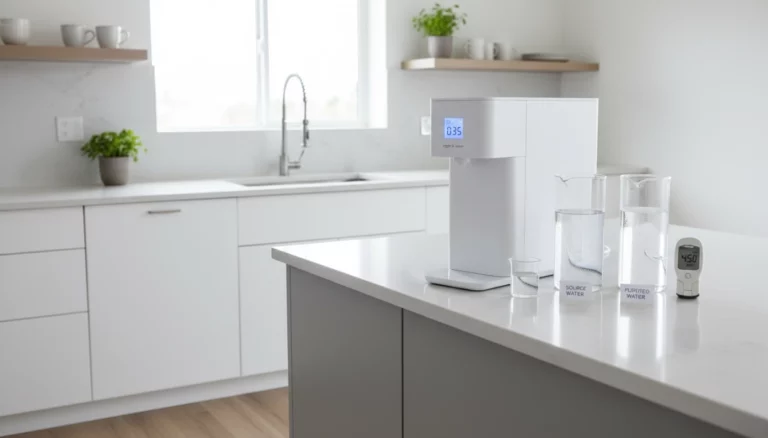
Many homeowners rely on handheld Total Dissolved Solids (TDS) meters to test water quality, but these devices often mislead users regarding specific municipal tap water contaminants.
- Taste Improvement: Carbon filters remove chlorine and sediment, instantly improving the taste and smell of the water.
- The Measurement Gap: A standard carbon filter does not significantly lower TDS readings because it leaves dissolved minerals and ions—including fluoride—intact.
- The Reality: You get better-tasting water that still contains the same level of fluoride as the unfiltered tap. A lower TDS reading does not automatically guarantee fluoride removal, and a better taste does not mean the water is free of industrial additives.
User Takeaway: Packaging Claims and Truth
Marketing language is often designed to obscure the limitations of basic filtration. As a manufacturer, we see the confusion daily.
- Check the Label: If the packaging only claims to reduce “Chlorine, Taste, and Odor,” it does not remove fluoride.
- Ignore the Hype: Phrases like “Pure Taste” or “Advanced Filtration” are meaningless without specific lab data.
- The Requirement: True fluoride removal requires specialized mechanisms, such as Reverse Osmosis Systems or filters utilizing Activated Alumina. Unless the product explicitly states “Fluoride Removal” with a percentage attached, assume it is leaving the fluoride in your water.
cURL error: transfer closed with outstanding read data remaining
Deep Dive: Reverse Osmosis vs. Gravity Filters (Comparison)
Choosing between a Reverse Osmosis System and a Gravity-fed water filter often comes down to your specific lifestyle needs and how much you want to interact with your filtration setup. While both technologies effectively tackle fluoride, the user experience is vastly different.
To make this decision easier, we have broken down the key differences in the table below:
| Feature | Reverse Osmosis (RO) Systems | Gravity-Fed Systems |
|---|---|---|
| Installation | Under-sink filtration (requires plumbing) | Countertop (no tools required) |
| Filtration Speed | Fast (Continuous pressure) | Slow (Drip method) |
| Maintenance | Low (Annual changes + Smart alerts) | Moderate (Frequent cleaning required) |
| Fluoride Removal | 95-99% (Consistent) | 95%+ (Dependent on media contact time) |
| Mineral Content | Strip & Remineralize | Retains some / Media dependent |
Installation: Plumbing vs. Plug-and-Play
For homeowners looking for a permanent “set it and forget it” solution, an under-sink filtration RO unit is the standard. It connects directly to your cold water line and drain, hiding the equipment away. However, for renters or those who want portability, a stainless steel countertop filter or gravity system is superior. You simply place it on the counter and fill the upper chamber manually. If you are looking for smaller, more portable options, checking out top-rated fluoride water filter pitchers can provide a flexible alternative to larger gravity systems.
Maintenance: Smart Tech vs. Manual Scrubbing
Modern RO systems have evolved significantly. At Driplife, we integrate smart alerts into our faucets and system bodies, notifying you exactly when a filter change is needed based on actual usage. This removes the guesswork. Conversely, gravity filters require more hands-on maintenance. Because the water sits in the chambers, the filters require regular scrubbing to prevent biofilm buildup and ensure the flow rate doesn’t stall.
Mineral Content and the Driplife Solution
One of the biggest debates in water filtration is the “dead water” issue. Standard RO systems are so efficient at removing contaminants that they also strip out healthy minerals like calcium and magnesium. Gravity filters often claim to retain these minerals, but this can be inconsistent depending on the specific media used.
We take a different approach. We believe you shouldn’t have to choose between fluoride-free water and mineral-rich water. Our advanced RO configurations include a dedicated remineralization stage. This post-filter cartridge adds beneficial Calcium and Magnesium back into the purified water, effectively turning it into an alkaline water filter system. This ensures the water not only tastes crisp but also supports healthy hydration.
What to Look for When Buying a Fluoride Water Filter
Finding reliable water filters that filter out fluoride requires looking past the marketing fluff on the box. Since fluoride is chemically difficult to remove, standard filters often fall short. Here is the checklist I use to ensure a system is actually up to the task of cleaning up municipal tap water contaminants.
Third-Party Certifications
Never take a manufacturer’s word for it. Look for NSF/ANSI Standard 58 certification. This is the specific industry benchmark for Reverse Osmosis Systems regarding the reduction of contaminants like fluoride. If a brand cannot provide third-party lab testing results showing a specific fluoride removal percentage, they likely aren’t getting the job done.
Multi-Stage Filtration Necessity
A single cartridge rarely cuts it. You need a system that employs multi-stage filtration to handle different threats at different steps:
- Sediment & Carbon Stages: These protect the main membrane by removing larger particles and chlorine.
- RO Membrane: The 0.0001-micron barrier that physically rejects fluoride ions.
- Remineralization Stage: Since RO removes everything, this stage adds healthy calcium and magnesium back in.
If you are planning to install an under-sink water filter system, make sure you have adequate space for a unit that houses these essential multiple stages.
Filter Lifespan & Cost Efficiency
Don’t just look at the sticker price; look at the cost per gallon. A cheap pitcher might cost less upfront but requires monthly filter changes, whereas high-capacity systems often run for 6 to 12 months before needing maintenance. Comparing the longevity helps you calculate the true cost of ownership.
Material Safety
The housing of your filter matters just as much as the media inside. Avoid cheap plastics that might leach chemicals back into your clean water.
- BPA-Free Plastics: A minimum requirement for any plastic components.
- 304 Stainless Steel: For gravity-fed units, a stainless steel countertop filter is superior. It offers durability, prevents bacterial growth, and looks much better in a modern kitchen.
Spotlight: The Driplife Approach to Fluoride Removal
At Driplife, we treat filtration as precise engineering, not just assembly. When we design water filters that filter out fluoride, we rely on rigorous science and ISO certified production lines to guarantee consistency. We don’t cut corners with standard carbon blocks that let dissolved solids pass through; instead, we utilize 0.0001-micron filtration precision. This level of tightness is essential for effectively blocking fluoride ions, which are significantly smaller than common bacteria or sediment.
Our commitment extends to broad contaminant removal. A filter that only catches fluoride isn’t doing enough if it leaves behind modern industrial chemicals. Our systems are engineered for:
- PFOA/PFOS reduction: Tackling “forever chemicals” found in many municipal supplies.
- Heavy Metal Filtration: Removing lead and arsenic.
- Chlorine & Taste: Eliminating the chemical bleach taste of city water.
We understand that installation needs vary, which is why we offer versatile solutions. Whether you need a high-capacity under-sink unit or a countertop reverse osmosis water filter that requires no plumbing, the core filtration technology remains uncompromising.
Sustainable and Healthy Hydration
Beyond removal, we focus on what goes into your body and what stays out of landfills. By adopting our systems, you are actively replacing thousands of single-use plastic bottles, contributing to a massive reduction in plastic waste.
However, stripping water of everything can leave it tasting flat and acidic. To counter this, we integrate a remineralization stage into our designs. This transforms our units into an alkaline water filter system that adds back beneficial calcium and magnesium. This “Healthy Water Promise” ensures that while we strip out the bad stuff like fluoride, we keep the hydration mineral-rich and balanced for your health.
Frequently Asked Questions About Fluoride Filters
Does boiling water remove fluoride?
No, and it can actually make the problem worse. Unlike chlorine, which can dissipate into the air, fluoride is a dissolved mineral salt. When you boil water, you lose pure water to steam, but the fluoride stays behind. This effectively concentrates the fluoride, increasing the levels in the water left in your pot.
Do refrigerator filters remove fluoride?
Generally, no. Most standard refrigerator filters rely on basic carbon blocks designed primarily to improve taste and odor by reducing chlorine. They simply do not have the density or the right media to trap fluoride ions. To truly address this, you need a system capable of 0.0001-micron filtration, like reverse osmosis. It is also worth noting that once these powerful systems strip contaminants, remineralization plays a role in balancing water pH to ensure the water remains healthy and alkaline.
How often should I change fluoride filters?
This varies by the type of system and your local water quality.
- Gravity-fed water filters: Usually replaced every few months based on the number of gallons filtered.
- Reverse Osmosis Systems: These are more efficient. Pre-filters might last 6-12 months, while the RO membrane can last up to 2 years.
We build our systems with smart alerts to monitor GPD efficiency and filter life, so you never have to guess when it’s time for a change.
Can fluoride be tested at home?
Testing for fluoride specifically is difficult with standard home tools. A common Total Dissolved Solids (TDS) meter measures all conductive minerals in the water, not just fluoride. While a very low TDS reading from an RO system is a strong indicator that municipal tap water contaminants are being removed, it doesn’t isolate fluoride. For a 100% confirmation of your fluoride removal percentage, sending a sample to a certified lab is the most reliable method.