














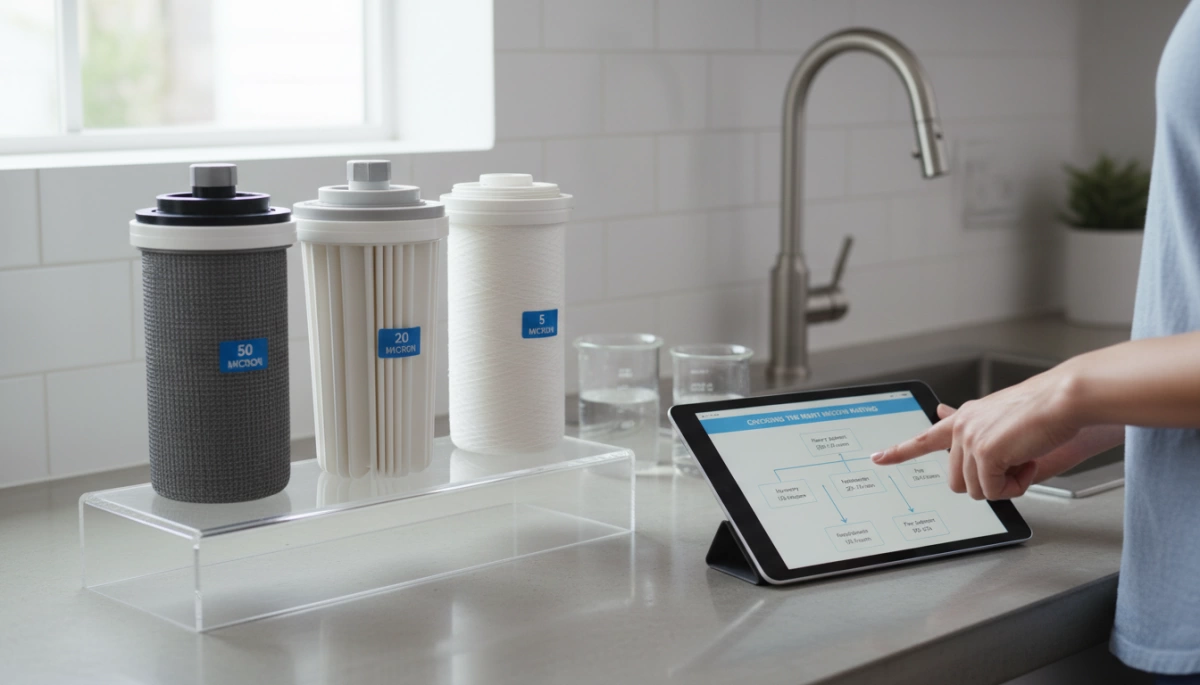
Understanding the Micron: The Technical Basics and Visual Scale
When we guide customers through Choosing the Right Micron Rating for Pre-sediment Filters, the first step is demystifying the measurement itself. A micron (short for micrometer) is the standard unit used to describe the pore size of a water filter. To be precise, one micron is equal to 1/25,400th of an inch.
In the world of filtration, the micron rating tells you how tight the “mesh” is. If the rating is too large, contaminants pass right through; if it’s too small, water flow is restricted.
Visualizing the Microscopic Scale
It can be difficult to grasp just how small these particles are without a reference point. We use the following scale to help homeowners visualize what their filtration system is actually catching:
| Object | Approximate Size (Microns) | Filter Capability |
|---|---|---|
| Beach Sand | 100+ | Easily caught by coarse pre-filters |
| Human Hair | 50 – 70 | Visible to the naked eye |
| Pollen / Dust | 10 – 30 | Requires fine sediment filtration |
| Red Blood Cell | ~8 | Invisible without magnification |
| Bacteria | 0.2 – 2 | Requires advanced filtration (Sub-micron) |
Nominal vs. Absolute Ratings
Understanding the distinction between Nominal vs. Absolute Rating is critical for selecting the right equipment.
- Nominal Rating: This indicates that the filter will trap a percentage (usually 85–95%) of particles at the stated size. This is the industry standard for most residential pre-sediment filters.
- Absolute Rating: This guarantees that 99.9% of particles at the stated size are stopped. This is typically reserved for medical or industrial applications where sterilization is required.
For the average household, relying on absolute ratings for a pre-sediment stage is often overkill and cost-prohibitive. Our goal with pre-filtration is to remove the bulk of physical dirt—like rust and silt—to protect the more expensive stages downstream. By utilizing high-quality filters with a reliable nominal rating, we ensure the coconut shell activated carbon block remains unclogged and effective for its full 6-month lifespan, focusing its capacity on removing chemicals and heavy metals rather than physical debris.
The Flow Rate vs. Filtration Efficiency Trade-off
Choosing the right filter isn’t just about trapping the smallest particles; it is a critical balancing act between water clarity and water pressure. The physics here are simple: smaller holes create higher resistance. When you tighten the filtration mesh to trap tiny contaminants, you inevitably increase the Water Pressure Drop (PSI). If the resistance is too high, your faucet turns into a trickle, and your appliances struggle to draw water.
Balancing High-Flow Systems
For modern households, especially those using tankless systems, maintaining flow is non-negotiable. These units often demand high speeds, typically between 600 and 800 Flow Rate (GPM/GPD), to function correctly. If you install a pre-filter that is too restrictive, you risk starving the system of water. This is particularly important when understanding what is an undersink reverse osmosis system and how it relies on consistent pressure to push water through the main membrane.
The Risks of Going to Extremes
Selecting the wrong micron rating can lead to immediate operational headaches or long-term damage:
- Too Fine (1 Micron or less): While these filters offer superior clarity, using them as a primary sediment filter often results in “choking” the pump. The filter clogs rapidly with larger debris, causing a massive pressure drop that strains your system’s motor and drastically shortens the filter’s lifespan.
- Too Coarse (20+ Micron): A loose filter allows abrasive sediments like sand and rust to pass through. These particles act like sandpaper on downstream components, fouling your premium coconut shell activated carbon block and ruining the expensive RO membrane.
Why 5 Micron is the Industry Standard
For most residential applications, 5-Micron is the “sweet spot.” It effectively captures the visible sediment—sand, silt, and rust—that threatens your plumbing, yet it remains open enough to maintain strong water pressure. This rating provides the perfect shield for your NSF-certified filters, ensuring they can focus on removing chemicals and heavy metals rather than getting clogged by dirt.
Scenario Guide: Choosing the Right Rating for Your Water Source
When we talk about Choosing the Right Micron Rating for Pre-sediment Filters, one size definitely does not fit all. The quality of water entering your home dictates exactly what kind of barrier you need to set up. If you choose a filter that is too tight, you kill your water pressure; too loose, and you risk clogging the premium coconut shell activated carbon block in your main refrigerator or under-sink system.
Municipal (City) Water: The 5-Micron Standard
For most of our US customers on city water, the water is already chemically treated, but it travels through miles of aging infrastructure before reaching your tap. The main enemies here are pipe scale, rust flakes, and physical debris.
- Recommendation: A 5-Micron Polypropylene (PP) sediment filter is the industry “sweet spot.”
- Why it works: It effectively stops visible particles without restricting flow. This ensures that your NSF-certified carbon filters can focus on their primary job—reducing chlorine taste, odor, and lead—rather than getting choked by physical dirt.
Well Water (Low Sediment): Targeting Invisible Silt
Private wells are a different beast. Even if your water looks clear, it often carries fine silt or sand that can wreak havoc on appliances. Here, surface filtration often fails because the debris is too fine.
- Strategy: Utilize depth filtration.
- Mechanism: Unlike a simple screen, a high-quality melt-blown filter traps particles deep within its core. This maximizes the filter’s holding capacity, preventing that fine silt from passing through to your downstream equipment or benefits of reverse osmosis water for home systems.
Well Water (High Sediment): Step-Down Filtration
If you are dealing with water that is visibly cloudy or heavy with sediment, installing a fine filter immediately is a recipe for disaster—it will clog in days. You need a Step-Down Filtration strategy.
- Stage 1: Coarse filtration to catch the heavy load.
- Stage 2: Finer filtration (like our standard replacements) to polish the water.
This method extends the lifespan of your more expensive cartridges by ensuring they aren’t overwhelmed by heavy muck instantly.
The First Line of Defense: Spin-Down Filters
For homes with significant sediment issues, we often recommend starting with a Spin-Down filter. These typically feature a mesh rating between 50 and 100 Microns.
- Function: They physically spin water to separate heavy sands and large particulates.
- Benefit: They are flushable and reusable. By catching the “boulders” first, they protect your disposable 5-micron filters and ensure your Twist and Lock cartridges last their full 6-month cycle.
Material Matters: Surface vs. Depth Filtration Mechanics
When selecting a pre-filter, the construction material determines how effectively it traps contaminants without killing your water pressure. It is not just about the hole size; it is about how the filter captures the dirt. We generally categorize these into two distinct technologies: surface filtration and depth filtration.
Pleated Filters: Maximizing Surface Area
Pleated filters function primarily through Surface Filtration. Imagine a folded piece of paper or a screen; the debris gets caught on the outer layer while clean water passes through.
- High Surface Area: The accordion-like folds significantly increase the filtration area, allowing for higher flow rates.
- Washability: Since the dirt sits on the surface, many pleated filters can be rinsed and reused, making them economical for areas with heavy, coarse sediment like sand.
- Application: These are excellent as a first-stage defense to prevent large particulate matter removal from overwhelming finer stages.
Melt-Blown Polypropylene (PP): The Power of Depth Filtration
For protecting sensitive downstream components like our coconut shell carbon blocks, the Polypropylene (PP) Sediment Filter is the industry standard. These utilize Depth Filtration, which works differently than a simple screen.
- Multi-Layered Density: The filter wall is engineered with a gradient density—looser on the outside to trap large particles and tighter on the inside to catch fine silt.
- Trapping Efficiency: Contaminants get trapped throughout the entire thickness of the filter, not just on the outside. This allows the filter to hold a massive amount of dirt before clogging.
Why Melt-Blown PP is Preferred for RO Systems
In our experience, melt-blown PP is the superior choice for high-purity applications. Because Depth Filtration captures microscopic particles that would otherwise slip through a pleated surface, it provides the ultimate protection for the next stages of your system. This is critical when you are choosing the right RO membrane brand or trying to extend the lifespan of an expensive NSF-certified carbon filter. By stopping fine sediment deep within the PP fibers, we ensure the main filtration media remains clean and efficient for the long haul.
Protecting Your Investment: The Pre-Filter and RO Connection
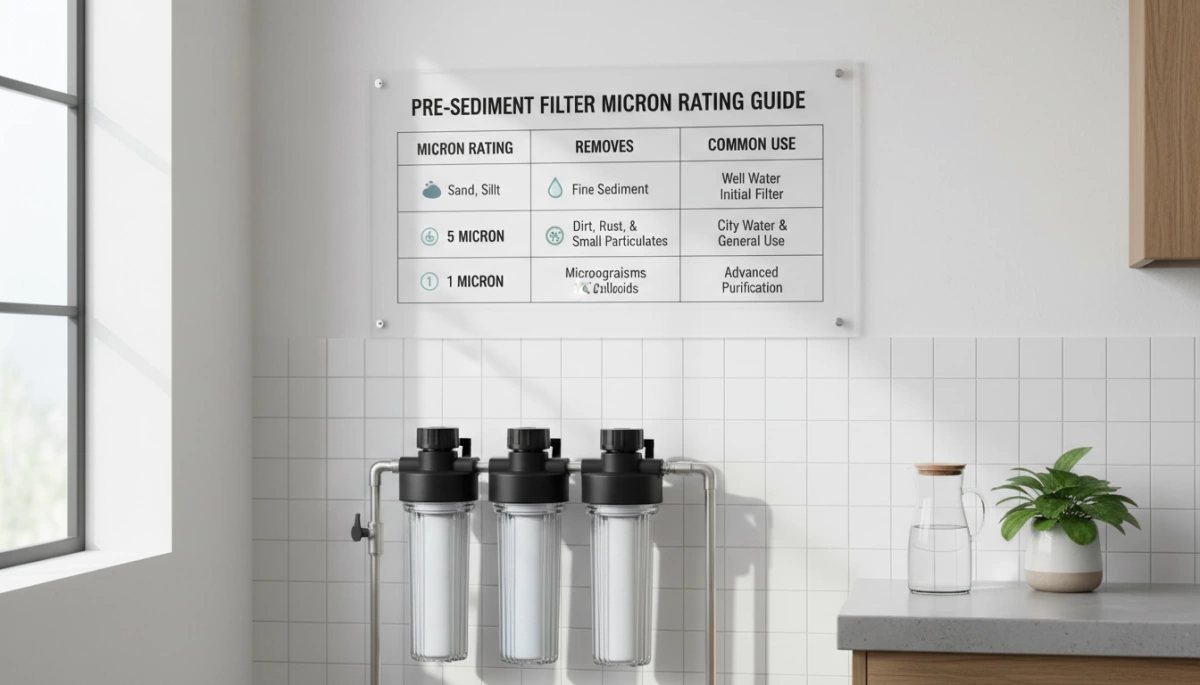
When we talk about Reverse Osmosis Pre-filtration, we are talking about protecting the heart of your system. The filtration hierarchy is non-negotiable: water must pass through the sediment filter first, then the activated carbon, and finally the RO membrane. If you mess up the first step with the wrong micron rating, the whole chain collapses.
The High Cost of Membrane Fouling
Choosing a filter that is too coarse allows particulate matter to pass right through. This debris doesn’t just disappear; it slams into your carbon block and eventually reaches the RO membrane. This leads to membrane fouling, where the microscopic pores get physically plugged by dirt rather than rejecting dissolved solids.
- Reduced Lifespan: Your expensive RO membrane fails months earlier than it should.
- Lower Efficiency: The system has to work harder to push water through clogged layers.
- Poor Water Quality: Contaminants that should be trapped early on compromise the final purity.
Preserving TDS Rejection Rates
The RO membrane operates at an incredibly fine 0.0001 micron rating. Its job is to strip away dissolved solids, heavy metals like lead, and chemicals. It is not designed to handle physical sediment. By using a proper 5-micron or 1-micron pre-filter, you ensure the membrane focuses solely on chemical and molecular separation. This is crucial for maintaining high TDS rejection rates. If you aren’t sure if your membrane is still performing, learning how to use a TDS tester can help you monitor the health of your system.
Engineering of Integrated PP+CTO Filters
Many of the modern replacement filters we offer utilize integrated PP+CTO composite technology. This engineering combines two stages into one efficient cartridge:
- Outer Layer: Melt-blown Polypropylene (PP) for depth filtration of sediment.
- Inner Core: Premium coconut shell activated carbon block for chlorine and odor removal.
This dual-action design maximizes contact time and protection, ensuring that only clean, sediment-free water reaches the delicate RO stage.
Maintenance Signs: When to Change Your Pre-Sediment Filter
Even if you succeed in Choosing the Right Micron Rating for Pre-sediment Filters, every cartridge eventually reaches its limit. We design our filters for longevity, typically lasting 6 months or roughly 200–300 gallons, but local water quality dictates the actual schedule. Protecting your system requires vigilance.
Here is how to spot the end of a Filter Cartridge Lifespan:
- Water Pressure Drop (PSI): This is the most common sign. As the depth filtration media traps rust and silt, it creates resistance. If you notice a significant reduction in Flow Rate at the dispenser, the filter is clogged.
- Visual Inspection: If your system allows you to see the cartridge, look for color changes. The material starts white and turns dark brown as it captures contaminants. Ignoring a fouled filter too long can lead to hygiene issues, such as spotting mold in water filters, which compromises the safety of your water.
- Pump Strain: Listen to your filtration system. A humming or straining sound often means the pump is working overtime to push water through a blocked sediment filter.
We prioritize user-friendly maintenance. Our replacement filters feature a “Twist and Lock” design, allowing for tool-free, DIY changes in seconds. This eliminates the hassle, encouraging timely replacements to keep your NSF-certified system running efficiently.
Frequently Asked Questions About Micron Ratings
Can I wash and reuse a melt-blown sediment filter?
No, you really shouldn’t. Melt-blown Polypropylene (PP) filters utilize depth filtration, meaning they trap contaminants deep within the filter walls, not just on the surface. While washing might remove visible dirt from the outside, it cannot clean the saturated inner layers. Reusing a clogged filter risks channeling, where water forces its way through weak spots, bypassing filtration entirely. For the safety of your water and to protect downstream components like your sink water filter dispenser, we always recommend replacing the cartridge rather than attempting to clean it.
Does a lower micron rating significantly reduce TDS?
This is a common misconception. A lower micron rating (like 1 micron) is excellent for removing finer suspended particles like silt and rust, but it does not significantly lower Total Dissolved Solids (TDS). TDS consists of dissolved minerals, salts, and metals that are far smaller than 1 micron. To effectively lower TDS, you need a Reverse Osmosis (RO) membrane, not just a tighter sediment filter. The primary job of our sediment filters is to physically clear the water so the subsequent carbon blocks and membranes can do their job efficiently.
How does micron rating affect water pressure in tankless systems?
There is a direct trade-off between filtration precision and water flow. A tighter filter (lower micron rating) creates more resistance, leading to a higher pressure drop.
- 1 Micron: Creates significant resistance; can strain pumps in tankless systems if the water is heavily sedimented.
- 5 Micron: Offers the best balance, allowing adequate flow rates while stopping the debris that causes damage.
If you notice a significant drop in flow at your faucet, it may mean you’ve chosen a rating that is too fine for your incoming water quality, or the filter has reached its holding capacity.
Is a 1-micron filter always better than a 5-micron filter for city water?
Not necessarily. For most municipal water supplies in the US, a 5-micron rating is the industry “sweet spot.” City water is already treated, so you are mostly dealing with pipe scale and occasional sediment. Using a 1-micron filter on standard city water often results in premature clogging without providing a noticeable benefit in water clarity. We typically recommend 5-micron pre-filters to maximize the lifespan of your more expensive carbon block filters while maintaining strong water pressure.