


















If you’ve spotted mold in your water filter, you’re not alone—and you’re right to be concerned.
That musty smell, odd taste, or slimy buildup inside a cartridge or housing isn’t just gross… it can signal stagnant water, trapped organic matter, and a filter that’s no longer doing its job.
The good news?
You can usually fix and prevent mold with the right setup and a simple maintenance routine—especially in under-sink water filter systems, where smart design goes a long way. Systems like driplife’s sealed, flow-through under-sink filters are engineered to reduce mold risks from the start, so you’re not constantly fighting buildup in dark, damp housings.
In this guide, you’ll learn exactly what causes mold in water filters, how to spot early warning signs, when to clean vs. replace, and the step-by-step prevention tactics that keep your under-sink system clean, efficient, and safe for daily drinking.
What Causes Mold in Water Filters?
Mold in a water filter isn’t random—it grows because the filter creates the perfect environment for it if you don’t manage it properly.
Constant moisture + low airflow:
Inside any filter—pitcher, under-sink, refrigerator, or whole-house—the media stays damp. There’s almost no airflow, so the inside never fully dries. That dark, wet space is exactly where mold in a water filter starts.Trapped organic matter and gunk:
Your filter catches sediment, tiny bits of organic material, and other “gunk” from the water. If the cartridge isn’t replaced on schedule, that buildup becomes food for mold and biofilm. A moldy water filter usually means the media has been used too long.Stagnant water from low or irregular use:
When water sits in the filter for days without flow—like in a rarely used pitcher, faucet water filter, or spare under-sink tap—it becomes stagnant. Stagnant water mold growth happens fast, especially in warm conditions.Warm, humid under-sink environments:
The cabinet under your sink often stays warm, humid, and poorly ventilated, especially if there’s a small leak or high household humidity. That combination of heat + moisture + darkness makes mold in under-sink water filters and housings much more likely if you don’t keep up with maintenance.
Water Filter Types Most Prone to Mold
Not all filters grow mold at the same rate. Mold in a water filter is mainly about design, airflow, and how often water moves through the system. Here’s where mold shows up most.
Mold in Pitcher and Countertop Water Filters
Pitcher filters (including popular brands like Brita-style pitchers) and countertop units are the most prone to mold because they:
- Sit at room temperature on the counter or in the fridge
- Have standing water sitting above and below the filter cartridge
- Are opened frequently, letting in airborne mold spores
- Often go days without being fully emptied or cleaned
Common mold signs here include black mold in the water filter, slimy buildup around the reservoir, and a musty taste. If you use a pitcher, you need to be disciplined about regular cleaning and timely cartridge changes. Choosing a design that’s easier to clean, such as a smooth-glass pitcher with fewer crevices like a glass water filter pitcher, can also help cut down mold risk.
Mold in Refrigerator and Faucet-Mounted Filters
Refrigerator water filter mold and faucet water filter mold usually happen when people forget to swap filters on time:
- Fridge filters sit in a dark, moist, enclosed space
- Faucet-mounted filters get frequent short bursts of water and then sit damp
- Mineral buildup and trapped particles create “food” for mold and biofilm
If you notice musty taste in filtered water from the fridge or tap, or see dark spots on the filter housing, you may be dealing with a moldy water filter. These systems rely heavily on on-schedule filter replacement—ignore the indicator light or recommended months, and mold risk jumps.
Mold in Under-Sink and Whole-House Water Filters
Mold in an under-sink water filter or whole-house system is less common, but it happens when:
- The system sits in a damp, humid cabinet or basement
- There’s a slow leak around fittings or housings
- The home has low water usage, so water sits stagnant in cartridges
- Filter housings are never cleaned during cartridge changes
Whole-house water filter mold usually appears in clear housings as dark or cloudy growth on the cartridge or inside the canister. Under-sink systems can grow mold outside and inside the housing if humidity stays high.
For under-sink systems, I always recommend:
- Keeping the area dry and ventilated
- Flushing the system after long periods of non-use
- Sanitizing housings when you change the cartridges
If mold keeps coming back, upgrading to a sealed, continuous-flow system with better materials and fewer “dead zones” can dramatically reduce mold growth over time.
Signs of Mold in Your Water Filter
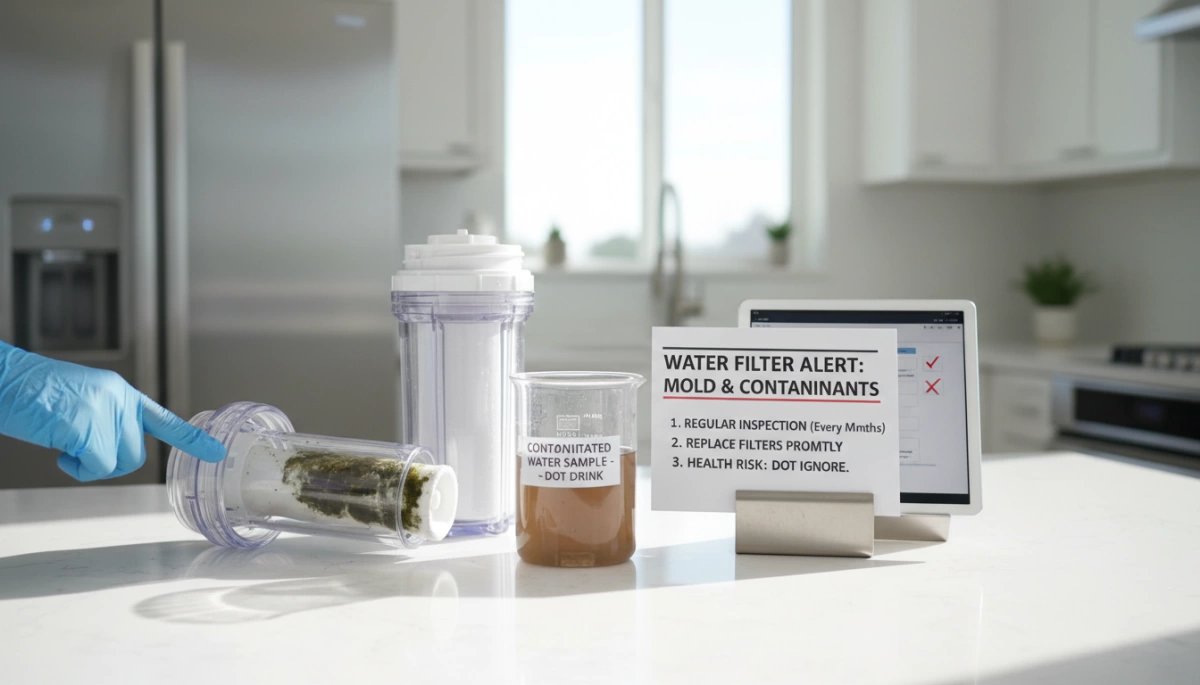
If there’s mold in a water filter, it usually gives you a few clear warnings. I always tell customers: if something looks or smells off, don’t ignore it.
1. Visible Spots on the Filter or Housing
Check your cartridges and housings regularly for:
- Black mold in water filter (dots, streaks, or fuzzy patches)
- Green, pink, or white spots on the plastic, rubber seals, or inside the housing
- Slimy or fuzzy growth in pitcher lids, refrigerator filter heads, or under-sink housings
Anything that looks like mildew on shower grout is a red flag for a moldy water filter.
2. Musty Smell or Odd Taste
Mold and biofilm often show up as:
- Musty, earthy smell in your drinking water
- Mold smell in drinking water from the tap that feeds your filter
- Strange or “stale” taste in water from a Brita-style pitcher, faucet-mounted filter, or refrigerator dispenser
If flushing the system for 30–60 seconds doesn’t clear the musty taste in filtered water, stop drinking it and inspect the system.
3. Slow Flow or Discolored Water
Mold, algae, and trapped gunk can clog the media and cause:
- Slow water flow from your faucet filter, fridge dispenser, or under-sink tap
- Cloudy or slightly tinted water (greenish, brownish, or gray)
- Little flakes or dark specks in the glass that don’t look like normal sediment
Any sudden change in flow or appearance is a reason to check for water filter mold or biofilm in water filter components.
4. When and Where to Inspect Your System
To catch mold in under sink water filter setups early, I recommend:
- Every 1–3 months:
- Open under-sink housings and visually inspect cartridges and O-rings
- Check inside pitcher lids, fridge filter compartments, and faucet filter casings
- After vacations or long periods of no use:
- Run water for a few minutes, then inspect for smells, color, and visible growth
- Key spots to look at:
- Under-sink cabinet (for leaks and humidity)
- Whole house filter housings
- Refrigerator filter head and drip tray
If you’re upgrading from a pitcher (which is more prone to mold) to a sealed, continuous-flow system, an under-sink reverse osmosis filtration system like our under-sink RO system can reduce stagnant water and help cut mold risk when you maintain it on schedule.
Health Risks and Performance Issues from Mold in Water Filters
Mold in a water filter isn’t just gross to look at—it can affect your health and ruin your filtration system’s performance.
Allergy and Respiratory Symptoms from Mold Exposure
If you’re drinking or even just smelling water from a moldy water filter, you can breathe in or ingest mold spores. That can trigger:
- Allergy-like symptoms: sneezing, runny nose, itchy eyes, sinus pressure
- Respiratory issues: coughing, wheezing, chest tightness, irritated throat
- Worsening of asthma or COPD: more frequent flare-ups and harder breathing
People often blame “seasonal allergies,” when the real problem is mold in a Brita filter, refrigerator water filter mold, or faucet water filter mold sitting in the kitchen every day.
Digestive Upset from Contaminated Drinking Water
Drinking water that’s passed through a moldy water filter can also bother your stomach:
- Nausea or mild vomiting
- Stomach cramps or discomfort
- Loose stools or diarrhea
Most healthy adults will bounce back, but it’s still a sign your moldy water filter is overdue for replacement or a serious cleaning.
How Mold Hurts Taste, Smell, and Filtration Performance
You’ll usually notice performance problems before you see full-on black mold in a water filter:
- Musty, earthy, or “old basement” smell in your drinking water
- Flat, stale, or odd taste that doesn’t go away even after you flush the filter
- Slower flow rate because mold and biofilm are clogging the media
- Reduced filtration performance as the clogged cartridge can’t effectively remove contaminants
If your filtered water tastes off, or smells musty, that’s a red flag that something in the filter housing or cartridge is wrong. In some cases, upgrading to a better-designed under-sink system (especially if you’re also concerned about things like PFAS) gives you cleaner water and less risk of mold and other contaminants building up, similar to how a high-performance PFAS removal water filter setup is designed for tighter contaminant control.
Who Is Most at Risk from Mold in Drinking Water?
Some groups need to take mold in under-sink water filters, whole house water filter mold, or refrigerator filter mold especially seriously:
- Kids and infants – developing immune systems, smaller bodies
- Seniors – often more sensitive to allergens and respiratory triggers
- People with asthma, allergies, or chronic lung issues
- Anyone immunocompromised (cancer patients, transplant patients, autoimmune conditions, etc.)
For these households, a strict filter replacement schedule, regular cleaning of the filter housing, and using sealed, mold-resistant under-sink filter systems isn’t optional—it’s part of keeping everyday drinking water safe.
How to Safely Remove Mold from a Water Filter
If you see mold in a water filter, treat it like a safety issue, not just a “gross” issue. Here’s how I’d handle it step-by-step.
1. Prep and Safety First
Before touching a moldy water filter:
- Shut off the water supply to the system (under-sink valve, fridge valve, or main line for whole-house filters).
- Unplug any connected appliance (like a refrigerator) if needed.
- Wear protection:
- Disposable gloves
- Mask (N95 or similar) if you’re sensitive to mold
- Safety glasses if you’ll be using bleach
- Carefully disassemble the filter housing so you don’t splash or spread mold spores.
If you’re unsure how your system comes apart, check the manual or use the diagrams in the manufacturer’s support section, similar to how we lay things out in our own technical support guides.
2. Natural Cleaning: Vinegar or Hydrogen Peroxide
For light mold in the housing (not the cartridge media):
- Remove and discard the old filter cartridge if it’s moldy. Don’t try to “save” it.
- Mix one of these solutions:
- White vinegar: 1 part vinegar to 1 part water
- Hydrogen peroxide (3%): use full strength
- Pour solution into the empty housing or soak removable parts.
- Let it sit 15–30 minutes.
- Scrub gently with a clean brush or sponge dedicated to this job.
- Rinse thoroughly with clean water until there’s no smell left.
Natural methods are great for pitcher-style filters, faucet filters, and basic under-sink filter housings when the mold isn’t severe.
3. Deep Sanitizing with Diluted Bleach
For heavy mold or long-neglected systems (whole-house, under-sink, inline):
- Use unscented household bleach.
- Mix 1 tablespoon bleach per gallon of water (about 1:256).
- Fill the empty housing with the solution or soak removable parts.
- Let it sit 10–15 minutes max—don’t overdo it, bleach is strong.
- Scrub any remaining spots, then rinse repeatedly with clean water until there’s zero bleach smell.
- Never mix bleach with vinegar or other cleaners.
Only sanitize the housing and hard parts, not the actual filter media.
4. Rinse, Dry, and Reassemble Correctly
Once everything is clean:
- Rinse all parts with potable water until they’re clear and odor-free.
- Let housings and parts air dry if possible, especially if the system will sit unused for a while.
- Install a new filter cartridge according to flow direction arrows and gaskets/O-rings.
- Lubricate O-rings lightly with food-grade silicone grease if recommended.
- Turn the water back on slowly and check for leaks.
- Flush the system for several minutes (or as the manufacturer recommends) before drinking the water.
5. Clean vs. Replace: What’s Non-Negotiable?
Use this rule of thumb:
- Always replace the filter cartridge if:
- You see visible mold on the filter media
- The filter smells musty, even after rinsing
- It’s past its recommended lifespan (time or gallons)
- Water taste is still off after cleaning the housing
- You may clean and keep the housing if:
- Mold is only on the plastic/metal housing or fittings
- You can fully sanitize all surfaces and rinse well
- Replace the entire unit (pitcher, faucet filter, badly damaged housing) if:
- Mold is deep in cracks you can’t reach
- Plastic is heavily stained or rough, making mold regrowth likely
- Leaks or warped parts prevent a safe seal
If you’re looking at upgrading to an under-sink system that’s easier to maintain and less prone to mold in the first place, a more permanent setup like our bathroom sink water filter system gives you sealed housings and cleaner flow paths than typical pitchers or faucet-mounted filters.
How to Prevent Mold in Under-Sink Water Filters
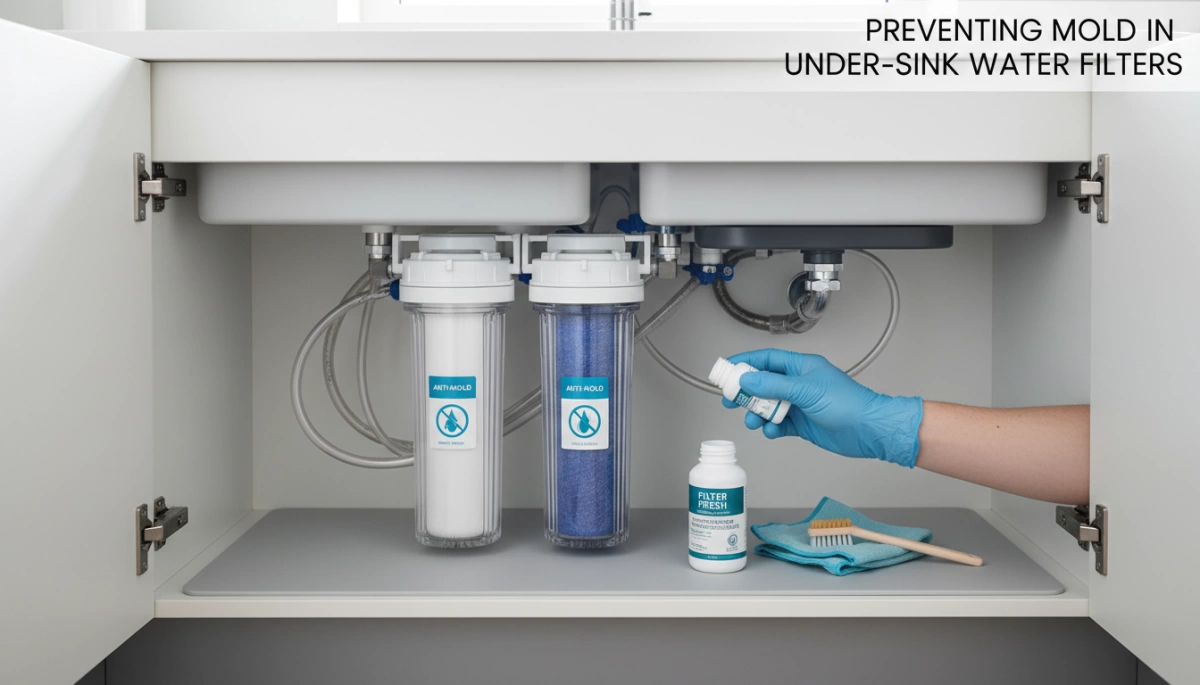
Keeping mold out of an under-sink water filter is all about consistency and smart system design. Here’s how I handle it and what I recommend:
Follow the Filter Replacement Schedule
- Change cartridges on time—never stretch them “a few more months.”
- Use the manufacturer’s rated gallon capacity or months (whichever comes first).
- If you see a musty taste or slow flow before the due date, replace early.
Clean Housings and Flush Regularly
- Every time you change a cartridge, clean the filter housing with mild dish soap, then sanitize with diluted vinegar or a small amount of unscented bleach.
- Rinse thoroughly until there’s no smell of cleaner left.
- After installing a new filter, flush the system for a few minutes to push out trapped air, carbon dust, and any residual cleaner.
Keep Water Moving (No Stagnant Water)
- Use your filtered tap daily so water doesn’t sit in the cartridge for days.
- If you’re gone for a week or more:
- Run the filter for a few minutes when you get back.
- If it’s been several weeks, consider replacing the cartridge.
Install in a Dry, Ventilated Under-Sink Area
- Make sure the cabinet is dry, not humid, and not crammed full of stuff blocking airflow.
- Fix any slow leaks from drains, garbage disposals, or supply lines right away.
- Use a small vent, louvered door, or even a moisture absorber if your under-sink cabinet tends to stay damp.
Use Antimicrobial, Sealed, Mold-Resistant Designs
- Look for sealed under-sink filter systems where the media isn’t exposed to open air.
- Choose cartridges and housings designed to limit biofilm and mold growth, not just remove basic chlorine.
- Many of the better under-sink water filtration systems focus on tight, closed designs and smoother internal surfaces that are harder for mold to stick to. You can see examples of this in modern systems on reviews like the top under-sink water filtration systems of 2026.
Extra Prevention: Control Humidity and Check for Leaks
- Add these habits to your regular kitchen routine:
- Check under the sink monthly for damp wood, puddles, or musty smells.
- Use a small humidity absorber or desiccant if your cabinet is naturally humid.
- Keep cleaning supplies in bins so you can quickly see any water pooling.
- If you ever find ongoing moisture, fix the plumbing issue first—otherwise mold in the water filter will keep coming back no matter how often you clean it.
If you dial in these steps—on-time filter changes, clean housings, moving water, and a dry cabinet—you’ll dramatically cut the risk of mold in your under-sink water filter and keep your drinking water safe and fresh.
Mold vs Other Build-Up in Water Filters
Not all “gunk” in a water filter is the same. Mold, biofilm, and algae each behave differently, and I deal with them differently in my systems.
Mold vs Bacterial Biofilm in Water Filters
Mold in water filters:
- Look:
- Black, dark green, gray, or sometimes white fuzzy/spotty patches
- Grows in clusters on plastic, rubber, and filter media
- Smell:
- Strong musty, earthy, “basement” odor
- Feel:
- Dry or slightly slimy on top, often patchy or fuzzy
- Cause:
- Moisture + trapped organic matter + poor airflow
Bacterial biofilm in water filters:
- Look:
- Clear, milky, or yellowish slimy coating
- Can look like a thin layer of jelly or slime on surfaces
- Smell:
- Mild musty or “swampy” smell, sometimes metallic
- Feel:
- Very slick, slimy, slippery layer
- Cause:
- Bacteria sticking together in a protective layer on wet surfaces
Mold vs Algae in Water Filter Systems
Algae in water filters:
- Look:
- Green, blue-green, or brown film or strings
- Most common where light hits water (clear housings, clear tubing)
- Smell:
- “Pond water” or grassy smell
- Feel:
- Slippery, can be stringy or filmy
Quick Comparison Table
| Type of Build-Up | Typical Color | Smell | Feel | Common Cause |
|---|---|---|---|---|
| Mold in water filter | Black, green, gray, white spots | Strong musty/earthy | Fuzzy/patchy | Moisture + organic debris + darkness |
| Bacterial biofilm | Clear, milky, yellowish slime | Mild musty/swampy | Very slimy | Standing water + bacteria |
| Algae in water filter | Green, blue-green, brown | Pond/grassy | Slippery | Light + nutrients in water |
How to Tell by Look, Smell, and Feel
- If it’s spotty/fuzzy + heavy musty smell → usually mold.
- If it’s smooth, slick, slime coating with light odor → likely biofilm.
- If it’s green/brown + looks like pond scum → usually algae.
When I’m unsure, I assume the worst (mold or biofilm) and sanitize the housing thoroughly.
Different Cleaning Methods for Mold, Biofilm, and Algae
Never try to “salvage” a moldy or badly contaminated filter cartridge. Replace the cartridge and clean the housing.
For mold in a water filter housing:
- Remove and discard the filter cartridge.
- Scrub housing with dish soap and hot water.
- Sanitize:
- Use white vinegar or 3% hydrogen peroxide for light mold.
- Use a diluted bleach solution (about 1 tablespoon 5–6% bleach per gallon of water) for heavy mold.
- Let it sit 15–30 minutes, then rinse until there’s no smell.
For bacterial biofilm:
- Disassemble and scrub all parts with a brush.
- Use bleach sanitizing solution or peroxide to break down the slime layer.
- Flush the system thoroughly before drinking the water.
For algae in water filters:
- Clean with bleach solution after removing the filter.
- Block light where possible (no clear housings in bright areas).
- Rinse and reassemble with a new cartridge.
If you’re considering upgrading to systems that reduce mold and biofilm issues, under-sink or countertop systems with better flow control and sealed cartridges, like high-performance options similar to those reviewed in this guide to the best countertop water filter systems, usually give you a cleaner, lower-maintenance setup than basic pitchers.
Mold-Resistant Under-Sink Water Filter Systems
Why Under-Sink Systems Resist Mold Better Than Pitchers
Under-sink water filters are naturally more mold-resistant than pitchers and faucet jugs because:
- Closed, pressurized system: Less air exposure means less chance for spores to land and grow inside.
- More consistent water flow: You’re usually using the kitchen tap all day, so there’s less stagnant water sitting in the filter.
- Cool, dark plumbing environment: Unlike a warm countertop or fridge door, under-sink plumbing stays more stable and less favorable for mold in a water filter.
If you’ve dealt with mold in a Brita filter or other pitchers before, moving to a quality under-sink system is one of the easiest upgrades you can make.
Key Mold-Resistant Features to Look For
When you’re trying to prevent mold in an under-sink water filter, look for systems that are designed with mold-resistance in mind:
- Sealed, non-vented filter cartridges – Reduces air contact and mold spores entering the system.
- Quick-change, disposable cartridges – You replace the whole sealed filter, so there’s less gunk sitting in there long term.
- Smooth, easy-to-clean housings – Fewer grooves and corners where mold and biofilm can grab on.
- Continuous or frequent-use design – Systems sized for daily use keep water moving, cutting down on stagnant water mold growth.
- Food-grade, antimicrobial materials (where allowed) – Some components are engineered to resist mold, biofilm, and algae in water filters.
If you’re planning a new install, check guides like this walkthrough on how to install an under-sink water filter so the setup doesn’t accidentally create moisture pockets or leaks that feed mold.
Long-Term Benefits for Your Home
Going with a mold-resistant under-sink system pays off over time:
- Cleaner, safer water: Less risk of moldy water filter issues, musty taste, or mold smell in drinking water.
- Better performance: Filters aren’t choked by mold or biofilm, so flow rate and filtration stay consistent.
- Health peace of mind: You cut down on allergy triggers, respiratory issues, and digestive problems from bad water.
- Lower maintenance stress: With sealed, easy-swap cartridges and smart design, you spend less time scrubbing housings and worrying about black mold in a water filter.
For most homes in the U.S., upgrading from a mold-prone pitcher to a solid, mold-resistant under-sink filter is one of the most practical moves you can make for daily, safe drinking water.