














The Tech Inside: Why It’s No Shortcut
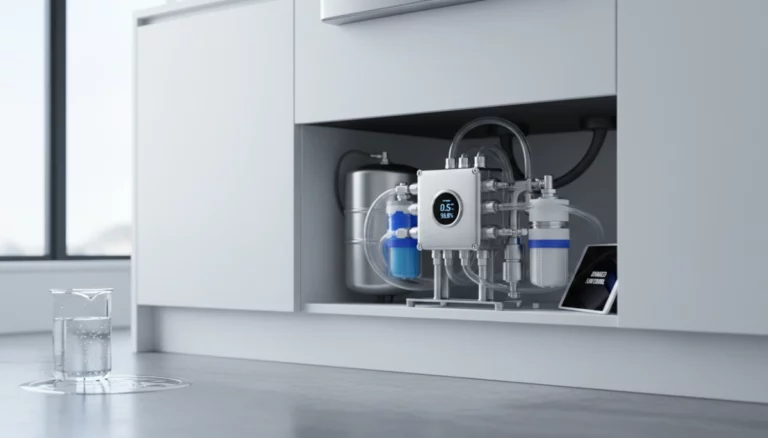
There is a common misconception that “countertop” implies a compromise in power. Let’s be clear: our systems are not glorified water pitchers. We have engineered a miniaturized water treatment plant that sits on your counter. The technology inside our countertop reverse osmosis system rivals—and often exceeds—the complexity of under-sink units, specifically designed to deliver purity without the plumbing headache.
The Membrane is the Master: 0.0001-Micron Filtration Accuracy
The heart of our system is the reverse osmosis membrane. While standard carbon pitchers filter down to about 1–5 microns, our RO technology operates at 0.0001-micron filtration accuracy.
To put that in perspective:
- Human Hair: ~75 microns
- Bacteria: ~0.5 microns
- Viruses: ~0.02 microns
- Driplife RO Pore Size: 0.0001 microns
This isn’t just filtration; it is separation on a molecular level. The membrane acts as an absolute barrier, allowing only pure water molecules to pass while rejecting virtually all dissolved solids.
The Pump Factor: Built-in Boosters vs. Line Pressure
Traditional under-sink systems rely on your home’s existing water pressure to force water through the membrane. If your pressure is low, performance suffers.
We took a different approach. Our countertop units utilize a high-efficiency internal booster pump. This ensures:
- Consistent Pressure: The membrane always operates at optimal efficiency, regardless of your building’s plumbing issues.
- Faster Filtration: We don’t wait for gravity. The pump drives water through the multi-stage filtration process rapidly.
- Higher Recovery: Controlled pressure allows us to achieve superior drain ratios (often 3:1), wasting significantly less water than passive systems.
Multi-Stage Defense: A Composite Shield
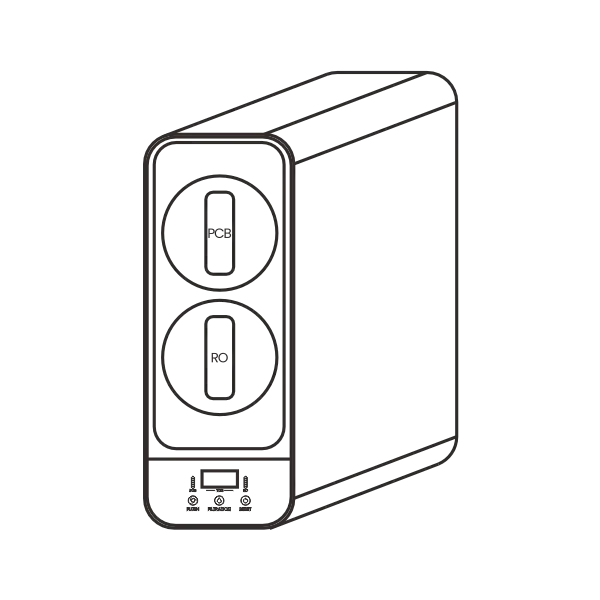
We don’t rely on a single barrier. Our Morpher series utilizes a composite filter design that integrates multiple stages into a single, easy-to-change cartridge. This “twist-and-pull” design simplifies maintenance without sacrificing layers of defense.
The Breakdown of Our Defense System:
- PP Cotton Layer: Traps large particles like rust, sand, and suspended solids.
- Activated Carbon Block: Absorbs chlorine, odors, and organic compounds that affect taste.
- RO Membrane (0.0001 Micron): The heavy lifter that removes dissolved solids and heavy metals.
- Post-Carbon Filter: Polishes the water for a crisp, clean finish before it hits your glass.
Blocking the Bad Stuff: Heavy Metal Reduction & PFAS
The primary reason our customers switch to RO is to tackle contaminants that standard filters leave behind. Because of the membrane’s density, our systems provide robust heavy metal reduction and chemical isolation.
We effectively target and remove:
- Forever Chemicals: PFAS and PFOA removal is critical in modern water safety.
- Heavy Metals: Lead, Arsenic, and Mercury are physically too large to pass through the membrane.
- Inorganic Compounds: Fluoride and Nitrates are filtered out, leaving you with nothing but pure H2O.
By integrating real-time TDS monitoring directly into the unit, we don’t just claim the water is clean—we show you the numbers on the screen, proving the tech works with every pour.
The Real Trade-Offs: Gains vs. Losses
When I talk to customers about zero-installation water purification, I always start with the reality of the situation. Choosing a countertop unit isn’t about getting a “lesser” filter; it’s about prioritizing flexibility over automation. You are trading the convenience of an endless tap flow for the freedom of a system that requires no tools to set up. Here is how the trade-offs actually play out in daily life.
Manual Refilling: The Ritual of Control
The biggest shift for new users is the manual refill vs. plumbed connection dynamic. With an under-sink system, water just appears. With a countertop RO, you are the supply line. You have to fill the feed tank and empty the wastewater tank.
- The Loss: You can’t just turn a handle and fill a 5-gallon pot instantly without refilling the tank.
- The Gain: You have zero risk of a hidden leak destroying your kitchen cabinets. You have total control over the source water. While some might see the tank management as a chore, many users find that the top benefits of a countertop RO system, such as portability and leak prevention, far outweigh the extra step of filling a pitcher.
Counter Space Real Estate
We have to talk about the countertop footprint and aesthetics. Unlike a hidden under-sink system, this appliance lives in your workspace. It competes with your coffee maker and toaster. However, modern manufacturing has shifted away from bulky, industrial designs. We now build these units to look like high-end kitchen appliances. It is a visible commitment to health, but you need to measure your counter depth before buying.
Capacity Reality Check
Be realistic about your volume needs. The removable water tank capacity on most units typically holds around 1 to 1.5 gallons of feed water.
- Ideal For: Individuals, couples, and families of 3–4 people.
- Not Ideal For: Large families who need 20+ gallons of purified water a day for cooking and drinking.
If you are running a busy commercial kitchen, this isn’t for you. If you are renting an apartment or own a standard home, the capacity is usually spot on.
Visible Water Quality
One of the hidden advantages of a countertop system is the visibility of the process. With a plumbed system, the dirty wastewater disappears down the drain unnoticed. With a countertop unit, you physically see the concentrated contaminants left behind in the feed tank. You can often monitor the TDS reduction rate right on the screen, giving you immediate proof that the membrane is doing its job. You aren’t just hoping the water is clean; you are verifying it every time you fill your glass.
Hidden Perks of Going Countertop
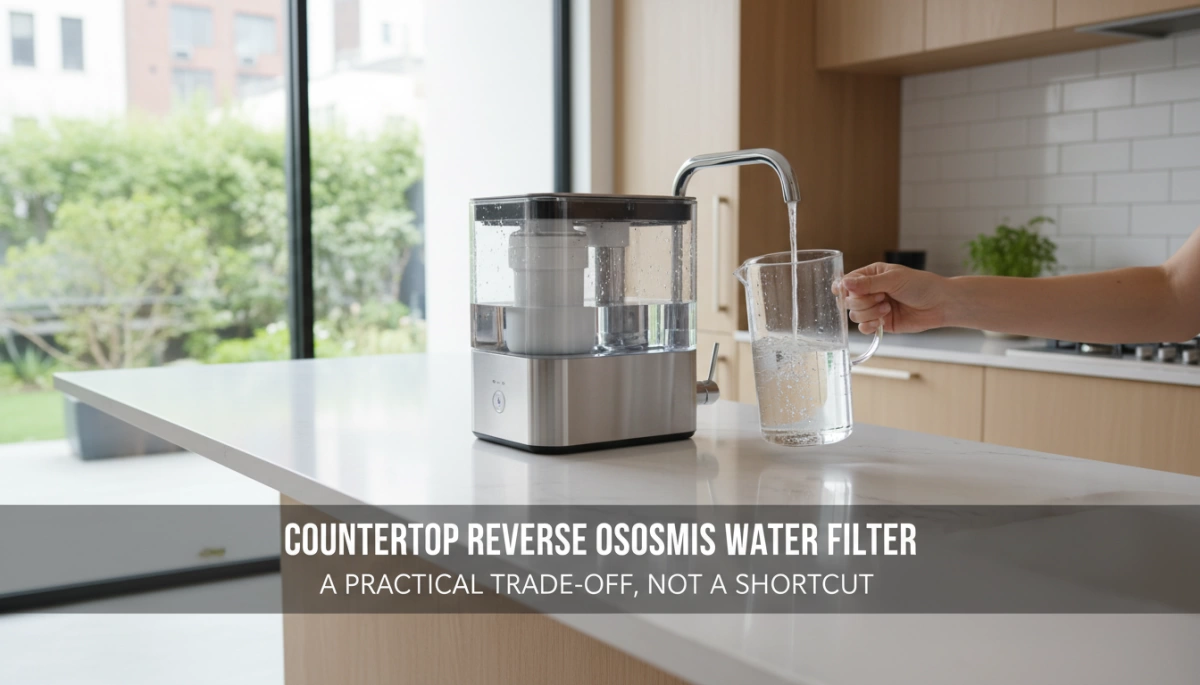
When we discuss a Countertop Reverse Osmosis Water Filter — A Practical Trade-Off, Not a Shortcut, we aren’t just talking about avoiding a plumber. We are talking about gaining control over your water quality in ways that fixed systems can’t match. I often emphasize that the portability here is a massive feature, not a compromise.
Zero Installation Freedom
For renters, apartment dwellers, or RV owners, drilling a hole in a granite countertop simply isn’t an option. Our countertop water filter systems offer true zero-installation water purification. You plug the unit into a standard power outlet, fill the feed tank, and you are done. It is plug-and-play engineering that moves with you, providing a portable RO system for renters that doesn’t sacrifice performance.
Efficiency and Intelligence
Traditional under-sink RO systems can be notoriously wasteful, sometimes dumping 3 gallons of water for every 1 gallon purified. We engineered our countertop models to be far more efficient and user-friendly.
- Wastewater Efficiency: We achieve a superior wastewater to pure water ratio, often hitting 3:1 or even 4:1. This minimizes waste while maximizing the efficiency of the filtration process.
- Smart Features: Many of our units function as an instant hot water RO dispenser. You get precise temperature control for coffee, tea, or baby formula without waiting for a kettle.
- Visible Metrics: You never have to guess if the filter is working. The integrated screen provides real-time TDS monitoring, showing you exactly how much the TDS reduction rate has improved from the raw water tank to your glass.
Feature Breakdown:
| Feature | Benefit |
|---|---|
| Plug-and-Play | No plumbing or drilling required; ideal for any living situation. |
| Smart Monitoring | LED displays show filter life and input/output water quality. |
| High Efficiency | Optimized drain ratio saves water compared to traditional RO tech. |
| Temp Control | Instant heating options (Room Temp, Coffee, Boiling) available on specific models. |
Comparison: Countertop vs. Under-Sink vs. Pitchers
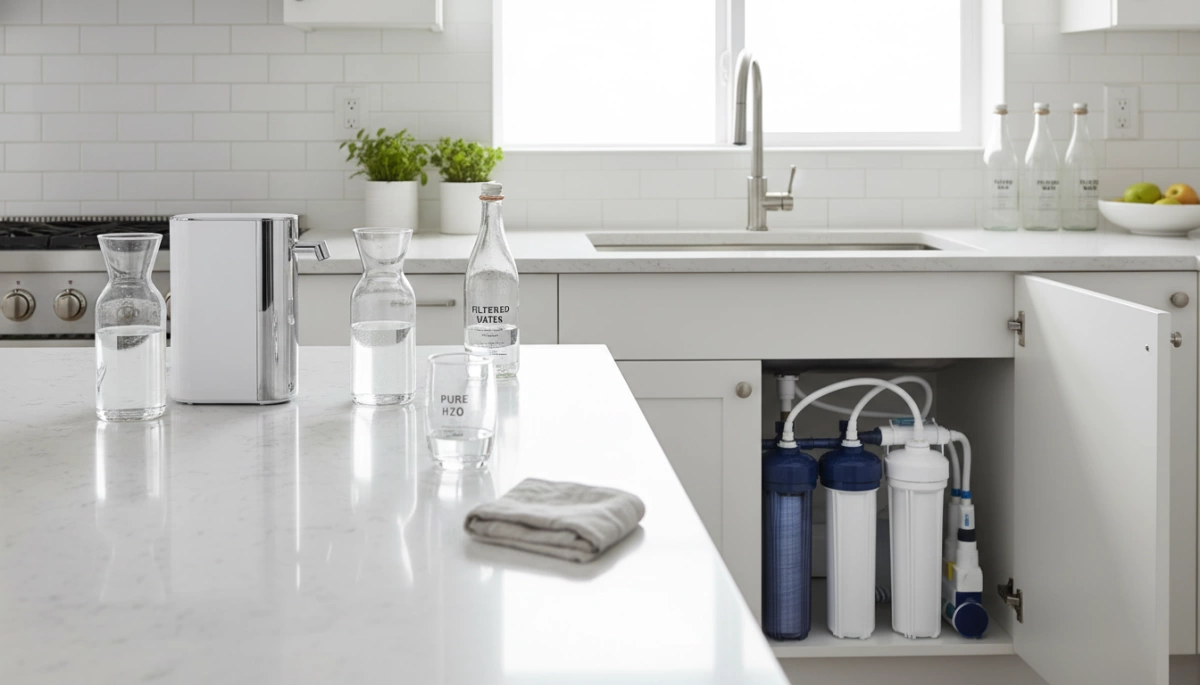
When evaluating water filtration options, most consumers get stuck choosing between the simplicity of a pitcher and the performance of a permanent system. We positioned our countertop reverse osmosis system to bridge this gap, offering industrial-grade purity without the permanence of installed plumbing. Here is how the different methods stack up against each other.
Installation Difficulty: Plug-and-Play vs. Drilling Holes
The biggest barrier to entry for high-quality water is usually installation. Under-sink systems often require drilling a hole in your granite countertop for a dedicated faucet and splicing into your cold water line—a nightmare for renters. Basic pitchers are easy but ineffective against dissolved solids. Our approach focuses on zero-installation water purification. You simply place the unit on the counter and plug it into a standard power outlet. There is no plumbing required, making it a true “plug-and-play” appliance.
Filtration Accuracy: RO Precision vs. Basic Carbon
Standard pitchers rely almost exclusively on activated carbon. While this improves taste and smell, it does little to reduce Total Dissolved Solids (TDS) or heavy metals. Conversely, our systems utilize 0.0001-micron filtration accuracy, which is the same technology used in major bottling plants. This level of precision is critical for protecting infants from lead and nitrates in tap water, ensuring that dangerous contaminants like Arsenic and PFAS are physically removed rather than just masked.
Maintenance Effort: Easy Tank Cleaning vs. Under-Cabinet Crawling
Maintenance is where the manual refill vs. plumbed connection debate gets interesting. While under-sink systems fill automatically, changing their filters often involves crawling under the sink, shutting off valves, and dealing with water pressure issues. With a countertop unit, maintenance is upright and accessible. The twist-and-pull filter design allows for changes in seconds, and the removable water tank can be easily cleaned at the sink to prevent biofilm buildup—something impossible to do with hidden under-sink tubing.
Portability: Moving With the User
For the modern workforce and renters, a portable RO system for renters is a financial asset. If you install an under-sink system, you typically leave it behind when you move. A countertop RO unit is an appliance you own, just like a coffee maker. Whether you move to a new apartment, an RV, or a dorm, your source of clean water travels with you.
Quick Comparison: The Trade-Offs at a Glance
| Feature | Standard Water Pitcher | Under-Sink RO System | Driplife Countertop RO |
|---|---|---|---|
| Installation | None | High (Drilling/Plumbing) | Zero (Plug-and-Play) |
| Filtration Precision | ~1–20 Micron (Carbon only) | 0.0001 Micron (RO) | 0.0001 Micron (RO) |
| TDS Reduction | Minimal (<10%) | High (>90%) | High (>90-95%) |
| Portability | High | Low (Fixed Fixture) | High (Move with you) |
| Water Source | Manual Pour | Automatic Line | Removable Tank |
| Maintenance | Frequent Filter Changes | Difficult Access | Easy Twist-and-Pull |
The Driplife Edge: Manufacturing Quality
As a dedicated manufacturer, we understand that building a reliable Countertop Reverse Osmosis Water Filter requires more than just assembling components. We control every step of the production line to ensure that the “trade-off” you make for countertop convenience never involves compromising on safety or durability.
Rigorous Testing Standards
We don’t leave quality to chance. Every unit is subjected to strict industrial protocols before it ever reaches a customer’s kitchen.
- Pressure Integrity: Systems undergo high-pressure testing to prevent leaks and ensure the internal pumps can handle daily demand.
- Membrane Health: We design our units to protect the core filtration components. We understand why auto-flush functions are essential for membrane longevity and incorporate these features to maintain 0.0001-micron filtration accuracy over years of use.
- Certification Compliance: Our manufacturing processes align with NSF/ANSI standard compliance requirements to guarantee performance consistency.
Material Safety: BPA-Free Assurance
There is no point in filtering water if the storage tank re-contaminates it. We use strictly food-grade, BPA-free plastics for all internal components and the removable water tank. This ensures that your purified water remains free from chemical leaching and plastic byproducts, maintaining the safety standards expected by health-conscious families.
Long-Term Supply Chain Security
Buying a filtration system is a long-term relationship. A common issue with generic resellers is that replacement filters disappear from the market.
- Direct Factory Access: Because we manufacture the systems, we guarantee the long-term availability of specific replacement filters and parts.
- Consistent Support: You won’t be left with an obsolete machine; our supply chain ensures you can always maintain your system.
- Easy Maintenance: We design our proprietary twist-and-pull filters for quick changes, ensuring the system remains user-friendly for its entire lifespan.
Frequently Asked Questions
Do countertop RO systems really remove fluoride and PFAS?
Absolutely. This is one of the main reasons people switch from standard pitchers to a Countertop Reverse Osmosis Water Filter. Standard carbon filters often let dissolved solids pass right through, but our systems utilize a 0.0001-micron filtration accuracy. This level of precision is effective at blocking microscopic contaminants, including PFAS and PFOA removal, Fluoride, Arsenic, and Lead. The RO membrane acts as a physical barrier that these dissolved chemicals simply cannot cross, ensuring the water in your glass is chemically pure, not just clear.
How often do the filters need to be changed?
Maintenance is straightforward, but timelines vary based on your local water quality and daily usage. Generally, the composite filters in our Morpher series are designed for longevity. The pre-filters and carbon stages typically last between 6 to 12 months, while the RO membrane can often go longer. We designed the system with smart monitoring that tracks actual usage, so the LED display tells you exactly when it’s time for a swap. When looking at a filter replacement cost analysis, the long lifespan of these cartridges makes the cost per gallon significantly lower than buying bottled water. Plus, the “twist-and-pull” design means you can change them in seconds without tools.
Is the wastewater from the tank reusable for plants?
Yes, and we encourage it. In a countertop reverse osmosis system, the remaining water in the feed tank has a higher concentration of Total Dissolved Solids (TDS) because the pure water has been extracted. This “concentrate” water isn’t toxic; it just contains the minerals and salts that were filtered out. Instead of dumping it down the drain, it is perfectly safe for watering non-edible plants, mopping floors, or pre-rinsing dishes. It’s a practical way to maximize efficiency and reduce waste in your home.
Can I use a countertop RO system with well water?
You can, but there are a few variables to consider. Well water often carries higher levels of sediment and varying degrees of hardness compared to municipal water. Our multi-stage systems include PP cotton and carbon blocks that handle sediment and organic matter effectively. However, if your well water is extremely hard, it can shorten the lifespan of the RO membrane over time. It is helpful to understand your water profile first; checking how to determine if your water is hard or soft can help you gauge how frequently you might need to replace filters. For most well water setups, this system is a powerful tool to ensure safety against bacteria and heavy metals.