















The Industrial Standard: Double Open End (DOE)
Configuration Overview: Understanding the Compression Seal Mechanism
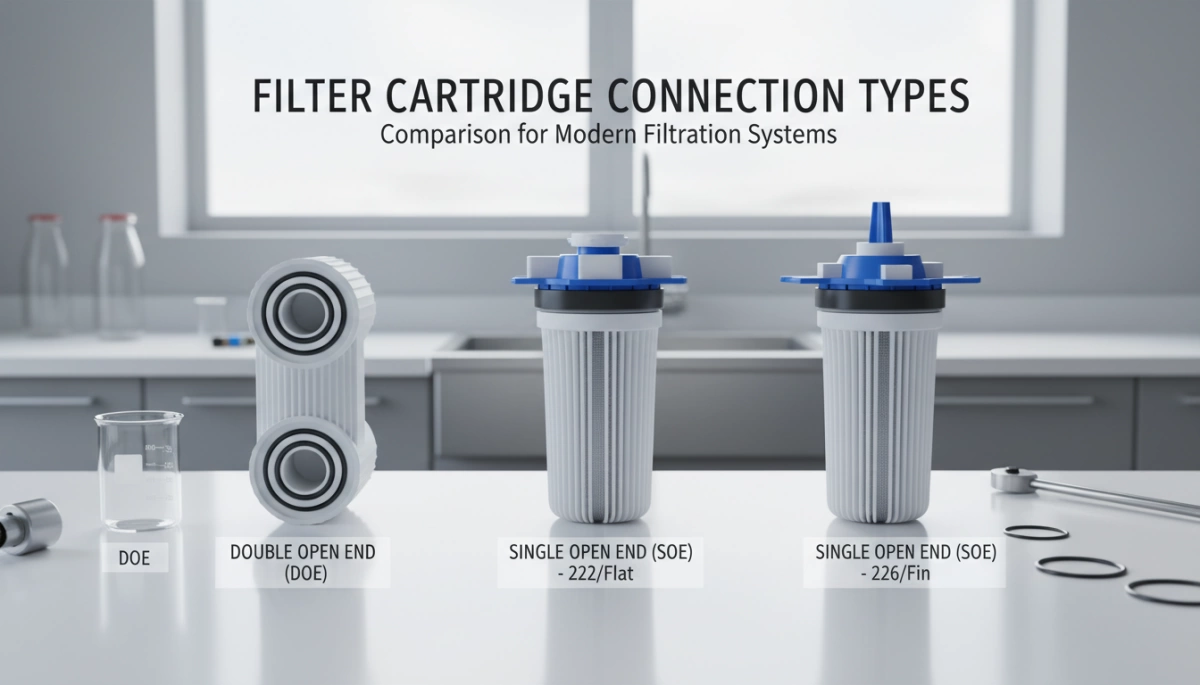
At DripLife, we view the Double Open End (DOE) configuration as the foundational “workhorse” of the filtration industry. This design relies on a straightforward axial seal mechanism. The cartridge is open at both ends, and the seal is created when the filter housing tightens down, compressing the gaskets located on the top and bottom of the cartridge. Whether using our Melt Blown or String Wound series, the integrity of this connection depends entirely on the vertical pressure applied by the housing’s knife-edge against the gasket material (typically EPDM, Viton, or Silicone).
The Pros: Universal Compatibility and Cost Benefits
For many of our clients, the primary appeal of DOE is its simplicity and universal water filter housing compatibility.
- Versatility: These cartridges fit the vast majority of standard industrial stainless steel and plastic housings without needing specialized adapters.
- Cost-Efficiency: The manufacturing process for DOE is less complex than Single Open End (SOE) types, making it a budget-friendly option for high-volume applications.
- Material Options: We can easily outfit these with various gasket materials to match specific chemical compatibility needs without altering the core cartridge design.
The Cons: Compression Risks and Hygiene Limitations
While effective for general use, the DOE design has inherent limitations regarding cartridge seal integrity. Because it relies on compression, any variance in cartridge length or improper housing tightening can lead to filter bypass, where untreated fluid slips past the seal.
- Bypass Risk: Thermal expansion or pressure surges can reduce the compression force, breaking the seal.
- Hygiene: The open design is less suitable for sterile applications compared to O-ring seals, as there are more potential crevices for bacterial growth.
Best For: Rough Pre-filtration in Non-Critical Zones
We recommend deploying DOE cartridges primarily for rough pre-filtration tasks. They excel in applications like general industrial water treatment, chemical processing, and food & beverage pre-treatment where the goal is removing bulk sediment, rust, and particulates. For these non-critical zones, the DOE offers the perfect balance of performance and economy before the water moves to more sensitive downstream stages.
High-Purity Solutions: Single Open End (SOE) & The ‘Code’ System
The Shift to O-Rings: Moving from Compression to Radial Seals
When absolute purity is the goal, the standard compression seal just doesn’t cut it. We move away from the “squish and pray” method of Double Open End filters to Single Open End (SOE) configurations. The major upgrade here is the transition from an axial seal to a radial seal.
Instead of relying on vertical force to create a seal, SOE cartridges use O-rings that slide snugly into the housing receiver. This design eliminates the risk of the cartridge bowing under pressure and provides superior filter bypass prevention. It ensures that 100% of the fluid passes through the media, which is critical when you are dealing with sub-micron ratings.
Evaluating Common Codes: Code 222 vs. Code 226
In the industrial and commercial sectors, filter end cap styles are categorized by “Codes.” While there are many variations, two dominate the US market for high-purity applications:
- Code 222 (Flat Cap): This design features two O-rings on the open end and a solid flat cap on the closed end. It relies on the housing’s top cap to hold it down. It is effective, but if the housing isn’t tightened perfectly, the cartridge can shift.
- Code 226 (Locking Tabs): Often called the Code 7 filter configuration, this is the gold standard. It features dual O-rings plus a set of locking tabs (fins) that engage with the housing base.
The ‘Locking’ Advantage: Preventing Unseating
The 226 O-ring with locking tabs offers a distinct mechanical advantage. By using a bayonet-style twist lock, the cartridge is physically secured into the housing sump. This prevents the filter from “floating” or unseating during pressure surges or back-flow conditions.
For critical applications, such as sterile filtration or protecting a high-end under counter water filter, this locking mechanism is essential. It guarantees cartridge seal integrity regardless of hydraulic shock. While you still need to decide between EPDM vs Viton O-rings based on chemical compatibility, choosing a locking Code 7 style ensures the physical connection never fails.
The Modern Commercial Standard: Twist-and-Lock & Sanitary Quick-Change (SQC)
In the modern water treatment game, especially for point-of-use systems, we have largely moved away from messy sumps in favor of integrated solutions. The Sanitary Quick Change (SQC) filter design—often referred to as Twist-and-Lock or a Bayonet mount filter—combines the filter media and the housing into a single disposable unit.
The Mechanism: Integrated Housing and Heads
The mechanics here are simple but brilliant. The permanent “head” stays plumbed into the water line, while the cartridge acts as the housing. You simply line up the locking tabs, push up, and twist a quarter turn. It is essentially the same motion as changing a lightbulb. This design relies on internal O-rings that engage automatically, ensuring cartridge seal integrity without the need for housing wrenches or physical strength.
Evaluation Factors: Sanitation and Speed
When I evaluate these connections for OEM water treatment components, three specific factors usually drive the decision:
- Sanitation: You never touch the wet filter element or the interior of a sump. This eliminates the risk of introducing bacteria during a change-out, which is critical for high-touch appliances like a hot water dispenser with filter where hygiene is paramount.
- Maintenance Speed: Swapping a cartridge takes seconds. This is a massive advantage for service technicians managing large routes or for office managers who aren’t plumbing experts.
- Leak Prevention: Because the O-rings are part of the disposable cartridge, they are replaced every single time. You aren’t relying on an old, compressed O-ring in a permanent housing to hold back pressure.
The Business Case: Proprietary Revenue Security
From a business perspective, the SQC format is the smartest play for manufacturers. Unlike standard DOE filters that can be swapped with generic parts from a hardware store, Twist-and-Lock heads often feature unique keying.
This proprietary design secures your aftermarket revenue. Once a customer installs your system—perhaps utilizing smart countertop RO water filter technology—they must return to you for replacements. It builds a stable, recurring revenue stream while ensuring the end-user always gets the correct specification filter for their equipment.
Inline Connections: Threaded vs. Push-Fit (Quick-Connect)
When integrating filtration into piping systems without a dedicated housing sump, we typically look at inline connection styles. Choosing between threaded and push-fit options often comes down to the balance between structural integrity and maintenance speed for OEM water treatment components.
Threaded (NPT/BSP): Analyzing Pressure Tolerance
For permanent installations where vibration or high pressure is a concern, threaded connections are the standard. We typically utilize NPT (National Pipe Taper) for the US market and BSP for international clients. The tapered threads create a mechanical seal that tightens under torque, offering exceptional resistance to pressure surges. This robustness makes threaded connections ideal for industrial environments where a filter accidental disconnecting could be catastrophic.
Push-Fit (Quick-Connect): Benefits for Confined Spaces
In tighter setups, such as under-sink applications or compact machinery, push-fit filter fittings are superior. These allow for instant installation without tools—you simply push the tubing into the collet, and the internal O-ring creates a radial seal. This speed is crucial for residential systems, such as the filtration stages used in efficient countertop reverse osmosis systems, where user-friendly maintenance is a priority. However, users must ensure the tubing is cut square to prevent leaks.
Comparison: Installation Speed vs. Side-Loading Sensitivity
Below is a breakdown of how these connection types perform in the field:
| Feature | Threaded (NPT/BSP) | Push-Fit (Quick-Connect) |
|---|---|---|
| Installation Speed | Slow (Requires tape/sealant & tools) | Fast (Instant manual connection) |
| Pressure Tolerance | High (Handles spikes well) | Moderate (Limited by grip ring) |
| Side-Loading | High Resistance (Rigid connection) | High Sensitivity (Side pressure causes leaks) |
| Best Application | Static Industrial Lines | Residential & Light Commercial |
Key Takeaway: Use threaded connections for structural rigidity and safety in high-pressure zones. Switch to push-fit when rapid change-outs and space constraints are the primary drivers.
Decision Matrix: Choosing the Right Connection for OEM Projects
When sourcing OEM water treatment components, selecting the connection type isn’t just about geometry; it’s about matching the hardware to the application’s stress levels and the user’s capability. We use a specific matrix to ensure the final product performs reliably in the field.
Factor 1: Viscosity & Pressure Demands
Pressure spikes are the enemy of cartridge seal integrity. If you are dealing with high-viscosity fluids or systems with significant pressure differentials, a standard compression seal (DOE) is risky because the cartridge can compress and unseat.
- Low Pressure: DOE is sufficient and cost-effective.
- High Pressure/Viscosity: You need a positive locking mechanism. I recommend the Code 7 filter configuration (226 style) for these scenarios. The locking tabs physically secure the cartridge into the housing, offering superior filter bypass prevention even when pressure fluctuates.
Factor 2: End-User Skill Level (Technician vs. Office Manager)
The best filter in the world is useless if the user installs it incorrectly. We have to be realistic about who is performing the maintenance.
- Trained Technicians: Can handle standard housings, alignment of O-rings, and proper torque settings.
- General Consumers: If the end-user is a homeowner or office manager, Ease of Change is the priority. They should not be handling wet housings or loose gaskets. This is why Sanitary Quick Change (SQC) and Twist-and-Lock systems are dominating the residential market. For instance, the rise of tankless RO filters is largely due to proprietary connections that allow users to swap filters in seconds without tools or mess.
Factor 3: Chemical Compatibility and O-ring Material Selection
When evaluating filter cartridge connection types, the physical shape is only half the battle; the seal material dictates longevity. A mechanical lock won’t stop a leak if the O-ring dissolves.
- Standard Water: EPDM is the industry standard for cold and hot water applications.
- Aggressive Fluids: You must decide between EPDM vs Viton O-rings. Viton offers better resistance to oils and chemicals but comes at a higher cost.
- Critical Purity: For semiconductor or pharma applications, Teflon-encapsulated O-rings are often required to prevent leaching.
FAQ: Common Questions About Filter Cartridge Connections
What is the main difference between DOE and SOE connections?
The core difference lies in the sealing mechanism and filter bypass prevention. A Double Open End (DOE) cartridge is open on both sides and relies on a “knife-edge” or compression seal (axial seal) created by the housing’s top and bottom. While cost-effective, it is prone to bypass if the housing isn’t tightened perfectly. In contrast, a Single Open End (SOE) cartridge is closed at one end and uses O-rings (radial seal) at the other. This design minimizes the risk of fluid slipping past the filter, making Double Open End (DOE) vs Single Open End (SOE) a choice between economy and security.
Why is the Code 7 (226) style recommended for high-purity water?
The Code 7 filter configuration (technically the Code 226 style) represents the gold standard for cartridge seal integrity. Unlike flat caps that just sit in place, the 226 O-ring with locking tabs features a bayonet-style locking mechanism. You push the filter in and twist it to lock it securely into the housing. This prevents the cartridge from unseating during pressure surges or back-flow, which is critical for protecting sensitive downstream equipment or ensuring sterility.
How do Sanitary Quick-Change (SQC) filters reduce maintenance time?
Sanitary Quick Change (SQC) filter systems eliminate the messy, time-consuming steps of traditional maintenance. With standard housings, a technician must unscrew a wet sump, manually remove a slimy cartridge, clean the housing to prevent bacterial growth, and carefully reseat the O-ring. With SQC, the filter media and housing are a single disposable unit. You simply twist the old one off and click the new one on—reducing a 15-minute job to 30 seconds.
Can I retrofit a standard housing to accept Twist-and-Lock filters?
Directly, no. Water filter housing compatibility is specific to the connection type. Standard housings are designed for drop-in cartridges, whereas twist-and-lock filters require a specific matching head or manifold. To switch, you would need to remove the existing housing head and plumb in a new manifold designed for the proprietary cartridge. This is a common upgrade for users moving toward modern, compact setups like countertop reverse osmosis systems where ease of maintenance is a priority.