

















If you’re worried about microplastics in drinking water, you’re not alone. Studies now suggest that more than 80% of tap water and a large share of bottled water contain tiny plastic particles you can’t see—but can definitely ingest.
The good news? You can dramatically reduce microplastics from tap water at home. You just need to know which water filters actually work and which ones don’t.
In this guide, you’ll learn exactly how to filter microplastics from water using proven methods like reverse osmosis, ultrafiltration, and nanofiltration—plus what pore size and certifications to look for before you buy a system. I’ll also show you how advanced RO membrane filtration solutions from brands like driplife fit into a long-term strategy for cleaner, safer water.
If you want clear, step-by-step advice on the best water filter for microplastics—without the hype—keep reading.
What Are Microplastics in Water?
When people ask me how to filter microplastics from water, we always start here: what exactly are we trying to remove?
Microplastics are tiny plastic particles, usually defined as less than 5 millimeters in size. Most of what we worry about in microplastics in drinking water is much smaller—often in the 1–1000 micrometer (µm) range, and some can even approach the sub‑micron level.
Types of Microplastics in Drinking Water
In tap, well, and bottled water, we typically see four main types:
- Fragments – broken pieces from larger plastic items (bottles, packaging, containers).
- Fibers – thin strands from synthetic textiles (polyester, nylon) released during laundry and industrial washing.
- Beads – tiny spheres once common in cosmetics and personal care products, and still present in some industrial uses.
- Films – thin, flexible pieces from plastic bags, wraps, and packaging films.
All of these can end up in tap water contamination and bottled water microplastics.
How Plastics Turn Into Microplastics
Most microplastics start as regular plastic items and break down over time:
- Sunlight (UV), heat, and oxygen weaken plastic.
- Mechanical wear (waves, friction in pipes, washing machines) breaks it into smaller particles.
- Over years, these pieces fragment into microplastics and can keep breaking down into even smaller particles.
The plastic rarely disappears; it just becomes harder to see and harder to avoid.
Main Sources Entering Water Systems
Microplastics enter our water supply from everyday activities and industry:
- Packaging and single‑use plastics – bottles, wrappers, bags, food containers.
- Textiles and laundry – synthetic clothing shedding microfibers into wastewater.
- Cosmetics and personal care – legacy microbeads from older exfoliating products, plus residues from current products.
- Industrial processes – plastic pellets, production waste, and dust from manufacturing.
- Tire and road wear – particles washed off streets into rivers and reservoirs.
Once in the environment, these particles move through rivers, lakes, oceans, and groundwater, and eventually into our drinking water systems.
How Microplastics Get Into Tap, Ground, and Bottled Water
Even in the United States, with treated municipal water, microplastics can slip through:
- Tap water – surface water and groundwater feeding treatment plants already contain microplastics; treatment often focuses on microbes and chemicals, not tiny particles.
- Groundwater – particles can migrate through soil from landfills, septic systems, and agricultural runoff.
- Bottled water – studies show particles come from both source water and the plastic bottles and caps themselves, especially when exposed to heat or stored for long periods.
In other words, switching from tap to bottled water does not guarantee less microplastic exposure.
How Common Are Microplastics in Drinking Water?
Real‑world testing shows microplastic contamination is now widespread:
- Global studies by organizations like Orb Media and WHO found microplastics in a majority of tap and bottled water samples tested worldwide.
- Many samples contained dozens to hundreds of particles per liter, with sizes often in the 1–100 µm range—small enough to require sub‑micron water filtration to remove effectively.
- Follow‑up reviews highlight that US drinking water is not exempt; both municipal and bottled sources can contain measurable microplastic levels.
This is exactly why I focus on home water filtration for microplastics and why choosing the best water filter for microplastics is no longer just a “nice to have”—it’s a practical step to reduce everyday exposure.
Microplastics Health Risks and Why Filtration Matters
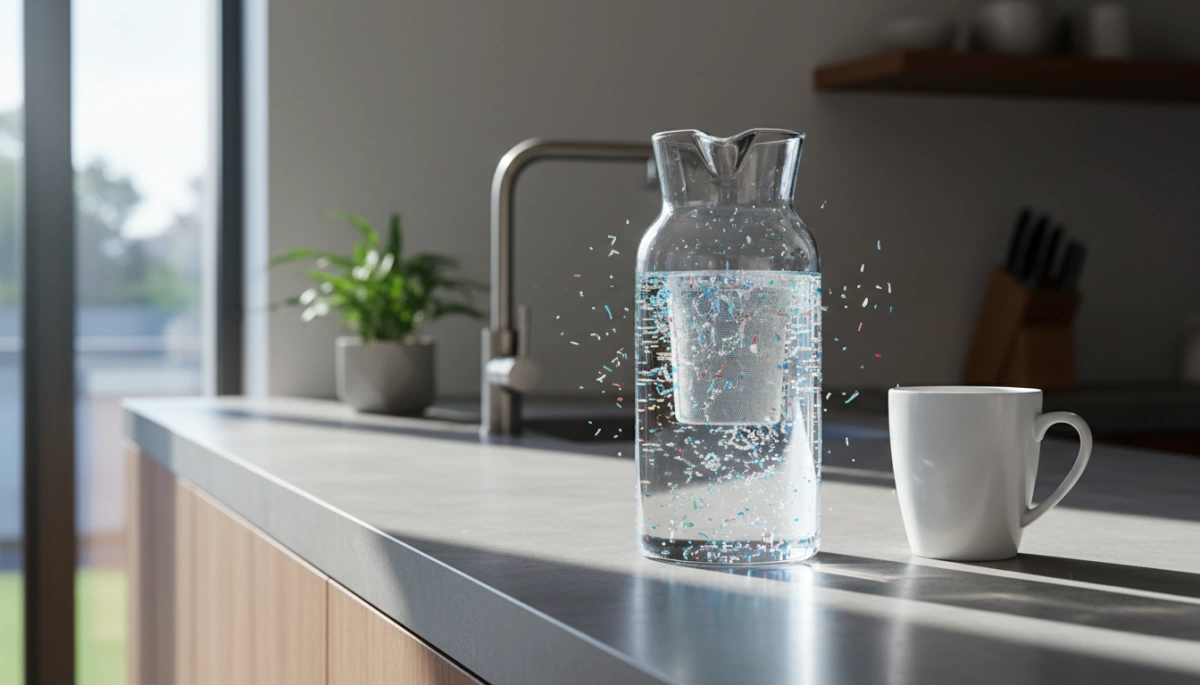
Current research on microplastics in drinking water is still evolving, but the direction is clear: we’re ingesting them regularly, and they don’t just pass through without concern. Studies have found microplastics in tap water, bottled water, table salt, and even human blood and placenta, which suggests at least some particles can move beyond the gut and interact with our bodies.
The risks come from two fronts:
- The particles themselves – Tiny plastic pieces can cause irritation and inflammation in the gut, may interfere with the gut barrier, and could potentially carry bacteria on their surfaces. Smaller “nanoplastics” are an even bigger concern because they’re small enough to move into tissues.
- The chemicals they carry – Microplastics can contain additives like BPA, phthalates, and flame retardants, and they can also absorb pollutants from water (like pesticides or heavy metals). These chemicals are linked to hormone disruption, developmental issues, and possible effects on immunity and metabolism.
Because of that, kids, pregnant women, and people with health issues are the ones I prioritize when I talk about removing microplastics from tap water. Their bodies are either still developing or under extra stress, so lowering unnecessary exposure just makes sense.
Even though scientists haven’t nailed down exact “safe levels” yet, major health and water experts lean toward a precautionary approach: reduce exposure where it’s practical and affordable, instead of waiting for perfect data. That’s where home water filtration for microplastics fits in.
Using a solid microplastics water filter (not just a taste-and-odor pitcher) is one of the simplest, highest-impact steps you can take—right alongside:
- Cutting back on plastic bottled water
- Using safer food containers
- Ventilating when cooking and heating plastics
In other words, filtration is part of a bigger personal health strategy, not a magic fix—but it’s one of the easiest habits to put on autopilot once you install the right system at home.
How to Filter Microplastics from Water: What Actually Works
If you want to remove microplastics from tap water at home, you need more than a “makes it taste better” pitcher. You need real sub‑micron water filtration.
Big picture: what actually works at home
The most effective options for microplastics in drinking water are:
| Solution type | How it works | Microplastics removal potential* |
|---|---|---|
| Reverse osmosis (RO) | Forces water through a dense membrane | Excellent (down to 0.0001 μm) |
| Nanofiltration (NF) | Tight membrane, just looser than RO | Very good (sub‑micron) |
| Ultrafiltration (UF) | Hollow-fiber membrane | Good for larger particles |
| Sediment + carbon + membrane | Multi‑stage system | Excellent when sub‑micron |
*Actual performance depends on system design, pressure, and maintenance.
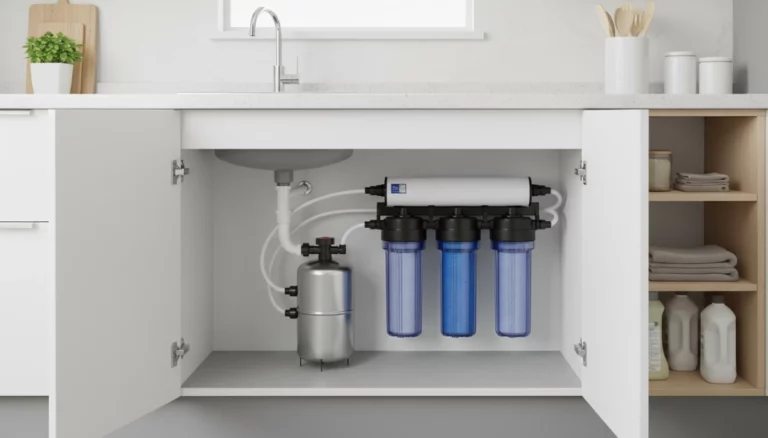
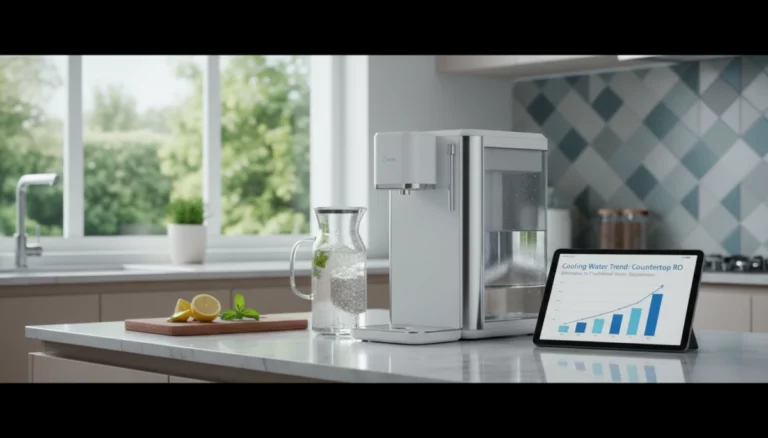
I usually recommend a compact RO system at the sink for most U.S. homes, or a gravity system with sub‑micron elements if you want something non‑electric. If you’re considering a modern countertop RO setup, look at how an efficient countertop reverse osmosis system is built and operates so you know what’s actually doing the work.
“Taste filters” vs real microplastic removal
Most people in the U.S. start with:
- Pitcher filters
- Basic fridge filters
- Simple faucet filters
These usually use granular activated carbon and maybe a coarse sediment screen.
| Filter type | Main job | Microplastics? |
|---|---|---|
| Pitcher / fridge filter | Improve taste, reduce chlorine | Limited (bigger particles) |
| Basic faucet filter | Taste, odor, some chlorine | Limited |
| Sub‑micron membrane filter | Physical particle removal | Strong microplastics removal |
If a product only talks about “better taste” and never mentions micron rating, membranes, or particle removal, assume it won’t reliably remove microplastics.
Combining pretreatment + fine filtration
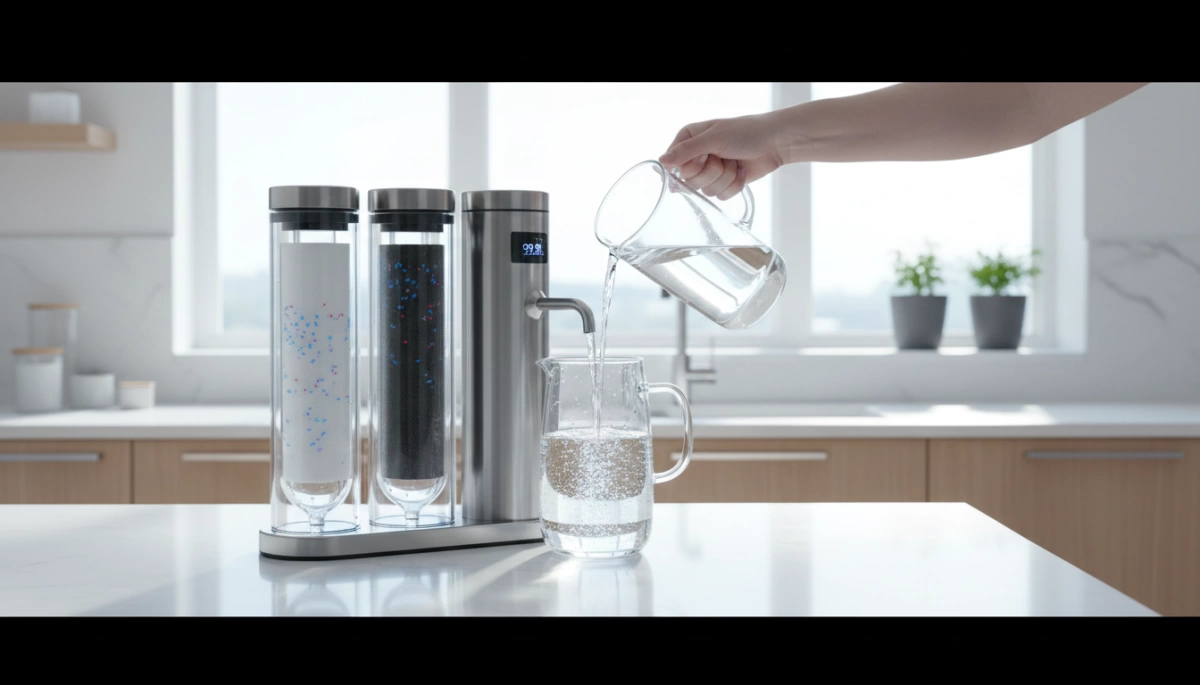
The best setups stack stages:
Sediment pre‑filter (5–1 μm)
- Catches sand, rust, larger plastic fragments
- Protects the fine membrane from clogging
Carbon block filter
- Improves taste and smell
- Reduces chlorine and some chemicals
Fine membrane (RO, NF, or tight UF)
- Does the heavy lifting for microplastic removal
- Also cuts many other contaminants
This multi‑stage design is how we build our own systems: pretreatment keeps maintenance low, and the membrane focuses on microplastics and dissolved pollutants.
When to upgrade from basic to advanced systems
You should move beyond basic filters when:
- You’re pregnant, have kids, or anyone immunocompromised at home
- Your city report or local news mentions microplastic contamination or aging pipes
- You rely heavily on bottled water and want to cut plastic use
- You already use a pitcher but still worry about microplastics in drinking water
That’s when an under‑sink RO system or a high‑capacity countertop RO becomes worth it. For higher household demand or light commercial use, stepping up to a larger unit like an 800 GPD RO system designed for serious daily flow gives you both volume and strong microplastics removal.
Can Common Water Filters Remove Microplastics?
What Basic Pitcher Filters Can and Can’t Do
Most standard pitcher filters in the U.S. are built to improve taste and smell, not to reliably remove microplastics from tap water.
Typical pitcher filters (like the ones you buy at big-box stores):
- Use granular activated carbon (GAC)
- Are optimized for chlorine, bad taste, odor, and some heavy metals
- Usually do not have a true micron rating small enough for microplastics
They may catch some larger plastic fragments by accident, but they are not engineered or tested for consistent microplastic removal.
If you want a pitcher that actually targets fine particles, look for a sub-micron cartridge or a ceramic/advanced block element, not just “carbon filter” in the description. A good example is a glass water filter pitcher with a high-performance cartridge designed for fine particle reduction, like our own glass water filter pitcher.
Limits of Standard Activated Carbon Filters
Standard activated carbon filters (pitcher, faucet, or fridge style):
- Are excellent for chlorine, VOCs, and improving taste/odor
- Can reduce some larger microplastic fragments (usually >5 microns)
- Struggle with smaller microplastics (often <1–5 microns)
- Often lack independent testing for microplastics in drinking water
If a filter doesn’t list a micron rating or tested particle reduction, assume it won’t reliably catch small microplastics.
Why Faucet and Fridge Filters Barely Touch Smaller Particles
Most built-in fridge filters and faucet-mount filters focus on convenience and taste:
- Many use loose carbon media, not tight membranes
- They typically have relatively large pore structures
- They’re rarely certified for sub‑micron particle removal
Result: they might reduce some sediment and larger fibers, but a lot of smaller microplastics pass straight through.
If the spec sheet only talks about “improves taste and odor” and doesn’t mention particle size, it’s not a serious microplastics water filter.
How to Read Product Claims vs Real Performance
When you see “removes microplastics” on the box, check for:
- Micron rating:
- For microplastics, look for ≤1 micron, ideally sub‑micron (0.5 µm or smaller)
- Absolute vs nominal:
- Absolute means it actually blocks that size
- Nominal means “about that size, some still get through”
- Certifications or testing:
- NSF/ANSI standards (even if not specific to microplastics)
- Independent lab test reports for particle reduction
Red flags:
- Vague “filters microplastics” with no micron rating
- No mention of testing, standards, or lab results
- Only marketing phrases like “premium carbon” or “5-stage” with no hard data
When a Basic Filter Is Fine (and When It’s Not Enough)
A basic carbon filter can be fine if your main goals are:
- Better taste and smell
- Less chlorine
- Some reduction in larger particles and rust
It’s not enough if:
- You want targeted microplastics removal
- You’re buying it mainly to solve microplastics in drinking water
- You have kids, pregnancy, or health concerns and want tighter control
In those cases, you should step up to:
- A sub‑micron countertop water filter
- An under-sink membrane system (UF or RO)
- Or a gravity filter with tested microplastics reduction
If you prefer countertop convenience, working with a dedicated countertop water filter manufacturer that focuses on sub‑micron and certified performance is the way to get real results instead of just better-tasting water.
Filter Micron Ratings and Microplastics Removal
When we talk about how to filter microplastics from water, the first thing that actually matters is the micron rating of the filter—not the brand name, not the color, not the marketing.
What does “micron rating” mean?
- Micron (μm) = one‑millionth of a meter.
- A micron rating tells you the approximate pore size of the filter media.
- Smaller number = tighter filter = better chance to remove microplastics.
Microplastics size vs common filter ratings
Most microplastics in drinking water are in the 1–100 μm range, and many studies are now detecting particles even smaller.
Compare that to typical home filters:
| Filter Type | Typical Micron Rating | What It Usually Catches |
|---|---|---|
| Basic sediment filter | 5–20 μm | Sand, rust, big flakes, some large plastics |
| Standard carbon block (pitcher) | ~1–5 μm (often unknown) | Chlorine, taste, odor, some larger particles |
| Fine sediment / carbon block | 0.5–1 μm | Bigger microplastic fragments and fibers |
| UF membrane | ~0.01–0.1 μm | Most microplastics, bacteria, larger colloids |
| RO membrane | ~0.0001 μm (0.1 nm) | Virtually all microplastics + many dissolved solids |
Because many microplastics are smaller than 5 μm, they pass right through most “standard” filters.
Why most microplastics slip through big‑pore filters
Large‑pore filters (5 μm and up) are designed for sediment control, not microplastics removal. That means:
- They grab visible debris, not tiny synthetic particles.
- Anything smaller than the pore size has a good chance of slipping through.
- So a 5 μm nominal filter might miss a huge portion of real‑world microplastics contamination in tap water.
Absolute vs nominal micron ratings
This part gets skipped in most marketing, but it’s critical:
Nominal micron rating
- Means the filter removes “around” that size—often 60–90% of particles.
- Example: A 1 μm nominal filter may let a lot of 1 μm particles pass.
Absolute micron rating
- Tested to remove ≥99% of particles at that size.
- Example: A 0.5 μm absolute filter is far more reliable for microplastics removal than a 0.5 μm nominal.
When you’re picking the best water filter for microplastics, always check if the micron rating is absolute and whether there’s independent test data behind it (NSF/ANSI or other lab reports).
Why sub‑micron filtration is key
If you want to remove microplastics from tap water reliably, you need sub‑micron filtration:
- 0.5 μm absolute carbon blocks: good for larger fragments and fibers.
- UF (0.01–0.1 μm): strong barrier for most microplastics.
- RO (≈0.0001 μm): overkill in a good way—blocks virtually all microplastics plus a lot of other contaminants.
In real life, that usually means using a multi‑stage system:
sediment pre‑filter → fine carbon block → UF or RO membrane. A setup like an under‑sink RO with a sub‑micron carbon stage (similar to our own 3‑in‑1 countertop RO purifier) is built exactly around this idea: big stuff first, then taste, then tight membrane to catch the microplastics you can’t see.
Bottom line: if a filter doesn’t clearly list a sub‑micron, preferably absolute micron rating, it’s not a reliable solution for microplastics in drinking water—no matter how good the marketing sounds.
Most Effective Ways to Remove Microplastics from Water
When people ask me how to remove microplastics from tap water at home, these are the methods that actually move the needle.
Reverse Osmosis for Microplastics (RO)
How RO works (simple):
RO pushes water through a super‑tight membrane (around 0.0001 microns). Water molecules pass, larger particles stay behind and get flushed to the drain.
Why RO blocks microplastics:
- Most microplastics in drinking water are 1–1000 microns
- RO pore size ≈ 0.0001 microns
- Result: RO membranes physically block essentially all microplastic particles plus many other pollutants (heavy metals, some PFAS, nitrate, etc.).
Typical RO microplastics removal rates:
| Source | Microplastics Removal |
|---|---|
| Lab data (controlled) | 99–100% |
| Real‑world home systems | ~95–99% (if maintained) |
Pros of RO at home:
- Extremely effective for microplastic contamination
- Also improves taste, odor, and reduces many dissolved contaminants
- Fits nicely under the sink for direct drinking and cooking
Cons of RO:
- Higher upfront cost than basic filters
- Produces some wastewater (varies by system)
- Requires filter and membrane changes every 6–24 months
- Needs enough water pressure
Best RO use cases:
- Under‑sink RO system for microplastics at the kitchen sink (most common)
- Point‑of‑use RO for apartments or rentals
- Whole‑house RO only when water quality is very poor and budgets are higher
If you’re comparing options, guides like these top water sink purifiers for all budgets can help line up RO vs simpler filters in one place: top water sink purifiers for all budgets.
Ultrafiltration (UF) and Nanofiltration (NF)
How UF and NF differ from RO:
- UF (Ultrafiltration): Larger pores than RO. Great for particles, not for dissolved salts.
- NF (Nanofiltration): Sits between UF and RO. Catches small particles and some dissolved contaminants but usually with less wastewater than RO.
Typical pore sizes:
| Technology | Approx. Pore Size | What It Catches Well |
|---|---|---|
| UF | ~0.01–0.1 microns | Fibers, fragments, bacteria, larger microplastics |
| NF | ~0.001 microns | Smaller microplastics, some hardness, some PFAS |
| RO | ~0.0001 microns | Very small particles + many dissolved salts |
UF performance for microplastics:
- Strong on fibers and larger microplastic particles
- Great for city tap water where the main concern is particles rather than salts
- Often used as a pre‑filter before RO in multi‑stage systems
NF performance:
- Targets smaller microplastics and some dissolved chemicals
- Good option when you want strong filtration but slightly less aggressive than RO
- Often used in multi‑stage combos with sediment + carbon
Ideal setups:
- Under‑sink UF systems for homes that want strong particle removal without wastewater
- Inline NF systems where you need more than UF but don’t want full RO
- Multi‑stage systems: sediment → carbon → UF/NF for balanced performance
Activated Carbon and Sediment Filters
What activated carbon is good at:
- Chlorine and chloramine
- VOCs and many organic chemicals
- Taste and odor issues in tap water
How carbon helps with microplastics:
- Some larger microplastic fragments get trapped physically in the carbon block
- Often combined with a sediment filter for better particle capture
Limits of carbon for microplastics:
- Very small microplastics (sub‑micron) pass right through
- Carbon is not designed as a primary microplastics water filter
- Good support layer, not a complete solution by itself
Role of sediment pre‑filters:
- Usually rated 5–20 microns
- Catch sand, rust, and bigger plastic pieces
- Protect finer membranes (UF/NF/RO) from clogging
Boiling, Distillation, and DIY Options
Boiling:
- Kills microbes, but does not remove microplastics
- May actually concentrate microplastics slightly as water volume drops
Distillation:
- Water is boiled, vapor rises, then condenses in a clean chamber
- Most microplastics and particles stay behind in the boiling tank
- Watch for:
- Proper cleaning of the boiling chamber
- A good post‑carbon filter for taste and any volatile chemicals
DIY + physical filtration:
- Boil water → let cool → pour through a sub‑micron filter or high‑quality gravity filter
- Better than nothing in emergencies, but:
- Flow can be slow
- Filter performance is rarely certified
- Hard to prove filtration efficiency for microplastics
Bottom line: DIY is a backup option, not a long‑term primary solution if microplastics are your main worry.
Certified Membrane and Multi‑Stage Systems
The most reliable way to remove microplastics from water at home is a certified, multi‑stage system that stacks the strengths of each technology.
Typical multi‑stage layout:
- Sediment filter (5–1 micron) – blocks rust, sand, larger plastic pieces
- Activated carbon block – handles chlorine, VOCs, taste, odor
- Membrane stage (UF/NF/RO) – catches microplastics and finer contaminants
- Optional post‑carbon – final polish for taste
Why certification and lab testing matter:
- Real microplastics reduction claims should be backed by:
- NSF/ANSI standards (e.g., NSF/ANSI 42, 53, 58 depending on system type)
- Independent lab test reports for particle removal
- Avoid vague language like “helps with microplastics” without data
Examples of microplastics‑focused setups:
- Under‑sink RO: sediment + carbon + RO + post‑carbon
- Under‑sink UF: sediment + carbon + UF membrane
- Countertop/gravity filters: multi‑stage with a sub‑micron element for particle removal
If you’re still on the fence about whether you even need a purifier at home, this breakdown of whether you need a water purifier in the first place is a solid starting point: do you need a water purifier?.
Choosing the Best Water Filter for Microplastics
When you’re trying to remove microplastics from tap water at home, the filter you pick matters more than the brand hype. Here’s how I look at it from both a technical and practical standpoint.
Key Factors That Actually Matter
1. Match pore size to microplastic particle size
Most microplastics in drinking water are roughly 1–100 microns (μm), but some are smaller.
- For reliable removal, aim for:
- ≤ 1 μm absolute for basic protection
- 0.01–0.1 μm (UF/NF/RO) for serious microplastics control
- Avoid filters that only list 5 μm or 10 μm nominal – they’ll miss a big chunk of particles.
If the spec sheet doesn’t list a micron rating (or just says “fine filtration” or “advanced”), assume it’s not designed for microplastics.
2. Certifications and independent lab tests
For the U.S. market, you want hard proof, not marketing talk.
- Look for NSF/ANSI certifications (or equivalent) for:
- Particulate reduction (Class I is the finest, down to 0.5–1 μm)
- Other contaminants you care about (lead, PFAS, etc.)
- If a company claims “microplastics removal,” ask for:
- Independent lab test reports
- Test conditions (pressure, flow, starting particle size)
If they can’t show documentation, I don’t count it as a microplastics water filter, no matter how nice the website looks.
3. Flow rate, water pressure, real performance
A filter that’s too restrictive for your plumbing will either:
- Kill your water pressure, or
- Be bypassed or used less often (which defeats the purpose)
Check:
- Minimum required inlet pressure (PSI)
- Rated flow rate at that pressure (gallons per minute)
- Whether your home’s pressure and usage pattern can support it
RO and ultrafiltration systems need proper pressure and enough contact time for high filtration efficiency on microplastics.
4. Filter lifespan, replacement cost, ease of use
A great filter you never replace on time becomes a bad filter.
- Look at:
- Cartridge lifespan (gallons or months)
- Replacement cost per year
- How easy it is to change filters (twist-lock vs tools, mess, leaks)
- Set a reminder on your phone – microplastics removal drops as membranes clog and carbon gets exhausted.
If you’re already invested in water safety (fluoride, chlorine, VOCs), it often makes sense to combine microplastics removal with other needs in a multi-stage system rather than juggling multiple separate filters. For example, if you care about both fluoride and microplastics, pairing an RO system with a good remineralization stage (like systems similar to those discussed in this guide on the best fluoride water filters and their efficiency: fluoride water filter types and efficiency) can cover more bases with one setup.
Types of Home Microplastics Filters
Here’s how different home water filtration options stack up for microplastics:
1. Under-sink RO and UF systems
Best for: Drinking and cooking water
- Reverse Osmosis (RO):
- Uses a tight membrane (down to ~0.0001 μm)
- Extremely effective for microplastics, plus many dissolved contaminants
- Ideal under-sink setup for a single kitchen tap and possibly a fridge line
- Ultrafiltration (UF):
- Pore size typically 0.01–0.1 μm
- Excellent for microplastics and bacteria, without wasting water like RO
- Good if your main concern is microplastics and particles, not dissolved solids
If you’re outfitting a U.S. kitchen, an under-sink RO system for microplastics is usually the most practical “set it and forget it” solution.
2. Countertop and gravity filters with sub-micron elements
Best for: Renters, small households, low-install setups
- Look for sub-micron filter elements (≤0.5 μm absolute)
- Good for:
- Apartments where you can’t modify plumbing
- Backup during boil-water notices or emergencies
- Gravity filters can be strong performers if they use quality ceramic or composite sub-micron elements
Pairing one of these with a portable water filter solution (like the options similar to those discussed in this roundup of best portable water filters for outdoor use) covers both home and travel scenarios.
3. Whole-house microplastics filters
Best for: Showers, laundry, and every tap
- Typically use:
- Sediment filters (5 μm or smaller)
- Sometimes UF membranes for finer filtration
- Makes sense if:
- You want to reduce microplastics exposure from showering and bathing
- You own your home and plan to stay long-term
- Just know: Whole-house RO or NF is more complex and expensive and usually only justified for serious water problems or commercial-grade needs.
4. Portable and travel microplastics filters
Best for: On-the-go protection
- Choose bottles or straw filters with:
- Sub-micron membrane (UF or similar)
- Clear test data on particle removal
- Useful for:
- Hotels with unknown tap water quality
- Gym, office, road trips
- Reducing reliance on plastic bottled water, which often contains its own microplastics
How to Read Labels and Specs
1. What to look for in product descriptions
On the label or product page, you want to see:
- A specific micron rating (preferably absolute, not just nominal)
- Mention of “particulate Class I” or similar
- NSF/ANSI standards listed by number (42, 53, 58, etc.)
- Clear capacity: “X gallons” or “X months” per filter
2. Spotting vague or misleading claims
Be cautious of phrases like:
- “Removes microplastics” with no size range or % reduction
- “Nano filter” with no pore size listed
- “Lab tested” with no lab name, report, or standard
If the marketing language is all buzzwords and no hard numbers, assume the filtration efficiency for microplastics is unknown or poor.
3. Questions to ask before you buy
I always confirm these points:
- What is the micron rating (absolute) of the finest stage?
- Do you have NSF/ANSI certifications or independent test reports specifically for microplastics or fine particulates?
- What water pressure is required and what flow rate can I expect?
- How often do I need to replace filters and what’s the annual cost?
A serious microplastics water filter manufacturer will have direct answers to these.
4. Red flags that a filter won’t do what you need
Walk away if you see:
- No micron rating anywhere
- Only “improves taste and odor” with nothing about particles
- Wild claims like “removes all contaminants” with no data
- Replacement filters that are hard to find or extremely expensive
If you stick to clear specs, certified performance, and realistic claims, you’ll end up with a home water filtration system that actually removes microplastics from tap water instead of just promising it on the box.
Microplastics Filtration for Daily Home Use
Filtering tap water for drinking and cooking
Here’s how I keep daily microplastics exposure low at home without overcomplicating things:
Filter priority #1 – kitchen tap
- Install an under-sink RO system for microplastics or a sub-micron countertop water filter on the main kitchen faucet.
- This covers almost all drinking, coffee, tea, and cooking water in one shot.
Filter priority #2 – kids’ water sources
- If your kids fill bottles in their bathroom, add a small faucet filter or gravity water filter with a sub-micron element.
- For babies and toddlers, I only use kitchen filtered water for formula, food, and ice.
Filter priority #3 – fridge and ice line
- Replace the standard fridge filter with one that specifies sub-micron filtration and tested microplastics reduction, not just “taste and odor.”
Daily routine that actually gets used
- Keep a glass or stainless pitcher filled with filtered water on the counter or in the fridge.
- Use reusable bottles and make “fill from the filter, not the tap” the default.
- Show kids which faucet is the “safe water” faucet and label it if needed.
Making one main home water filtration for microplastics the “go-to” source is more realistic than trying to filter every tap.
Using filters with bottled and delivered water
Bottled vs tap — what studies show
- Many studies have found more microplastics in bottled water than in most municipal tap water because of plastic bottles and caps.
- So bottled water is not a guaranteed win for microplastics in drinking water.
When to filter bottled or delivered water
- If you rely on 5-gallon jugs or cases of bottled water, it still makes sense to run it through a countertop or gravity water filter for microplastics with a sub-micron element.
- This is especially helpful if you live in a rental or can’t install an under-sink system.
Cutting plastic while staying safe
- Switch from single-use bottles to:
- A high-quality home filter system
- Stainless or glass bottles you refill from your filtered tap
- You cut plastic waste and lower tap water contamination from microplastics at the same time.
- Switch from single-use bottles to:
Maintenance tips to keep filters working
Your microplastics water filter only protects you if it’s maintained. I treat it like a safety device, not a “set and forget” gadget.
Signs your filter is losing effectiveness
- Noticeably slower flow or pressure drop
- Change in taste or smell after months of use
- Cloudiness or visible particles in water
- Filter past its rated gallon capacity or time limit
How often to change cartridges
- Most sediment and carbon filters: every 3–6 months, depending on use and water quality
- RO membranes: usually 2–3 years if pre-filters are changed on time
- Always follow the manufacturer’s schedule, or sooner if water quality changes
Cleaning, sanitizing, and checking seals
- Wipe and sanitize filter housings when changing cartridges
- Check O-rings and seals so unfiltered water can’t bypass the cartridge
- Flush new filters thoroughly before drinking
Why skipping maintenance is risky
- Clogged filters can trap then release particles, including microplastics.
- Bacteria can grow on dirty cartridges and re-contaminate your water.
- An overdue filter can be worse than no filter because it gives a false sense of safety.
If you’re already filtering for other contaminants like lead or fluoride, a similar maintenance rhythm applies; the approach used in guides on evaluating the effectiveness of water pitcher filters also helps here, especially when you’re tracking real-world performance and not just marketing claims (see how we break this down in our article on evaluating water pitcher filter performance).
Advanced and Professional Microplastics Solutions
When you move beyond basic home filters, microplastics control becomes a strategy issue, not just a product choice. That’s where commercial and OEM‑level systems matter.
Commercial and Whole‑Building Microplastics Systems
For businesses and facilities, you don’t just want to remove microplastics from tap water at one sink — you need consistent quality at scale.
How businesses handle microplastics in water
Most commercial setups use a multi‑stage membrane water purification approach:
- Sediment pre‑filters (5–1 μm) – catch large particles and bigger plastic fragments
- Carbon filters – improve taste, remove chlorine and organics before membranes (similar to what a dedicated carbon filter for water treatment does at smaller scale)
- UF, NF, or RO membrane filtration – the main barrier for microplastics and many other contaminants
- Final polishing (UV or carbon) – for microbes and taste, often using a commercial‑grade UV water sterilizer downstream
When to consider centralized RO, NF, or UF
You should look at centralized RO, NF, or UF systems when:
- You supply multiple outlets
Everyday Habits to Reduce Microplastics in Water
Filtering your water is a smart move, but your daily habits at home can cut a huge amount of microplastics at the source. I treat this as a “double defense”: good filtration plus fewer plastics going into your water in the first place.
Cutting Plastic at the Source
The less plastic you bring home and wash, the fewer microplastics end up in your tap water and local waterways.
How less plastic use helps:
- Fewer plastic bottles = less breakdown into microplastics in storage and transport
- Fewer synthetic textiles = less microfiber shedding in your washer
- Less plastic packaging = fewer fragments and dust in your home
Simple swaps that work in real life:
Bottles & cups
- Use stainless steel or glass bottles instead of single‑use plastic
- Keep one reusable bottle in your car, bag, and at your desk so you don’t default to plastic
Food containers & kitchen gear
- Switch to glass, stainless, or silicone containers for leftovers
- Avoid heating food in plastic (microwave and dishwasher wear plastics down faster)
- Choose wooden, silicone, or metal utensils instead of cheap plastic ones
Cleaning tools
- Pick cellulose or cotton cloths instead of synthetic sponges and wipes
- Use brooms or mops with natural fibers where possible
Textiles & home fabrics
- Favor cotton, linen, wool, or bamboo over polyester, nylon, and acrylic
- Skip fast fashion; buy fewer, better-made pieces that don’t shed as much
Laundry habits to reduce microfibers:
- Wash full loads (less friction = less shedding)
- Choose cold water and gentle cycles when possible
- Air‑dry when you can; high heat can break down fibers faster
- Use a microfiber filter or laundry bag (like a Guppyfriend-style bag) to catch fibers
- Clean your dryer lint trap often and toss lint in the trash, not down the drain
Pairing Filtration with Lifestyle Changes
Filters protect what you drink; habits reduce what you and your community are exposed to. Both matter.
Why filters alone aren’t enough:
- You still breathe in microplastics from dust and textiles
- Your washer and sink still send microplastics into the sewer system
- Bottled water can still be a big source of microplastics in drinking water
How to combine filtration and low‑plastic choices:
- Use a sub‑micron home water filtration system (like under‑sink RO or a high‑end countertop unit) for all drinking and cooking water. A compact system such as a countertop RO purifier that also improves taste and convenience can make it easier for the whole family to ditch bottled water.
- Cut back on plastic bottles, food containers, and synthetic fabrics so you’re not constantly “making” more microplastics at home
- Keep a reusable bottle filled from your filtered tap so grabbing water on the go doesn’t mean buying plastic
Getting your family on board (and tracking progress):
- Start with one or two easy rules, like “no plastic water bottles at home” or “no microwaving in plastic”
- Show simple wins: track how many plastic bottles you avoid each week after installing a good household water purifier
- Give each family member their own labeled reusable bottle or lunch container so the switch feels personal, not forced
These small, consistent habits—paired with the right microplastics water filter—add up to cleaner drinking water and less plastic in your home and environment.
FAQ: How to Filter Microplastics from Water
Does reverse osmosis really remove microplastics from water?
Yes. A quality under-sink RO system with a tight membrane (around 0.0001 microns) can remove well over 90–99% of microplastics in most tests. It also cuts other contaminants at the same time, which is why I usually recommend RO as a top pick if you’re serious about microplastics in drinking water.
Are microplastics in bottled water worse than in tap water?
Often, yes. Many studies show bottled water can contain more microplastics than municipal tap water because of the plastic bottle itself and the bottling process. If you rely on bottled water, it still makes sense to run it through a sub‑micron or RO water filter at home instead of drinking straight from the bottle.
Can boiling water remove or reduce microplastics on its own?
No. Boiling kills microbes but does not remove microplastics. In some cases, boiling might even break larger plastics into smaller fragments. If you boil water (for tea, baby formula, etc.), filter first with a RO, ultrafiltration, or sub‑micron filter, then boil.
How often should I replace filters to keep removing microplastics?
Stick to the manufacturer’s schedule, not just taste:
- Sediment filters: about every 3–6 months
- Carbon filters: about every 6–12 months
- RO membranes: about every 2–3 years (with good pre‑filtration)
Once filters clog or age out, filtration efficiency for microplastics drops fast, even if the water still tastes OK.
What certifications should a microplastics filter have?
Because there’s no single “NSF microplastics” badge yet, I look for:
- NSF/ANSI 42 & 53 for basic safety and contaminant reduction
- NSF/ANSI 58 for RO systems (strong sign the membrane is legit)
- Clear independent lab tests that list microplastic or particulate removal with size ranges in microns
If a product claims “removes microplastics” but shows no lab data or standards, I don’t trust it.
Do shower and bath filters matter for microplastics exposure?
For most people, drinking and cooking water is the priority, but shower and bath water can matter if:
- You have babies or young kids who swallow bath water
- You have skin or respiratory issues and want to cut total exposure
A whole‑house sediment + carbon + UF setup can help here, but I’d still start with point‑