
















The Industry Benchmark: NSF/ANSI 177 Standard
Defining the Standard: Aesthetic Effects Certification
When we engineer high-performance systems like our DL-series, we align with the core principles of NSF/ANSI 177 certification. This is the primary industry standard dedicated specifically to shower filtration systems. Unlike drinking water standards that focus on ingestion, this benchmark targets aesthetic effects—specifically the reduction of free available chlorine. For us, meeting these expectations means ensuring that our 15-stage and 20-stage filtration units effectively neutralize chemicals that cause dry skin and brittle hair, rather than just acting as a simple sieve.
Free Available Chlorine (FAC) Testing Protocols
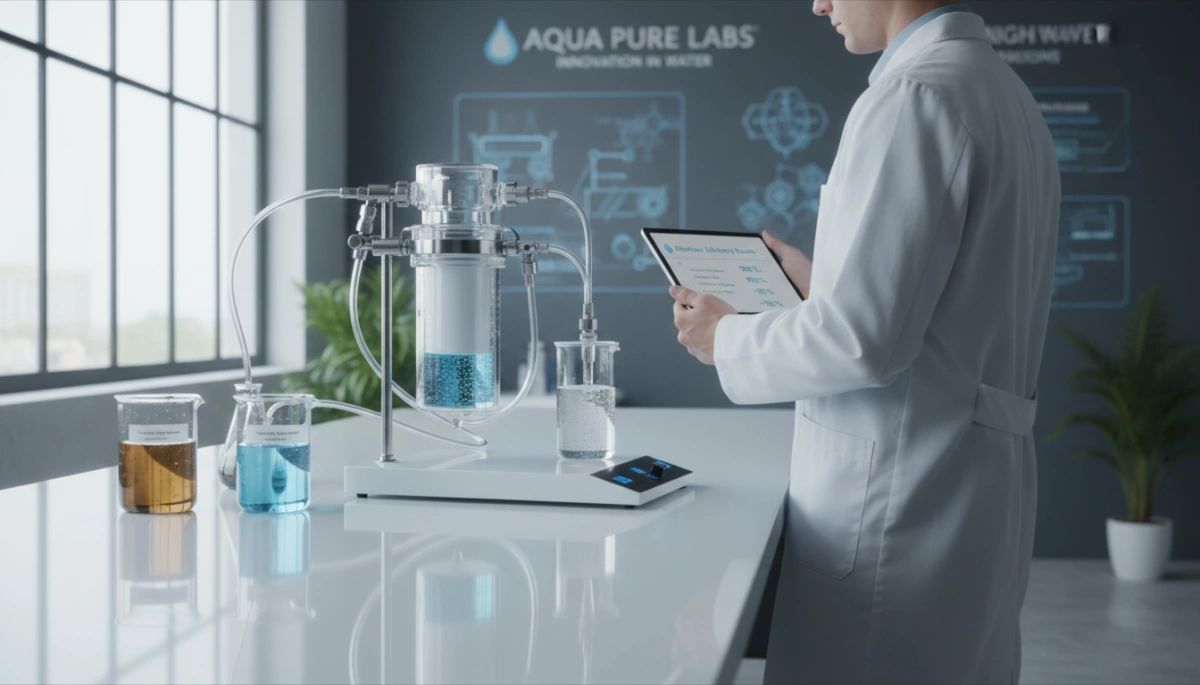
To validate Free Available Chlorine (FAC) reduction, rigorous protocols involving “challenge water” are essential. This process simulates real-world conditions to verify that the active media, such as KDF-55 and Calcium Sulfite, are performing correctly.
- Challenge Water Creation: We introduce water with a controlled, high concentration of chlorine.
- Influent vs. Effluent Analysis: We measure the chemical levels entering the system (influent) and compare them to the water exiting the showerhead (effluent).
- Reduction Metrics: The standard requires a consistent reduction percentage throughout the filter’s rated capacity, which for our units is typically around 10,000 to 12,000 gallons.
Structural Integrity: Withstanding High Pressure
Filtration efficiency means nothing if the housing fails. Structural integrity testing subjects the filter housing to hydrostatic pressure significantly higher than standard household levels. Whether we are using chrome-plated ABS or stainless steel housings, the goal is to guarantee that the unit will not leak, crack, or burst under stress. This ensures that our users experience consistent high pressure output without the risk of mechanical failure during their daily routine.
Chemical Reduction Testing Methodologies
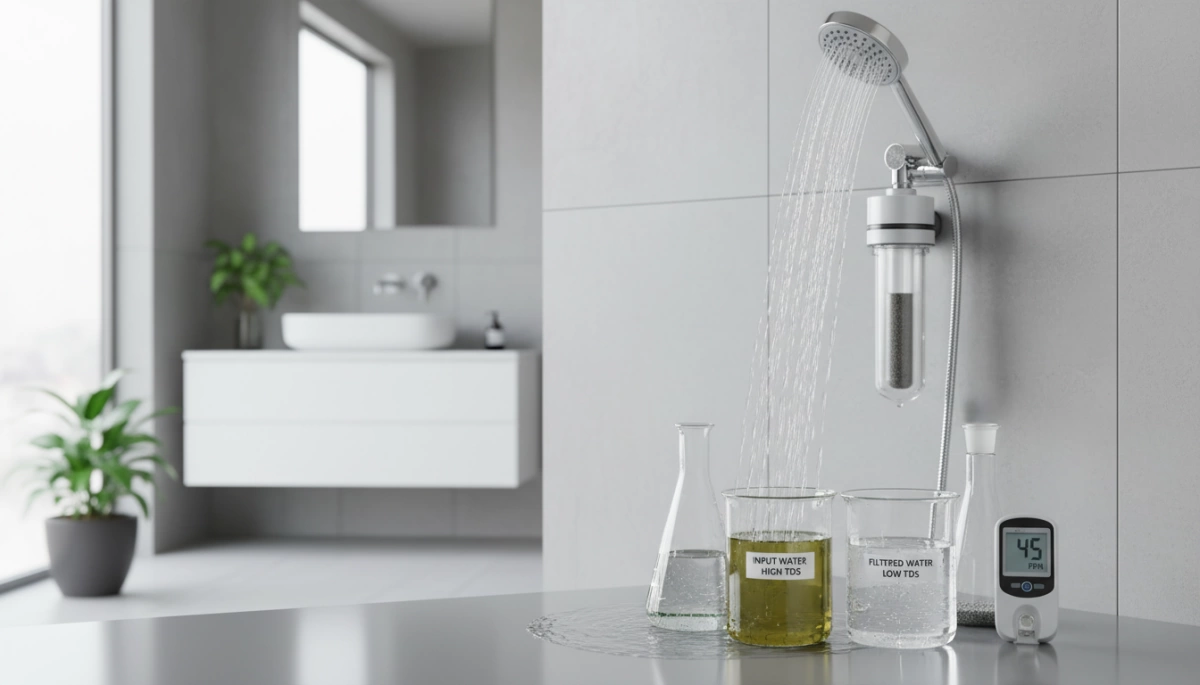
When we engineer high-performance filtration systems like our DL-series, we don’t just assume the media works; we validate it through rigorous chemical reduction testing. This phase is critical because it confirms that the specific 15-stage or 20-stage configurations are actually neutralizing harmful agents rather than just letting them pass through.
Influent vs. Effluent Analysis
The core of our validation process relies on influent vs effluent analysis. This involves measuring the concentration of contaminants in the water before it enters the filter (influent) and comparing it to the water exiting the filter (effluent).
- DPD Colorimetric Method: We often use this to visually and digitally quantify residual chlorine levels. If the effluent sample doesn’t show a significant reduction in the pink hue associated with chlorine presence, the media blend needs adjustment.
- Amperometric Titration: For even higher precision, this electrochemical technique detects minute traces of free chlorine, ensuring our Free Available Chlorine (FAC) reduction meets the strict standards expected by US households.
Heavy Metal Extraction (KDF-55 Focus)
Our systems rely heavily on KDF-55 media redox potential to tackle heavy metals. KDF-55 (Kinetic Degradation Fluxion) uses an electro-chemical oxidation-reduction process to convert soluble heavy metals into insoluble forms that are trapped within the filter bed. To verify this:
- Redox Potential Testing: We measure the electrical potential of the water to ensure the KDF media is creating the necessary environment to neutralize chlorine and metals.
- ICP-MS Analysis: We utilize Inductively Coupled Plasma (ICP) spectrometry to detect trace levels of lead, mercury, nickel, and chromium. This high-sensitivity testing confirms our heavy metal removal efficiency, ensuring that the water touching your skin is free from toxic elements.
Temperature Stress Testing
Unlike drinking water filters, a bath water filter must perform under high heat. Standard carbon filters can fail or even release contaminants (desorption) when water gets too hot. We conduct stress tests between 38°C and 45°C (approx. 100°F – 113°F) to verify that our Calcium Sulfite and KDF layers maintain their efficacy. This ensures that the calcium sulfite dechlorination process remains rapid and stable, even during a long, steamy shower.
Physical Performance & Hydraulic Testing
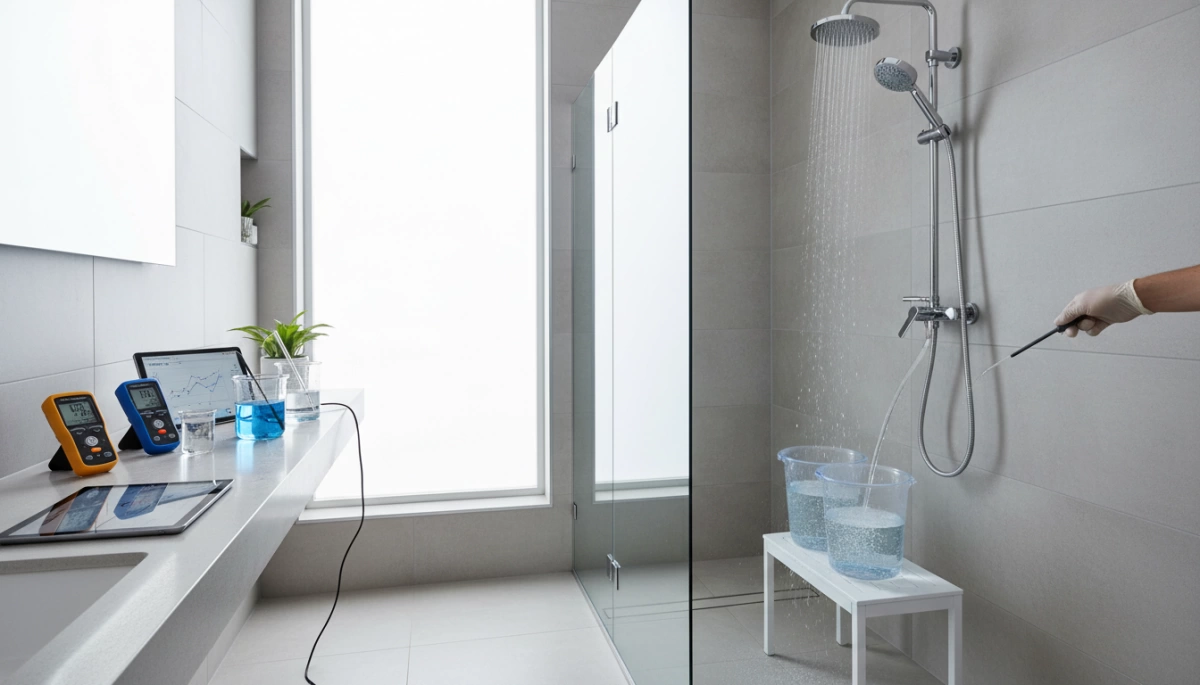
We know that superior chemical reduction means nothing if the showerhead just trickles. Balancing filtration density with water velocity is a critical part of our engineering process. We rigorously test the physical dynamics of our systems to ensure that the shower filter flow rate impact is negligible, maintaining the high-pressure experience US customers expect.
Differential Pressure (Flow Rate) Testing
To verify our “High Pressure/No Flow Loss” claim, we utilize differential pressure testing. This involves measuring the water pressure (psi) at the inlet versus the outlet. The goal is to maximize the contact time between the water and the active media—like KDF-55 and Calcium Sulfite—without causing a significant pressure drop.
- Baseline Measurement: We record the GPM (Gallons Per Minute) of a standard shower setup.
- Load Testing: We install the DL-series filter and measure the output again.
- Optimization: We adjust the density of the PP Cotton and mesh layers to ensure the flow remains consistent, even as the filter begins to trap particulates.
Media Life Cycle and Sediment Capacity
Our cartridges are rated for approximately 10,000 to 12,000 gallons, or roughly 6 months of use. To validate this filter media life cycle, we conduct accelerated aging tests. We run continuous water flow through the unit to determine the exact point where the sediment holding capacity is reached.
The multi-stage design relies on High-Density Stainless Steel Mesh and PP Cotton to physically trap rust, sand, and other suspended solids. It is vital that these layers hold debris without clogging the system prematurely. During these stress tests, we also verify the structural integrity of the housing, because understanding material safety and why BPA-free components matter is essential when subjecting plastic housings to fluctuating pressures and heat.
Physical Testing Benchmarks
| Test Parameter | Objective | Acceptance Criteria |
|---|---|---|
| Flow Rate Verification | Ensure consistent GPM | < 10% reduction in flow at 60 psi |
| Burst Pressure | Test housing safety | Withstand 2x standard household pressure |
| Sediment Loading | Measure particulate trapping | No bypass of solids > 5 microns |
| Life Cycle Duration | Verify capacity claims | Effective filtration up to 10,000+ gallons |
Advanced Verification for Multi-Stage Systems
When we engineer a 15-stage or 20-stage shower filter, relying on a single pass-fail test isn’t enough. We have to validate that each layer contributes to the overall filtration efficiency testing methods without creating a bottleneck. Since our systems combine physical filtration with chemical neutralization and water conditioning, our verification process must isolate specific components to ensure they perform correctly under real-world shower conditions.
Component-Specific Validation: Calcium Sulfite
Standard activated carbon can lose effectiveness in high-temperature water, which is why we rely on Calcium Sulfite for thermal stability. Our testing protocols specifically focus on Calcium sulfite dechlorination rates at temperatures between 38°C and 45°C. We verify that the media can rapidly neutralize chlorine in the split second the water passes through the cartridge, ensuring consistent protection even during long, hot showers.
Ceramic & Magnetic Balls: Conditioning Verification
Beyond removing contaminants, our DL-series filters are designed to improve water feel. We subject our mineral media—including ceramic balls, alkaline balls, and magnetic energy balls—to rigorous analysis to confirm they are actively conditioning the water.
- pH Stabilization: We monitor effluent water to ensure it maintains a balanced pH level suitable for skin and hair health.
- TDS Adjustments: We track Total Dissolved Solids to verify that the mineral media is releasing beneficial trace elements without spiking TDS levels beyond comfortable limits.
Leach Testing and Material Safety
High-performance filtration means nothing if the filter housing itself introduces impurities. We conduct extensive leach testing on our chrome-plated ABS and stainless steel housings to guarantee structural safety. This process ensures that no plasticizers, heavy metals, or manufacturing residues migrate from the casing into the filtered water stream, maintaining the purity achieved by the internal media.
How Buyers & Distributors Can Verify Quality
Ensuring you are getting a high-performance filtration system requires more than just reading the box. As a manufacturer, we believe in rigorous validation to prove that our multi-stage systems deliver on their promises. Whether you are sourcing for retail or upgrading your home, verifying quality involves a mix of technical data analysis and physical inspection.
Interpreting Lab Reports: Reading Data from SGS, Intertek, and WQA
The most reliable way to validate filtration performance benchmarking is through third-party documentation. When we look at reports from independent labs like SGS or Intertek, we focus on specific reduction metrics rather than general claims. A credible report should explicitly state the percentage of Free Available Chlorine (FAC) removed and the efficiency of heavy metal extraction.
For our partners, we emphasize the importance of our innovation and development protocols. When reviewing these documents, check for:
- Test Standards: Confirmation that testing aligns with NSF/ANSI 177 protocols for aesthetic effects.
- Contaminant Lists: Detailed breakdown of reductions for lead, mercury, and chlorine.
- Flow Rate Data: Verification that filtration does not drastically compromise water pressure.
The “Shake” and “Flow” Tests: Simple Physical Inspections
You don’t always need a laboratory to spot a poorly constructed filter. We recommend two simple physical checks to assess structural integrity and assembly quality immediately.
- The Shake Test: Pick up the replacement cartridge and give it a gentle shake. While some movement is normal for loose media like ceramic balls, excessive rattling often indicates poor packing density. A well-packed 15-stage or 20-stage cartridge should feel substantial and solid, ensuring water is forced through the media (KDF-55, Calcium Sulfite, Carbon) rather than channeling around it.
- The Flow Test: Install the unit and run the shower. Our systems are engineered to maintain high pressure. If you experience an immediate, drastic drop in flow, the internal mesh or PP cotton layers may be too restrictive or clogged, failing the shower filter quality assurance methods for hydraulic performance.
Transparency in Manufacturing
True quality assurance comes from transparency. We provide detailed specifications for every layer inside our cartridges, from the micron rating of the stainless steel mesh to the exact composition of our Vitamin C and alkaline balls. Sharing these technical specifics allows B2B partners to verify that the materials used match the performance claims, ensuring that the chrome-plated ABS housing contains exactly what is required for superior skin and hair health.
FAQs: Common Questions on Filtration Efficiency Testing
Does NSF/ANSI 177 certification cover heavy metal removal?
No, NSF/ANSI 177 certification is strictly an aesthetic standard. It focuses primarily on the reduction of free available chlorine to improve the smell and feel of the water. While this is the industry benchmark for shower systems, it does not validate health claims regarding lead, mercury, or other heavy metals. At DripLife, we rely on specific media testing—such as the redox potential of KDF-55 media—to verify heavy metal removal efficiency beyond the basic chlorine standards.
How does high water temperature affect testing accuracy?
Temperature is a critical variable in filtration efficiency validation. Unlike drinking water filters that operate with cold water, shower filters must perform at temperatures between 38°C and 45°C. High heat can cause standard activated carbon to release trapped contaminants (desorption). We conduct temperature stress testing to ensure materials like Calcium Sulfite and KDF-55 maintain their bond with chlorine and heavy metals even in hot steam, preventing chemical re-release.
What is the difference between influent and effluent water analysis?
This is the core of our performance data. Influent vs effluent analysis compares the water quality before and after filtration.
- Influent: The untreated “challenge water” containing a known concentration of contaminants (like chlorine or sediment).
- Effluent: The filtered water exiting the showerhead.
By measuring the difference between these two points, we calculate the exact percentage of reduction for each contaminant.
Why is differential pressure testing important for shower filters?
Nobody wants a weak shower. Differential pressure testing measures the drop in psi (pounds per square inch) as water moves through the filter cartridge. If a filter is too dense, it kills the flow; if it’s too loose, it doesn’t clean effectively. We monitor the shower filter flow rate impact to ensure our multi-stage systems provide maximum filtration without sacrificing the high-pressure experience you expect.