















Global Market Differences in Water Dispenser Demand
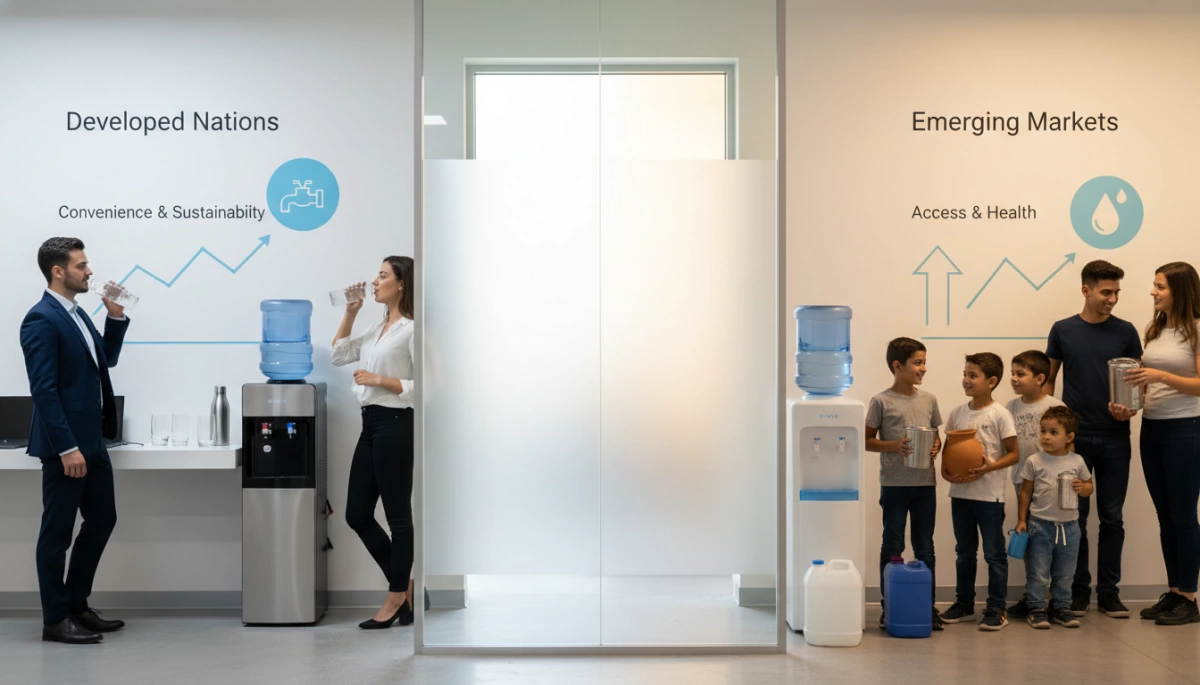
Are you struggling to scale your hydration products internationally because what sells in New York completely flops in Tokyo? When I map out commercial water dispenser market trends, one hard fact always stands out: a one-size-fits-all approach fails. Geography heavily dictates dispenser demand. Navigating regional water dispenser demand differences requires a deep understanding of local infrastructure and buyer priorities. From the local water condition impact to varying technological adoption rates, grasping this geographic preference variation is the absolute baseline for successful global expansion.
North America: Smart Water Dispenser Adoption
In the US and across North America, the B2B sector demands convenience, premium experiences, and innovation. Corporate buyers aren’t just looking for a cold drink; they want a high-tech hydration station.
- Multi-Functional Output: There is a massive push for units offering hot, ambient, cold, and sparkling water from a single tap.
- IoT and Hygiene: Facility managers expect touchless and IoT water dispenser technology to monitor filter life, track usage data remotely, and ensure post-pandemic hygiene standards.
- Aesthetic Integration: Sleek, modern designs built to seamlessly blend into high-end corporate breakrooms are mandatory for the US market.
Europe: Bottle-Less Water Dispenser Regulations
The European market is aggressively driven by sustainability and strict environmental compliance. The shift away from single-use plastics and carbon-heavy logistics is non-negotiable.
- Eco-Centric Policies: Tightening European bottle-less water dispenser regulations are forcing offices to rapidly abandon traditional bottled water coolers.
- POU Dominance: We are tracking a massive spike in the point-of-use (POU) water dispenser CAGR as businesses demand direct-line, sustainable commercial hydration solutions.
- Energy Efficiency: Low standby power consumption, eco-mode features, and a minimal carbon footprint strictly dictate B2B purchasing decisions.
APAC: Water Quality and Purification Growth
In the Asia-Pacific region, the conversation shifts rapidly from corporate luxury to fundamental health and safety. Extreme urbanization and aging infrastructure heavily influence the global water quality impact on dispenser sales.
- Aggressive Filtration: Due to severe local water condition impacts, buyers require heavy-duty purification, consistently demanding multi-stage Reverse Osmosis (RO) systems built directly into the unit.
- High-Capacity Heating: Cultural preferences for hot water mean that commercial units must have reliable, high-volume boiling capabilities to be viable.
- Market Surges: The overall APAC water purification market growth is skyrocketing as businesses prioritize employee health and guaranteed safe drinking water access over smart-tech aesthetics.
Key Technological Shifts Reshaping B2B Hydration

While I track global market differences in water dispenser demand, the US market clearly leads the charge in adopting high-tech, user-centric setups. Modern offices expect sustainable commercial hydration solutions that deliver a premium, seamless experience rather than just basic functionality.
Touchless Dispensing and Post-Pandemic Hygiene
Workplace safety standards have permanently shifted. Today’s facility managers prioritize sanitation alongside commercial water dispenser market trends.
- Hands-Free Operation: The rapid adoption of touchless and IoT water dispenser technology completely eliminates shared contact points on buttons and levers.
- Automated Sanitation: Integrated UV-C LED sterilization keeps water lines and dispense nozzles bacteria-free without constant manual cleaning.
- High-Volume Refills: Upgrading to a touchless bottle filling station is now the baseline standard for corporate lobbies and gyms looking to reduce plastic waste and minimize cross-contamination.
Under-Sink Soda Systems in Corporate Workspaces
Recent B2B water filtration market research points to a massive spike in breakroom upgrades. Companies are treating hydration as an employee perk.
- On-Demand Sparkling Water: Hidden under-counter carbonation units are replacing expensive, single-use seltzer cans and plastic bottles.
- Space Optimization: Moving the chilling and carbonation hardware underneath the sink frees up valuable counter space and keeps kitchen aesthetics clean.
- Precision Output: Employees want their drinks customized instantly. Reliable temperature accuracy control in thick film heating systems and high-efficiency chillers guarantee perfect hot teas and crisp, icy sodas on demand.
Navigating International Regulations and Certifications
Understanding global market differences in water dispenser demand means knowing the rules. You cannot just ship a US-compliant unit overseas and expect it to pass customs. Local regulations directly dictate whether your product lives or dies in a new market.
Local Rules Drive Product Viability
We have seen firsthand how ignoring local requirements ruins cross-border distribution. You need a solid regional adaptation strategy. Every country has different electrical grids, plumbing codes, and environmental laws. Mapping out these geography-driven trends is step one to ensuring your commercial hydration solutions are legally viable.
R&D Testing and Global Standards
Rigorous R&D testing is the backbone of our manufacturing process. Before we launch, every unit goes through extreme testing for reliability, lifespan, and pressure performance.
When we build products like our high-performance under-sink reverse osmosis filtration system, we design them to meet strict international standards to handle local water condition impacts safely. Meeting these benchmarks is non-negotiable for global market mapping:
- NSF/ANSI Standards: The global benchmark for material safety and water purity. Securing proper international water dispenser certification (NSF/ANSI) is an absolute must.
- UL Certification: Essential for proving electrical safety, especially for smart water dispenser adoption in high-traffic B2B environments.
- WQA Gold Seal: Guarantees the system actually removes the contaminants it claims to filter, building immediate trust with buyers.
Solving Global Market Differences in Water Dispenser Demand
Navigating regional water dispenser demand differences requires a strong manufacturing backbone. We know that trying to force a single product into every market just does not work. Instead, we rely on flexible water dispenser OEM/ODM manufacturing to solve global supply challenges and adapt to local market needs quickly.
Modular Platform Design
Customizing products from scratch for every new region drains your capital expenditure (CapEx) and slows down your launch. That is why we use a modular platform design for water dispensers. This approach allows us to mix and match core components—like filtration systems, heating elements, and smart tech—to build units that fit specific geographic preference variations.
- Lower CapEx: Reusing a proven base chassis cuts down on costly factory re-tooling.
- Faster Launch: Pre-engineered modular designs drastically accelerate our time-to-market.
- Easy Localization: We can quickly swap parts to handle different local water condition impacts without reinventing the wheel.
Before any customized unit leaves the factory, it undergoes rigorous checks based on reliability testing standards for water filter dispensers to ensure it performs perfectly, no matter the local environment.
Scaling Cross-Border Water Dispenser Distribution
As demand variability shifts, we must scale operations without hitting roadblocks. A highly adaptable manufacturing setup allows us to meet regional volume demands efficiently and keep supply chains moving.
| Supply Chain Benefit | Impact on Global Operations |
|---|---|
| Volume Flexibility | Ramp up production fast to meet sudden market growth or seasonal spikes. |
| Inventory Control | Using modular parts means we avoid overstocking regionally-locked finished goods. |
| Logistics Management | Streamlined, uniform core designs pack tighter, reducing global shipping costs. |
By structuring our operations around a reliable water filter supplier network, we smooth out the bumps in cross-border water dispenser distribution. This regional adaptation strategy ensures we deliver the right hydration solutions on time, overcoming global logistics hurdles and keeping our B2B partners fully stocked.
Frequently Asked Questions (FAQs)
Point-of-Use Water Dispenser Growth
Why is the demand for POU water dispensers growing rapidly in Europe?
The shift is entirely driven by the push to eliminate single-use plastics. Strict European bottle-less water dispenser regulations are forcing businesses to abandon traditional bottled coolers. This aggressive sustainability movement has significantly accelerated the Point-of-use (POU) water dispenser CAGR. Companies now demand eco-friendly, direct-line systems that align with their corporate environmental goals while lowering long-term hydration costs.
International Water Dispenser Certification
What are the most critical certifications for international water dispenser distribution?
When we handle cross-border water dispenser distribution, compliance is non-negotiable. Global buyers require proof of safety and reliability. To succeed in diverse markets, you must secure these core credentials:
- NSF/ANSI Standards: The absolute baseline for verifying material safety, structural integrity, and contaminant reduction.
- UL Certification: The gold standard for electrical and fire safety in the United States.
- CE Marking: Mandatory for health, safety, and environmental protection across the European Economic Area.
- WQA Gold Seal: Provides the B2B water filtration market with an independent, trusted verification of product performance.
Modular Platform Design for Water Dispensers
How does modular ODM design help brands localize products for different regional markets?
A modular approach allows us to easily swap out core internal components—like specialized filters or cooling capacities—without having to engineer a brand new machine from scratch. Because regional water dispenser demand differences dictate different hardware needs, modularity lets us pivot quickly. For example, understanding why tankless is the competitive edge against big box retailers proves how easily we can integrate high-flow, space-saving modules for dense urban offices while keeping CapEx low. This flexibility perfectly addresses geographic preference variation and speeds up our time-to-market.