

















The Physics of Accuracy: Why Thick Film Wins
For engineers and R&D teams, nothing is more frustrating than designing a precision system only to battle constant thermal overshoot. You cut the power, but the temperature keeps climbing. This isn’t a control logic failure; it’s a physics problem. At DripLife, we solve this by fundamentally changing the heating medium.
Eliminating Thermal Mass for Precision
The primary enemy of temperature accuracy in thick film heating is thermal mass. Traditional heating elements, like copper coils or cast aluminum heaters, are bulky. They act like thermal batteries, storing vast amounts of energy that take time to dissipate.
In contrast, our technology utilizes a low thermal mass heater profile. We screen-print dielectric, resistor, and conductor layers directly onto a stainless steel (SUS444 or 316L) substrate. These layers are mere microns thick. By removing the heavy bulk material found in legacy heaters, we eliminate the “lag” between the command to heat and the actual temperature rise.
Understanding Thermal Inertia and “Coasting”
Why does thermal inertia reduction matter? In high-mass systems, when your sensor hits the target temperature and cuts power, the residual heat in the heavy metal element continues to transfer energy to the fluid. This is called “thermal coasting,” and it destroys accuracy.
Because our thick film elements have near-zero heat retention, we achieve thermal overshoot prevention naturally. When the power cuts, the heat transfer stops almost instantly. This allows for tight tolerances without complex, over-engineered cooling algorithms.
High Power Density and Instant Response
We engineer our stainless steel tubes to handle high watt density heating, typically ranging from 60W/cm² to 100W/cm². This density allows for an incredibly aggressive ramp-up rate of 80°C to 150°C per second.
This creates a true “Instant-On, Instant-Off” capability:
- Rapid Start: We achieve target temperatures in just 3 to 5 seconds.
- Zero Lag: The instant heating response time means the system reacts immediately to flow rate changes or voltage adjustments.
- Efficiency: With thermal efficiency exceeding 97%, energy is directed into the fluid, not wasted heating the element itself.
By stripping away the mass, we give the control system a responsive engine capable of executing precise commands without the drag of thermal inertia.
The Control Loop: Integrating Electronics with Thermodynamics
Achieving precise temperature control isn’t just about the heating element; it’s about how that element talks to the brain of your appliance. In our thick film systems, we bridge the gap between raw power and digital intelligence. Because our stainless steel thick film heaters ramp up at rates of 80°C to 150°C per second, standard mechanical thermostats simply can’t keep up. We rely on a sophisticated closed-loop thermal control system that reacts in milliseconds.
Sensor Integration: The Eyes of the System
You cannot control what you cannot measure. For temperature accuracy control in thick film heating systems, we utilize NTC thermistor integration. Unlike traditional boilers where sensors are often placed far from the heat source, we mount high-sensitivity sensors directly on the water outlet or even on the stainless steel thick film substrate itself.
- Real-Time Feedback: The low thermal mass of our printed layers means the sensor detects temperature changes instantly.
- Reduced Hysteresis: Immediate data transmission prevents the “lag” that causes temperature spikes in conventional heaters.
The Role of PID Controllers
We pair our fast-response heaters with PID temperature controller logic (Proportional-Integral-Derivative). Since our heaters have near-zero thermal inertia, the PID controller can make micro-adjustments to the power input without waiting for a heavy copper coil to cool down or heat up.
This synergy allows for:
- Instant Response: The system adjusts voltage in real-time to match flow rates.
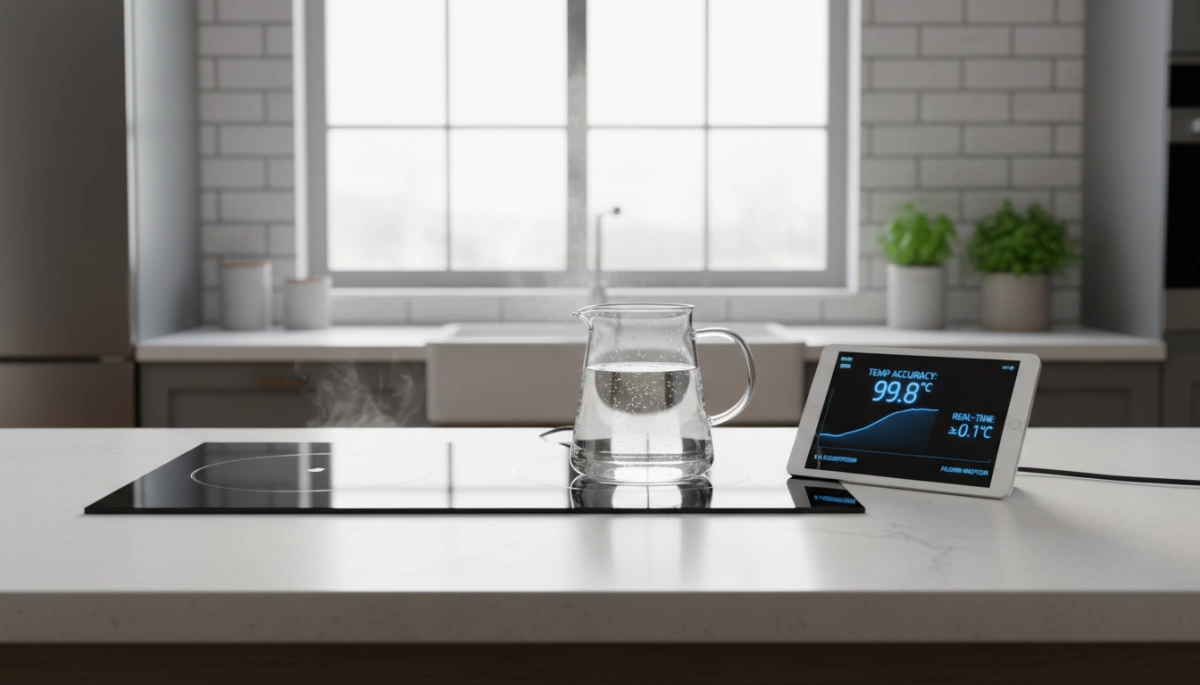
- Stability: We maintain target temperatures within ±1°C, essential for applications like brewing coffee or medical fluid warming.
- Efficiency: By modulating power precisely, we avoid the energy waste associated with “bang-bang” (on/off) control methods.
Eliminating the Air Gap
The physical design of the heater is just as critical as the software. In traditional heating, air gaps between the element and the water tube act as insulators, delaying heat transfer and confusing the control system.
Our design prints the resistive heating element directly onto the SUS444 heating element tube. This direct-contact method eliminates the air gap entirely. The heat generated is the heat delivered. This direct thermal path ensures that when the PID controller says “stop,” the temperature rise stops immediately, preventing thermal overshoot and ensuring safety.
| Control Feature | Traditional Heating | DripLife Thick Film Heating |
|---|---|---|
| Sensor Placement | External / Delayed | Integrated / Direct Contact |
| Response Time | Slow (>30 seconds) | Instant (<3 seconds) |
| Control Logic | On/Off Cycling | Precision PID Modulation |
| Thermal Lag | High (Overshoot risk) | Near-Zero (Precise cutoff) |
Design Factors Influencing Temperature Stability
Substrate Material: Why SUS444/316L Beats Ceramic
The foundation of temperature accuracy control in thick film heating systems starts with the substrate. While ceramic has its uses, we rely on SUS444 or 316L stainless steel for our heating elements. Ceramic is brittle and prone to cracking under thermal shock, whereas stainless steel offers the durability needed for high-pressure environments.
More importantly, the corrosion resistance of these specific steel grades ensures that the resistive heating element design remains stable over years of use. If a heater corrodes, its thermal conductivity changes, leading to sensor drift. Maintaining a clean surface is critical, which is why we often recommend pairing these systems with effective water filter types to prevent scale buildup that acts as a thermal insulator and throws off calibration.
Flow Rate and Power Modulation
Achieving precision isn’t just about the heater; it’s about fluid thermodynamics. We design our control logic to monitor flow rate in real-time.
- Dynamic Adjustment: If water flow slows down, the power density (60-100W/cm²) must drop instantly to prevent overheating.
- Consistent Output: By linking flow data with power modulation, we eliminate temperature spikes that occur during flow fluctuations.
Zoning and Uniformity
We don’t just print heating tracks randomly. We use advanced screen-printing techniques to create “zoned” heating patterns. This allows us to distribute heat energy evenly across the tube or plate surface.
- Eliminating Hot Spots: Concentrated heat creates localized boiling, which confuses NTC sensors and causes noise.
- Accurate Readings: Uniform heat distribution ensures the integrated sensor reads the true average fluid temperature, not just a superheated pocket.
Real-World Applications of High-Accuracy Control
When we implement Temperature Accuracy Control in Thick Film Heating Systems, we aren’t just chasing engineering metrics; we are defining the user experience across critical industries. Because our stainless steel thick film heaters have low thermal mass, they stop heating the moment the power is cut, preventing the “thermal coasting” that plagues traditional copper coil systems. This responsiveness opens the door for applications where a variance of even one degree is unacceptable.
Household Appliances: Precision on Demand
In the modern kitchen, the demand for a precise temperature control water dispenser has skyrocketed. Consumers expect their appliances to switch instantly between 98°C for brewing black tea and 45°C for preparing infant formula without a cooling-down period.
- Instant Adjustment: Our systems allow for rapid cycling between temperature setpoints.
- Taste Optimization: Whether utilizing specific mineral profiles discussed in our guide on spring water vs. purified water sources or standard tap water, accurate heat ensures the beverage flavor is never compromised by scorching.
- Safety: Digital temperature regulation ensures that water meant for a child never exceeds safe limits due to sensor lag.
Medical & Lab Equipment: Critical Fluid Warming
In medical environments, precision fluid warming is a matter of patient safety. Devices used for dialysis or intravenous delivery require strict body-temperature maintenance (37°C) with zero margin for overshoot.
- Closed-Loop Thermal Control: By integrating NTC sensors directly onto the substrate, we achieve a feedback loop that reacts in milliseconds.
- Sterility & Stability: The use of SUS444/316L stainless steel ensures the heating element remains non-corrosive and chemically stable, even during the rigorous sanitation cycles required in lab settings.
Commercial Beverage Systems: The Golden Ratio
For commercial espresso machines and coffee brewers, stable hot water output is the key to consistent extraction. High-end coffee shops rely on heating consistency design to maintain the “Golden Ratio” of extraction.
- High Watt Density Heating: Our modules handle high flow rates without a temperature drop, ensuring the first cup and the hundredth cup are identical.
- No Recovery Time: Unlike boiler systems that lose heat after a rush, thick film heaters provide continuous, stable thermal energy, maximizing throughput during peak business hours.
Driplife’s Approach to Thermal Management
At Driplife, we approach heating physics with a focus on absolute predictability. Achieving temperature accuracy control in thick film heating systems requires more than just a fast sensor; it requires a heating element that behaves consistently under load. Our engineering philosophy centers on minimizing thermal noise to give your control algorithms a clean environment to work in.
The 98% Efficiency Advantage
We don’t just chase raw power; we prioritize energy transfer. Our thick film modules achieve thermal efficiency exceeding 97%, often hitting 98%.
- Reduced Waste Heat: High efficiency means almost no energy is lost to the surrounding air or casing.
- Cleaner Data: Less ambient heat dissipation means less interference with onboard sensors.
- Tighter Control: By directing energy strictly into the fluid, we eliminate the “thermal lag” that causes overshoot in less efficient systems.
Durability Meets Precision
Accuracy is meaningless if it drifts over time. A heater that changes its electrical resistance after a few months will confuse even the smartest PID controller. We utilize high-grade SUS444 and SUS316L stainless steel substrates to ensure our printed resistor layers maintain constant resistance stability.
- Long Lifespan: Our units are rated for a service life exceeding 10,000 hours.
- Zero Drift: The resistive layers do not degrade significantly, ensuring the power output remains calculated and precise throughout the product’s life.
- Reliable Calibration: Your control board doesn’t need to constantly recalibrate for aging components.
Customization for OEM Control Boards
We understand that hardware must sync perfectly with software. Whether you are engineering a medical device or upgrading legacy fountains to modern bottle filling stations, the thermal profile must match your specific logic. We offer deep customization options:
- Voltage Tuning: Adjusting voltage requirements to match global or local power standards.
- Resistance Calibration: Fine-tuning the resistance density to align with your specific OEM control boards.
- Zoning: Creating specific heat zones on the substrate to optimize flow dynamics.
Frequently Asked Questions About Thick Film Temperature Control
How does thick film technology prevent thermal overshoot?
Thermal overshoot occurs when a heating element continues to release stored heat even after the power is cut, causing temperatures to spike beyond the target. Our technology prevents this through significant thermal inertia reduction. Unlike bulky copper coils, the printed resistive layers on our heaters have extremely low mass. This allows for an “instant-off” capability—once the power stops, heat generation ceases immediately, ensuring thermal overshoot prevention and protecting sensitive components.
What is the response time for a standard stainless steel thick film heater?
Speed is a defining characteristic of our systems. A standard unit delivers an instant heating response time, typically reaching the target temperature in under 3 seconds. With heating ramp-up rates ranging from 80°C to 150°C per second, these elements are designed for high-performance applications where waiting for a pre-heat cycle is not an option.
Why is SUS444 stainless steel preferred over ceramic for precision heating?
We utilize SUS444 heating elements because they offer superior durability compared to ceramic alternatives. While ceramic is effective, it is brittle and prone to cracking under the stress of rapid thermal cycling. Stainless steel (SUS444/316L) provides excellent mechanical strength, corrosion resistance, and the ability to withstand high internal pressures, making it the reliable choice for long-term temperature accuracy control.
Can thick film heaters integrate with existing PID control systems?
Yes, they are exceptionally well-suited for this. Because the heater responds instantly to voltage changes without lag, it pairs perfectly with a PID temperature controller. This allows for a closed-loop thermal control system where the logic board can make micro-adjustments to the power supply thousands of times per second. This level of responsiveness is critical for maintaining precise temperatures in a modern sink water filter dispenser or medical device.
How does flow rate affect the temperature accuracy of the heating element?
Flow rate is a critical variable in fluid thermodynamics. If water moves through the tube faster, the system must increase power to maintain the set temperature; if it slows, power must decrease. Our modules rely on NTC thermistor integration to monitor these changes in real-time. This data allows the control board to modulate power output dynamically, ensuring stable hot water delivery regardless of fluctuations in inlet water pressure or flow speed.