













You might already know that not all water filters are created equal…
But do you understand the massive difference between a standard 5-micron filter and 0.0001 micron filtration accuracy?
Selecting the right filtration system is about more than just clear water; it’s about understanding the microscopic engineering that protects your health.
As water quality experts, we know that a single stage of filtration simply isn’t enough. You need a Multi-stage filtration hierarchy to effectively strip away contaminants without clogging your system instantly.
In this guide, we’re going to break down the critical difference between a Nominal vs. Absolute micron rating and explain why the Reverse Osmosis membrane pore size is the only barrier capable of stopping dissolved solids and heavy metals.
If you are looking to understand the “why” behind Driplife’s precision engineering, this post is for you.
Let’s dive in.
What Exactly is a Micron Rating?
When we dive into Micron Ratings Explained for Multi-Stage RO, we are essentially measuring the size of the “holes” in a sieve. A micron (short for micrometer) represents one-millionth of a meter. In the water treatment industry, this rating is the standard for defining exactly what size particle a specific filter acts as a barrier against and what it allows to pass through.
Defining the Microscopic Scale: Human Hair vs. Bacteria
It is difficult to visualize just how small these contaminants are without a reference point. To understand why particulate reduction class matters, consider this scale:
- Human Hair: Approximately 75 microns in diameter.
- Red Blood Cell: About 5 microns.
- Bacteria: Ranges from 0.2 to 2 microns.
- Viruses: Even smaller, often roughly 0.02 to 0.4 microns.
If your filter has a rating of 5 microns, it acts like a chain-link fence against a basketball (sand or hair) but looks like a wide-open door to a marble (bacteria). This is why understanding the pore size is critical for ensuring water safety.
Why One Single Filter Can’t Catch Everything
We often get asked, “Why not just use the tightest filter right away?” The answer lies in efficiency and longevity. If we forced raw tap water directly through a 0.0001 micron filtration accuracy membrane without any pre-treatment, the system would fail almost immediately.
Large particles like rust, silt, and sand would clog those microscopic pores in seconds, destroying the membrane’s flow rate. Effective water purification requires a step-down filtration process. We must use a multi-stage filtration hierarchy to strip away the large debris first, ensuring the finer membranes are free to target the dangerous, invisible dissolved solids.
Nominal vs. Absolute Micron Ratings
When we look at filter specifications, you will often see two distinct terms: Nominal and Absolute. While they might sound similar, the difference is massive when it comes to the actual purity of your water.
- Nominal Rating (The Approximate): This rating indicates that the filter will trap most particles of a specific size, typically somewhere between 85% and 95%. Think of it as a general screening. It is excellent for pre-filtration stages where we need to catch larger debris like sand or rust without clogging up the system immediately.
- Absolute Rating (The Strict Standard): This is the gold standard for safety. An absolute rating means the filter rejects 99.9% or more of particles at that specific micron size. This level of filtration accuracy is non-negotiable when dealing with microscopic threats like cysts or bacteria.
For true drinking water safety, relying solely on a nominal filter isn’t enough. We design our 5-stage systems using a strategic combination: nominal filters handle the heavy lifting upfront to protect the system, while the high-grade TFC membrane provides the absolute precision required for health. Understanding the nuance between these types of water purification methods clarifies why a multi-stage approach is superior to a single filter. We rely on that absolute rating in the final stages to ensure that when we say “Pure Water,” we mean it.
The Step-Down Filtration Strategy Explained
We design our systems using a logical step-down filtration process. Instead of forcing water through the tightest filter immediately, which would clog the system instantly, we guide it through progressively smaller pores. This multi-stage filtration hierarchy ensures that every component operates at peak efficiency, protecting the heart of the system while delivering the purest results.
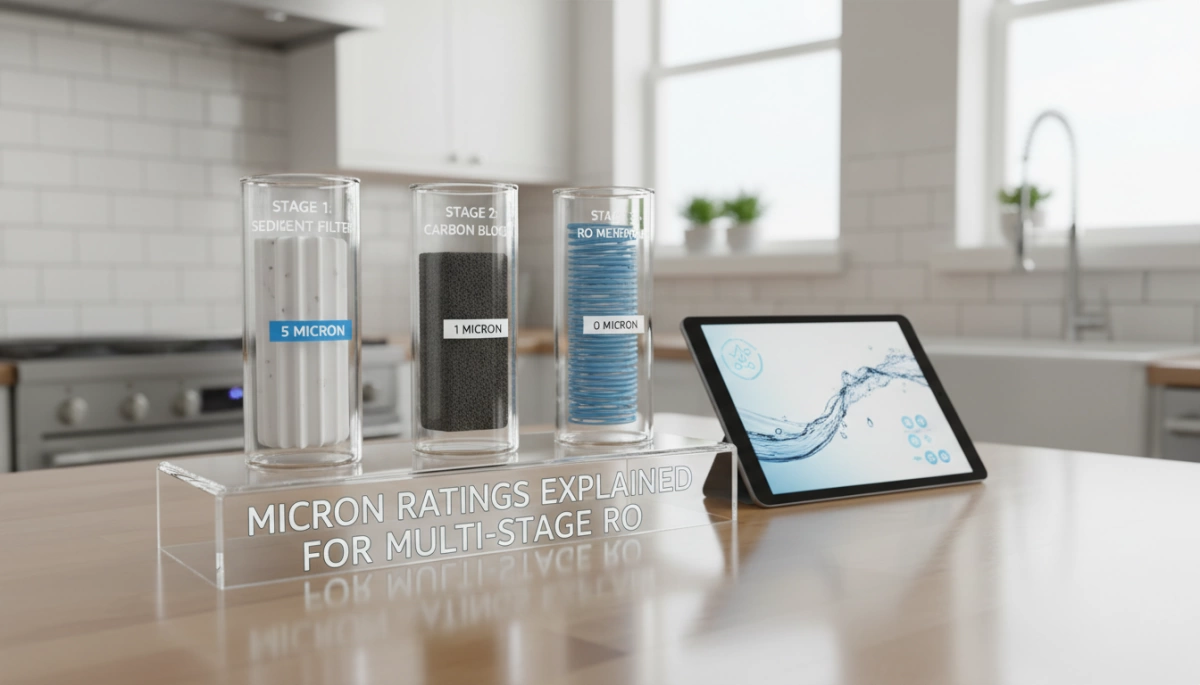
Stage 1: The Bodyguard (5-10 Micron PPC Pre-Filter)
The first line of defense in our 5-stage system is the Composite PPC filter. Operating with a pore size typically between 5 and 10 microns, this stage acts as the bodyguard for the rest of the unit. Its primary job is sediment pre-filter efficiency—physically trapping visible and semi-visible contaminants.
- Sand and Dirt: Stops abrasive particles from entering the system.
- Rust and Silt: Captures pipe residue commonly found in municipal water lines.
- Membrane Protection: Prevents large debris from fouling the delicate RO membrane downstream.
Stage 2: The Carbon Block (1-5 Micron)
Once the large particulate matter is removed, the water moves to the carbon block stage. Here, the filtration tightens to approximately 1-5 microns. While this stage continues to filter out smaller sediments, its main function is chemical adsorption. We rely on this stage to strip away chlorine and chloramines, which can chemically damage the Thin-Film Composite (TFC) membrane if left unchecked. For a deeper dive into chemical reduction, it is helpful to understand exactly what carbon filters remove from water to improve the aesthetic quality of your drink.
Key Targets:
- Chlorine: Eliminates the “pool water” taste and smell.
- Volatile Organic Compounds (VOCs): Reduces industrial solvents and pesticides.
- Cloudiness: Polishes the water for crystal-clear clarity.
Stage 3: The RO Membrane (0.0001 Micron Precision)
This is the core of the DripLife system. The Reverse Osmosis membrane pore size is incredibly small, rated at 0.0001 micron filtration accuracy. To put this in perspective, this pore size is roughly 500,000 times smaller than the diameter of a human hair.
At this microscopic level, the semi-permeable membrane separates water molecules from dissolved contaminants that carbon and sediment filters cannot catch. This is where heavy metal removal happens, effectively blocking lead, arsenic, fluoride, and PFAS. By forcing water through this ultra-dense barrier, we achieve up to 99% rejection of Total Dissolved Solids (TDS), ensuring that what ends up in your glass is professional-grade purity.
Does Lower Micron Rating Mean Lower Water Pressure?
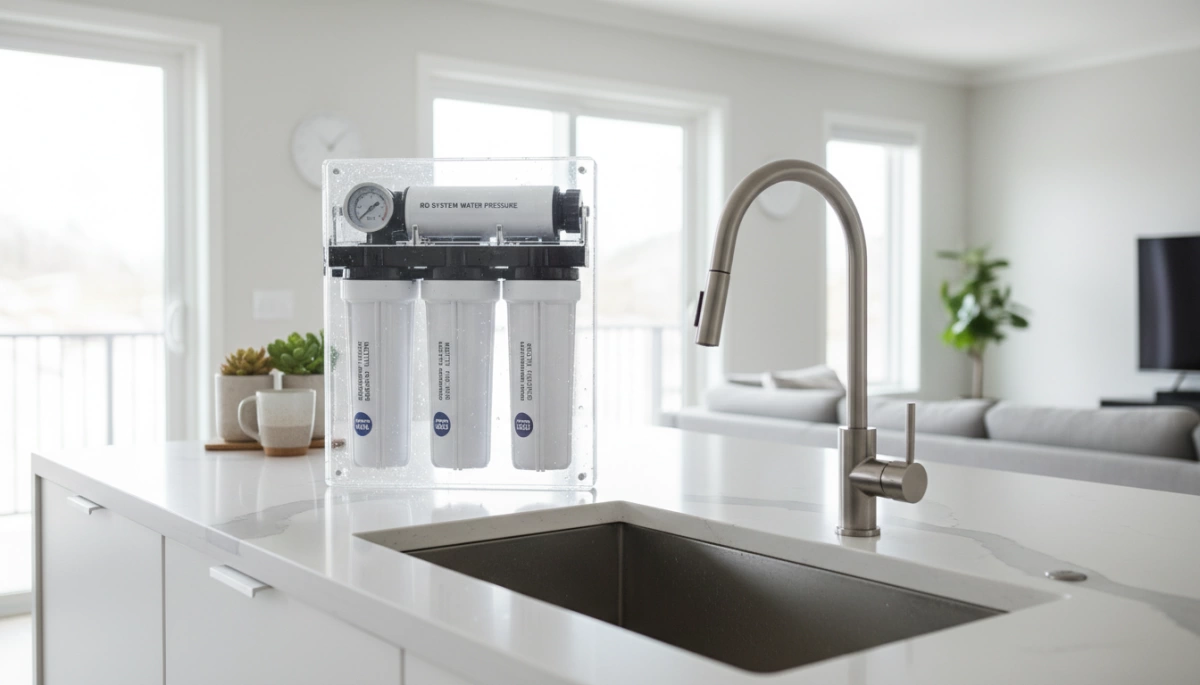
Busting the Myth of Slow Flow Rates
There is a common misconception that tightening the filtration net down to a 0.0001 micron filtration accuracy will inevitably turn your kitchen faucet into a frustrating trickle. While it is true that forcing water through microscopic pores creates resistance—technically known as water filter pressure drop—modern engineering has largely solved this issue. The drop in pressure isn’t caused by the semi-permeable membrane alone; it is often the result of clogged pre-filters or poor system design. In a balanced multi-stage setup, the sediment and carbon filters handle the bulk of the debris, ensuring the RO membrane operates freely without choking the flow.
High Efficiency and Membrane Performance
To combat resistance, we utilize high-grade Thin-Film Composite (TFC) membranes. This technology allows us to maintain a steady production rate, such as our standard 50 Gallons Per Day (GPD) capacity, without sacrificing water quality. By sourcing components from professional water purifier suppliers, we ensure that the membrane structure is dense enough to catch heavy metals but permeable enough to keep your glass full. The system is designed to build up hydraulic pressure to push water through the membrane efficiently, ensuring that “high purity” doesn’t mean “low speed.”
Understanding Pure-to-Drain Efficiency
Efficiency is the name of the game when dealing with RO systems. Older units were notorious for wasting gallons of water for every cup of pure water produced. However, modern high-efficiency designs have improved the pure-to-drain ratio significantly. By optimizing the internal pressure and membrane surface area, we minimize wastewater while maximizing contaminant rejection. This balance ensures that the 0.0001 micron barrier effectively strips out dissolved solids like lead and arsenic, delivering professional-grade water safety without the professional-grade waste.
Understanding Micron Ratings Through TDS Readings
A common point of confusion for many homeowners is testing their water after installing a standard filter and seeing that the TDS (Total Dissolved Solids) numbers haven’t budged. This happens because standard sediment and carbon filters operate at nominal micron ratings of 1 to 5 microns. While effective at trapping physical debris like rust and silt, these pores are far too large to catch dissolved substances. Even a high-quality filter for water dispenser is designed primarily for taste and sediment, not for stripping dissolved minerals from the water.
Why 0.0001 Micron Matters for TDS
To actually lower TDS, you need the 0.0001 micron filtration accuracy provided by a high-grade Thin-Film Composite (TFC) membrane. This specific Reverse Osmosis membrane pore size is tight enough to reject dissolved ions, salts, and heavy metals that slip past the pre-filters.
- Standard Filters (1-5 Microns): Remove suspended solids; TDS remains unchanged.
- RO Membrane (0.0001 Microns): Removes dissolved solids; TDS drops significantly.
We achieve this level of precision through strict manufacturing controls, similar to the processes detailed in how countertop water filters are produced. This is why the RO stage is the only part of the system capable of delivering up to 99% Total Dissolved Solids (TDS) reduction.
Verifying Accuracy with Smart Technology
The most reliable way to confirm your system’s micron rating is performing as advertised is by monitoring the TDS output. While our systems come with a standard lead-free chrome faucet, using a TDS meter or upgrading to a smart faucet provides real-time data. A low TDS reading is the ultimate proof that your water is being forced through that 0.0001-micron barrier, ensuring that invisible contaminants like arsenic and fluoride are being physically blocked.
When to Change Filters Based on Micron Size
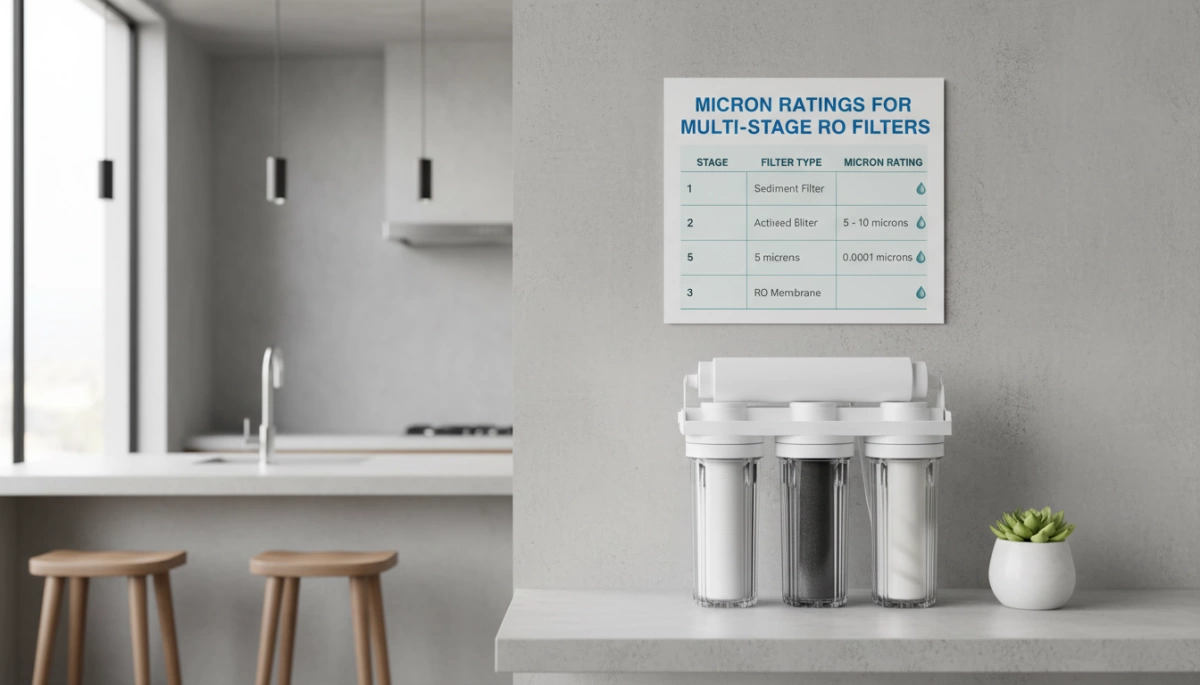
Managing a multi-stage system relies heavily on the step-down filtration process. Think of your filters as a defensive lineup; the larger micron filters (Stage 1 and 2) must do their job to protect the incredibly delicate semi-permeable membrane downstream. If you neglect the pre-filters, larger particles and chlorine blow right past them, instantly clogging the microscopic 0.0001 micron pores of the RO unit. This creates a “cascade effect,” where skipping a basic maintenance step forces you to replace the most expensive component of the system prematurely.
Lifecycle Guide: PPC vs. RO Membrane Replacement
To maintain peak performance and the correct filtration hierarchy, you need to follow a split schedule. The filter life cycle varies significantly between the pre-filtration stages and the core membrane:
- Pre-Filters (Sediment & Carbon): These are the workhorses that trap physical debris and neutralize chemicals. We recommend changing these every 6 to 12 months. Understanding the chemistry inside, such as the role of KDF in prolonging active carbon life, highlights why fresh carbon is essential for protecting the membrane from chlorine damage.
- RO Membrane (TFC): Because it is shielded by the pre-filters, the high-grade Thin-Film Composite membrane lasts much longer. You generally only need to replace this every 24 to 36 months, provided the pre-filters are changed on time.
DripLife’s Approach to Maintenance
We design our systems around the “Simple Life” philosophy. Whether utilizing standard-sized cartridges or modern quick-connect designs, the goal is to ensure that swapping out a saturated filter doesn’t require a plumber. By adhering to this schedule, you ensure the 0.0001 micron filtration accuracy remains compromised, keeping your water free of heavy metals and dissolved solids year-round.
Frequently Asked Questions About RO Micron Ratings
Is 0.0001 micron really necessary for tap water?
Absolutely. While municipal water is treated, it often travels through aging infrastructure that can leach invisible contaminants. A standard carbon filter handles taste and chlorine, but it takes 0.0001 micron filtration accuracy to effectively manage dissolved solids. This specific rating is critical for heavy metal removal, targeting substances like lead and arsenic that are far too small for a standard 1-5 micron filter to catch. If your goal is the purest drinking water possible, the semi-permeable membrane is non-negotiable.
Can I wash and reuse a 5-micron sediment filter?
I strongly advise against this. These components are designed for depth filtration, meaning they trap particles deep inside the matrix, not just on the surface. Washing a filter might remove visible outer dirt, but it cannot clear the internal structure. Reusing a clogged unit compromises sediment pre-filter efficiency, leading to significant pressure drops and forcing your expensive RO membrane to work harder than it should. It is always safer and more cost-effective to stick to the recommended filter life cycle.
How do I know if my micron rating is effective?
You cannot see 0.0001 microns with the naked eye, so visual inspection is unreliable. The best method is measuring Total Dissolved Solids (TDS) reduction. Since the RO membrane removes conductive ions and dissolved minerals, a significantly lower TDS reading compared to your feed water confirms that the multi-stage filtration hierarchy is functioning correctly. If your TDS levels start creeping up, it is a clear indicator that the membrane’s precision is compromised or the pre-filters are exhausted.