

















NSF 58 Tankless RO: Demystifying the Standards
Are you navigating the costly and time-consuming hurdles of reverse osmosis standard NSF compliance for your next product line? In the B2B water purifier market, achieving NSF/ANSI 58 certification is the non-negotiable baseline for market access. However, engineering a modern, high-capacity system that passes these rigorous third-party audits is notoriously difficult. We understand the commercial risk and launch delays associated with failed testing.
To build a compliant point-of-use reverse osmosis unit, our manufacturing process strictly targets the four non-negotiable pillars of the NSF 58 tankless RO standard:
- RO System Material Safety: Highly purified water is naturally corrosive. We guarantee that zero harmful chemicals or VOCs leach from the system\’s plastics, composites, or components into the clean water.
- Tankless RO Structural Integrity: Pushing instant water requires powerful internal booster pumps. We engineer the casing, manifolds, and tubing to withstand intense pressure spikes and continuous long-term water pressure without leaking or bursting.
- Contaminant Reduction Performance: The system must pass rigorous TDS reduction testing. This verifies the exact heavy metal rejection rates and chemical reduction capabilities under realistic, stressed conditions.
- NSF Recovery Rating: We balance high water output with environmental demands by strictly testing the pure-to-drain waste ratio, ensuring the system meets efficiency standards without prematurely fouling the membrane.
How NSF 58 Directly Dictates Tankless RO Engineering & Design
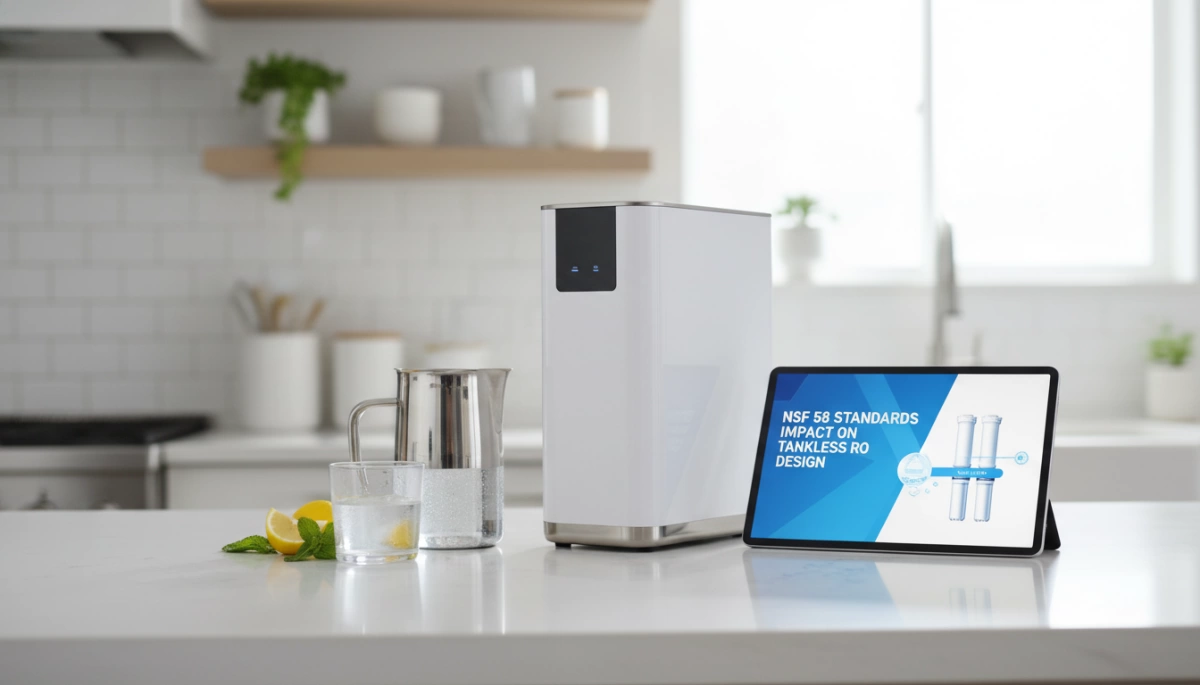
The NSF 58 Standards Impact on Tankless RO Design cannot be overstated. We don\’t just build these units to look sleek under a kitchen counter; we engineer them from the ground up to survive rigorous third-party testing. As a leading B2B water purifier supplier, here is exactly how these strict constraints shape our manufacturing floor.
Material Selection and the \’Corrosive\’ Nature of Pure Water
When you strip water of its impurities, it becomes \”hungry.\” Highly purified RO water will aggressively leach minerals right out of standard metal fittings.
- Beating the Extraction Tests: To pass strict NSF 58 material extraction tests, our engineers completely eliminate reactive metals from the purified water pathways.
- Advanced Composites: We strictly utilize high-grade, food-safe plastics and specialized composites for all internal manifolds and waterways.
- Guaranteed Safety: This relentless focus on RO system material safety prevents contamination and guarantees absolute purity at the dispense point.
Tankless RO Structural Integrity vs. Internal Booster Pumps
Point-of-use reverse osmosis without a storage tank relies entirely on heavy-duty internal pumps to force water through the membrane on demand.
- High-Pressure Environments: Driving water fast enough for instant dispensing creates extreme internal pressure.
- Passing the Pressure Test: NSF 58 dictates that the casing, tubing, and the core integrated waterboard design must be able to withstand massive PSI spikes without leaking, swelling, or bursting.
- Solid Engineering: Flawless booster pump RO engineering ensures that our under sink distribution systems can handle years of heavy, on-demand residential use across the United States without a single structural failure.
Balancing High GPD Output with NSF Efficiency Standards
American consumers demand instant, fast-flowing water, but they also want low waste. Hitting that sweet spot is the ultimate engineering challenge.
- Optimizing the Waste Ratio: Squeezing a massive volume of water through a High GPD RO membrane while maintaining an excellent pure-to-drain waste ratio requires absolute precision inside the housing.
- Meeting the Standards: We successfully hit the rigorous NSF recovery rating requirements without premature clogging by utilizing advanced, tight membrane winding techniques.
- Pre-Filtration Defense: We also lean heavily on targeted multi-stage pre-filtration. Dialing in the precise micron ratings for multistage RO protects the main membrane from fouling, sustains high flow rates, and keeps the entire system compliant with strict efficiency protocols.
Winning Consumer Trust in RO Compliance
The Danger of Marketing Fluff
American consumers are tired of greenwashing in the water filtration market. I see it all the time: buyers researching exactly why a high-quality water filter is important for their homes, only to be met with confusing industry jargon. Today\’s buyers are smart. They know the difference between a system that is officially \”certified\” and one that vaguely claims to be \”tested to\” a standard.
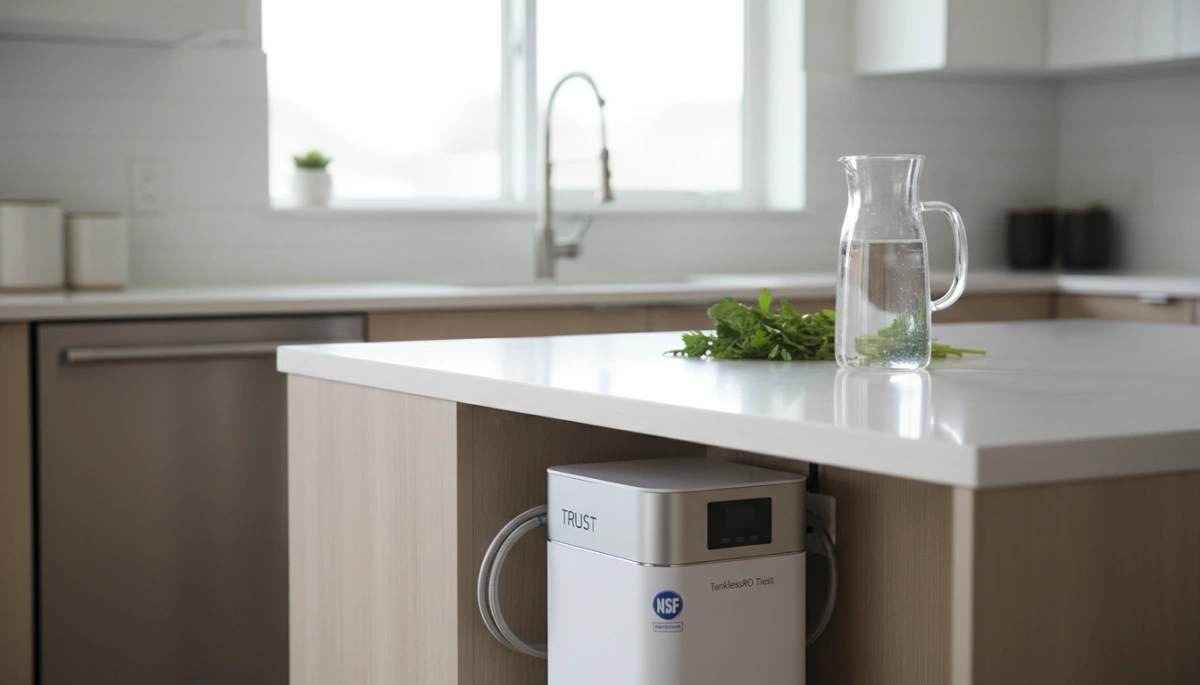
For water brands, relying on clever wordplay and marketing fluff carries severe commercial risk. Slapping \”tested to meet NSF performance criteria\” on a box won\’t win long-term loyalty and can quickly destroy your brand\’s credibility. On the other hand, holding an official NSF/ANSI 58 certification delivers a massive competitive advantage. It is absolute proof of your reverse osmosis compliance and gives your customers total peace of mind.
Why Official Certification is Non-Negotiable:
- Brand Protection: You completely avoid the liability and public relations nightmare of failed safety claims.
- Consumer Confidence: An official certification seal instantly validates your system\’s performance and safety metrics.
- Market Dominance: Certified systems easily justify premium pricing and outmaneuver non-certified competitors on the shelves.
You cannot fake true compliance. Achieving that official stamp of approval requires teaming up with a specialized B2B water purifier supplier. I always remind our partners that building a compliant system isn\’t just about assembling standard parts. It requires a manufacturing partner who has the in-house engineering infrastructure to consistently pass the industry\’s most rigorous third-party audits. Ultimately, your brand\’s reputation rests entirely on the capability of the factory floor.
The Driplife Advantage: Your OEM/ODM Partner for Compliant Manufacturing
Navigating the NSF 58 Standards Impact on Tankless RO Design is a complex process that demands a capable partner. As a leading water filter OEM ODM manufacturer, we provide the engineering backbone required to bring fully compliant, high-performance systems to the US market.
We build custom water filtration solutions that meet rigorous global standards, ensuring your brand stands up to heavy consumer scrutiny. Here is exactly how we deliver that advantage:
- World-Class R&D: We bring over 15 years of dedicated experience to designing high-capacity RO systems. From managing complex integrated waterboard designs to hitting strict NSF recovery ratings, our engineering team knows exactly what it takes to achieve full NSF/ANSI 58 certification.
- Advanced Manufacturing Infrastructure: Our 60,000-square-foot facility is built for precision. We utilize strict online inspection protocols and run continuous in-house laboratory testing. Whether we are optimizing high-pressure under-sink models or evaluating how our countertop water filters work, our internal labs guarantee absolute tankless RO structural integrity and RO system material safety before any unit goes into mass production.
- Scalability for Global Brands: As your reliable B2B water purifier supplier, we have the infrastructure to scale seamlessly with your growth. We maintain an annual production capacity of 500,000 machines backed by a robust supply chain. This ensures distributors get top-tier, compliant tankless systems delivered nationwide on time, every time.
Partnering with us means you secure the manufacturing firepower to meet strict NSF performance criteria without ever sacrificing speed to market or production scale.
FAQ: NSF 58 Standards Impact on Tankless RO Design
Does NSF 58 certification test the wastewater ratio of tankless RO systems?
Yes, it does. Under NSF/ANSI 58 certification, the pure-to-drain waste ratio is evaluated to determine the system\’s official NSF recovery rating. We engineer our point-of-use reverse osmosis units to strike the perfect balance—delivering high water efficiency to meet modern environmental standards without causing premature membrane fouling.
Why are tankless RO systems harder to design for structural integrity?
Traditional setups rely on external storage, but tankless models use powerful internal motors to force water through the membrane instantly. This booster pump RO engineering creates intense internal PSI spikes. To guarantee tankless RO structural integrity, we have to aggressively reinforce the plastics, optimize the pressure regulation logic, and utilize a seamless integrated waterboard design so the unit can survive rigorous NSF pressure testing without leaking or bursting.
Can a high GPD tankless RO system still pass NSF 58 TDS reduction tests?
Absolutely. Pushing water faster doesn\’t have to mean a drop in water quality. By using a tightly wound high GPD RO membrane and premium multi-stage pre-filtration, we maintain the necessary contact time for optimal purification. This ensures the system delivers high-flow, on-demand water while consistently passing strict TDS reduction testing and maintaining superior heavy metal rejection rates.