
















The \”Hungry Water\” Phenomenon: What Happens Inside the Membrane?
When we engineer high-performance filtration systems like the DripLife G3 series, our primary goal is absolute purity. However, achieving this level of filtration introduces a fascinating scientific paradox. When water is stripped of virtually every contaminant, it enters a state often referred to in the industry as \”hungry water.\” In this ultra-pure state, water becomes chemically aggressive because it lacks the dissolved ions it naturally carries. To understand The Science of Water Taste: Why RO Needs a Final Polish, we first have to look at what happens at the molecular level inside the filtration chamber.
Stripping the Good with the Bad: Mechanics of the 0.0001-Micron Pore Size
The heart of our system is the reverse osmosis membrane, featuring a pore size of just 0.0001 microns. To put that in perspective, this is fine enough to filter out particles at the atomic scale.
While this precision is necessary to block harmful contaminants like lead, arsenic, PFAS, and fluoride, the membrane does not discriminate between \”good\” and \”bad\” dissolved solids. It acts as an absolute barrier.
- Contaminants Removed: Heavy metals, viruses, bacteria, and synthetic chemicals.
- Minerals Removed: Calcium, magnesium, and potassium.
By removing these mineral ions, we are left with a solvent that is technically pure but chemically unbalanced.
The Taste of Nothing: Why Low TDS Lacks Body
Water enthusiasts and sommeliers often talk about \”mouthfeel.\” In tap water, Total Dissolved Solids (TDS) provide texture and weight. When we reduce TDS by over 90%—a standard benchmark for our high-efficiency RO units—we are essentially creating a blank canvas.
Without minerals to round out the sensory profile, the water can feel \”thin\” or \”flat\” on the tongue. It lacks the velvety texture that our palates unconsciously associate with hydration, leading to a sensation that feels less satisfying despite being cleaner.
The Chemistry of pH Drop: Henry’s Law and Carbonic Acid
Here is where the chemistry gets interesting. While our RO membrane blocks solid contaminants, it allows gases to pass through. Carbon dioxide (CO2) is a gas naturally present in water sources.
According to Henry’s Law, when we remove the dissolved solids (which often act as a buffer), the CO2 gas remains and dissolves into the pure water. This reaction forms a weak acid known as carbonic acid.
- The Reaction: H₂O + CO₂ → H₂CO₃
- The Outcome: A slight drop in pH, shifting the water from neutral (7.0) to slightly acidic (often between 6.0 and 6.5).
The Result: Why RO Water Tastes Sharp or Bitter
The combination of extremely low TDS and the formation of mild carbonic acid creates a distinct flavor profile. Without the alkaline buffer of calcium or magnesium to neutralize the acid, raw RO water can taste sharp, metallic, or slightly bitter.
This isn\’t a defect in the system; it is proof that the membrane is working exactly as intended. However, for the end-user, \”pure\” shouldn\’t mean \”bitter.\” This chemical reality is exactly why we integrate a final stage—the Carbon Block (CB) or \”polish\”—to correct the pH and restore a crisp, refreshing taste before the water ever hits your glass.
The Storage Problem: Why \”Tank Taste\” Occurs
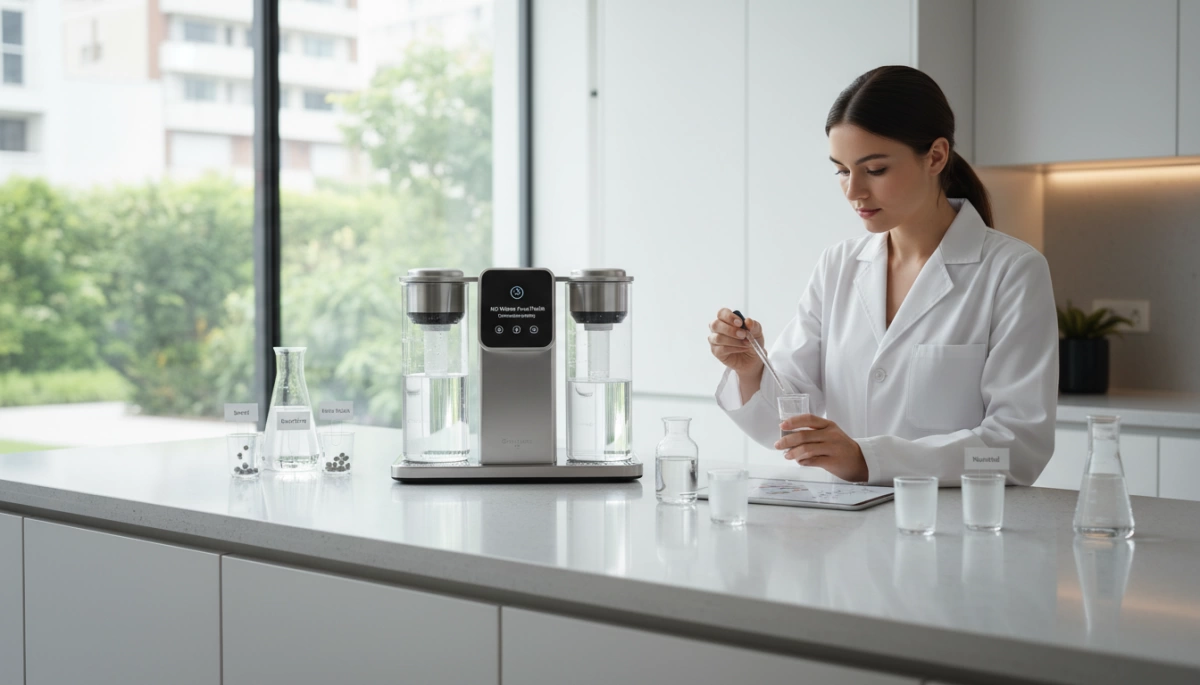
When we talk about the science of flavor, we cannot ignore where the water lives before it hits your glass. In traditional reverse osmosis setups, the slow filtration speed necessitates a storage container. This is where the purity we worked so hard to achieve often gets compromised.
Stagnation in the Bladder
Most standard systems utilize a hydro-pneumatic tank to store filtered water. Inside these metal shells lies a rubber or butyl bladder that holds the water under pressure. While effective for storage, this design creates a perfect environment for stagnation.
Water is a universal solvent; it wants to dissolve things. When ultra-pure, \”hungry\” RO water sits stagnant inside a rubber bladder for hours or days, it begins to interact with the material. This is a common source of secondary pollution, where the very vessel meant to hold clean water ends up degrading its quality.
Permeation: Absorbing Rubbery Odors
If you have ever tasted water that seems to have a \”plastic\” or \”burnt rubber\” note, you are likely tasting the storage tank. Over time, volatile organic compounds (VOCs) from the bladder material can permeate the water.
- Material Leaching: The rubbery notes transfer into the water profile, especially during warm weather or long periods of non-use.
- Metallic Taints: As the internal air charge drops, water may come into contact with the metal casing, introducing a metallic zing.
- Biofilm Potential: Stagnant water is more prone to bacterial growth if the system isn\’t sanitized regularly.
Many families decide to replace bottled water with RO systems for better health, only to be disappointed by this \”tank taste.\” This is exactly why we engineered the DripLife G3 Series with a tankless design—eliminating the bladder eliminates the risk of storage-based contamination entirely.
The Role of the Polish
Because storage tank odors are such a prevalent issue in the industry, the final filtration stage becomes non-negotiable. Even in our tankless systems where water is filtered on-demand, a final polish is essential to ensure every drop is crisp.
In systems with tanks, the post-filter acts as a \”scrubber,\” removing the rubbery taste accumulated during storage just seconds before the water exits the faucet. In our tankless G3 models, this stage serves to refine the flavor profile, ensuring that the water isn\’t just chemically pure, but also palatable and refreshing.
The Anatomy of a Final Polish: How We Fix the Taste
We don\’t just stop at the membrane. While the 0.0001-micron RO layer does the heavy lifting for safety, the final polishing stage is where we engineer the enjoyment. This is the difference between water that is technically pure and water that you actually want to drink.
The Carbon Scrub: Coconut Shell Activated Carbon and Adsorption
The workhorse of our final stage is the Carbon Block (CB) filter. We utilize high-grade coconut shell activated carbon because of its incredible porosity. Think of this stage as a molecular sponge. Through a process called adsorption, the carbon scrub traps any lingering volatile organic compounds (VOCs) or residual chlorine that might have slipped through. This ensures that when you turn on your DripLife faucet, there are no \”off\” odors—just crisp freshness.
Remineralization: Reintroducing Calcium, Magnesium, and Potassium
Pure water is often described as \”hungry\” because it lacks dissolved solids. In the science of taste, a complete polishing stage often involves remineralization. By subtly reintroducing trace elements like Calcium, Magnesium, and Potassium, we restore the water\’s \”body.\” This doesn\’t just improve health parameters; it fixes the texture. Water without minerals feels thin; water with restored minerals feels substantial and satisfying.
Flavor Profile Changes: Adding Smoothness and Eliminating Acidic Bite
The goal of the final polish is to transform the sensory profile from \”sharp\” to \”smooth.\” Unpolished RO water can sometimes have a harsh, metallic edge due to the lack of buffering ions. Our filtration design focuses on flavor optimization, smoothing out those rough edges. This results in a velvety mouthfeel that makes hydration feel like a premium experience rather than a chore.
pH Correction: Neutralizing Acid for a Silky Finish
One of the most immediate changes during the polishing phase is pH balance. Because the RO process removes dissolved solids, the water becomes slightly acidic as it reacts with CO2 in the air. Understanding the natural pH of reverse osmosis water is key to knowing why this correction matters. The final polish helps neutralize this acidity, eliminating the sour bite and leaving you with a silky, neutral finish that pairs perfectly with coffee, tea, or just a glass of ice.
Beyond Taste: The Health & Sensory Benefits of Polished Water
When we engineer water filtration systems, we look past the lab reports and focus on the actual drinking experience. Pure water is essential for safety, but mouthfeel and sensory satisfaction are what make people actually want to drink it. A high-quality polishing stage transforms water from a sterile liquid into a refreshing beverage.
Mouthfeel: The Difference Between Thin and Velvety Water
Standard Reverse Osmosis (RO) water, having passed through a 0.0001-micron membrane, is stripped of almost all Total Dissolved Solids (TDS). While chemically pure, this creates a sensation often described as \”thin\” or \”flat.\” It lacks the body that our palates expect.
The final polish, achieved through our specialized Carbon Block (CB) filter, corrects this. By refining the water structure immediately before it hits the glass, we shift the texture from aggressive to smooth.
| Feature | Standard RO (Unpolished) | Polished Water (Driplife CB Stage) |
|---|---|---|
| Texture | Thin, \”hungry,\” sharp | Velvety, smooth, rounded |
| Aftertaste | Slightly acidic or bitter | Clean, neutral, refreshing |
| Sensation | Drying | Quenching |
Hydration Psychology: Why Better Taste Leads to Better Habits
There is a direct link between the sensory profile of water and hydration frequency. In the US market, where consumers are increasingly health-conscious, the barrier to proper hydration is often palatability. If water tastes \”medical\” or flat due to low TDS and uncorrected pH, users subconsciously avoid it.
By utilizing a post-carbon filter to remove residual odors and organic compounds, we improve the drinking experience. This subtle shift in flavor profile encourages users to refill their cups more often, turning hydration from a chore into a habit.
Driplife’s Innovation: Freshness via Tankless Design
While the industry buzzes about additives and infusions, the most critical innovation for taste is immediacy. Traditional RO systems store filtered water in a rubber-lined tank, where it can sit for hours, absorbing \”tank taste\” and losing its freshness.
At Driplife, we solved this with our Tankless Reverse Osmosis architecture found in the G3 and G2 series. By eliminating the storage tank, we ensure that the Carbon Block polish happens seconds before you drink.
- Real-time Filtration: Water flows through the CB stage at up to 800 GPD, ensuring the polish is fresh, not stagnant.
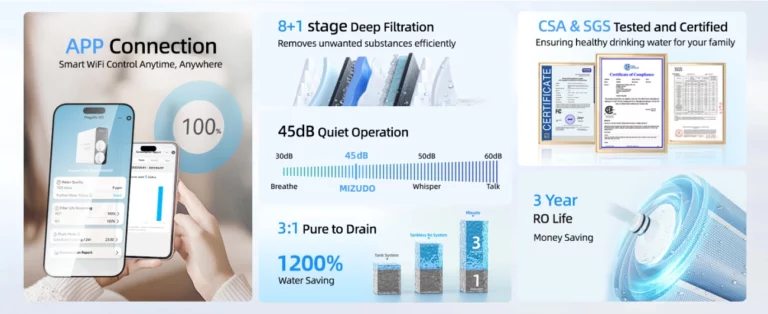
- Smart Monitoring: Our systems display real-time TDS levels, giving visual proof of the water\’s purity and the effectiveness of the filtration stages.
For those tracking industry news and filtration trends, the shift toward on-demand, tankless polishing is setting a new standard for how premium water should taste. We focus on removing the bad (Lead, PFAS, Fluoride) while ensuring the final product feels right on the palate.
Choosing the Right Polishing Filter for Your System
When customizing your water filtration setup, the final stage—often called the polishing stage—is where the magic happens for your palate. While the reverse osmosis membrane does the heavy lifting by removing contaminants like lead and PFAS, the final filter defines the drinking experience. Generally, you are choosing between refining purity with carbon or altering the chemistry with minerals.
Inline Post-Carbon vs. Mineral Cartridges
The choice comes down to what you want your water to do. An inline post-carbon filter, like the advanced Carbon Block (CB) used in our G3 series, is designed for flavor optimization. It acts as a safety net, catching any lingering Volatile Organic Compounds (VOCs) or stale tastes that might have developed.
On the other hand, a remineralization cartridge focuses on electrolyte balance. Since RO removes minerals, these cartridges dissolve trace amounts of calcium and magnesium back into the water to neutralize acidic water pH and improve mouthfeel. For most users, a high-quality carbon polish provides that crisp, clean \”bottled water\” taste, while mineral options are for those seeking a specific alkaline profile.
Maintenance Matters: Replacement Schedules
Even the best coconut shell activated carbon eventually saturates. Once the adsorption sites are full, the filter can no longer trap odors, and you might notice a return of that flat or slightly rubbery taste. Sticking to a strict replacement schedule is non-negotiable for safety and taste.
- Monitor Filter Life: Don\’t guess. Our systems feature real-time monitoring on the faucet to tell you exactly when the post-filtration stage is depleted.
- Budgeting: Understanding the long-term cost of water filter for home maintenance helps you plan for these necessary replacements without surprise expenses.
- System Health: Beyond changing cartridges, features like how autoflush technology prevents clogging and foul odors play a massive role in preserving the internal hygiene of the system, ensuring the polishing filter doesn\’t get overwhelmed by upstream contaminants.
The Driplife Advantage: Rigorous Testing
We don\’t just use generic carbon. At Driplife, we prioritize coconut shell activated carbon with high iodine values. The iodine value is a technical measurement of the carbon\’s porosity—a higher number means more surface area to trap contaminants.
By selecting carbon with superior adsorption capabilities, we ensure that our Carbon Block (CB) filters effectively eliminate residual chlorine and organic compounds that affect the sensory profile. This rigorous attention to material quality is why our tankless systems can deliver a consistent, silky finish that generic filters often miss.
Frequently Asked Questions About RO Water Taste
Why does my RO water taste acidic?
This is a common side effect of high-purity filtration. When our 0.0001-micron RO membrane removes Total Dissolved Solids (TDS), it strips away the minerals that act as a pH buffer. Without these solids, the water becomes \”hungry\” and absorbs carbon dioxide from the air, forming mild carbonic acid. This slight drop in acidic water pH creates that sharp or \”flat\” sensation on the tongue. This is exactly why we integrate a Carbon Block (CB) filter as the final stage—to polish the water and neutralize that bite before it hits your glass.
Does reverse osmosis remove good minerals?
Yes, and that is by design. The RO membrane cannot distinguish between harmful contaminants like lead or arsenic and beneficial minerals like calcium and magnesium. It blocks everything larger than a water molecule to ensure safety. While this results in pure water, it lacks the \”body\” provided by electrolytes. However, getting your minerals from a balanced diet is far more effective than relying on tap water, which often carries more risks than nutritional benefits.
How often should I change my post-filter?
Maintaining the \”final polish\” is crucial for preventing odor return and ensuring a crisp taste. For our systems, the Carbon Block (CB) filter typically requires replacement every 6 to 12 months, depending on your water usage and quality. You don\’t need to guess, though. Our G3 and G2 series feature smart faucets and system indicators that monitor filter life in real-time, alerting you exactly when the adsorption capacity is reached so you can swap it out in seconds with our twist-and-pull design.
Can I add minerals back to RO water?
Absolutely. Many users prefer to restore the electrolyte balance for a smoother mouthfeel and health benefits. You can easily integrate a remineralization stage or use a specialized countertop alkaline water filter to reintroduce essential elements like Calcium and Magnesium restoration. This process corrects the pH level and gives the water a silky, velvety texture that rivals premium bottled brands.