















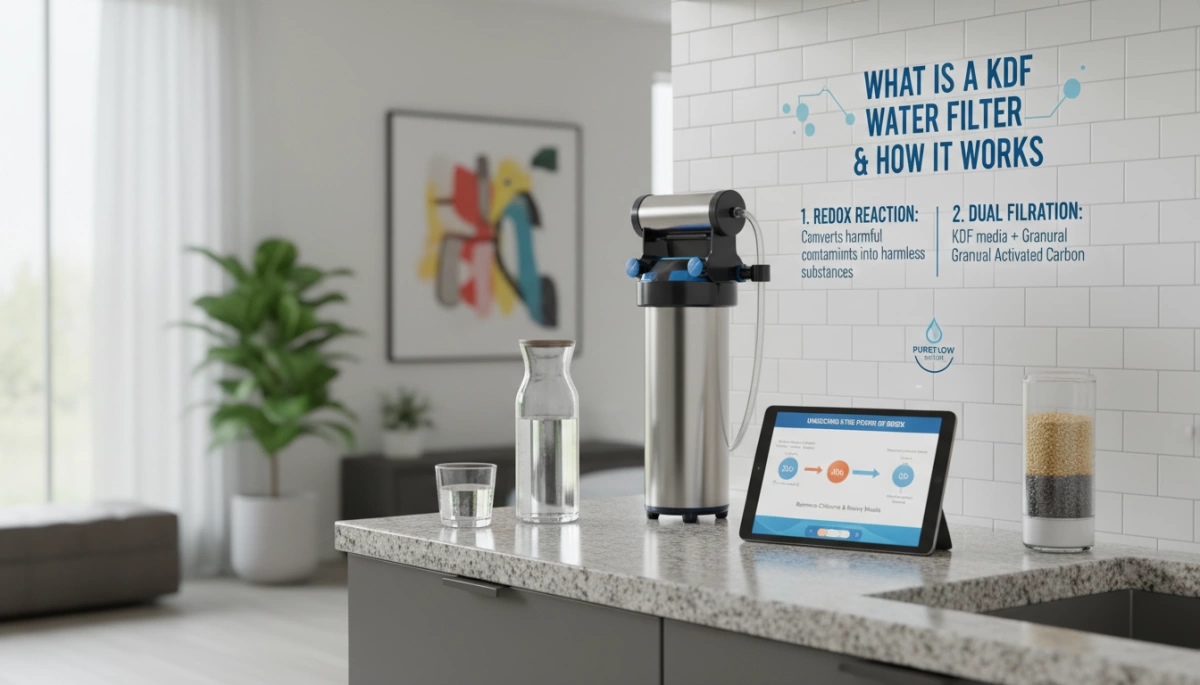
Unlocking the Power of Redox: What is a KDF Water Filter and How it Works
The Engine Room: How the Redox Process Works
At Driplife, we don’t rely on magic to purify water; we rely on established science. The core of our high-performance filtration systems is Kinetic Degradation Fluxion (KDF), a technology that utilizes the principle of Redox (Oxidation-Reduction). This process is the “engine room” of our filters, driving the chemical transformation of harmful contaminants into harmless components. Unlike standard physical filters that merely block debris, our KDF media actively changes the molecular structure of pollutants through electro-chemical oxidation.
The Electro-Chemical Reaction: The Battery Analogy
To understand how our copper-zinc alloy formulation works, imagine a miniature battery. The KDF media is composed of high-purity copper and zinc granules. In the presence of water, these two dissimilar metals create a small electrolytic field.
- Copper acts as the cathode.
- Zinc acts as the anode.
This setup generates an Oxidation-reduction potential (ORP), effectively turning the filter bed into a powerful electrochemical cell that targets impurities instantly upon contact.
Electron Exchange: Unlocking Contaminants
The magic happens during the electron exchange. As water flows through the KDF granules in our 15-stage system, electrons are transferred between the media and the contaminants. This exchange neutralizes pollutants by altering their electron charge. It is a rapid, kinetic reaction that renders toxic substances inert without reducing water pressure—a critical factor for the shower experience we guarantee.
Chlorine Removal: Converting to Harmless Chloride
One of the most immediate benefits of our Redox process is the elimination of free chlorine, the primary cause of dry skin and the “swimming pool” smell in bathrooms. Through chlorine to chloride conversion, the KDF media donates an electron to the chlorine molecule.
- Before Redox: Free Chlorine (Harmful oxidant that damages skin/hair proteins).
- After Redox: Water-soluble Chloride (Harmless, similar to table salt).
This conversion is instantaneous and highly effective, even in the high-temperature environment of a hot shower where carbon filters often fail.
Heavy Metal Sequestration: Trapping Lead and Mercury
Beyond chlorine, our KDF filters excel at heavy metal sequestration. Soluble heavy metals like lead, mercury, copper, nickel, and chromium are attracted to the surface of the KDF media via the electrochemical potential.
- The Mechanism: Soluble metal cations are reduced to insoluble metal atoms.
- The Result: These dangerous metals are electroplated onto the surface of the filter media, effectively trapped and permanently removed from the water stream.
This ensures that inorganic contaminant removal is handled efficiently, preventing these toxins from being absorbed through the skin.
No Chemicals Added: Pure Physical-Chemical Treatment
We prioritize safety and purity. The Redox process is a strictly physical-chemical treatment. We do not add any chemicals to the water during filtration. The copper-zinc alloy acts solely as a catalyst and a capture medium. This means the water exiting a Driplife filter is cleaner and safer without the introduction of new synthetic compounds, adhering to the highest standards of water quality for residential and commercial use.
Distinguishing the Media: KDF 55 vs. KDF 85
When we talk about Kinetic Degradation Fluxion (KDF), we aren’t just dealing with a single solution. In the water treatment industry, we primarily utilize two distinct formulations: KDF 55 and KDF 85. While both rely on the same core copper-zinc alloy formulation to drive the redox reaction, they are engineered to tackle specific water profiles. Understanding the difference between KDF 55 vs KDF 85 is critical for ensuring the filter actually solves the problem at the tap.
KDF 55: The Chlorine and Heavy Metal Specialist
This is the powerhouse we rely on for municipal water applications. KDF 55 is specifically designed to target the contaminants most commonly found in treated city water. Its electrochemical potential is optimized for chlorine to chloride conversion, effectively neutralizing the harsh chemicals that dry out skin and damage hair.
Beyond chlorine, KDF 55 excels at heavy metal sequestration. It targets soluble heavy metals like lead, mercury, nickel, and chromium, bonding them to the media surface so they don’t wash over you in the shower. Because it creates a bacteriostatic environment, it also prevents bacteria buildup within the filter cartridge itself.
- Best For: Municipal/City Water
- Primary Targets: Chlorine, Lead, Mercury, Bacteria, Scale
KDF 85: Targeting Iron and Hydrogen Sulfide
While KDF 55 handles the city, KDF 85 is the heavy hitter for private wells and groundwater sources. This formulation is tweaked to handle oxidation of iron and hydrogen sulfide removal. If your water smells like rotten eggs or leaves reddish-brown stains on your fixtures, KDF 85 is usually the required media. It acts as a catalyst to change soluble iron (ferrous) into insoluble iron (ferric), which can then be easily trapped by the mechanical filtration layers.
- Best For: Private Wells / Groundwater
- Primary Targets: Iron (Ferrous), Hydrogen Sulfide (Sulfur), Manganese
Choosing the Right Media for Your Water Source
Selecting the correct media isn’t a guessing game; it comes down to water chemistry. For the vast majority of residential users connected to a public supply, KDF 55 is the superior choice because chlorine is the primary aggressor. This is why high-performance shower systems focus on KDF 55 to protect skin and hair health. However, as a dedicated water filter supplier, we know that using the wrong media on well water can lead to premature clogging.
Quick Selection Guide:
- City Water: Stick to KDF 55 for maximum chlorine reduction and inorganic contaminant removal.
- Well Water: Opt for KDF 85 to combat iron staining and sulfur odors.
By leveraging the correct scale reduction technology and alloy blend, we ensure that the filtration system delivers consistent pressure and purity, regardless of the source.
Critical Advantages of KDF in Commercial Applications
When we look at commercial water filtration systems, reliability is the name of the game. We use Kinetic Degradation Fluxion (KDF) media because it handles heavy lifting that standard filters simply can’t manage. Whether it is for a high-traffic hotel shower system or industrial pre-treatment, KDF offers distinct operational advantages that translate directly to better water quality and lower maintenance.
Bacteriostatic Environment: Stopping Microbial Growth
One of the biggest headaches in water filtration is the potential for bacteria to breed inside the filter itself. Standard carbon filters can sometimes become breeding grounds for microorganisms if water sits stagnant. KDF media solves this by creating a bacteriostatic water filter environment.
The exchange of electrons in the redox process creates an electrolytic field that is hostile to bacteria, algae, and fungi. This prevents slime buildup inside the cartridge, ensuring that the water flowing through our water filter for tap and shower systems remains hygienic throughout the filter’s entire lifespan.
High-Temperature Stability: Performance in Hot Water
Most people don’t realize that standard Activated Carbon filters lose efficiency when the water gets hot. In fact, hot water can sometimes cause carbon to release trapped contaminants back into the stream. This is why KDF is non-negotiable for shower filtration.
KDF-55 is engineered for high-temperature stability. It maintains its effectiveness even in scalding hot water, continuing to remove chlorine and heavy metals where other media fail. This thermal resistance makes it the perfect engine for our shower systems, ensuring you get purified water regardless of your temperature preference.
Scale Control: Protecting Internal Heating Elements
Hard water is a massive issue across the United States, leading to clogged pipes and reduced water pressure. KDF media utilizes scale reduction technology to modify the crystal structure of calcium and magnesium. Instead of forming hard calcite scale that sticks to heating elements and shower nozzles, the minerals are converted into a simpler form that flows freely through the system.
- Prevents Clogging: Keeps showerheads and pipes free from mineral buildup.
- Maintains Pressure: Ensures consistent flow rates without restricting water output.
- Extends Equipment Life: Protects internal plumbing components from corrosion and scale damage.
The Perfect Duo: Why KDF and Carbon Work Together
In the filtration world, we rarely rely on a single media to do the heavy lifting. While Kinetic Degradation Fluxion (KDF) is a powerhouse for inorganic contaminants, it performs best when paired with Activated Carbon. This combination creates a multi-barrier defense system, addressing both chemical and organic impurities simultaneously. We engineer our systems to leverage this Granular activated carbon (GAC) synergy, ensuring that water isn’t just chemically balanced, but also free of odors and organic compounds.
The Pre-Treatment Strategy: Protecting the Carbon
Think of KDF as the bodyguard for the Activated Carbon. Carbon is incredibly effective at absorbing organic contaminants, herbicides, and pesticides, but it has a weakness: chlorine can rapidly exhaust its absorption sites. By placing KDF media before the carbon stage, we utilize the Redox process to neutralize up to 99% of chlorine into harmless chloride.
This pre-treatment step ensures that the water hitting the carbon layer is already free of harsh oxidizers. This allows the carbon to focus entirely on polishing the water—removing bad tastes, odors, and volatile organic compounds (VOCs). This strategic layering is a primary reason why high-quality systems are so effective and why do shower head filters work so well in municipal water settings.
Extending Lifespan: Reducing Maintenance Costs
When KDF shields the carbon from chlorine damage, it significantly boosts the system’s longevity. Without KDF, a standard carbon filter in a high-chlorine environment might become saturated in just a few weeks. With the addition of our copper-zinc alloy, we achieve substantial filter cartridge lifespan extension.
- Bacteriostatic Benefits: KDF inhibits bacteria growth within the filter media, preventing the fouling that often shortens the life of pure carbon filters.
- Reduced Clogging: By handling heavy metals and scale, KDF keeps the carbon pores open for longer.
- Cost Efficiency: For the end-user, this translates to reduced maintenance frequency and fewer cartridge replacements over the year.
Supply Chain Efficiency for Driplife Clients
For our B2B partners, incorporating this dual-media technology streamlines inventory and boosts customer satisfaction. We provide supply chain reliability by sourcing high-purity, lead-free copper-zinc formulations that meet strict safety standards. By offering a product that combines the heavy-duty power of KDF with the refining capabilities of carbon, we deliver a “total solution” cartridge. This reduces the need for clients to stock multiple types of specialized filters, as our multi-stage systems cover the widest range of water quality issues found in the US market.
Safety and Certification Standards
When we integrate filtration media into our systems, safety isn’t just a checkbox; it’s the foundation of our engineering. We understand that adding metal to water to clean it sounds counterintuitive to some, which is why the purity and certification of the media are non-negotiable.
Material Purity: Lead-Free Copper-Zinc
The Kinetic Degradation Fluxion (KDF) media we utilize is strictly a lead-free copper-zinc high purity alloy. We don’t cut corners with low-grade metals that could introduce new contaminants. Instead, we use a patented copper-zinc alloy formulation that is specifically engineered for water treatment. This ensures that the Redox process remains stable and safe, effectively neutralizing harmful elements without leaching dangerous heavy metals back into your water supply.
NSF/ANSI Compliance: Assuring B2B Safety
Reliability is key, whether for a single household or a large commercial application. The KDF media used in our filters adheres to rigorous industry benchmarks, specifically NSF Standard 42 compliance. This standard verifies that the materials are safe for contact with drinking water and effectively reduce aesthetic impurities like chlorine.
When evaluating different types of water filters, certification provides the assurance that the system will perform as promised. By adhering to these standards, we guarantee:
- Structural Integrity: The media won’t break down physically under pressure.
- Material Safety: No harmful substances are added to the water.
- Verified Performance: The chlorine to chloride conversion actually happens efficiently.
Frequently Asked Questions About KDF Filters
Is KDF filtration safe for drinking water?
Absolutely. KDF process media is composed of a high-purity copper-zinc alloy formulation that is completely safe for human consumption. It meets NSF Standard 42 compliance for material safety and structural integrity. Unlike chemical additives, KDF uses a physical electro-chemical oxidation process that leaves no toxic residuals. While we primarily utilize KDF-55 in our shower systems to protect skin and lungs from vaporized chlorine, the media is widely recognized in the industry for safely reducing heavy metals and chlorine in drinking water applications as well.
How often do KDF filters need to be replaced?
One of the biggest benefits of Kinetic Degradation Fluxion media is its durability. In our 15-stage systems, the KDF layer helps facilitate filter cartridge lifespan extension by preventing bacterial buildup and protecting the carbon layers from fouling. Generally, for a standard household, we recommend replacing the cartridge every 6 months or after approximately 10,000 to 12,000 gallons of usage. This ensures the Oxidation-reduction potential (ORP) remains effective enough to continue neutralizing chlorine and sequestering heavy metals without a drop in water pressure.
Can KDF filters remove fluoride?
It is important to be precise here. While KDF media is a powerhouse for heavy metal sequestration (like lead and mercury) and chlorine to chloride conversion, it is not the primary technology for fluoride removal. KDF-55 and KDF-85 focus on inorganic contaminants and redox reactions. To effectively remove fluoride, specific filtration media like activated alumina or reverse osmosis systems are typically required. We focus on what KDF does best: creating a bacteriostatic water filter environment and eliminating the harsh chemicals that damage hair and skin.
What is the difference between KDF and activated carbon?
Think of them as partners rather than competitors. Granular activated carbon (GAC) synergy with KDF is what makes our filters so effective. Carbon uses adsorption to trap organic compounds, pesticides, and odors, but it struggles in hot water and can become a breeding ground for bacteria. KDF, on the other hand, uses the Redox process to tackle inorganic contaminants and kills bacteria, even in high temperatures. This heat resistance is why KDF is essential for shower filtration, significantly improving the impact of filtered water on colored hair longevity by neutralizing chlorine before it strips natural oils.