













AC vs. DC: The Voltage Breakdown
When we design kitchen appliances at DripLife, we operate under a simple rule: water and high-voltage electricity should never meet. Yet, for decades, traditional reverse osmosis systems relied on 110V or 220V AC pumps running directly under the sink. This old-school approach brings lethal line voltage into a “wet zone” where leaks, condensation, and plumbing failures are common realities.
We believe the future of home filtration is 24V DC. By shifting from Alternating Current (AC) to Direct Current (DC), we fundamentally change the safety profile of the device.
The Danger of Old-School 110V Pumps
In older or industrial-style RO setups, the pump motor is often powered directly by the mains voltage. If a seal fails or a pipe bursts, that water can come into contact with 110V wiring. This creates a severe shock hazard for anyone reaching under the sink to grab a cleaning spray or check a valve. High-voltage AC systems are prone to:
- Arcing risks in humid environments.
- Severe electrical shock if insulation is compromised.
- Short circuits that can trip main breakers or damage home wiring.
Why Modern 12V/24V Systems Are the New Standard
We engineered our T600, T800, and T1000 series to operate strictly on 24V DC. This is considered Low Voltage, drastically reducing the potential for injury. Even if a catastrophic leak occurs and floods the bottom of the unit, 24V is not enough to push a dangerous current through the human body in typical scenarios.
The Laptop Charger Analogy
The best way to understand our safety architecture is to look at your laptop charger.
- At the Wall: The power brick (adapter) takes the dangerous 110V AC from your outlet.
- The Conversion: It steps that power down to a safe, steady DC current.
- At the Device: The cord plugging into your laptop—or in our case, the RO system—carries only safe, low-voltage power.
By keeping the high-voltage conversion at the wall outlet and away from the plumbing, we ensure that the appliance sitting under your sink is electrically benign.
Understanding SELV (Safety Extra Low Voltage)
In engineering terms, we utilize SELV protection. This stands for Safety Extra Low Voltage. It is an electrical system design where the voltage is low enough that there is no risk of electric shock during normal operation or a single fault condition.
- Touch-Safe: You can touch 24V terminals without getting “zapped.”
- Isolation: The circuitry is electrically separated from the mains power.
- Compliance: This standard meets strict international safety codes for wet-area appliances.
By adhering to SELV standards with our 24V architecture, we prioritize family safety without sacrificing the high-torque performance needed for our 600-1000 GPD tankless systems.
Shock Protection: Why You Won’t Get Zapped
When we talk about “touch-safe” voltage, we are referring to power levels low enough that they cannot penetrate human skin resistance to cause a harmful shock. DripLife systems operate on 24V DC, which falls squarely into the Safety Extra Low Voltage (SELV) category. Unlike the 110V AC running through your garbage disposal or dishwasher, a 24V DC current lacks the electrical pressure to deliver a dangerous jolt. This is crucial for appliances installed in the “Wet Zone” under your sink, where plumbing and power inevitably sit side-by-side.
Eliminating Lethal Arcing Risks
The biggest fear regarding under-sink electrical hazards is water bridging a connection. If a standard high-voltage wire gets compromised by moisture, it can arc, spark, or electrify the surrounding puddle. With a 24V DC water pump, the physics change completely to favor homeowner safety.
- Wet Wire Scenario: If a low-voltage wire is exposed to water, the system typically just shuts down or blows a small internal fuse rather than creating a hazardous live zone.
- No Arcing: 24V DC does not have the energy to sustain dangerous electrical arcs across gaps, significantly reducing fire risks.
- Safe Maintenance: You can inspect your system or change filters without the anxiety of working near lethal voltage.
This low-voltage architecture ensures that every component, from the main pump to the tap with filter water, remains safe to touch even in humid conditions. We prioritize this splash protection to ensure that a minor plumbing leak never turns into a major electrical emergency.
Fire Safety and Heat Management
When we engineer our DripLife units, we prioritize tankless RO fire safety just as much as water purity. Traditional AC motors often suffer from significant energy loss in the form of heat, which can be dangerous in enclosed spaces. By switching to a modern 24V DC water pump, we eliminate the excess thermal buildup common in older, high-voltage appliances.
Why DC Motors Run Cooler
The efficiency of Direct Current (DC) means more energy goes directly into pushing water through the RO membrane and less into generating waste heat. High-voltage AC pumps can become hot to the touch after heavy usage, but our low-voltage systems remain cool even when filtering large volumes of water. This is crucial for energy efficient water filtration and maintaining a safe operating temperature in your home.
Preventing Overheating in Enclosed Spaces
Your undersink cabinet is a tight, unventilated space often packed with cleaning supplies, trash bins, and plumbing. This lack of airflow makes heat management critical. If you are still learning about how these units fit into tight spaces, understanding what is an undersink reverse osmosis system helps clarify why compact, cool-running tech is essential.
- Cabinet Protection: Continuous heat radiation from an inefficient appliance can warp wooden cabinetry or cause laminate to peel over time. Our cool-running DC motors protect your kitchen joinery.
- Reduced Fire Risk: By keeping operating temperatures low, we significantly lower the risk of combustion in the “dead air” zone under the sink.
- High Torque, Low Heat: We achieve high flow rates (up to 1000 GPD) using high-torque motors that deliver pressure without the electrical strain or spark risk associated with 110V/220V motors.
Hydro-Electric Separation Engineering
When we design our filtration units, we operate on a simple rule: water and electricity must never meet. Hydro-electric separation is the structural backbone of our safety philosophy. It is not enough to just lower the voltage; we physically isolate the water routes from the electronic control systems to prevent catastrophic failures.
Our Driplife engineering approach focuses on a “no-leak” integrated water path. Instead of a messy web of tubing that can burst or drip onto wires, we use a consolidated manifold. This internal architecture ensures that the water flow is strictly contained, while the electrical components are housed in a separate, dry compartment.
Here is how we secure the hardware:
- Physical Isolation: The circuit board and pump electronics are positioned away from water inlets and outlets.
- Sealed Components: Critical electronics are enclosed to provide moisture defense against humidity and accidental splashes.
- Short Circuit Prevention: By creating a physical barrier, we stop short circuits at the hardware level before they can start.
This multi-layered protection ensures that your undersink reverse osmosis water filter remains safe and operational, even in the damp environment of a kitchen cabinet.
Smart Safety Features Powered by Low Voltage
Switching to a 24V DC platform isn’t just about preventing shocks; it is the foundation that allows us to integrate intelligent monitoring without adding electrical risk. In the past, adding sensors or electronic displays to a high-voltage AC unit under a sink was a recipe for disaster. Today, our low-voltage architecture safely powers a suite of smart safety features that actively protect your home and family.
We utilize this safe power delivery to run automated leak detection sensors. These sensors constantly monitor the internal environment of the system. If moisture is detected where it shouldn’t be, the system triggers an instant power cut-off mechanism. This shuts down the pump immediately, preventing water damage to your cabinetry and eliminating electrical hazards before they start. It is a proactive approach to reverse osmosis leak detection that passive systems simply cannot match.
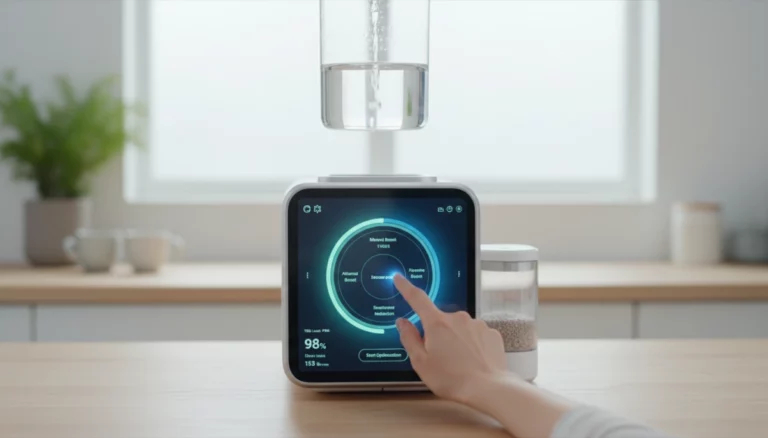
Furthermore, the 24V supply extends to the countertop, powering our smart water filter faucet. Because we are working with safe extra-low voltage, we can integrate a digital screen directly into the faucet handle. This provides real-time system monitoring, displaying your TDS (Total Dissolved Solids) levels and filter lifespan instantly. You get the data you need to ensure water quality without running dangerous high-voltage lines through your countertop.
Smart 24V System Capabilities:
| Feature | Function | Safety Benefit |
|---|---|---|
| Leak Sensors | Detects internal moisture accumulation. | Prevents flooding and electrical shorts. |
| Auto Shut-Off | Cuts power upon leak detection. | Stops the pump to minimize water damage. |
| Smart Faucet | Displays TDS and filter status. | Safe power for smart faucets eliminates shock risk at the tap. |
| Filter Alerts | Tracks usage for timely replacement. | Ensures water purity without guessing. |
This level of integration mirrors the technology found in efficient countertop reverse osmosis systems, bringing advanced digital monitoring to the undersink environment safely. By relying on energy efficient water filtration components running on DC power, we ensure that being “smart” never compromises safety.
DIY Installation Safety Benefits
When we engineered our tankless RO lineup, we wanted to ensure that setting it up didn’t require hiring a licensed electrician. Traditional high-voltage appliances often need hardwiring, which poses significant risks if not done perfectly. Our systems utilize a DC adapter approach—similar to a laptop charger—effectively separating the dangerous wall voltage from the wet undersink environment.
Plug-and-Play Simplicity
The transition to 12V/24V low voltage allows for a true plug-and-play experience. You simply plug the external power adapter into a standard outlet, and it converts the current before it ever reaches the filtration unit. This eliminates the risk of handling live 110V wires under your sink. Whether you are setting up a standalone unit or configuring a complex under-sink distribution system, the electrical connection remains touch-safe.
Why Low Voltage is Safer for DIYers:
- No Hardwiring Required: Eliminates the need for wire stripping or circuit breaker management.
- Touch-Safe Output: The cable running from the adapter to the RO unit carries safe low voltage (SELV).
- Child Safety: Reduces shock hazards significantly if curious children access the cabinet.
Global Voltage Compatibility
Our power adapters are designed to handle a wide input range (110V–240V), making them robust against voltage fluctuations while ensuring the internal pump always receives a steady 24V. This protects the sensitive electronic components and the smart faucet display from power surges.
| Feature | Traditional AC Pump | DripLife 24V DC System |
|---|---|---|
| Installation Type | Often requires hardwiring | Standard Wall Plug (Adapter) |
| Shock Risk | High (110V/220V at unit) | Negligible (24V at unit) |
| Professional Help | Electrician Recommended | 100% DIY Friendly |
| Moisture Risk | Dangerous arcing potential | Sealed, low-voltage connections |
By keeping the high voltage at the wall socket and only running 24V DC to the machine, we ensure that DIY RO installation is not only easy but inherently safe for the average homeowner.
FAQ: Common Questions on RO Electrical Safety
Does low voltage mean low water pressure?
Absolutely not. There is a common misconception that “low voltage” equals “low power,” but that isn’t the case with modern engineering. Our 24V DC water pump systems, like the DripLife T800 and T1000, utilize high-torque motors designed specifically to push water through the 0.0001-micron RO membrane efficiently.
We achieve flow rates of up to 1000 GPD (Gallons Per Day), filling a cup in about 6 seconds. The voltage reduction is purely for safety and heat management; the internal mechanics deliver the same, if not better, pressure than older high-voltage AC pumps. You get the safety of a 12V RO system safety standard with the performance of a commercial unit.
Is the external power adapter waterproof?
The external power adapter acts as a DC step-down transformer, converting your home’s 110V AC outlet power into safe 24V DC current before it ever reaches the undersink area. While the adapter itself is built to withstand standard kitchen humidity and minor splashes, it is not fully waterproof and should never be submerged.
The key safety benefit here is separation. By keeping the high-voltage conversion at the wall outlet—away from the plumbing—we minimize under-sink electrical hazards. The cord running to your reverse osmosis water filter under sink carries only safe, low-voltage electricity, significantly reducing shock risks in the “wet zone.”
Do 24V systems consume less electricity?
Yes, energy efficient water filtration is a major benefit of switching to DC. Direct Current (DC) motors generally run more efficiently than Alternating Current (AC) motors, generating less waste heat and using only the power necessary to drive the pump.
Furthermore, our tankless design adds to these savings. Unlike traditional systems that may cycle on and off frequently to keep a storage tank pressurized, our systems only consume power when you turn on the faucet. This “on-demand” operation, combined with smart monitoring that prevents unnecessary running, keeps your utility bills low.
Can I install a tankless RO system myself safely?
Definitely. One of the biggest advantages of our low-voltage architecture is that it enables safe DIY RO installation. You do not need a professional electrician or complex hardwiring skills.
Since the system uses a standard plug-in adapter, you are not exposing yourself to live 110V wires during installation. The connections are simple, quick-connect fittings, and the electrical component is as safe as plugging in a laptop. This plug-and-play approach removes the fear of short circuit protection failures often associated with wiring traditional high-voltage appliances in tight, damp spaces.