

















The Physics: Why Do RO Systems Vibrate?
Ever wonder why your peaceful kitchen suddenly sounds like a mini-factory the moment you turn on the faucet? It’s not just in your head. As engineers, we know that noise is simply energy escaping in the wrong direction. To solve the noise problem, we first have to understand the mechanics creating it.
The Booster Pump Factor: High Pressure & RPM
Reverse Osmosis isn’t passive filtration; it’s a high-pressure process. To force water through a microscopic membrane (especially in high-flow units like a 600 GPD high-flow system), we need significant force.
This requires a powerful Tankless RO booster pump. These pumps spin at high RPMs to generate the necessary psi.
- High RPM: The motor spins thousands of times per minute.
- Kinetic Energy: That rapid movement creates physical oscillation.
- The Result: Without proper isolation, that energy transfers directly into the unit’s frame as vibration.
Understanding the Resonance Effect in Cabinetry
The pump creates the vibration, but your kitchen cabinet makes it loud. This is a phenomenon called Under-sink cabinet resonance.
Think of an acoustic guitar. The strings make a tiny sound on their own, but the hollow wooden body amplifies it. Your under-sink cabinet does the exact same thing.
- The RO system vibrates against the cabinet floor.
- The wooden panels vibrate sympathetically.
- The enclosed space traps and amplifies the sound waves.
What starts as a minor hum from a Brushless DC motor (BLDC) can turn into a structure-shaking drone by the time it reaches your ears.
Loose Tubing vs. Integrated Waterways
If you look at older, traditional RO units, they look like a bowl of plastic spaghetti. This “loose tubing” design is a major culprit for noise.
When water surges through these flexible tubes, they jump and shudder. If they aren’t secured, they slap against the housing or each other, creating a rattling racket.
Why we moved to new tech:
- Old Tech: Dozens of connection points and loose hoses that vibrate independently.
- New Tech: Integrated water board technology. We at Driplife utilize a solid, molded waterway plate. This eliminates the “jiggle” of loose hoses and drastically reduces the surface area available to vibrate. A solid block is simply quieter than a bundle of tubes.
The Apartment Factor: Why Vibration is Worse in High-Rises
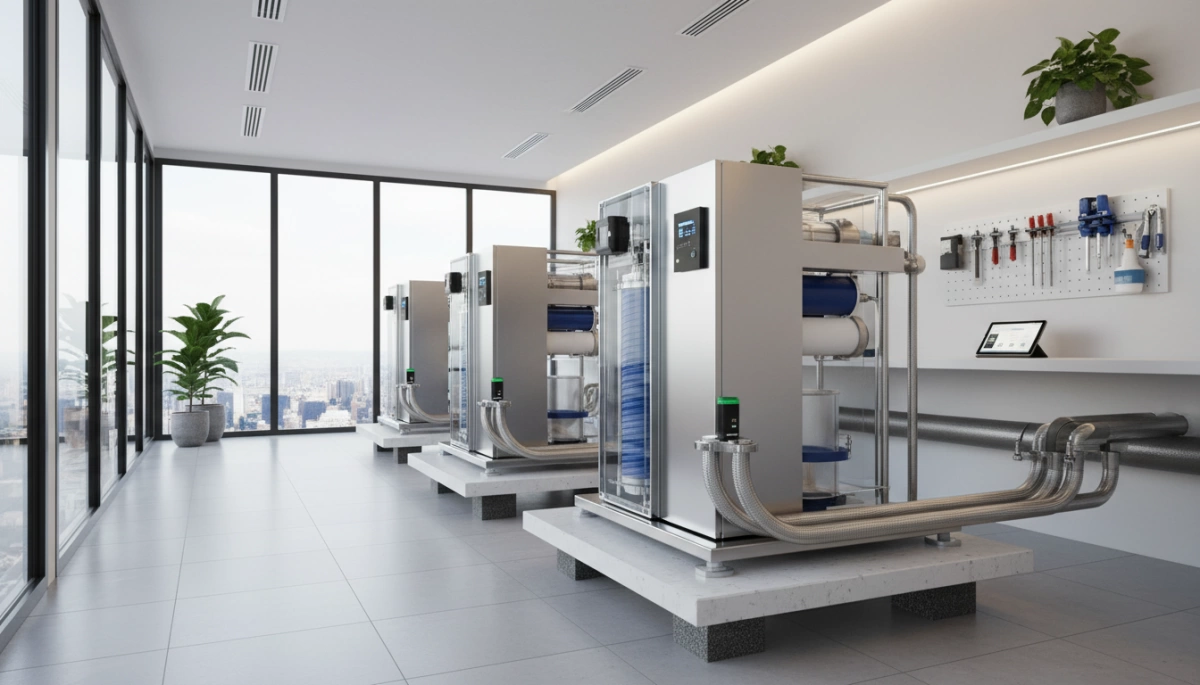
Living in a high-density building changes how we have to think about appliance mechanics. In a detached house, a humming pump in the basement isn’t a big deal. In a third-floor apartment, that same vibration becomes a headache for you and the neighbors below. The physics of apartment plumbing vibration creates a unique set of challenges that standard filtration units often fail to address.
Structure-Borne Noise Transmission
The real enemy here isn’t just the sound you hear in the air; it’s structure-borne noise transmission. When a high-pressure RO pump vibrates against a pipe or a cabinet floor, that energy travels through the solid materials of the building. Concrete floors and shared rigid plumbing lines act as highways for these vibrations, carrying the hum of a running filter into adjoining units. Unlike airborne sound, which dissipates quickly, structure-borne noise retains its energy over longer distances, turning a simple glass of water into a disturbance for the whole floor.
The “Hollow Box” Problem in Modular Kitchens
Most modern apartments utilize modular cabinetry constructed from lightweight materials like particle board or plywood. While cost-effective, these materials create a “hollow box” effect. Essentially, your under-sink cabinet acts like the body of an acoustic guitar. If an RO system lacks proper isolation, the under-sink cabinet resonance amplifies the mechanical vibration of the pump, turning a low hum into a loud, rattling drone. This amplification makes modular kitchen soundproofing difficult without addressing the source of the vibration itself.
Space Constraints and Direct Contact Points
We design our tankless systems to save 70% of under-sink space because we know apartment kitchens are tight. However, compact installation spaces often force appliances into direct contact with walls, drain pipes, or other stored items. Without advanced anti-vibration engineering, these direct contact points bridge the gap between the machine and the cabinetry, bypassing any basic rubber feet. In these tight quarters, the lack of a buffer zone means every RPM of the motor is felt immediately by the surrounding structure.
Beyond Noise: The Structural Risks of Vibration
Most people think vibration is just an annoyance—a buzzing sound while you’re trying to watch TV. But as a manufacturer, I look at it differently. Vibration is kinetic energy that has to go somewhere, and in a confined space, it usually translates into mechanical stress. If your RO system doesn’t have a solid anti-vibration design, you aren’t just dealing with noise; you are dealing with a reduced lifespan for the machine and potential water damage to your home.
Micro-Movement and the Danger of Plumbing Leaks
The biggest threat from apartment plumbing vibration is what we call “micro-movement.” Every time the booster pump kicks on, the entire unit shifts slightly. Over months of operation, this constant jittering works against the push-connect fittings and threaded joints.
- Loosening Fittings: The constant oscillation acts like a slow-motion wrench, gradually backing nuts off their threads.
- Tubing Fatigue: Plastic tubing that rubs against cabinet walls or the chassis eventually wears thin.
- Seal Failure: Rubber O-rings rely on compression to work. Vibration can momentarily break that seal, leading to slow drips that cause mold before you ever see a puddle.
A robust leak prevention mechanism isn’t just about a sensor on the floor; it starts with stopping the shaking that causes the leak in the first place.
Wear on Internal Electronic Components
Modern RO systems, especially smart units, are packed with electronics. We use printed circuit boards (PCBs) to control the Brushless DC motor (BLDC) and monitor water quality. While these components are durable, they hate vibration.
Continuous shaking causes solder fatigue. The tiny metal connections that hold chips and sensors to the board can develop microscopic cracks. Once that happens, you start seeing phantom error codes, display failures, or a pump that won’t turn on. We design our mounts to isolate these sensitive electronics from the mechanical force of the pump.
Membrane Housing Stress and Filtration Bypass
The heart of the system is the RO membrane, often housed in a high-pressure vessel. In a 600 GPD high-flow system, the pressure inside that housing is intense. If the housing is vibrating against the chassis, it creates stress points on the plastic manifold.
This physical stress can warp the housing cap slightly. If the internal seal shifts even a fraction of a millimeter, you risk filtration bypass—where raw tap water slips past the membrane and mixes with your clean water. You end up drinking water that isn’t as pure as the display says it is, all because the unit wasn’t stabilized properly.
The Engineering Solution: How Driplife Eliminates Vibration
We tackled the noise issue head-on by completely rethinking the internal architecture of our RO systems. Standard filters often rely on a chaotic web of loose tubing that shakes violently under high pressure. We replaced that outdated approach with integrated water board technology. By molding water channels directly into a single, solid unit, we eliminate the loose hoses that typically cause rattling and increase leak risks. This structural rigidity is a cornerstone of our IoT-integrated smart water filter solutions, ensuring consistent data readings and performance without mechanical interference.
Integrated Waterway Design
The “Integrated Waterway” is our primary defense against structure-borne noise transmission. Instead of multiple connection points that can loosen and vibrate, our one-piece design streamlines the flow path. This not only reduces the physical footprint—saving 70% of under-sink space—but also creates a solid mass that resists resonance.
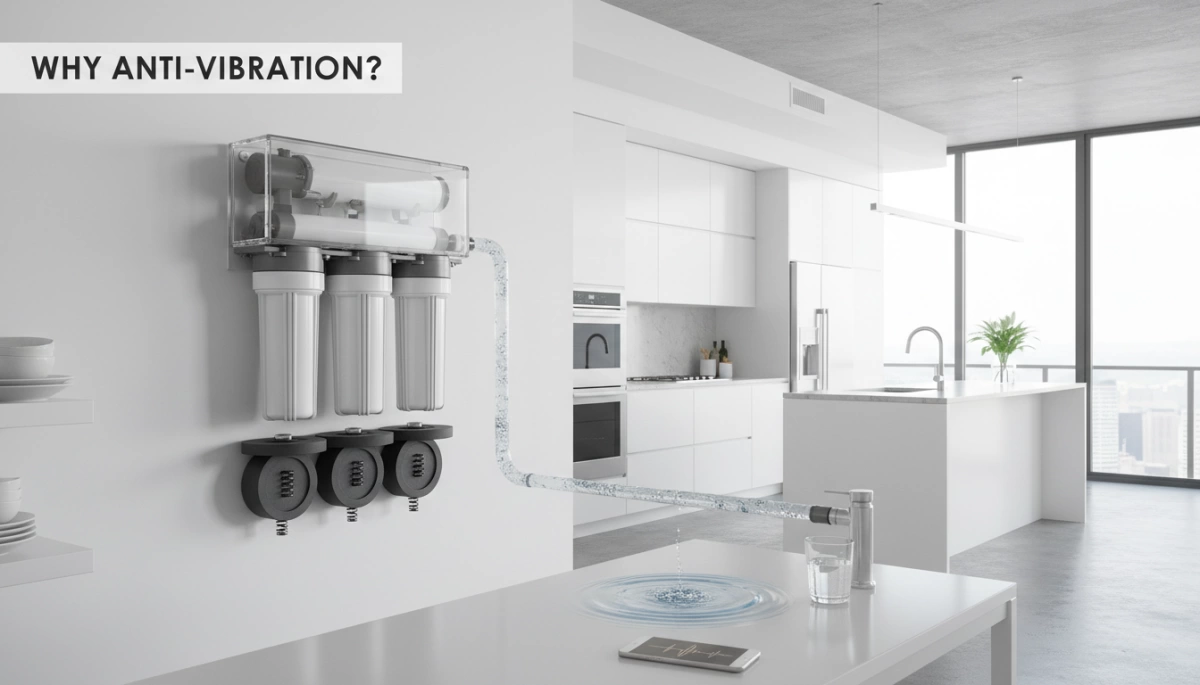
Suspended Pump Mounting & Dampening Feet
High-capacity systems, like our 600G and 1000G models, require powerful motors. To manage this, we don’t just bolt the tankless RO booster pump to the frame. We utilize acoustic dampening mounts and a suspended internal structure.
- Vibration Isolation: The pump “floats” on rubber vibration isolators, preventing torque from transferring to the chassis.
- Stability: Heavy-duty rubber feet grip the cabinet floor, stopping the unit from “walking” or vibrating against the cabinetry.
Precision Manufacturing
Noise often comes from gaps and poor fitting. We use precision manufacturing to ensure tight tolerances across every component. This eliminates the “wiggle room” that leads to mechanical humming. By combining a leak-proof design with quiet operation water purifier engineering, we ensure that the only thing you notice is the clean water, not the machine making it.
Choosing the Right System for Your Apartment
Checklist for Buyers: Tankless, dB Rating, and Base Footing
When you live in a high-density building, you can’t just install any industrial-grade equipment under your sink. You need a compact water filtration design that respects your limited space and your neighbors’ peace. The first rule for apartment living is to ditch the bulky storage tank. A tankless RO booster pump system saves about 70% of your under-sink cabinet space, leaving room for cleaning supplies and preventing the clutter that often amplifies vibration.
Here is what you need to look for to ensure a quiet home:
- Tankless Architecture: Eliminates the resonance chamber effect of a hollow storage tank.
- Decibel (dB) Reduction: Look for units specifically engineered with internal anti-vibration structures and sound-dampening materials.
- Solid Footing: The system should have high-quality rubberized mounts or a weighted base to stop structure-borne noise transmission into the wood of your cabinets.
The Efficiency Bonus: Shorter Run Times
Noise isn’t just about how loud a machine is; it’s about how long it runs. Older, slow-filtering units might drone on for five minutes just to fill a pitcher. This is where a 600 GPD high-flow system or a 1000 GPD model becomes a game-changer. These high-capacity systems produce water at a rate of 1.5L to 2.6L per minute, meaning the pump is active for a fraction of the time compared to traditional units.
Understanding how a water filter works reveals that the booster pump is the primary noise source. By upgrading to a high-efficiency model with a superior pure-to-drain ratio (often exceeding 2:1 or even 3:1), you get your clean water faster, and the quiet operation water purifier shuts down sooner. This minimizes the window of disturbance, ensuring that your late-night glass of water doesn’t wake up the household.
FAQ: Anti-Vibration and Apartment RO Systems
Why is my RO purifier making so much noise?
If your system sounds like a generator running under your sink, it is usually due to the booster pump vibrating against the cabinet floor or loose internal tubing rattling against the casing. In standard setups, the high pressure required for filtration creates mechanical energy. Without proper acoustic dampening mounts or a solid internal structure, this energy transfers directly to your cabinetry, creating that annoying “hum” that resonates through the kitchen.
Can vibration cause my water filter to leak?
Yes, this is a major hidden risk. Constant vibration causes micro-movements at the connection points where tubes meet fittings. Over months of operation, this shaking can loosen joints and degrade O-rings, leading to slow drips or sudden bursts. We mitigate this by using integrated water board technology, which molds the waterways into a single solid piece. This leak prevention mechanism eliminates the maze of loose hoses found in traditional systems, removing the parts most likely to shake loose.
Do I need a specific RO system for a small apartment?
Absolutely. In an apartment, you are dealing with tighter spaces and shared walls where structure-borne noise transmission can bother neighbors. You need a system that balances high performance with a compact water filtration design. If under-sink installation isn’t an option due to rental restrictions or lack of space, a countertop water filter is often the best alternative, offering the same filtration quality without the installation hassle or cabinet resonance issues.
Is a tankless RO system quieter than a tank system?
Modern tankless systems are generally less intrusive. While a tankless RO booster pump is powerful enough to support high flow rates (like 600 GPD or 1000 GPD), the run time is significantly shorter. A tank system might hum for 20 minutes to refill a storage reservoir, whereas a tankless unit only runs for the few seconds it takes to fill your glass. When combined with our anti-vibration internal structure, the result is a quiet operation water purifier that doesn’t disrupt your household.