















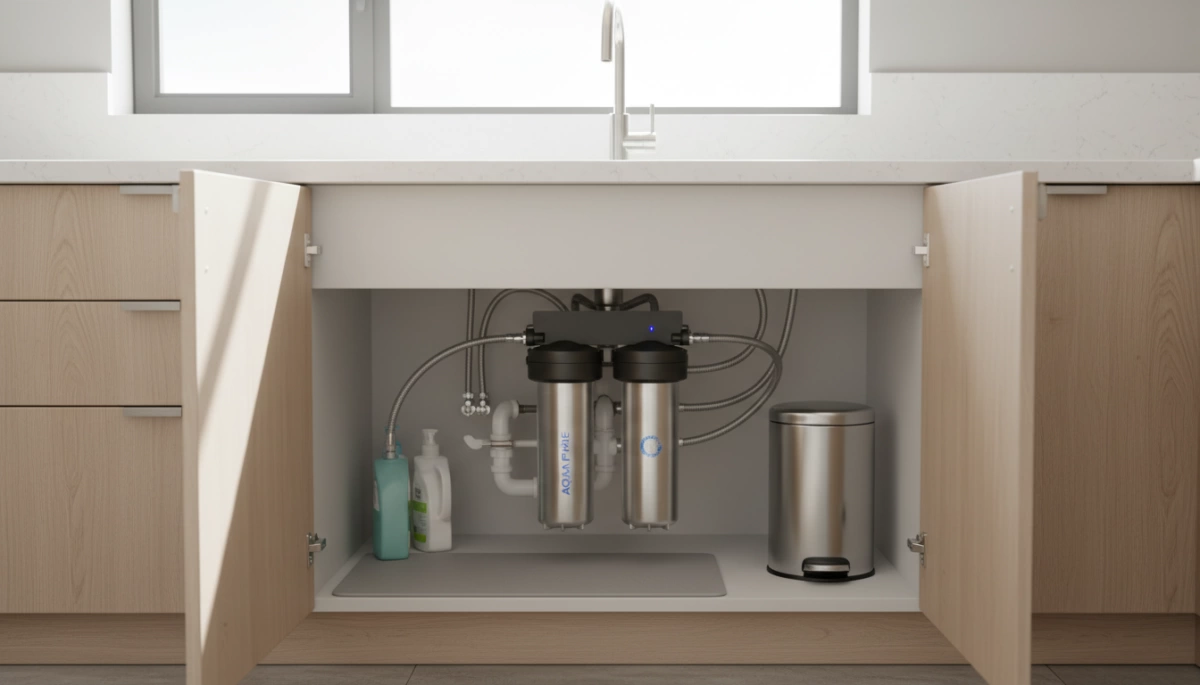
Thinking about installing an under cabinet water filter system but not sure where to start?
You’re not alone. More and more homeowners are ditching bottled water and basic pitchers for hidden, high‑performance under sink water filtration that actually tackles real contaminants—things like chlorine, lead, PFAS, sediment, and bad odors—right at the kitchen tap.
The challenge? There are so many options: carbon block filters, reverse osmosis under sink systems, tankless RO, ultrafiltration, different NSF certifications, and a wide range of prices and performance claims. It’s easy to feel overwhelmed and end up guessing.
In this guide, you’ll quickly learn how under cabinet water filter systems work, the real differences between carbon vs. RO, how to match a system to your water quality and kitchen space, and what to look for in a reliable OEM supplier if you’re sourcing at scale.
If you want cleaner, better‑tasting kitchen water without cluttering your countertop, keep reading.
What Is an Under Cabinet Water Filter System?
If you’re worried about what’s actually in your tap water but don’t want a bulky gadget on your counter, an under cabinet water filter system (also called an under sink water filter or under counter water filter system) is usually the cleanest, most practical solution.
At its core, an under cabinet water filter system is a point-of-use water filter installed inside the cabinet under your kitchen sink. It connects directly to your cold-water line and filters water right before it reaches your tap, giving you cleaner, better-tasting water for drinking and cooking.
Core components
Most under cabinet / under sink water filters share a simple structure:
- Inlet connection – ties into your cold-water pipe under the sink.
- Filter cartridges – one or more stages (sediment, carbon, RO, etc.) that actually treat the water.
- Filter housing or manifold – holds the cartridges and routes water through each stage.
- Outlet line – sends filtered water to the faucet.
- Optional dedicated drinking water faucet – a small under sink drinking water faucet on the sink deck just for filtered water.
How it differs from other kitchen filters
Compared with other kitchen water filtration systems:
- Pitchers – cheap and portable, but slow, low capacity, and always need refilling.
- Faucet-mounted filters – visible, can be bulky, and often reduce flow at the main faucet.
- Countertop filters – take up space and clutter your kitchen surface.
- Whole house filters – treat all water in the home, but cost more and are overkill if you mainly care about drinking and cooking water.
An under cabinet water filter system stays hidden, runs on demand, and is designed specifically for kitchen drinking water applications. You turn on the tap, and filtered water is there—no refilling, no countertop mess.
Why homeowners and renters choose under cabinet systems
People in the U.S. typically choose an under sink water filter because it:
- Keeps the kitchen clean and uncluttered (no big units on the counter).
- Delivers consistent, on-demand filtered water right where it’s used most.
- Works as a long-term bottle water alternative filter, cutting plastic waste and costs.
- Fits both homeowners and many renters, especially compact under sink filters for small cabinets that can be installed with minimal changes.
In short, an under cabinet water filter system gives you a hidden, everyday kitchen water filtration system that’s practical, efficient, and built for real daily use.
Main Benefits of an Under Cabinet Water Filter System
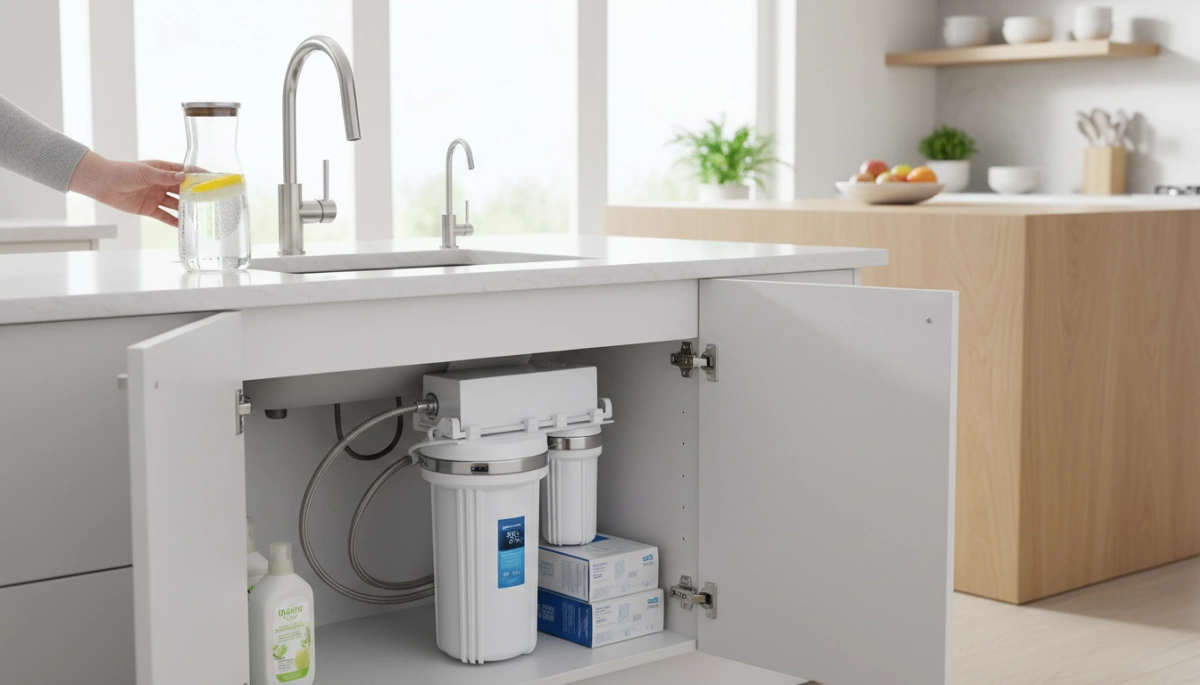
An under cabinet water filter system is one of the easiest upgrades you can make to your kitchen if you care about daily drinking water quality, space, and long-term cost.
Key Benefits at a Glance
| Benefit | What It Means for You |
|---|---|
| Cleaner, better-tasting water | Better flavor for drinking, coffee, tea, and cooking |
| Hidden, space-saving design | Nothing on the counter, all tucked under the sink |
| Health-focused filtration | Targeted reduction of chlorine, lead, PFAS, VOCs, and more |
| Real cost savings | Cheaper than bottled water and most fridge filters over time |
| Less plastic waste | Fewer bottles and jugs going in the trash or recycling |
| Quiet & convenient | On-demand filtered water right at your kitchen tap or faucet |
Why It Works So Well in Daily Life
- Cleaner, better-tasting water
A quality under sink water filter strips out chlorine taste and odor, along with many off-flavors from city water. If you’re picky about coffee, tea, or cooking, you’ll notice the difference immediately. For a deeper dive on how purified vs filtered water compare, you can check this breakdown of purified water vs. filtered water. - Space-saving, hidden install
The whole under counter water filter system lives inside the cabinet, so:- No bulky pitchers in the fridge
- No awkward tank taking over your countertop
- Clean, uncluttered kitchen look
- Health-focused filtration performance
Depending on the configuration (carbon, RO, or hybrid), a point-of-use under sink water filter can help reduce:- Chlorine and chloramine
- Lead and other heavy metals
- PFAS, VOCs, and some pesticides
- Sediment, rust, and scale particles
This is exactly what most U.S. households want: safer, better-tasting drinking water straight from the kitchen tap.
- Cost savings vs. bottled water and fridge filters
Over a year, an under cabinet water filter system usually beats:- Buying cases of bottled water
- Constantly replacing OEM fridge filter cartridges
You pay once for the system, then budget predictable, lower-cost filter replacements.
- Lower plastic waste, more sustainable habits
When you trust the water coming out of your sink, you naturally cut back on:- Single-use water bottles
- Big plastic jugs and dispensers
It’s a simple way to improve your daily footprint without changing your routine.
- Quiet, convenient, on-demand filtration
- No noise during normal use
- Just open the under sink drinking water faucet (or main tap if inline) and you get filtered water instantly
- No refilling a pitcher or waiting for slow gravity filters
For U.S. households that care about both taste and health, an under cabinet water filter system is a clean, hidden, and cost-effective alternative to bottled water and basic faucet-mounted filters.
Types of Under Cabinet Water Filter Systems
When you’re picking an under cabinet water filter system, you’re really choosing between a few core technologies: carbon filters, reverse osmosis (RO), ultrafiltration (UF), and hybrid multi‑stage setups. Each one fits a different water quality, budget, and cabinet space situation.
Main Technology Options
- Carbon-Based Under Sink Filters (GAC & Carbon Block)
- Best for: City water with chlorine, bad taste, and odor.
- Uses activated carbon or carbon block media to polish tap water.
- Pros: Lower cost, strong flow, compact size, easy DIY under sink install.
- Cons: Limited on TDS, fluoride, and some heavy metals compared to RO.
- Reverse Osmosis Under Cabinet Systems
- Best for: High TDS, lead, PFAS, nitrates, and tougher contaminants.
- Uses a multi-stage RO membrane setup to deeply purify water.
- Often comes as a tank-based under sink RO system; some newer designs are tankless.
- Pros: Strong contaminant reduction, bottled-water alternative.
- Cons: Takes more space, sends some wastewater to drain, higher upfront cost.
If you want to dig into how RO works, I break it down in this guide on reverse osmosis water purification.
- Ultrafiltration (UF) & Hybrid Under Counter Filters
- Best for: Low TDS city water where you care more about particles, cysts, and taste than salt/mineral removal.
- UF uses a tight membrane but doesn’t waste water or need a tank.
- Hybrid systems combine sediment, carbon, UF, RO, and sometimes remineralization for taste and pH balance.
Matching System Type to Water, Budget, and Space
Use this as a quick under counter water filter guide:
- If you’re on municipal city water, mainly worried about chlorine taste and smell:
- Go with a carbon-based under sink water filter (carbon block if you want stronger performance).
- If you’re worried about heavy metals, PFAS, or high TDS, or you just want “premium” drinking water:
- Choose an under sink reverse osmosis system (tank or tankless depending on cabinet space).
- If your cabinet is tight or you rent and want less invasive install:
- Look at a compact inline under sink water filter or a slim UF or carbon system.
- If you drink and cook a lot at home and want max protection:
- A multi-stage hybrid system under the cabinet will give you the widest coverage.
The key
Carbon-Based Under Cabinet Water Filter Systems
Carbon-based under cabinet water filter systems are the go-to choice for most U.S. homes on municipal water. They focus on chlorine, taste, and odor removal while keeping things simple and affordable.
How Activated Carbon Cartridges Work
Activated carbon (AC) uses adsorption to trap contaminants on the surface of the carbon granules or block.
What it typically helps with:
- Chlorine and chloramine (better taste and smell)
- Musty or chemical odors
- Some organic chemicals (VOCs), depending on the cartridge
- Sediment and rust (when paired with a sediment pre-filter)
Carbon Block vs. Granular Activated Carbon (GAC)
| Feature | Carbon Block Under Sink Filter | Granular Activated Carbon (GAC) Filter |
|---|---|---|
| Structure | Compressed solid block | Loose carbon granules |
| Filtration precision | Finer, more consistent | Good, but less uniform |
| Flow rate | Slightly slower | Usually faster |
| Best for | Taste, odor, some lead/chemical claims (if certified) | Basic chlorine/taste/odor |
| Typical use | Premium under cabinet water filters | Budget under sink water filter systems |
If you care about taste and some contaminant reduction, carbon block is usually the better under counter water purifier choice, especially when paired with NSF/ANSI 42 and 53 certifications.
Best Use Cases (Municipal City Water)
Carbon-based under sink water filters are ideal when:
- You’re on city water with a recent water quality report
- Your main issues are chlorine, smell, or “swimming pool” taste
- You want a bottle water alternative filter without a bulky RO tank
- You prefer high flow for cooking, coffee, and filling pots
For more background on why point-of-use filtration matters at the tap, I often point customers to our quick guide on why water filters are important for everyday health and taste.
Pros of Carbon Under Cabinet Filters
- Fast flow rate – great for normal kitchen use
- Lower upfront cost than RO or hybrid systems
- Simple DIY under sink filter installation
- Easy maintenance with quick-change under sink filter replacement cartridges
- Compact, hidden kitchen water filter that fits in most cabinets
Cons vs. RO or Multi-Stage Systems
- Limited heavy metal removal unless it’s a certified lead-reducing water filter
- Does not remove TDS (total dissolved solids) the way an under sink reverse osmosis system does
- Not ideal for high nitrate, fluoride, or very hard well water on its own
- For PFAS and more complex contaminants, you often need RO or hybrid RO and carbon systems
If you want to stay with carbon but add hot water convenience, some U.S. homeowners pair a carbon-based under cabinet system with a hot water filter under sink setup for tea, instant meals, and on-demand hot drinking water.
RO Under Cabinet Water Filter Systems
Under cabinet reverse osmosis under sink systems are what I go to when someone wants “bottled water quality” straight from their kitchen tap. These systems use a multi-stage setup to strip out a wide range of dissolved contaminants that basic carbon filters can’t touch.
How Multi-Stage RO Under Sink Systems Work
A typical under sink reverse osmosis system runs in this order:
- Sediment pre-filter – catches sand, rust, and dirt so later stages don’t clog.
- Carbon filter (or carbon block) – reduces chlorine, chloramine, and chemicals that affect taste and odor and that can damage the RO membrane.
- RO membrane – the core stage that pushes water through an ultra-fine membrane, rejecting most dissolved solids and heavy metals.
- Post carbon “polishing” filter – final taste and odor cleanup before the water reaches your under sink drinking water faucet.
This multi-stage structure is what makes an RO under cabinet water filter system a true kitchen water purification system, not just a taste-improvement filter.
What RO Systems Actually Remove
A quality under sink RO system can reduce:
- Total Dissolved Solids (TDS) – minerals, salts, and hardness ions.
- Heavy metals – like lead, arsenic, chromium, and cadmium.
- Fluoride – one of the main reasons many US homeowners step up from carbon to RO.
- PFAS (“forever chemicals”) – when paired with good carbon stages and validated performance.
- Nitrates and nitrites – especially important for well water and some agricultural areas.
If you want deeper detail on contaminant reduction, I always suggest checking the system’s NSF/ANSI 58 or similar test data, not just the marketing claims.
Tank vs. Tankless RO Under Sink Systems
You’ll typically see two styles in the US market:
- Tank-based under sink RO system
- Stores filtered water in a pressurized tank.
- Pros: Strong, steady flow at the faucet; more forgiving with lower incoming pressure.
- Cons: Takes more cabinet space; needs occasional tank sanitizing.
- Tankless RO under sink system
- Filters water on demand without a storage tank.
- Pros: Slim footprint; more space left in the cabinet; usually higher “pure water” efficiency.
- Cons: Needs good inlet pressure; flow rate can feel slower under heavy use; more sensitive to clogged pre-filters.
For most US kitchens with standard 36″ cabinets, a tank-based under sink RO tank system still fits fine, but small apartments often lean toward compact tankless RO under sink models.
Pros of RO Under Cabinet Systems
- Deep purification – much stronger reduction of TDS, heavy metals, fluoride, and many chemical contaminants versus a basic carbon block under sink filter.
- Consistent taste – ideal for coffee, tea, and cooking water if you’re picky about flavor.
- Better protection for homes with questionable city infrastructure or mixed well water quality.
- Great bottled water alternative – once installed, the cost per gallon is much lower than buying cases of water.
For people redoing their kitchen, it’s common to pair an RO system with a dedicated filtered water faucet. If you’re planning a remodel, it’s worth thinking about faucet placement right alongside things like faucet filtration benefits and tap layout.
Cons and Trade-Offs to Know
No under counter water purifier is perfect, and RO has a few trade-offs:
- Wastewater production – RO creates a reject stream that goes to the drain; the ratio depends on system design and water pressure.
- Slower initial flow – especially on tankless models or when a tank is nearly empty.
- “Flat” taste without remineralization – because RO strips most minerals, many people prefer a remineralization filter cartridge added after the RO membrane to bring back a more natural taste and slightly raise pH.
- More involved maintenance – you need to keep up with pre-filter changes to protect the RO membrane and maintain good flow.
For US homeowners dealing with high TDS, older pipes, or concerns like lead and PFAS, a multi stage under sink RO system is usually the most straightforward way to get high-quality drinking water from a compact, hidden kitchen water filter.
Ultrafiltration and Hybrid Under Cabinet Systems
Ultrafiltration (UF) and hybrid under cabinet water filter systems are a smart upgrade when you want more than basic carbon filtration but don’t necessarily need a full-blown RO setup.
Under Sink Ultrafiltration Systems (UF)
An under sink ultrafiltration system uses a hollow-fiber membrane with much larger pores than an RO membrane. That gives you:
- No storage tank, no wastewater – UF runs directly off line pressure, so it’s more efficient and easier to fit into tight cabinets.
- High flow, normal taste – it keeps the natural minerals in your water, so you don’t get the “flat” taste some people notice with RO.
- Great for low-TDS city water – UF is ideal if your water doesn’t have high dissolved solids but you’re concerned about bacteria, cysts, and fine particles.
Choose an under sink ultrafiltration system when:
- You’re on generally good municipal water with low TDS.
- You want extra protection for kids and seniors without dealing with RO tanks and drains.
- You care about water efficiency and don’t want any reject water.
Hybrid Under Cabinet Water Filter Systems
A hybrid under cabinet water filter system combines multiple technologies in one compact setup. A typical multi-stage layout can include:
- Sediment pre-filter – catches sand, rust, and dirt.
- Carbon block or granular activated carbon (GAC) – handles chlorine, taste, and odor.
- UF membrane and/or RO membrane – targets microbiological risks and dissolved contaminants like lead, PFAS, and nitrates.
- Remineralization cartridge – adds back healthy minerals and improves taste.
This kind of multi-stage under sink filtration is ideal for:
- Families and high-usage kitchens that want cleaner drinking and cooking water all day.
- Picky taste users who notice small changes in flavor and want consistent, “bottled-water quality” from the tap.
- Homeowners planning long-term who want one hidden kitchen water filter that can handle a wide range of contaminants without changing systems later.
If you’re already comparing RO, UF, and hybrid setups for issues like lead or PFAS, it helps to understand how different technologies perform. I break down lead removal options in detail in this guide on how water filters remove lead and which technologies work best, which applies directly to under cabinet system planning.
How an Under Cabinet Water Filter System Actually Works
An under cabinet water filter system (under sink water filter / under counter water filter system) is simple in practice: it cleans your tap water right before you use it.
Basic Flow Path
Here’s the basic flow path for most point-of-use kitchen water filtration systems:
- Tap water in
- Cold-water line feeds into the under cabinet water filter system via a small tee valve.
- Through each filter stage
- Water moves through 1–4+ filter cartridges in sequence.
- Out to faucet or main tap
- Clean water comes out either a dedicated drinking water faucet or your main kitchen faucet (inline setup).
Typical Multi-Stage Setup
Most under sink water filters use a simple stacked structure:
- Sediment pre-filter
- Catches sand, rust, and dirt so the next stages last longer.
- Carbon filter (GAC or carbon block)
- Reduces chlorine, bad taste, and odor and cuts many common chemicals.
- Membrane or advanced media (RO or UF, optional)
- Reverse osmosis (RO) or ultrafiltration (UF) targets dissolved solids, heavy metals, and very fine particles.
- Final polishing filter
- A small carbon or remineralization cartridge that improves taste right before the faucet.
If you prefer a simple faucet-mounted option instead of a full under cabinet unit, a compact sink faucet water purifier can use a similar carbon-based principle at the tap.
Inline vs. Dedicated Faucet
You’ll usually see two configurations:
- Inline under sink water filter
- Hooks directly to the existing kitchen faucet.
- Easy to use, but the whole faucet is filtered (including dish washing), so filters may need more frequent replacement.
- Dedicated filtered water faucet
- A small separate drinking water faucet mounted on the sink or countertop.
- Only used for drinking, coffee, tea, and cooking, so filters last longer and you get a clear “filtered vs. unfiltered” split.
Pressure, Flow Rate, and Pore Size
System performance and user experience depend on three key specs:
- Water pressure
- Higher pressure = better flow through cartridges and RO membranes.
- Most under sink RO systems need a minimum feed pressure to work well.
- Flow rate (GPM)
- Measured in gallons per minute.
- High-flow carbon block under sink filters feel close to a normal tap, while RO systems are slower (tankless RO uses pumps to speed this up).
- Filter pore size / membrane rating
- Sediment filters: 5–20 micron (larger particles).
- Carbon block: typically 0.5–5 micron effective rating.
- RO membranes: down to 0.0001 micron for deep purification.
- Smaller pores remove more, but usually mean slower flow unless the system uses a storage tank or pump.
Dialing in the right mix of stages, faucet type, and flow rate is what makes an under cabinet water filter system feel seamless in a U.S. kitchen—good pressure, clean taste, and zero fuss day-to-day.
Contaminants Removed by Under Cabinet Water Filter Systems
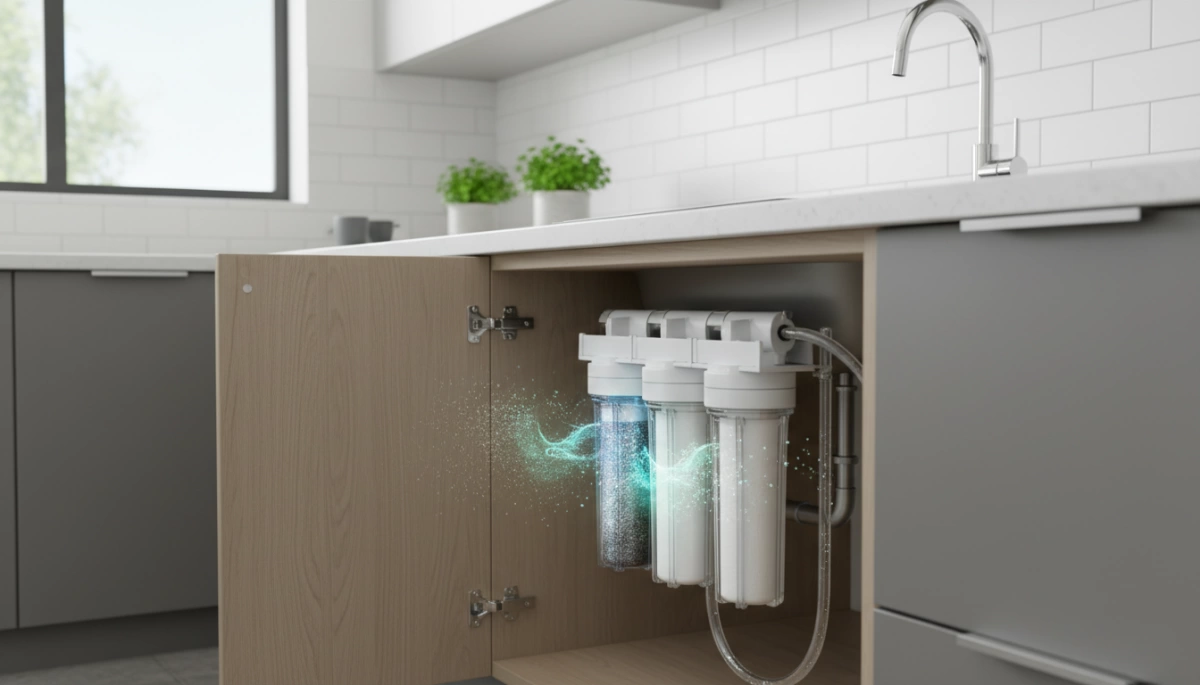
A quality under cabinet water filter system is built to target the most common tap water problems you see in U.S. homes, but what it removes depends on the exact technology and media inside.
Everyday Tap Water Issues
Most under sink water filters focus first on the basics:
- Chlorine & chloramine – for better taste, smell, and safer cooking water
- Sediment & rust – sand, silt, pipe scale that make water look cloudy
- Bad taste & odor – musty, metallic, or “swimming pool” flavors
A good carbon block under sink filter handles these very well and is usually the first upgrade people notice in their kitchen water.
Heavy Metals & Chemical Contaminants
For many U.S. homeowners, the priority is cutting down on more serious contaminants:
- Heavy metals: lead, mercury, cadmium (needs certified media)
- PFAS (“forever chemicals”) – requires specific PFAS-rated carbon or RO
- VOCs & pesticides/herbicides – like industrial solvents and farm runoff
- Disinfection byproducts (THMs, HAAs) – from chlorinated city water
A standard carbon filter improves some of these, but deep reduction usually calls for an NSF/ANSI 53 lead reducing water filter, a PFAS water filter system, or a reverse osmosis under sink system.
Microbiological Concerns
If you’re on well water or worried about microorganisms:
- Carbon filters: can reduce cysts with the right rating, but not full bacteria/virus protection
- Ultrafiltration systems: can physically remove many cysts and some bacteria
- RO systems: significantly reduce many microbiological contaminants when properly maintained
For any microbiological claim, I only trust units that clearly list the standard or test method used.
Carbon vs. RO vs. Specialty Media
Here’s the quick breakdown:
- Carbon-based under cabinet filters
- Great for: chlorine, taste, odor, basic chemical reduction
- Limited for: high TDS, fluoride, nitrates, some heavy metals, PFAS (unless specially designed)
- Under sink reverse osmosis systems
- Great for: TDS, fluoride, nitrate, arsenic, many heavy metals, PFAS, a wide range of chemicals
- Usually paired with carbon stages for chlorine, VOCs, and taste
- Specialty media cartridges
- Target: specific issues like lead, iron, manganese, arsenic, or PFAS
- Often added as an extra stage in a multi stage under sink filtration setup
If you want a deeper dive into how each filter stage actually works, I explain the basics of how water filters work on our site in plain language: how a water filter system works step by step.
How to Read Performance Data Sheets
Don’t rely on marketing claims alone. For any under counter water purifier, I look for:
- NSF/ANSI standards listed (e.g., 42 for chlorine/taste/odor, 53 for lead/PFAS/VOCs, 58 for RO)
- A clear contaminant list with:
- Starting concentration (mg/L or µg/L)
- % reduction and final concentration
- The lab or certification body that tested it
- Matching model number on the filter label and the test report
If a brand talks about “removing 99% of contaminants” but doesn’t publish a real performance data sheet, that’s a red flag. A serious under sink water filter supplier in the U.S. market will always back up claims with documented, third‑party-tested results.
NSF/ANSI Certifications for Under Cabinet Water Filter Systems
When you’re picking an under cabinet water filter system, third‑party testing isn’t a “nice to have” — it’s mandatory if you actually care what’s coming out of your tap.
Why NSF/ANSI Certification Matters
Independent NSF/ANSI certifications prove the system was tested to do what the label claims. For any serious under sink water filter or under counter water purifier, I always look for:
- Real test data, not just “filters up to 99% of contaminants” marketing lines
- Specific standards listed, plus the contaminants and reduction levels
Key NSF/ANSI Standards to Know
When you compare under sink water filters, watch for these:
- NSF/ANSI 42 – Aesthetic only: chlorine, taste, odor, some particulates
- NSF/ANSI 53 – Health-related: lead, heavy metals, cysts, VOCs, some PFAS and chemicals
- NSF/ANSI 58 – For under sink reverse osmosis systems: TDS reduction, RO performance, structural integrity
- NSF/ANSI 401 – “Emerging contaminants”: pharmaceuticals, some pesticides, and newer chemicals
For a true lead reducing water filter or PFAS water filter system, look for NSF/ANSI 53 or 401 listed clearly.
How to Verify a Certified Under Counter Water Filter
Before buying an under cabinet water filter system:
- Match brand + model number on the box to the NSF or WQA listing
- Check the performance data sheet (PDS) for:
- Contaminants tested
- Reduction percentage
- Capacity (gallons) and flow rate
- Make sure the certification covers the exact configuration you’re buying (same cartridges, same RO membrane, same tank).
Red Flags to Avoid
Skip any “best under cabinet water filter” that shows:
- Vague claims like “filters heavy metals and 99% of impurities” with no standard listed
- No downloadable test reports or PDS
- Only internal “factory tested” statements
- Big claims about fluoride or PFAS with no NSF/ANSI 53, 58, or 401 reference
If a brand can show test data and backs it with strong support and warranty, that’s the kind of under sink water filter system I’m comfortable putting my name behind.
How to Choose the Right Under Cabinet Water Filter System
When you pick an under cabinet water filter system, you want something that actually fits your water, your kitchen, and your budget. Here’s how I’d break it down.
1. Start with Your Water Source
City water (municipal):
- Usually chlorinated, may have chlorine, taste/odor, PFAS, lead from old pipes.
- A carbon-based under sink water filter or carbon + sediment + lead media is often enough.
- If your TDS is high or you’re picky about taste, consider an under sink reverse osmosis system.
Well water:
- Can have iron, hardness, bacteria, nitrate, sulfur smell, etc.
- Under cabinet systems are point-of-use add-ons, not full treatment.
- Many well users pair a whole house system with an RO under cabinet system at the kitchen sink.
2. Use Reports and Simple Test Kits
- Pull your local Consumer Confidence Report (CCR) from your city’s website and look at:
- Chlorine/chloramine
- Lead, copper
- Nitrate, arsenic, PFAS if listed
- For more detail, add a home test kit (TDS, hardness, pH, iron, basic metals).
- Match what you find to the tech:
- Mostly taste/odor → carbon block under sink filter
- Heavy metals, high TDS, nitrate, fluoride → under sink RO or hybrid system
3. Carbon vs. RO vs. Hybrid: When to Step Up
| Situation | Recommended Under Cabinet Water Filter System |
|---|---|
| Water tastes like pool water, basic odor | Carbon block / GAC under cabinet filter |
| You want bottled-water style taste | RO under sink system (with remineralization) |
| Lead/PFAS or a mix of issues | Multi-stage hybrid (sediment + carbon + RO or specialty media) |
| Low TDS city water but want stronger protection | Carbon + ultrafiltration under cabinet system |
Simple carbon is enough when:
- You’re on city water
- Main complaints are chlorine and smell
- No big heavy metal or nitrate issues in reports
Step up to RO or hybrid when:
- You want deep purification and better taste than fridge filters
- You’re pregnant, have kids, or immunocompromised family members
- Your report flags lead, PFAS, nitrate, arsenic, or high TDS
For more context on RO performance at the faucet, you can look at how a countertop reverse osmosis water filter works; under sink RO systems use very similar technology with a different form factor: countertop reverse osmosis water filter benefits.
4. Match Size, Flow Rate, and Capacity to Your Household
Family size & usage:
- 1–2 people:
- Compact inline under sink water filter or small RO is usually enough.
- 3–5 people:
- Higher flow rate (≥ 0.75–1.0 GPM for carbon, high-output RO)
- Larger filter capacity and RO tank (if not tankless).
Key specs to check:
- Flow rate (GPM): affects how fast the filtered water comes out.
- Filter capacity (gallons): tells you how long cartridges last.
- NSF certifications (like NSF/ANSI 42, 53, 58): to verify performance claims.
5. Check Your Cabinet Space and Plumbing Layout
Before buying, open the cabinet and actually measure:
- Width, depth, height under the sink
- Space taken by garbage disposal, trash can, and drain pipes
- If you can mount a RO tank or if you’re better off with a tankless RO under sink system
- Whether you’re ok adding a dedicated under sink drinking water faucet or prefer an inline setup to the main kitchen faucet
If you’re doing a kitchen remodel or adding a 4-in-1 boiling + filtered tap, plan filtration and faucet together so you don’t redo plumbing later. You can see how combined taps are typically laid out in this breakdown of a 4-in-1 boiling water tap system: 4-in-1 boiling water tap features, installation, brands, maintenance.
6. Balance Price, Filter Costs, and Long-Term Value
Think in 3 cost layers:
- Upfront price
- Carbon under cabinet filters: lower initial cost
- RO and hybrid systems: higher initial cost but more performance
- Filter replacement costs
- Carbon: cheaper, more frequent
- RO: multiple cartridges + RO membrane, but longer intervals
- Total cost per gallon vs bottled water
- A good under cabinet water filter system usually beats bottled water by a huge margin over a year.
- For U.S. households that drink and cook with filtered water daily, the best under cabinet water filter is usually the one that hits:
- Real contaminant reduction for your water
- Easy DIY filter changes
- Reasonable yearly cartridge cost
If you line up your water report, real space under the sink, and budget, you’ll quickly see whether a carbon-based under counter water filter system or a RO / hybrid under cabinet water purifier is the smarter move for your kitchen.
Key Buying Factors for an Under Cabinet Water Filter System
When I compare under cabinet water filter systems for U.S. homes, I always look at a few key specs first. These decide how well the system fits your kitchen and how much it really costs you over time.
Filter Life & Cartridge Change Frequency
Check both months and gallons:
- Basic carbon under sink filters: usually 6–12 months or 500–1,500 gallons
- Multi-stage and RO systems: pre-filters every 6–12 months, RO membrane every 2–3 years
- Go for clear specs and easy-to-find replacement cartridges, not vague “long-life” claims
Flow Rate & Water Pressure
You want good flow at the kitchen sink, not a trickle:
- Look for 0.75–2.0 GPM (gallons per minute) for non-RO under counter water filters
- For under sink reverse osmosis systems, check the minimum inlet pressure (often 40–60 psi)
- If your house pressure is low, lean toward high-flow carbon systems or pressure-boosted RO
System Footprint & Under Sink Clearance
Cabinet space in U.S. kitchens is often tight:
- Measure under your sink before buying: width, depth, and height
- For RO, check tank size (common: 2.5–4 gallons) and allow room for tubing
- Choose a compact under cabinet water filter system if you have garbage disposals or pull-out trash bins
Connection Type & DIY Installation
Most homeowners want simple install and easy swaps:
- Quick-connect fittings and quick-change cartridges make DIY under sink water filter installation much easier
- Inline under sink water filters are simpler; RO under cabinet systems are more complex but still DIY-friendly if instructions are clear
- If you’re stocking units for projects or rentals, standardized fittings simplify service across all units; partnering with an OEM under sink water filter supplier like Driplife’s water purifier solutions helps here
Warranty, Support & Parts
This is where long-term value really shows:
- Look for at least 1–2 years warranty on the under counter water purifier system body and tank
- Make sure spare parts and filters are easy to buy in the U.S.
- Prioritize brands that offer clear manuals, video support, and responsive service, especially if you plan larger or project-based installations
When all these boxes are checked—filter life, flow rate, footprint, DIY-friendliness, and solid support—you end up with an under cabinet water filter system that works smoothly every day and doesn’t surprise you with hidden costs.
Under Cabinet Filter Installation Basics
Installing an under cabinet water filter system under your kitchen sink is very doable for most U.S. homeowners and renters with basic tools. Here’s the simple version of what you actually need and what to watch out for.
Tools and Supplies You’ll Need
Most DIY under sink water filter installs only require:
- Adjustable wrench or basic wrench set
- Phillips and flathead screwdriver
- Drill (if you’re adding a dedicated drinking water faucet)
- Teflon/PTFE tape for threaded connections
- Utility knife or tubing cutter for plastic tubing
- Bucket or towel to catch any leftover water
Many under sink water filter systems come with an installation kit (fittings, tubing, brackets), so you typically don’t have to buy much else.
Core Installation Steps
The basic install flow is similar across most under counter water filter systems:
- Shut off the cold-water supply under the sink and open the faucet to relieve pressure.
- Mount the filter bracket on the cabinet wall so cartridges hang vertically and are easy to change.
- Connect the inlet line from the cold-water valve to the system’s “IN” port using the supplied adapter.
- Connect the outlet line from the system to your dedicated filtered water faucet or inline connection.
- Install or tie into the faucet:
- For a dedicated under sink drinking water faucet, drill the sink/counter (if needed), mount the faucet, then connect the tubing.
- For inline setups, connect the outlet line to the main kitchen faucet feed as directed by the manufacturer.
If you’re not sure whether you should go with a dedicated faucet or adapter setup, this guide to choosing the right PUR water filter faucet adapter walks through the pros and cons.
Routing Tubing in Tight Cabinets
Clean routing matters for both performance and safety:
- Keep tubing runs as short and direct as possible to maintain good flow.
- Avoid sharp bends and kinks; use wide loops instead of tight corners.
- Use clips or zip ties to secure lines along the cabinet wall so they don’t get pinched by trash cans or cleaning supplies.
- Make sure tubing isn’t rubbing against sharp edges or screws under the sink.
Safety Checks Before First Use
Never skip the final checks on a new under sink water filter:
- Slowly turn the water back on and watch each fitting while the system pressurizes.
- Do a 5–10 minute leak check with paper towels under all joints so small drips show up fast.
- Flush new filters as the manual states (usually 3–10 minutes) to clear carbon fines and air.
- Check flow rate from the faucet or outlet; low flow right after install usually means trapped air that will clear after a full flush.
Once you’ve done this once, swapping under sink filter replacement cartridges in the future is usually much faster and cleaner than the initial installation.
Dedicated Faucet vs. Inline Under Sink Setup
When you install an under cabinet water filter system, you’ve got two main ways to get filtered water to your kitchen sink: a dedicated drinking water faucet or an inline under sink setup that feeds your main faucet.
What Is a Dedicated Filtered Water Faucet?
A dedicated faucet is a small, separate tap mounted on your sink or countertop that delivers filtered water only.
Your under sink water filter or under sink reverse osmosis system connects to this faucet with its own tubing, so filtered and unfiltered water never mix.
How it works:
- Cold-water line → under cabinet water filter system → dedicated faucet spout
- Turn the small handle when you want drinking, coffee, or cooking water
- Main kitchen faucet still supplies regular hot and cold tap water
Pros and Cons of a Dedicated Faucet
Pros:
- Maximum filter life – You’re only filtering what you actually drink or cook with
- Better flow control – Easy to fill bottles and coffee makers without affecting normal sink use
- Cleaner plumbing layout – Clear separation between filtered and unfiltered lines
- Ideal for RO – Most under sink reverse osmosis systems are designed for a dedicated faucet
Cons:
- Requires drilling or an extra hole in the sink/counter (unless you reuse a side-sprayer or soap dispenser hole)
- Slightly more installation time and hardware
- Not always allowed in rentals if the landlord doesn’t want extra holes
Inline Under Sink Water Filter Setup
With an inline setup, the under counter water filter system connects directly to the cold side of your main kitchen faucet. Every time you open cold water, you get filtered water from the same tap.
Pros:
- No extra faucet or drilling – perfect for renters and quick DIY installs
- Clean look – nothing new on the countertop
- Simple user experience – one faucet for everything
Cons:
- Filters wear out faster – you’re filtering dishwashing, rinsing, and handwashing water
- High-flow faucets may reduce contact time with the filter, which can impact performance
- Not ideal for most under sink RO tank systems, which need their own lower-pressure line
Which Option Makes More Sense?
Use this quick guide based on your plumbing, space, and usage:
- Choose a dedicated faucet if:
- You’re installing a reverse osmosis under sink system or hybrid RO and carbon system
- You own your home or are remodeling the kitchen
- You want longer filter life and clear separation of drinking water
- Choose an inline under sink filter if:
- You’re in a rental apartment and can’t drill the sink
- You’re using a simple carbon block under sink filter for chlorine, taste, and odor
- You want the fastest, cleanest-looking install with minimal changes
Both options work well for a point-of-use water filter in a U.S. kitchen. The right choice comes down to how permanent you want the setup to be, how much water you plan to run through it daily, and whether you’re going with a basic carbon system or a more advanced RO under cabinet water filter system.
Common Under Cabinet Installation Issues and Fixes
Even a good under cabinet water filter system can act up if installation isn’t just right. Here’s how I handle the most common problems.
1. Small Leaks at Fittings
Most leaks come from push-fit or compression connections that aren’t fully seated.
What to do:
- Shut off the cold-water supply and open the faucet to relieve pressure.
- For push-fit (quick-connect) fittings:
- Push the tubing in firmly, then pull back gently to “lock” it.
- Make sure the cut end is straight and clean (use a tubing cutter, not scissors).
- For compression fittings:
- Hand-tighten first, then give ¼–½ turn with a wrench.
- Don’t overtighten; that can crack plastic housings.
- Turn water back on and check for drips with a dry paper towel.
If a fitting still leaks after re-seating, replace the insert or the fitting instead of forcing it.
2. Low Water Pressure or Slow Flow
If your new under sink water filter or under sink reverse osmosis system has weak flow:
- Check the shutoff valve – fully open it (many are only half open after install).
- Make sure the tubing isn’t kinked or crushed behind the system.
- New cartridges often need a full flush (2–5 minutes for carbon, up to 30–60 minutes for RO).
- On RO systems, confirm the tank valve is open and the tank has time to fill (2–4 hours).
- If you have very low home pressure (under ~40 psi), you may need a booster pump for RO.
3. RO Tank Not Filling or Water Tastes “Flat”
For an under sink RO tank system:
- If the tank won’t fill:
- Make sure the feed valve and tank valve are open.
- Check the drain saddle isn’t blocked or misaligned.
- Confirm the flow restrictor is installed in the drain line; without it, the membrane won’t build pressure.
- If water tastes flat or “too pure”:
- This is normal for RO because it strips minerals and lowers TDS.
- Add a remineralization filter cartridge to improve taste and mouthfeel, especially if you use RO water for making drinks or home seltzer setups.
- Always flush new carbon and remineralization filters to remove loose carbon dust.
4. When to Call a Plumber Instead of DIY
I’m all for DIY under sink filter installation, but there are clear lines where it’s safer to bring in a pro:
- You see persistent leaks at copper or old galvanized pipes.
- Your shutoff valve won’t close, or the stem starts to drip.
- You’re not comfortable drilling the sink or countertop for a dedicated drinking water faucet.
- Local code requires a licensed plumber for any plumbing changes.
If you’re unsure, get a quote. A simple under counter water purifier install is usually quick work for a plumber and cheaper than fixing water damage later.
Maintenance and Filter Replacement Schedule
Keeping an under cabinet water filter system on schedule is non‑negotiable if you care about water quality and system life. I always recommend planning filter changes the day you install the system, not when the water “starts to taste off.”
Typical Replacement Cycles
Most under sink water filter setups follow this general cycle (check your exact model specs):
- Sediment pre-filter: every 6–12 months
- Carbon block / granular activated carbon filter: every 6–12 months
- Ultrafiltration (UF) membrane: about 12–24 months
- RO membrane (under sink reverse osmosis system): about 24–36 months (depending on TDS and usage)
- Post-carbon / polishing filter / remineralization cartridge: every 12 months
If you’re running high usage (big family, cooking a lot, coffee machine hooked up, etc.), stay on the shorter end of these ranges.
Easy Ways to Remember Filter Changes
For most U.S. households, the hardest part isn’t changing filters—it’s remembering to do it. A few simple habits fix that:
- Write the install date and “change by” date directly on the filter with a marker
- Use phone reminders or calendar apps (set recurring 6–12 month alerts)
- Smart-home or OEM apps if your under counter water purifier supports it
- Label inside the cabinet door with each stage and its replacement schedule
If you’re planning a kitchen upgrade with other equipment like an under sink water chiller, tie all maintenance dates into one master schedule.
Signs Your Filters Are Overdue
If you notice any of this at your kitchen tap, your under sink water filter is probably past due:
- Water tastes “flat,” metallic, or chlorine comes back
- Bad odors (musty, chemical, or “swimming pool” smell)
- Cloudy water or visible particles
- Slower flow rate compared to normal
- RO tank refills much more slowly than when the system was new
When these signs show up, don’t wait—swap the cartridges immediately.
Why You Shouldn’t Stretch Replacement Intervals
Pushing filters past their rated life is where people get into trouble. It can:
- Reduce contaminant reduction (chlorine, lead, PFAS, VOCs, etc.) and defeat the whole purpose of a kitchen water filtration system
- Clog the system, causing low flow and extra stress on fittings and RO tanks
- Shorten RO membrane life, which is more expensive to replace
- Risk bacteria growth inside overloaded carbon media and housings
If you treat filter replacement like oil changes on a car—on time, every time—your under cabinet water filter system stays reliable, safe, and cheaper to own long term.
Filter Replacement Costs and Long-Term Care
If you want an under cabinet water filter system that stays reliable for years, you have to think beyond the purchase price. Filters, cleaning, and simple checks are what really decide your long‑term cost and water quality.
How to calculate yearly filter replacement cost
Start by checking the spec sheet for each cartridge in your under sink water filter:
- Carbon under cabinet filters
- Typical life: 6–12 months or 500–2,000 gallons
- Yearly cost: usually $40–$120/year for most single or dual‑stage systems
- RO under sink systems (with tank)
- Sediment + carbon pre/post filters: change every 6–12 months
- RO membrane: every 2–3 years
- Average yearly cost (spread out): typically $80–$200/year, depending on brand and filter count
- UF and hybrid under counter water filter systems
- Similar schedule to multi‑stage carbon systems
- Expect $60–$150/year
To estimate your own cost:
- Add up the price of all cartridges you’ll change in a year.
- Divide that by 12 to see your monthly cost.
- Compare systems before buying based on that number, not just the upfront price.
OEM vs. compatible replacement cartridges
For a high‑flow, leak‑free under counter water filter system, the cartridges you use matter:
- OEM (original) cartridges
- Designed to match your system’s flow rate, sealing surfaces, and pressure rating
- Much more likely to keep NSF/ANSI performance levels for chlorine, lead, PFAS, and other contaminants
- Best choice for warranty protection and consistent taste
- Compatible / third‑party filters
- Can be cheaper, but may:
- Use lower‑grade carbon or media
- Have looser tolerances, causing leaks or bypass
- Lack independent NSF/ANSI certification
- If you use them, stick to known brands with published test data and clear model cross‑references
- Can be cheaper, but may:
For our own under cabinet water filter systems, I always recommend staying with OEM or certified equivalents so your performance on chlorine, lead, and PFAS reduction stays where it should be.
Basic cleaning and sanitation during filter changes
Every time you service an under sink water filter or under sink reverse osmosis system, do a quick clean-up:
- Shut off water and depressurize (open the faucet to release pressure).
- Wipe inside the filter housings with a clean, lint‑free cloth.
- If there’s visible slime, odors, or long overdue maintenance:
- Use a food‑grade sanitizer or diluted unscented bleach (follow manufacturer’s ratio).
- Rinse thoroughly before installing new filters.
- Check and lightly lubricate O‑rings with food‑grade silicone if the manufacturer allows it.
- After installing new cartridges, flush the system as directed (often 2–5 gallons) before drinking.
These simple steps help keep your under sink water purifier clean and prevent bacteria growth, especially in multi‑stage RO or UF setups.
Why good maintenance pays off
Sticking to the recommended service schedule on your under cabinet water filter system does three things:
- Protects water quality
- Old carbon can start releasing trapped contaminants and lose chlorine, VOC, and odor reduction.
- A clogged sediment filter can cause pressure drops and stress later stages like RO membranes.
- Extends system life
- RO membranes, housings, and fittings last longer when sediment and chlorine are controlled.
- Pumps and valves in tankless RO under sink systems run smoother at proper flow and pressure.
- Keeps performance stable
- You stay closer to the tested performance for lead, PFAS, and other contaminants.
- Flow rate stays comfortable at the kitchen sink faucet, so you actually use the system instead of going back to bottled water.
If you’re looking into deeper RO performance and long‑term care, you can also check how a reverse osmosis water filter setup is managed in different markets, like in this overview of a reverse osmosis water filter system in the UK; the maintenance principles are very similar for U.S. homes.
Plan your filter budget up front, stick to a clear replacement schedule, and your under cabinet water filter system will stay a solid, long‑term alternative to bottled water.
Best Uses and Real-World Under Cabinet Water Filter Setups
Typical Home Kitchen Setups (Families, Couples, Singles)
An under cabinet water filter system is easy to match to how your household actually uses water:
- Families with kids
- Go with a multi-stage under sink water filter or under sink reverse osmosis system for cooking, drinking, formula, and school bottles.
- A dedicated under sink drinking water faucet keeps filtered water ready without slowing the main tap.
- Couples
- A carbon block under sink filter is usually enough for city water that mainly has chlorine, taste, and odor issues.
- Compact systems free up cabinet space and still give strong daily capacity.
- Singles or small apartments
- A compact under counter water filter system or inline under sink water filter works well when you just need better-tasting water for coffee, meal prep, and a refillable bottle.
Feeding Ice Makers, Coffee Machines, and Fridges
You can easily turn one under cabinet water filter system into a small “water hub” for your kitchen:
- Run a line from the under sink RO tank system or carbon system to:
- Your refrigerator water and ice maker
- Your built-in or countertop coffee machine
- A chilled water dispenser if you have one
This gives you consistent taste and quality at every point of use without stacking multiple filters with different replacement schedules.
If you need higher flow for multiple outlets, a high flow under sink water filter or a more powerful system like our under sink 800–2000 GPD reverse osmosis filtration system is a strong fit.
Pairing with Whole House Filters or Softeners
A smart setup many U.S. homeowners use is:
- Whole house filter or softener for:
- Sediment, rust, scale, and basic chlorine reduction
- Protecting plumbing, fixtures, and appliances
- Under counter water purifier at the kitchen sink for:
- Final polishing for taste and odor
- Lead reducing water filter performance and PFAS water filter system capability (RO or specialized cartridges)
- Clean water for drinking, cooking, and ice
This combo keeps costs under control: the whole house unit handles bulk treatment, and the under cabinet water filter system handles precise, high-quality drinking water where you actually use it most.
Under Cabinet Water Filter Systems for Apartments and Rentals
If you’re in a rental, an under cabinet water filter system can still work for you—you just need compact, low-commitment options that won’t upset your landlord.
Compact Under Sink Filters for Small Kitchens
For apartments, I focus on compact under sink water filters that fit inside tight cabinets and don’t fight for space with trash cans or cleaning supplies. Good picks usually offer:
- Slim, vertical cartridges that mount against the side wall
- Inline under sink water filter designs that connect directly to the cold-water line
- High-flow carbon block under sink filters so you don’t feel like the water is “trickling”
These setups give you a clean, hidden kitchen water filtration system without cluttering your countertop.
Non-Permanent, Landlord-Friendly Install Options
Most renters want a non-permanent, low-drill under counter water filter system. When I design for rentals, I look for:
- No or minimal drilling (use existing faucet holes if possible)
- Quick-connect fittings that can be removed without cutting pipes
- Inline systems that use the existing kitchen faucet instead of adding a new one
If drilling the sink or countertop for a dedicated under sink drinking water faucet isn’t allowed, an inline setup that feeds the main faucet is usually the best call.
Moving Your Under Cabinet Water Filter When You Relocate
A big advantage of point of use water filters is that you can take them with you:
- Shut off the cold-water valve, disconnect the tubing, and remove the brackets
- Cap or reconnect the original plumbing so the sink works like normal
- Keep all fittings and tubing—bag and label them for your next place
- Reinstall the system in your new apartment, and consider starting with fresh filter replacement cartridges if they’re close to the end of life
If you want a more portable option to pair with an apartment system, you can also keep a small water filter jug like our compact 3.2L small water filter jug in the fridge for backup or travel.
For U.S. renters, this approach delivers bottled water–level quality from a hidden kitchen water filter, without leaving a permanent mark on the property.
Under Cabinet Systems for Projects and Commercial Use
For projects, I treat an under cabinet water filter system as part of the core kitchen spec—just like faucets and disposals. Builders, remodelers, and property managers in the U.S. want standard, repeatable, low-maintenance under sink water filter setups that keep residents happy and service calls low.
How Pros Spec Under Cabinet Water Filters
When I work with project buyers, we lock in a standard under sink water filter spec for all units. Typical criteria:
- Water source: city water vs. mixed or well water
- Technology choice:
- Carbon block under sink filter for basic chlorine and taste control
- Under sink reverse osmosis system in premium units or areas with higher TDS/contaminants
- Install simplicity: quick-connect fittings, clear flow direction, compact bracket
- Serviceability: easy access to under sink filter replacement cartridges without pulling the system apart
This approach makes the under counter water purifier part of a predictable, repeatable package that’s simple for trades to install.
Standardizing Models Across Units
Standardization is where project owners really save money and time:
- One or two under counter water filter system SKUs across the entire building or portfolio
- The same under sink installation kit and layout for every kitchen
- Shared filter change intervals for whole properties (ex: annual cartridge swap across all units)
- Common training for maintenance teams on a single under cabinet water filter system design
With one standard point of use water filter model, inventory, training, and troubleshooting all get easier.
OEM and Bulk Procurement for Large Projects
For larger developments and commercial portfolios, I treat filtration like any other OEM component:
- Modular system architecture: choose between carbon, RO, or hybrid multi stage under sink filtration based on project tier
- OEM branding and packaging: private label options so your project or management brand is front and center
- Bulk procurement: pallet or container-level orders to lock in pricing and availability
- Certification support: NSF-focused specs (NSF/ANSI 42, 53, 58) to align with local code and project requirements
If you’re planning water treatment across multiple units or buildings, it pairs well with a broader strategy around why water filtration is crucial in today’s environment, especially with growing concerns about chlorine, lead, and PFAS in municipal supplies (as outlined in this overview of key reasons why water filtration is crucial).
Safety, Sustainability, and Everyday Use Tips
Keep Lines Safe and Separate
With any under cabinet water filter system, you want clear separation between filtered and unfiltered lines:
- Use a dedicated under sink drinking water faucet or clearly label the main faucet lever that delivers filtered water.
- Never connect the filtered outlet back into any line that can send water backward (no “T” into appliance drain lines).
- Use check valves/backflow preventers where required by local code so unfiltered water can’t push into your filtered line.
- If you’re unsure about cross-connection risks, have a plumber review your under sink layout.
Cut Bottled Water with a Reliable Under Counter System
A good under counter water filter system can replace almost all single-use bottles in your home:
- Keep a few reusable bottles filled from your under sink water filter and store them in the fridge.
- For guests, fill a glass pitcher from your under sink RO system or carbon filter and keep it on the table.
- Use filtered water for coffee makers, kettles, and ice to get more value from your system and avoid buying “premium” bottled water.
- If you’re comparing bottled water vs. RO, see how an under-sink RO system improves everyday drinking water for typical U.S. kitchens.
Store and Use Filtered Water Safely
Even with a high-quality kitchen water filtration system, basic hygiene still matters:
- Store filtered water in clean, food-safe containers with lids. Wash them regularly with hot, soapy water.
- Don’t leave filled bottles in a warm car or on the counter for days; use or refrigerate within 24 hours when possible.
- Avoid touching the inside of bottle necks or caps with your hands to keep bacteria transfer low.
- If your system includes a remineralization filter cartridge, taste is usually best right after dispensing or within a day.
During Boil-Water or Contamination Notices
When your city issues a boil-water advisory or contamination alert, follow these steps:
- Do not assume your under sink water filter or under counter RO purifier makes unsafe water safe from all microbes.
- Unless your system specifically includes certified disinfection (like UV or a certified microbiological filter), boil tap water for drinking, ice, baby formula, and brushing teeth.
- If you want extra protection for future events, consider pairing your under sink filter with a UV water sterilizer for microbiological safety.
- After the notice is lifted, flush your under sink water filter and lines per the manual (run water for several minutes, replace filters if recommended).
Driplife Under Cabinet Filter Solutions and OEM Options
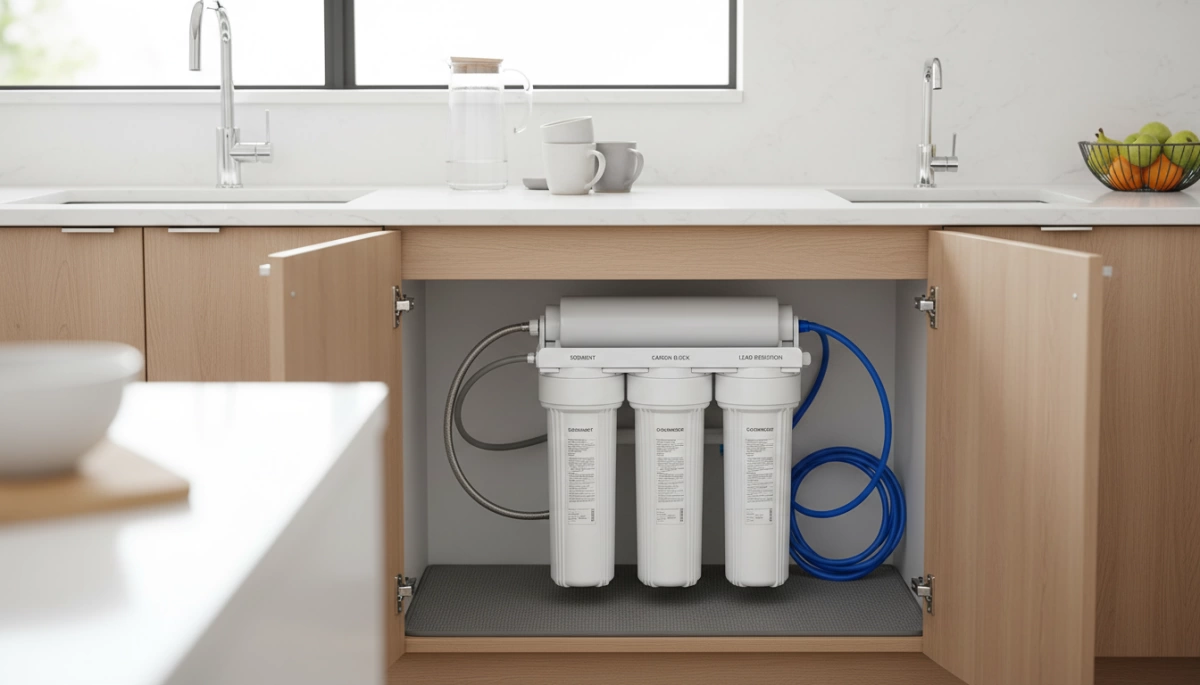
Under Cabinet Water Filter System Product Lines
I offer a full lineup of under cabinet water filter systems designed for U.S. kitchens:
| System Type | Best For | Key Benefits |
|---|---|---|
| Carbon under sink water filter | City water, taste & odor issues | High flow, chlorine/taste/odor reduction |
| Under sink reverse osmosis system (RO) | High TDS, heavy metals, PFAS, fluoride | Deep purification, multi‑stage filtration |
| Tankless RO under sink | Small cabinets, modern kitchens | Space‑saving, fast flow, lower wastewater |
| Under sink ultrafiltration system (UF) | Low‑TDS, microbiological concerns | No tank, no wastewater, steady flow |
| Hybrid RO and carbon system | Picky drinkers, families, heavy use | Balanced taste, high contaminant reduction |
I also supply dedicated under sink systems like our UF kitchen faucet purifier, and RO solutions focused on health and cost savings, as described in our guide on the benefits of reverse osmosis water for home use.
Custom Configurations: Carbon, RO, Tankless RO, UF, Hybrid
For brands, retailers, and project buyers, I build point-of-use kitchen water filtration systems to spec:
- Media choices: activated carbon, carbon block, RO membrane, UF membrane, remineralization.
- Layouts: compact inline under sink water filter, multi-stage under counter water purifier, tank-based and tankless RO.
- Performance tuning: flow rate, filter capacity, lead-reducing water filter options, PFAS water filter system options.
You get modular under counter water filter system designs that can be tailored to your market and pricing.
OEM and Private Label Under Sink Water Filter
I operate as an OEM under sink water filter supplier and private label manufacturer:
- Services I provide:
- Custom branding (logo, color, packaging, manuals).
- Model standardization for builders, multi‑unit projects, and chains.
- Support for Amazon/retail specs and documentation.
- Who it suits:
- U.S. brands launching “best under cabinet water filter” lines.
- Kitchen remodel companies and builders needing a standard hidden kitchen water filter.
- Importers looking for a reliable Chinese water filter OEM partner.
Certifications, Quality Control, and Global Support
I build systems to meet common NSF/ANSI targets (such as 42/53/58) and support compliance in the U.S. and other regions:
| Area | What I Focus On |
|---|---|
| Certification support | Designs aligned with NSF/ANSI 42, 53, 58 performance goals |
| Quality control | Incoming material checks, on‑line testing, batch inspections |
| Documentation | Technical sheets, performance data, OEM spec files |
| After‑sales support | Spare parts planning, filter replacement cartridges supply |
If you need a scalable OEM under cabinet water filter system, from simple carbon block under sink filters to full multi stage under sink filtration, I can configure, build, and support it end‑to‑end.
Frequently Asked Questions About Under Cabinet Water Filter Systems
1. What do under cabinet water filter systems usually cost?
Typical price ranges in the U.S.:
| System Type | What It Is | Typical Price (System Only) |
|---|---|---|
| Basic carbon under sink water filter | 1–2 stage carbon / carbon block | $60 – $180 |
| Multi‑stage carbon / hybrid (no RO) | Sediment + carbon + specialty media | $150 – $350 |
| Tank-based under sink reverse osmosis system | RO + tank, 4–5+ stages | $220 – $600 |
| Premium / tankless RO under sink | High-flow, compact, often smart/monitoring | $450 – $1,000+ |
Filter replacement usually runs $60 – $200 per year, depending on gallons used and cartridge type.
2. How much wastewater does an under sink RO system produce?
Under sink reverse osmosis systems do create wastewater as they flush out dissolved solids:
| RO Type | Typical Waste Ratio* | Notes |
|---|---|---|
| Older tank RO systems | ~3–4:1 | 3–4 gallons waste per 1 gallon filtered |
| Newer efficient tank RO systems | ~2–3:1 | Better membranes and flow restrictors |
| Tankless RO under sink systems | ~1–2:1 | Uses a pump and smart control |
*Actual numbers depend on water pressure, temperature, and TDS.
Ways to manage wastewater:
- Route waste line to a nearby laundry drain or utility sink and reuse for mopping or flushing (where allowed).
- Make sure your home pressure is at least 50–60 psi for better RO efficiency.
- If water is expensive or you’re in a drought-prone area, favor a tankless RO or a high-efficiency RO.
3. Do under cabinet water filters work with well water?
Yes, but you need the right configuration:
- Carbon under sink water filter alone is not enough for many wells.
- Common well issues: iron, manganese, hardness, sulfur smell, bacteria.
For well water, I usually recommend:
- Pre-treatment (whole house) for iron, hardness, sulfur if levels are high.
- Under sink RO system for drinking water if you have high TDS, nitrates, or unknown chemistry.
- UV or certified microbiological filtration if coliform bacteria are a concern.
Always start with a well water lab test before choosing your under counter water purifier.
4. Under cabinet vs countertop vs faucet-mounted filter performance?
Quick comparison:
| Filter Type | Typical Performance | Best For |
|---|---|---|
| Faucet-mounted filter | Basic chlorine & taste removal | Renters, very tight budgets |
| Countertop filter (non-RO) | Better carbon capacity, some extra stages | Small kitchens, no drilling |
| Countertop RO system | High purification, sits on counter | RO without plumbing changes |
| Under cabinet carbon filter | Strong everyday kitchen filtration, hidden | City water, taste/odor, light contaminants |
| Under sink RO system | Deep purification (TDS, heavy metals, PFAS, etc.) | High concern water quality, families, heavy use |
Under cabinet water filter systems are usually the best balance of performance, convenience, and clean look for U.S. kitchens.
5. How long does installation take, and can I DIY it?
Most U.S. homeowners can DIY installation if they’re comfortable with basic tools:
| System Type | Typical DIY Install Time | DIY Difficulty (1–5) |
|---|---|---|
| Inline under sink water filter | 30–60 minutes | 2/5 |
| Carbon system w/ dedicated faucet | 1–2 hours | 3/5 |
| Tank-based under sink RO system | 2–3 hours | 3–4/5 |
| Tankless RO under counter system | 1.5–3 hours | 3–4/5 |
You should probably call a plumber if:
- You’re not comfortable drilling the sink/counter for a drinking water faucet.
- You have complex plumbing, old copper lines, or tight spaces.
- You’re installing multiple point-of-use water filters in a remodel and want everything standardized.
If you’re also comparing brands and OEM suppliers for projects, you can look at how leading water purifier companies structure their systems and support: water purifier companies and OEM support.