












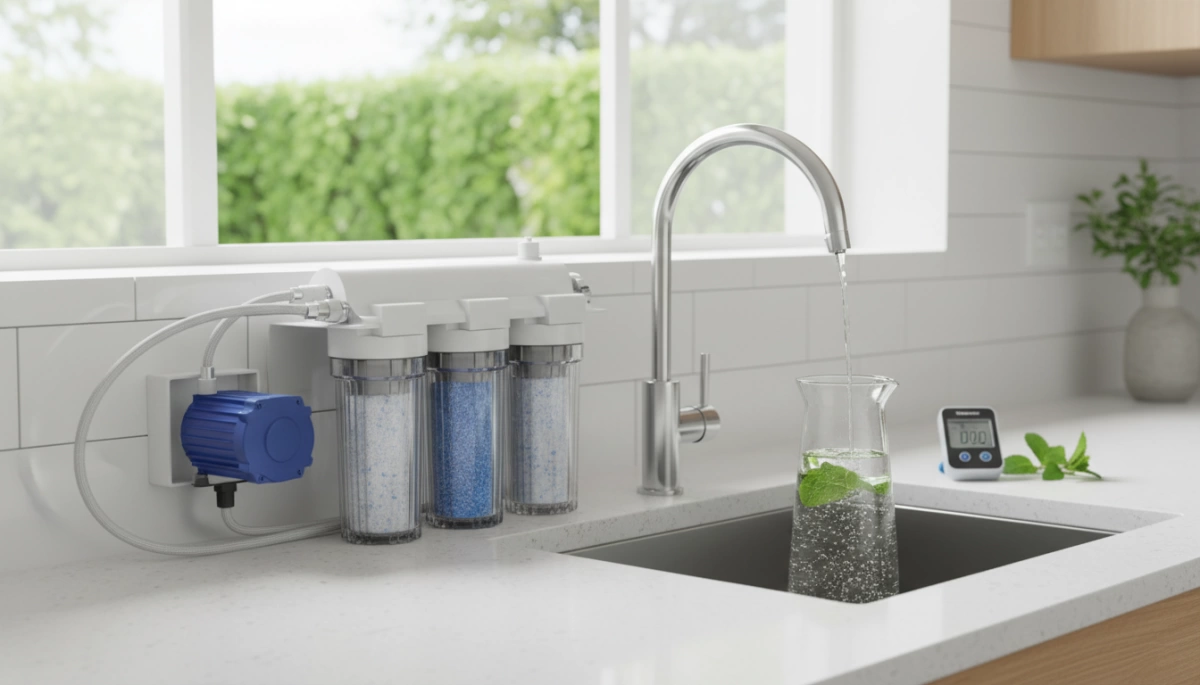
If you’re serious about high purity water, a basic filter isn’t going to cut it.
Whether you need spot-free rinse water for car detailing, stable parameters for aquariums and hydroponics, or ultra-clean water for laboratory and industrial processes, a DI water filter system is often the real game-changer.
Most people know about RO units and standard filters.
But deionized water systems go further: they strip out dissolved ions, slash TDS, and deliver low conductivity water that standard filtration simply can’t achieve.
In this guide, you’ll see exactly:
- What a DI water filter system is (in plain language)
- How ion exchange resin and mixed bed DI actually work
- When to use straight DI vs. RO DI systems
- How to choose the right setup for your lab, workshop, factory, or detailing business
And if you’re looking for a custom DI water system from a reliable manufacturer, you’ll also see how driplife supports global partners with OEM, industrial-grade solutions—without the inflated price tag.
Let’s get straight into how DI systems really work and how to pick the right one.
What Is a DI Water Filter System?
A DI water filter system (deionized water system) is a water treatment setup that strips out dissolved ions—like calcium, magnesium, sodium, chloride, and sulfate—to produce ultra-low conductivity water. Instead of just “filtering” particles, a DI system targets the charged minerals and salts that drive up TDS (total dissolved solids) and cause spotting, scaling, or interference in sensitive processes.
In practical terms, deionized (DI) water is water that’s passed through an ion exchange water filter until its electrical conductivity drops to extremely low levels. High-purity DI water is often measured in megohm-cm resistivity (18.2 MΩ·cm being lab-grade) or in microsiemens per centimeter (µS/cm) for conductivity. The lower the conductivity, the fewer ions are left in the water.
Core Components of a DI Water Filter
Most DI water filter systems—whether portable or fully plumbed—are built around a few core components:
- Ion exchange resin
- Cation resin removes positively charged ions (calcium, magnesium, sodium, iron).
- Anion resin removes negatively charged ions (chloride, nitrate, sulfate, bicarbonate).
- In a mixed bed DI system, both resins are blended in one cartridge for higher purity.
- Tanks and cartridges
- Regenerable DI tanks for industrial or high-volume users.
- Single-use DI cartridges for smaller systems, spot-free rinse water filters, aquariums, and lab polishing units.
- Meters and sensors
- A water resistivity meter or conductivity monitor tracks water quality in real time.
- Many RO DI water systems use inline TDS meters so you know when DI resin replacement is due.
Main DI System Types
In the U.S. market, I typically design and supply DI water filtration solutions in a few standard formats:
- Portable DI filter system
- Compact tanks or cartridges, often used for a car wash DI water filter, solar panel rinse system, or spot-free window cleaning.
- Laboratory water purification system
- Bench-top or wall-mounted laboratory DI water systems to feed analyzers, glassware rinsing, or reagent prep—usually as a final polish after RO.
- Industrial deionization unit
- Skid-mounted or custom DI water systems for electronics DI water, boiler feed water deionizers, pharmaceutical grade water systems, and other industrial deionization needs.
- Mixed-bed DI system
- Single vessel combining cation and anion resin to deliver high purity water with very low conductivity—common for labs, electronics, and polishing stages.
- Dual bed (separate bed) deionizer
- One tank with cation resin and one with anion resin, often followed by a mixed bed polisher in industrial water treatment setups.
Typical Uses of DI Water Filter Systems
You’ll see DI water filter systems wherever ion removal and low conductivity water matter more than just basic filtration:
- Home and hobby
- Aquarium RO DI water, reef tanks, hydroponic water filters, and spot-free car or RV rinsing.
- Laboratories and research
- Feeding instruments, making standards, and rinsing labware where lab-grade DI water is required.
- Industrial and commercial
- Electronics manufacturing, pharmaceutical production, cosmetics, boiler and cooling water treatment, medical device cleaning, and more.
If you work in any environment where minerals, salts, or residue can cause damage, contamination, or spotting, a properly designed DI water filter system—often as part of a broader ultra pure water system—is one of the most reliable tools you can put in place.
How a DI Water Filter System Works
A DI water filter system strips out dissolved ions to give you ultra-low TDS, low conductivity water. Here’s how it actually works in real life.
Ion Exchange Process Explained
Deionized water filtration is built around ion exchange:
- Tap or RO feed water enters the DI housing.
- Dissolved ions in the water (like calcium, magnesium, sodium, chloride, sulfate) are attracted to ion exchange beads.
- The beads “swap” these ions for hydrogen (H⁺) and hydroxide (OH⁻) ions.
- H⁺ and OH⁻ then combine to form pure H₂O.
That swap is what turns regular water into DI water with extremely low conductivity and low TDS.
Role of Cation and Anion Exchange Resins
A DI water filter system usually uses two types of ion exchange resin:
- Cation resin – removes positively charged ions (Ca²⁺, Mg²⁺, Na⁺, etc.) and releases H⁺.
- Anion resin – removes negatively charged ions (Cl⁻, NO₃⁻, SO₄²⁻, etc.) and releases OH⁻.
In a dual bed deionizer, these resins are in separate tanks. In a mixed bed DI system, they’re blended together for higher purity.
Mixed-Bed DI Systems for Higher Purity
A mixed bed DI system is what most people use when they need high purity water for labs, electronics, or spotless rinsing:
- Cation and anion beads are fully mixed in a single cartridge or tank.
- Ions see many exchange sites in sequence, so you get very low conductivity water (often 0–1 µS/cm).
- Ideal for RO DI systems, lab DI water, and spot-free rinse water filters for auto detailing and solar panel cleaning.
If your incoming water is heavily contaminated, pairing DI with reverse osmosis first (RO DI setup) is more cost-effective than DI alone. For more on RO and purity levels, you can check the differences between purified vs filtered water in this breakdown: purified water vs filtered water.
Monitoring Purity: Resistivity & Conductivity
To know if your deionized water system is still performing, you watch the numbers:
- Conductivity meter (µS/cm or mS/cm): lower = purer water.
- Water resistivity meter (MΩ·cm): higher = purer water (18.2 MΩ·cm is lab-grade).
When conductivity starts to climb or resistivity drops, it’s time for DI resin replacement or cartridge change.
Typical Flow Path: Feed Water to DI Outlet
Most DI water filter systems follow a simple flow path:
- Feed water (tap or RO) enters the system.
- Optional pretreatment (sediment and carbon filters) protects the resin and improves taste/odor if needed.
- Water passes through the DI resin cartridge or tank (mixed bed or dual bed).
- A conductivity or resistivity monitor checks outlet water quality.
- High purity water exits the DI outlet to your tap, hose, lab point-of-use, or storage tank.
That’s the basic workflow whether you’re running a portable DI filter system for car washing or a fixed industrial deionization unit feeding equipment.
DI Water Filter vs Other Water Filtration Systems
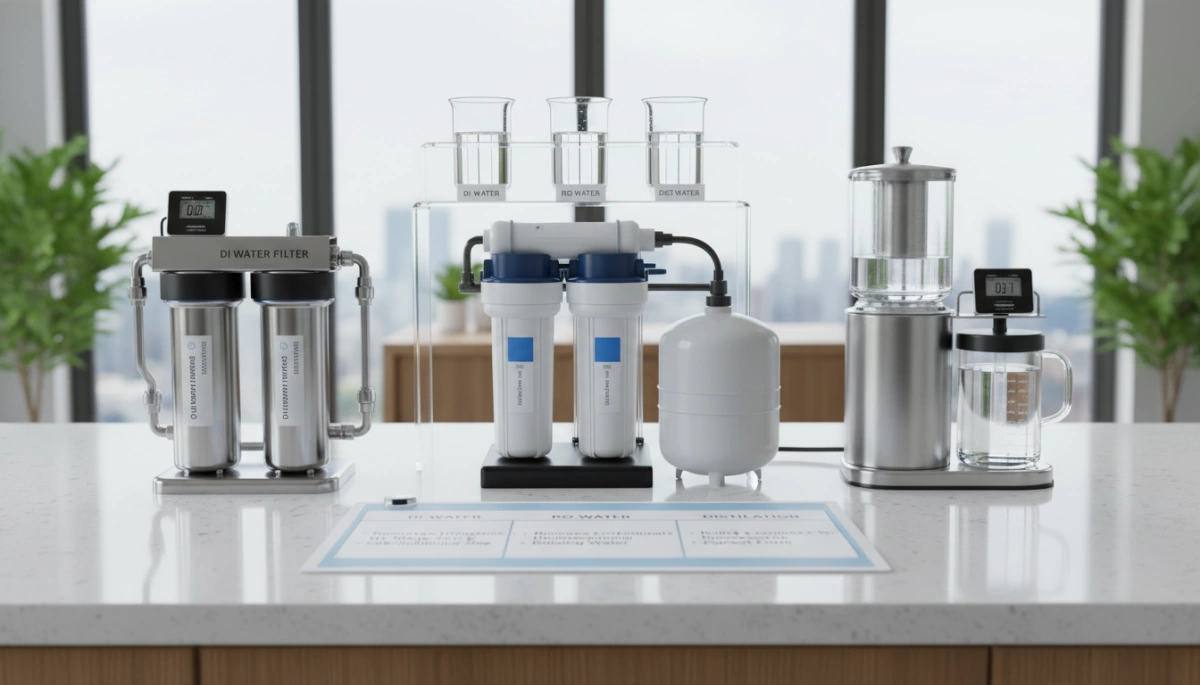
DI vs Reverse Osmosis (RO)
A DI water filter system and a reverse osmosis system both make cleaner water, but they don’t do the same job.
- Reverse osmosis (RO) pushes water through a membrane to remove most dissolved solids, chlorine byproducts, and many organics. It’s great for big TDS reduction and cutting down on total contaminants.
- Deionization (DI) uses ion exchange resin to swap out the remaining charged ions (like calcium, magnesium, sodium, chloride) and drive TDS close to zero for truly low-conductivity water.
For high purity water:
- RO alone = good for drinking water, aquariums, and general use.
- DI alone = fine if your tap water isn’t too hard and you only need small volumes
What a DI Water Filter System Actually Removes
A DI water filter system is built to strip out charged contaminants so you end up with very low conductivity water and near-zero TDS.
What DI Removes Well
A deionized water system is excellent at removing:
- Dissolved salts and minerals
- Calcium, magnesium, sodium, potassium
- Carbonates, chlorides, sulfates, nitrates
- Inorganic ions
- Metals like iron, copper, zinc (in ionic form)
- Silica (as dissolved ions)
This is where DI shines. A good ion removal water setup can bring TDS close to 0 ppm and boost water resistivity into the megohm range (for lab and industrial use).
TDS Removal & Low Conductivity Water
The goal of a DI water filtration system is simple:
Turn high-TDS tap water into ultra-low TDS, low conductivity water.
- Typical U.S. tap water: 150–500+ ppm TDS
- Basic DI for rinsing / hobby use: <10–20 ppm TDS
- Lab / industrial high purity water: <1 ppm TDS or >1 MΩ·cm resistivity
A TDS removal filter with mixed-bed resin can take RO water or well-treated tap water and push it into true high purity water territory.
Limits of DI Filtration
A DI water filter system does not fix everything on its own. Resin only works on ions, so it has limits:
- Organic compounds (like oils, solvents, many carbon-based chemicals)
- Microbes (bacteria, viruses, biofilm)
- Particles & sediment (rust, sand, silt)
- Chlorine / chloramine (must be removed with carbon)
That’s why I never recommend using DI alone as a full drinking water solution. For that, something like a countertop reverse osmosis unit with built-in carbon prefiltration such as our countertop reverse osmosis system is a better base, with DI added only if you actually need ultra-low TDS.
Why Pretreatment Matters
To get the best performance and longest ion exchange resin life, you want solid pretreatment:
- Sediment filter – keeps dirt and rust from clogging resin
- Carbon filter – removes chlorine/chloramine that can destroy resin
- RO system (for higher demand or bad source water) – slashes TDS before DI
Good pretreatment means:
- Longer DI resin lifespan
- Lower operating costs
- More stable low conductivity water
Target Water Quality by Use
Different jobs need different purity levels:
- Car wash / spot-free rinse water filter: typically <20 ppm TDS
- Aquarium RO DI water / hydroponic water filter: often 0–5 ppm TDS
- Boiler feed water deionizer: low TDS to reduce scaling and corrosion
- Electronics / pharma / lab grade DI water: ultra low TDS and high resistivity (up to 18.2 MΩ·cm for ultra pure water systems)
The key is matching your DI water filter system design (pretreatment, resin type, and monitoring) to the purity level you actually need—no more, no less.
Key Applications of a DI Water Filter System
A DI water filter system is all about consistent, ultra-low TDS water. Here’s where it really earns its keep in the U.S. market:
Lab & Research Use
- Laboratory water purification and reagent prep – DI water protects test results, standards, and buffers from mineral contamination.
- Rinsing glassware & feeding instruments – Prevents spotting and residue in glassware, and protects HPLC, IC, AA, ICP, and other analytical systems from scale and ion interference.
- Most labs pair DI with carbon prefilters for chlorine and organics, similar to how a chlorine removal filter protects sensitive equipment at home.
Industrial & Manufacturing
- Electronics & semiconductor rinsing – DI water avoids ionic contamination that can short circuits or corrode boards.
- Pharma & biotech – Used in process water, rinsing, and some formulation steps where low conductivity water is required.
- Boilers & cooling systems – A DI water filter system helps cut scale, reduces blowdown, and extends equipment life.
- Humidifiers & environmental chambers – Prevents white dust, nozzle clogging, and mineral buildup.
Auto, Windows & Solar
- Automotive detailing & spot‑free rinse water – A car wash DI water filter or portable DI filter lets you air‑dry vehicles with no water spots.
- Solar panel & window cleaning – DI water leaves glass and panels streak‑free, which is key for efficiency and for pro window washing crews.
Aquariums & Hydroponics
- Aquariums & reef tanks – RO DI water gives you a clean starting point so you can dial in minerals and salinity precisely. Many hobbyists remineralize DI water later, similar to how you’d add minerals back to purified water.
- Hydroponic water filter setups – DI water removes background hardness and metals so nutrient recipes stay consistent and plants respond predictably.
Medical, Cosmetic & Food Uses
- Medical & dental equipment – Used for instrument rinsing, autoclaves, and certain device washers to prevent deposits and staining.
- Cosmetic production – Low conductivity water reduces variability in skincare, haircare, and makeup formulations.
- Food & beverage processes – Used where mineral‑free water is needed for blending, ingredient dilution, or equipment rinsing (not usually as finished drinking water).
How to Choose the Right DI Water Filter System
Picking the right DI water filter system comes down to knowing your purity target, your water, and how you actually use it. I’ll keep this straight and practical.
Define Your Purity Needs (TDS & Resistivity)
Start with the water quality you actually need:
| Application | Target TDS (ppm) | Typical Resistivity |
|---|---|---|
| Car wash / spot-free rinse | < 10 | ~1–2 MΩ·cm |
| Home humidifier / small appliances | < 5 | ~1–5 MΩ·cm |
| Reef aquarium / hydroponics | 0–2 | 10–18 MΩ·cm |
| General lab DI water | 0–1 | ≥ 10 MΩ·cm |
| High-purity / analytical use | ~0 | 15–18.2 MΩ·cm |
- Higher purity = faster DI resin exhaustion = higher operating cost.
- For most homes and light commercial users, pairing DI with an RO filtration system is the best way to hit low TDS without burning through resin.
Check Your Feed Water First
Before you choose a DI system, test:
- Incoming TDS (ppm)
- Hardness (grains or ppm of Ca/Mg)
- Chlorine/Chloramine
- Iron, silica, and organics if you’re in a problem area
High TDS or very hard water? Use a softener or RO ahead of DI to protect your resin. A soft water system or RO + DI combo usually cuts DI costs dramatically in the U.S. where hardness can be high.
Size by Flow Rate & Usage Pattern
Ask yourself:
- Flow rate needed: Instant draw (gpm) or slow fill?
- Total daily volume: Gallons per day or per week.
- Usage type: Occasional batches vs continuous use.
General sizing rules:
- Home / hobby: Small portable DI cartridges or an RO DI system.
- Detail shops / small labs: Wall-mounted or skid systems with larger DI tanks.
- Industrial: Engineered industrial deionization units sized for peak and average flow.
Choose Resin Type: Mixed-Bed vs Dual-Bed
- Mixed-bed DI system (cation and anion resin mixed):
- Higher purity, lower TDS, ideal for lab grade and reef tanks.
- Cartridge-style systems, usually non-regenerable on-site.
- Dual-bed deionizer (separate cation and anion tanks):
- Great for higher volume, industrial systems.
- Easier to regenerate via service provider, lower cost per gallon.
For most labs, car wash DI, and aquariums, I lean to mixed-bed DI after RO.
Portable DI Filter vs Fixed Installation
- Portable DI filter system:
- Best for mobile car wash, detailers, window and solar panel cleaning.
- Easy hookup to a hose, low upfront cost, simple to move.
- Fixed installation:
- Best for labs, production lines, boilers, humidifiers.
- Stable piping, better monitoring (conductivity meters), supports RO DI and prefilters.
Choose portable if mobility matters more than automation. Choose fixed if you need repeatable, controlled water quality.
Single-Use Cartridge vs Regenerable DI Tanks
- Single-use DI cartridges:
- Swap-and-go, clean, no chemical handling.
- Best for homes, hobbyists, small shops.
- Higher cost per gallon, but low hassle.
- Regenerable DI tanks:
- Exchanged or regenerated by a service company.
- Best for industrial deionization and higher volume users.
- Lower long-term cost, but needs a service contract and space.
Budget, Operating Cost & Maintenance
When comparing DI water systems, look at total cost, not just the sticker:
- Upfront: System, plumbing, meters, prefilters, storage tank.
- Ongoing:
- DI resin replacement or tank exchange
- Prefilter changes (sediment, carbon)
- Occasional service calls or calibration of conductivity meters
- Ways to lower cost per gallon:
- Add RO before DI
- Use a water softener upstream in hard water areas
- Right-size the system so you’re not overspending for purity you don’t need
If you tell me your incoming TDS, hardness, and what you’re using the DI water for, I’d always design the smallest, simplest setup that still hits your target TDS and keeps resin costs under control.
Installation and Setup Tips for DI Water Filter Systems
Installing a DI water filter system (or RO DI system) is pretty simple if you plan it out right. Here’s how I set these up so they run reliably and stay easy to service.
Basic Plumbing Layout (RO DI & DI-Only)
For most home and light commercial setups, I recommend:
RO DI system layout:
- Feed line → sediment filter → carbon filter → RO membrane
- RO product water → DI cartridge or mixed-bed DI tank
- DI outlet → storage tank (optional) → faucet, hose, or process line
DI-only layout (for already low-TDS water):
- Feed line → sediment/carbon prefilter → DI resin cartridge or dual-bed DI
- DI outlet → point of use (lab, rinse gun, etc.)
Use:
- 1/4″ or 3/8″ tubing for home/lab RO DI
- 1/2″+ piping for higher-flow industrial DI
- Shutoff valves and unions near each unit so service is fast and clean
If you’re comparing different point-of-use options, it can help to understand how smaller systems like a countertop 3-in-1 RO purifier are plumbed and valved—they follow the same logic, just in a compact format.
Placement, Drainage, and Pressure
Pick a location that’s dry, accessible, and stable:
- Close to feed and drain: Less tubing, fewer leak points.
- Vertical mounting of DI cartridges and tanks is best.
- Drain line: Needed for RO reject water and any tank blowdown. Use an air gap or standpipe to prevent backflow.
Pressure rules of thumb:
- RO DI: Feed pressure typically 50–80 psi for good performance.
- DI-only: Most systems are happy at 30–80 psi.
- If pressure is low, add a booster pump; if it’s high, install a pressure regulator.
Safety and Handling Guidelines
Even though DI systems are simple, I always set them up with safety in mind:
- Secure all housings before pressurizing. Never open filter housings under pressure.
- Use food-grade tubing and fittings rated for your pressure.
- Anchor tall DI tanks or racks so they can’t tip.
- If you’re handling regenerable tanks, follow chemical safety rules for acid/caustic regenerants (PPE, ventilation, spill control).
- Keep electrical gear (meters, pumps) away from splash zones.
If you’re already filtering tap water with other devices (like faucet or pitcher filters), you’ll notice DI/RO DI units run at higher pressures and flows, so plumbing and safety need to be a bit more deliberate than a simple water pitcher filter setup.
Start-Up Flushing & Initial Water Checks
Once everything is plumbed and tight, I always do this sequence:
- Cold water only: Never start up on hot water.
- Slowly open the feed valve and check for leaks.
- Flush prefilters: 5–10 minutes until the water runs clear and air is purged.
- RO membrane flush: 30–60 minutes to rinse preservatives and stabilize performance.
- DI resin flush: Run water through until:
- Conductivity drops and stabilizes
- No resin fines or discoloration in the outlet
Then, verify quality:
- Use a TDS meter or conductivity/resistivity meter at the DI outlet.
- Compare readings against your target (e.g., 0–5 ppm TDS for car rinse, >15 MΩ·cm for lab/analytical work).
- Log the initial values—this becomes your baseline for future maintenance and DI resin replacement timing.
Set it up cleanly once, and a DI water filtration system will give you consistent, low-conductivity water with very little day-to-day hassle.
Maintenance & DI Resin Management
Keeping a DI water filter system in top shape is all about watching the resin and staying ahead of problems. Here’s how I handle DI resin management in a simple, repeatable way.
How to know when DI resin is exhausted
You’ll know your ion exchange resin is done when:
- TDS starts climbing – Your TDS meter shows higher ppm than normal.
- Conductivity goes up / resistivity goes down – For high purity setups, anything below your target (e.g., < 1–10 MΩ·cm for lab work) means the resin is fading.
- Color-changing DI cartridges – If you use color-indicating resin, the color band has reached the outlet.
- Spots return on rinsing – For car wash DI water filters or window cleaning, spotting is a clear sign the resin is exhausted.
I always recommend keeping a TDS or water resistivity meter inline so you see problems before they hit your process.
DI resin replacement & regeneration options
For most home and small business users, DI resin replacement is as simple as:
- Swapping single-use DI cartridges when the TDS/resistivity tells you they’re spent.
- Using pre-filled cartridges that drop into your existing housings.
For industrial deionization units or larger systems:
- Regenerable DI tanks can be swapped out and regenerated off-site by a service provider.
- On high-volume systems, a dual bed deionizer (separate cation and anion resin) plus a mixed-bed polisher is common, and each bed is regenerated on a schedule.
If you’re building or branding your own systems, we design around easy cartridge access and simple DI resin replacement to keep downtime low.
Ways to extend DI resin life with pretreatment
To stretch DI resin life and cut operating cost, I always front-load the system with pretreatment:
- Sediment and carbon filtration – Removes particles, chlorine, and organics that damage resin.
- Reverse osmosis (RO) – Handles most TDS removal so the DI only “polishes” to ultra-low conductivity.
- Water softener (where needed) – Takes out hardness that can foul resin and plumbing.
- Good flow and pressure control – Avoids channeling that wastes resin capacity.
A simple sediment + carbon filter setup, like a compact point-of-use water filter, in front of your DI stage can dramatically extend resin lifespan.
Monitoring resistivity & conductivity over time
I treat monitoring as non‑negotiable on any serious DI system:
- Install inline conductivity or resistivity meters at the DI outlet.
- Log readings regularly (daily/weekly depending on use).
- Set alarm thresholds or simple “change cartridge at X µS/cm or Y MΩ·cm” rules.
This gives you predictable resin change intervals instead of guessing or waiting for product failures.
Troubleshooting low flow, leaks, and purity drops
Common issues and quick checks:
- Low flow
- Check for clogged prefilters.
- Confirm inlet pressure.
- Make sure the DI cartridge isn’t channeling or compacted.
- Leaks
- Re-seat O-rings and check for nicks.
- Tighten housings evenly—hand tight plus a little, not overtightened.
- Inspect fittings and tubing for cracks.
- Purity drops
- Verify meter calibration.
- Confirm resin age and usage—likely time for DI resin replacement.
- Check pretreatment: fouled RO membrane or spent carbon filter will push more load onto the DI.
If you’re running DI water for lab, manufacturing, or as part of a table‑top or point‑of‑use dispenser, I always design the system so resin changes, leak checks, and meter readings take minutes—not hours—because that’s what keeps operating costs and headaches down.
Choosing a DI Water Filter System Manufacturer
When I’m choosing (or recommending) a DI water filter system manufacturer, I focus on reliability, support, and real-world performance—not just specs on a brochure.
What to Look for in a DI Water System Supplier
A solid DI water system supplier should offer:
- Clear water quality specs: Published resistivity, conductivity, and TDS removal levels for each deionized water system.
- Application expertise: They should understand lab DI water, industrial deionization units, spot-free rinse systems, aquariums, and more—and guide you to the right setup.
- Transparent consumable costs: DI resin replacement, filters, and maintenance pricing should be upfront and predictable.
- Good pre-sales support: Sizing help, feed water review, and realistic expectations about performance and lifespan.
If you’re dealing with drinking or RO pretreatment in your process, it can help to compare options with a well-explained guide like this breakdown of a drinking water filter setup.
Off-the-Shelf vs Custom DI Water Systems
For most U.S. users, an off-the-shelf deionized water system works fine:
- Off-the-shelf:
- Faster lead times
- Lower upfront cost
- Ideal for labs, car wash DI water filters, spot-free rinse, and hobby RO DI water
- Custom DI water systems:
- Designed around your flow rate, peak demand, and target purity
- Can integrate RO, electrodeionization modules, UV, and storage tanks
- Best for industrial deionization units, pharma-grade water, and large manufacturing lines
If you’re already running or considering RO pretreatment, looking at RO DI system specs alongside DI can help, similar to how you’d compare features in a countertop RO system comparison.
OEM and Private Label DI Water Solutions
For B2B buyers, I look at whether a DI water system manufacturer can:
- Provide OEM and private label DI water filter systems with your branding
- Support custom DI water system configurations (dual bed deionizers, mixed-bed DI systems, skids, and modular frames)
- Offer documentation and marketing support so you can resell with confidence
- Scale production reliably for distributors and national service providers
Quality Control, Certifications, and Support
Quality and support matter more than fancy marketing:
- Certifications: Look for ISO, relevant NSF/ANSI standards, and any required pharma or medical documentation if applicable.
- Factory testing: Each industrial deionization unit or lab-grade DI system should be pressure-tested and function-tested before shipping.
- After-sales support:
- Technical support for commissioning and troubleshooting
- Replacement parts and DI resin availability in the U.S.
- Service options or clear DIY maintenance guides
In short, the right DI water filter system manufacturer should help you hit your purity target, keep your operating cost under control, and support you long-term—whether you’re running a single portable DI filter system or a full industrial water treatment line.
DI Water Filter System FAQs
Quick answers to the questions I get most about DI water filter systems in the U.S. market.
Typical DI Resin Lifespan
Real-world DI resin life depends mainly on TDS, flow, and whether you use RO first.
| Setup Type | Feed Water TDS (approx) | Typical DI Resin Life* |
|---|---|---|
| DI-only, hard city water | 250–500+ ppm | Days to a few weeks |
| RO DI system (RO before DI) | 5–30 ppm | Months in home/lab use |
| Portable car wash DI filter | 150–400 ppm | 50–400 gallons per cartridge |
| Industrial deionization unit | Engineered feed | Weeks–months between service |
*Actual life depends on usage hours and flow rate. Use a TDS meter or water resistivity meter and replace when TDS starts to climb above your target.
Is DI Water Safe to Drink?
- Technically, yes, small amounts of DI water are safe for healthy adults.
- Practically, I don’t recommend using a deionized water system for drinking:
- It has flat taste (no minerals).
- It’s not designed as a full drinking water filtration system (no carbon, no UV).
- For drinking, a typical under-sink water purifier or countertop RO system is a better fit. If that’s your priority, compare options using this countertop RO system guide.
DI Water vs Softened Water
| Feature | DI Water | Softened Water |
|---|---|---|
| Main function | Remove ions to ultra-low TDS | Replace hardness (Ca/Mg) with sodium |
| TDS level | Very low, near 0 ppm (lab-grade) | Similar TDS to tap, just “softer” |
| Spot-free rinsing | Yes | No (still leaves residue) |
| Use for boilers/RO | Ideal as high purity water | Often used only as pretreatment |
| Drinking use | Not recommended as main source | Commonly used in homes |
Bottom line: A water softener vs DI is not either/or. Softeners protect plumbing; DI creates high-purity, low-conductivity water for specialty uses.
When Is RO Pretreatment Recommended Before DI?
Use an RO DI water system (RO before DI) when:
- Feed TDS is high (200+ ppm).
- You need lab grade DI water or ultra-low conductivity.
- You want to cut DI resin costs dramatically.
- Applications: reef aquariums, hydroponics, labs, electronics, pharma, and any ultra pure water system.
RO removes 90–98% of TDS first. DI resin then “polishes” the water and lasts much longer.
Maintenance for Industrial Deionization Systems
For an industrial deionization unit, plan on:
- Continuous monitoring:
- Conductivity/resistivity meters on the outlet
- Pressure and flow monitoring
- Regular resin service:
- Regenerable DI tanks swapped on schedule
- Resin testing in critical pharma/electronics use
- Pretreatment upkeep:
- Sediment filters
- Carbon filters
- Softeners and RO membranes (if installed)
- Records and validation:
- Logs for water quality and maintenance
- Compliance with industry standards (USP, ASTM, etc.)
Common Mistakes With Portable DI Filters
I see the same issues over and over with portable DI filter systems (car wash, RV, windows):
- Running hot water through DI cartridges (kills resin).
- Using DI-only on very hard water with no RO or softener → resin dies fast.
- No TDS meter → people keep using it long after resin is exhausted.
- High flow rate → not enough contact time, worse purity and shorter life.
- Leaving cartridges dry and open to air → resin degrades.
How to Store and Handle DI Water Properly
To keep low conductivity water clean:
- Use sealed containers (HDPE or glass) with tight caps.
- Avoid metal containers (they leach ions back in).
- Store in a cool, dark place; avoid sun and heat.
- For lab/medical use, use dedicated DI lines and clean glassware only.
- Use DI water quickly for critical applications; resistivity drops over time as it reabsorbs CO₂ and ions from the air.
Cost of Running a DI Water Filter System
Total cost depends on how you design your deionized water system:
Main cost drivers:
- DI resin replacement or tank exchange
- RO membrane and prefilter changes (in RO DI systems)
- Water and wastewater (especially for big industrial setups)
- Monitoring gear (conductivity meters, resistivity sensors)
Simple cost snapshot (home/small business):
| System Type | Typical Ongoing Costs |
|---|---|
| DI-only small cartridge | Lower upfront, higher resin replacement cost |
| RO DI system (home/aquarium) | Resin lasts longer, some RO maintenance |
| Industrial deionization unit | Service contracts, resin regen, monitoring |
To lower operating costs:
- Use RO pretreatment whenever TDS is moderate to high.
- Keep sediment and carbon filters fresh.
- Size the system correctly for your actual gallons per day.
For faucet-based setups or under-sink prefiltration that can help before a DI stage, I usually recommend reviewing practical installation guides like this step-by-step water filter faucet install guide](https://driplifecorp.com/how-to-install-water-filter-faucet-step-by-step-guide/) to understand plumbing and layout requirements.